









- Why the old AMP SEO 2020 practices no longer work and what has changed in current optimization prioritiesAug 02, 2026View details
- How to Choose Topics for an Industry News Section to Attract More Organic Search TrafficJul 29, 2026View details
- Digital Marketing Shenzhen Market Insights: Why Are Companies Expanding Overseas Looking for Growth Teams in Shenzhen?Jul 31, 2026View details
- Can Zhejiang foreign trade independent websites still be developed today? Look at changes in traffic and lead generationJul 28, 2026View details
- What New Signals Are Emerging in Enterprise Services SaaS Marketing ReportsJul 27, 2026View details
- What Does a Global Traffic Ecosystem Service Provider Do? What Are the Differences from a Single Advertising AgencyJul 16, 2026View details
How does product iteration management affect website project progress? Requirement changes, version cadence, and collaboration recommendations
Product Iteration Management: Why It Directly Affects Website Project Progress
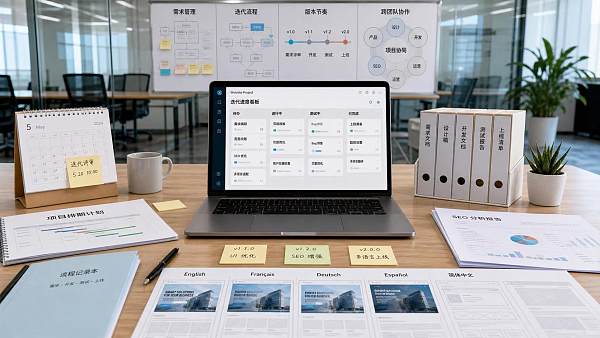
A website project may look like a development task, but when it actually moves forward, what often gets stuck is not the code, but the cadence. Requirements change today, designs are revised tomorrow, content is added the day after, and in the end the launch of each version is delayed again and again. This is exactly where many teams tend to lose control in product iteration management.
Judging from recent project changes, a website is no longer just a display tool. It also carries tasks such as customer acquisition, conversion, brand communication, search indexing, and advertising traffic reception. Therefore, product iteration management is no longer just about arranging requirements. It has become a core methodology that determines whether a website project can move forward as planned.
If product iteration management is handled too loosely, the three most common results are continuous scope expansion, unclear version goals, and ambiguous collaboration responsibilities. On the surface, everyone is busy, but in reality the project keeps consuming time without producing stable deliverables.
Especially in an integrated website + marketing service scenario, the launch of a single page often involves website development, content, SEO, ad placement, data tracking, and multilingual adaptation. Once product iteration management is missing, even a small change may have a chain effect on the overall execution efficiency.
Therefore, if you want a website project to truly move forward, the key is not to compress the schedule, but to establish a product iteration management mechanism that can handle changes, control cadence, and drive collaboration.
When Requirements Change Frequently, How Product Iteration Management Can Stabilize the Project
Requirement changes are not frightening in themselves. The real problem is when changes have no boundaries, no priorities, and no cost assessment. In this situation, teams can easily fall into the cycle of “do it first and adjust it later,” while project risks continue to increase.
For effective product iteration management, the first step is not to reject changes, but to classify them. Common categories include functional changes, experience-related changes, marketing-related changes, and technical changes. Once changes are classified, the handling approach becomes clearer.
Establish an Evaluation Sequence for Requirement Changes
In actual business operations, whenever a new requirement is proposed, it is recommended to ask four questions first: whether it affects the goals of the current version, whether it affects the launch schedule, whether it affects the existing page structure, and whether it can bring clear business value. This helps avoid emotion-driven decisions.
- Items strongly related to the current version goals should be prioritized for inclusion.
- Items with high cost and low return should be moved to later evaluation.
- Items that only affect local user experience should be handled in a minor version.
- Items involving the overall architecture should be reviewed as separate initiatives.
The value of this sequence lies in shifting product iteration management from “following whoever speaks the loudest” to “making decisions around version goals.” The more complex a website project is, the more it needs this kind of decision-making discipline.
Separate the Requirement Pool from the Launch Pool
Many projects move slowly not because there are too many requirements, but because every requirement is expected to be done immediately. A more stable approach to product iteration management is to separate the “requirement pool” from the “launch pool.” The former is responsible for collection, while the latter only retains what must be completed in the current version.
This approach has two benefits. First, stakeholders can still continue to submit requirements and will not lose the willingness to communicate because the process is too rigid. Second, development and design teams can move forward around a fixed scope without repeated rework.
Unstable Version Cadence Is Often the Root Cause of Website Project Delays
Many teams attribute delays to insufficient manpower, but a more obvious signal is an unstable version cadence. Without a clear rhythm, the team works on the homepage today, adds landing pages tomorrow, and inserts a multilingual revision the day after. In the end, the entire website project struggles to achieve predictable progress.
For product iteration management to work, versions must be broken down into executable cycles. For website projects, a common and practical cadence is “two weeks of planning, two weeks of development, and one week of joint testing and launch preparation,” followed by rolling adjustments based on business needs.
Version Goals Should Be Focused, Not Attempt to Finish Everything at Once
The most common mistake in website projects is putting official website redesign, SEO optimization, advertising landing pages, content migration, form integration, and data analytics into the same version all at once. As a result, every item is important, but none of them is completed thoroughly.
More effective product iteration management usually starts by defining a single version goal. For example, this phase may focus only on “quickly launching core pages and meeting indexing requirements,” while the next phase handles “improving form conversion” and “multilingual expansion.”
This also means that a larger version is not necessarily better. A clearer version is better. As long as the website can be launched steadily, the project will have room for continuous optimization, and subsequent growth will be easier to achieve.
Use Tables to Unify Version Decision Criteria
When Cross-Team Collaboration Becomes Chaotic, Product Iteration Management Must Add Three Things
A website project is not something a single team can complete independently. Design focuses on experience, development focuses on implementation, SEO focuses on structure and indexing, marketing focuses on conversion, and the content team focuses on accurate messaging. When goals differ, collaboration can easily deviate.
The role of product iteration management here is to align different roles around the same version goal, rather than allowing each team to push forward what it believes is important. To achieve this, at least three things need to be added.
First, Unify Input and Output Standards
A great deal of rework comes from incomplete upstream deliverables. For example, prototypes lack state descriptions, copy has no multilingual versions, and tracking points have no event definitions. Product iteration management should clearly document the delivery standards for each stage and reduce verbal confirmations.
Second, Unify the Issue Escalation Path
When design, development, and marketing judgments conflict, the worst scenario is leaving issues unresolved for a long time. It is recommended to set a clear escalation mechanism within the product iteration management process, specifying who makes the final decision, how quickly responses should be given, and which situations must be handled on the same day.
Third, Unify Data Feedback Criteria
After a website goes live, teams should not only look at “whether development has been completed.” They should also review page indexing, traffic sources, form conversions, bounce performance, and advertising traffic reception performance. Only by incorporating this data into product iteration management can later version optimization have a solid basis.
Practical Product Iteration Management Methods for Website Projects
Truly executable product iteration management does not need to be heavy, but it must be grounded. For website projects jointly driven by website development, SEO, advertising, and overseas marketing, it is recommended to compress management actions into one clear workflow.
- First define the version goal and clarify the business problem to be solved in this phase.
- Then organize the requirement pool and prioritize by value, cost, and urgency.
- Next, freeze the launch pool and lock the scope and milestones for this phase.
- Synchronize weekly during execution and promptly handle blockers and cross-department issues.
- After launch, conduct a data review to drive the next round of product iteration management.
The focus of this method is not how complex the tools are, but whether every step is traceable, assessable, and reviewable. As long as the process is stable, website project progress will no longer have to rely heavily on individual experience.
For companies that also need to acquire overseas customers, this type of product iteration management is especially important. This is because multilingual pages, SEO structure, advertising landing pages, and content localization often happen simultaneously. Without a unified cadence, the project can easily lose speed in the details.
Platforms such as 易营宝, which integrate intelligent website building, SEO optimization, ad placement, and overseas social media operations, essentially provide not only execution capabilities, but also help companies place website development and marketing growth into the same product iteration management logic, allowing launch, promotion, and optimization to form a closed loop.
Make Product Iteration Management Practical, and Website Projects Will Move Faster Over Time
Returning to actual execution, product iteration management affects website projects not only because it can control requirements, but also because it gives versions a cadence, collaboration clear boundaries, and optimization a basis. As a result, project progress no longer swings back and forth repeatedly.
If the current project is already experiencing frequent insertion of new requirements, repeated version delays, and unfocused team communication, the priority should not be to keep working overtime to catch up. Instead, the basic actions of product iteration management should be completed first to bring execution order back on track.
Only when requirement changes have rules, version cadence has planning, and cross-team collaboration has unified criteria can a website project truly achieve rapid launch, continuous optimization, and stable growth. This is also the most practical value of product iteration management today.
Related Articles



Related Products
 Yiyingbao SaaS Intelligent Website Building and Marketing SystemYiyingbao SaaS Intelligent Website Building and Marketing System, AI-powered no-code website building, rapid creation of multilingual B2B international websites in 10 minutes, global server acceleration, AI-powered SEO optimization, helping businesses connect efficiently with global markets. The perfect integration of technology and operation makes building an international trade website remarkably simple
 AI+SEM Intelligent Advertising Marketing SystemAI+SEM drives intelligent ad creation, empowering full-funnel precision advertising marketing. The system automatically generates weekly/monthly reports, AI recommends keywords and target countries, monitors core metrics in real-time with intelligent alerts, and enables one-click high-conversion ad solutions to help quickly acquire customers and improve ROI.
 AI+SEO Dual-Engine System Optimization ServicesYiyingbao’s AI+SEO dual-engine optimization system helps foreign trade enterprises acquire high-quality organic traffic through AI-powered keyword research, content generation, and comprehensive technical optimization, significantly improving search rankings and conversion rates.
 AI+SNS Social Media Marketing SystemYingbao AI+SNS Social Media Marketing System - Precision social capture for the social media era. Supports one-click content synchronization across major platforms like Facebook and LinkedIn. AI intelligently rewrites posts for enhanced relevance. 24/7 AI customer service and user profiling analysis empower businesses to efficiently expand into global markets.
 AI+SEO营销解决方案易营宝AI+SEO营销解决方案,通过AI批量写作、智能生成TDK、精准关键词扩词等功能,全面优化网站SEO效果,提升流量与转化率。助力企业构建高效智能网站新生态。
 AI+SEM Advertising Marketing SolutionsAI+SEM Advertising Marketing Solution leverages AI technology to deeply empower SEM ad campaigns. It automatically generates weekly/monthly reports using AI, presenting account data across multiple dimensions for comprehensive insights into campaign performance and trends. The system precisely recommends keywords and target countries, intelligently generates high-conversion ad copy, and enables one-click activation of efficient campaign plans to help businesses rapidly acquire customers. Simultaneously, it monitors core metrics in real time, intelligently identifies abnormal fluctuations, and issues timely alerts to ensure stable, high-return advertising results.
 Domain Name ServicesEasyWin provides professional domain name services, including intelligent queries, one-stop registration, brand protection, and full lifecycle management, helping businesses build a digital brand image.
 EasyOperate B2C Cross-Border E-Commerce Platform & Independent WebsiteEasyStore B2C Cross-border E-commerce Independent Store is an intelligent website building and cross-border e-commerce integrated solution independently developed by EasyStore Information Technology (Beijing) Co., Ltd. The system is specially designed for small and medium-sized as well as large export enterprises, integrating 'website building, operation, marketing, advertising, and conversion' into one, helping enterprises quickly establish cross-border e-commerce independent stores to achieve brand globalization and global sales growth.
The platform supports multiple languages, multiple currencies, and multi-channel marketing, with built-in AI intelligent translation and SEO optimization systems, suitable for mainstream markets such as Southeast Asia, Europe and America, Latin America, and the Middle East, assisting Chinese manufacturing enterprises in efficiently deploying international e-commerce strategies. SSL证书易营宝提供专业SSL安全证书服务,包括单域名和泛域名证书,确保网站数据传输加密、身份验证和完整性保护,助力企业建立安全可信的在线业务环境。









