- Welche Kanäle zur Kundengewinnung werden von den Trends im grenzüberschreitenden Marketing 2026 beeinflusst?06-09-2026Details anzeigen
- Welche Homogenisierungsrisiken bei der Branchenanalyse für KI-gestützte Website-Baukästen zu beachten sind30-08-2026Details anzeigen
- Wie werden die KI-Marketingtrends 2026 die Verteilung von Werbebudgets verändern?28-08-2026Details anzeigen
- Schrumpft der Markt für EV-SSL-Zertifikate oder entwickelt er sich weiter? Wie sollten Unternehmen den Einkauf von Zertifikaten beurteilen?11-08-2026Details anzeigen
- Warum die alten Methoden von AMP SEO 2020 nicht mehr funktionieren und welche Änderungen es bei den aktuellen Optimierungsschwerpunkten gibt02-08-2026Details anzeigen
- Wie lassen sich Themen für die Rubrik Brancheninformationen auswählen, die leichter organischen Such-Traffic generieren?29-07-2026Details anzeigen
Was ist der Unterschied zwischen einer responsiven Website, einer maßgeschneiderten Website und einer Vorlagen-Website? Vergleich von Budget, Skalierbarkeit und Wartungsaufwand
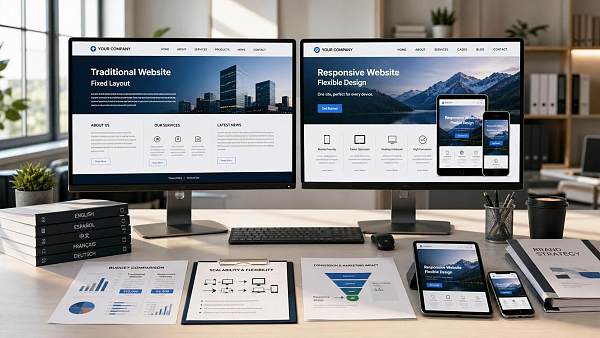
Responsive Website Customization and Template Sites: The Core Difference Is Not Just Price
What is the real difference between responsive website customization and a template site? Many companies only look at the quote at the beginning, but later realize that the factors that truly widen the gap are often promotion efficiency, feature scalability, and long-term maintenance.
Especially in the website + marketing service integrated scenario, a website is not just a display page, but an entry point for customer acquisition, a brand asset, and a data-carrying platform. This also means that the website-building approach will directly affect subsequent advertising, SEO optimization, and conversion performance.
Looking at recent changes, companies’ requirements for websites have clearly increased. In addition to launch speed, they now pay more attention to multilingual support, mobile adaptation, page indexing, inquiry conversion, and system integration capabilities.
Therefore, when judging whether responsive website customization is worth the investment, you should not only ask whether it is “expensive,” but whether it is suitable for the growth needs of the next three years. That is a more realistic decision-making logic.
What Is Responsive Website Customization, and What Is a Template Site
Simply put, a template site is a quick deployment based on an existing framework. The page structure, functional modules, and interaction logic are relatively fixed, with limited room for adjustment, making it suitable for projects with simple needs and tight timelines.
Responsive website customization, on the other hand, is designed around the company’s business. Based on brand positioning, product structure, user journey, and marketing goals, it re-plans the way pages, functions, and content are presented.
Here, “responsive” means that the same website can adapt to computers, tablets, and mobile phones. When users visit, the page automatically adjusts its layout according to screen size, without needing a separate mobile site.
If a company also needs overseas promotion, multilingual SEO, landing pages, and social media traffic in the future, responsive website customization is usually more stable than a template site.
How to View Budget Differences: Don’t Compare Only the Initial Quote
Budget is the part most easily used for comparison, but it is also the part most easily misjudged. A template site has lower initial cost, faster delivery, and looks cheaper, making it suitable for short-term launch needs.
The problem is that template sites often hide many later costs. For example, charges for page modifications, plugin renewal fees, limited feature upgrades, and unfriendly SEO structure can all increase long-term investment.
Responsive website customization usually requires a higher initial budget because it involves planning, design, front-end adaptation, back-end configuration, and testing. But this kind of investment is more like a one-time foundation build, and the reuse value later is higher.
If you look at the three cost items together, the real situation becomes clearer:
- Initial construction cost: template sites are lower, responsive website customization is higher.
- Iteration and upgrade cost: template sites are less stable, customized sites are more controllable.
- Marketing usage cost: responsive website customization usually has more advantages.
Therefore, budget comparison should not only look at the website-building quotation, but also whether you will still need to place repeated orders one year later or two years later because of limitations.
Scalability Is the Divider: It Determines Whether the Website Can Grow Alongside the Business
Many companies’ initial needs are not complex, but once the business grows, new requirements appear quickly. For example, adding multiple languages, integrating form systems, connecting customer service tools, building product filtering, or adding store modules.
The problem with template sites is that they are originally designed around general scenarios. When adding new functions, they are often restricted by the template structure; some features can be added, but others become awkward even after being added.
Responsive website customization is more suitable for medium- and long-term business planning. Website architecture, category hierarchy, content models, and conversion paths can all reserve expansion space in advance, so later upgrades do not require frequent rework.
In actual business, the following needs best reflect the value of responsive website customization:
- Need to do Google SEO for the long term, with emphasis on page indexing and content expansion.
- Need a multilingual website covering multiple overseas markets.
- Need to handle advertising traffic and continuously optimize landing page conversions.
- Need integration with CRM, forms, e-commerce, or marketing systems.
If a company will in the future pursue content marketing, search growth, or an overseas independent-site strategy, then responsive website customization is usually not an “optional” choice, but a more reasonable basic infrastructure.
Comparison of Maintenance Difficulty: The Real Concern Is the Management Method
Many people assume template sites are easier to maintain, but that is not necessarily true. In the short term, template-site backends are simple and quick to learn, but once deep modifications are needed, they are easily constrained by template rules.
For example, changing page structure, adding fields, adjusting URL logic, or managing content for multiple regions often leaves template sites lacking flexibility. Maintenance staff can only repeatedly work around the limitations, and efficiency is not high.
Responsive website customization, if delivered to spec, is actually more favorable for long-term maintenance. The premise is that the website provider offers a clear backend, standardized modules, permission management, and ongoing technical support, rather than only delivering a front-end page.
The key to real peace of mind is not whether it is a template or custom build, but these four points:
- Whether the backend is easy to use and non-technical staff can independently update content.
- Whether pages and modules are standardized to avoid one change affecting the whole site.
- Whether version iteration and data backup are supported.
- Whether the service provider can continuously support SEO, advertising, and content operations.
From the Perspective of Marketing Results: Responsive Website Customization Is Better for Long-Term Customer Acquisition
Website launch is not the end, but the beginning of marketing actions. Especially when search engines, advertising, and social media traffic operate in parallel, whether the website structure is reasonable will directly affect traffic utilization efficiency.
A common problem with template sites is high page similarity, redundant code, and a single structure. They are fine for basic display, but when used for SEO layouts, keyword mapping, and high-conversion landing pages, limitations become obvious.
Responsive website customization can be built around marketing goals. For example, the homepage carries the brand, product pages carry search demand, case pages strengthen trust, landing pages focus on conversion, and the overall path becomes clearer.
For companies that need global promotion, this advantage is even more obvious. Platforms like 易营宝, which are AI-driven, take intelligent website building, multilingual layout, SEO optimization, advertising, and social media marketing into account together, so the website does not become an isolated link.
This kind of integrated solution is more suitable for foreign trade companies, manufacturing factories, cross-border e-commerce sellers, and brand overseas expansion companies. Because what they really need is not a “website that can be seen,” but a “website that can grow.”
How to Choose More Appropriately: First Look at This Decision Checklist
If a company is only looking for short-term display, with little content and almost no later changes, a template site can serve as a transition plan, with the focus on fast launch, low investment, and completing the basic build first.
But if any of the following situations exist, responsive website customization is usually worth considering first:
- The website needs to take on customer acquisition tasks, not just brand display.
- SEO, advertising, or overseas social media promotion is planned for the next year.
- Multiple languages, multiple regions, and multiple product lines are needed for management.
- The website is expected to keep expanding later, rather than being rebuilt frequently.
- Data accumulation, conversion paths, and content asset building are emphasized.
A more stable approach is to evaluate website-building needs and marketing goals together. Budget, scalability, and maintenance difficulty are not three separate issues in essence, but different aspects of the same growth system.
Going back to the original question, what is the difference between responsive website customization and a template site? The answer is very clear: a template site solves the problem of “having one first,” while responsive website customization solves the problem of “being continuously useful and continuously growing.”
When a company already sees the website as a marketing infrastructure rather than a one-time project, the direction becomes clear. First think through future needs, then decide how to build, which often saves more cost and avoids more detours.
Verwandte Artikel



Verwandte Produkte
 易营宝 SaaS-Marketing-System für die intelligente Website-ErstellungDas 易营宝 SaaS-Marketing-System für die intelligente Website-Erstellung ermöglicht eine KI-gestützte Website-Erstellung ohne Programmieraufwand. Erstellen Sie in nur 10 Minuten schnell eine mehrsprachige internationale B2B-Website, beschleunigt durch globale Server und intelligente KI-gestützte SEO-Optimierung, um Unternehmen effizient mit globalen Märkten zu verbinden. Die perfekte Verbindung von Technologie und Bedienkomfort macht die Erstellung von Websites für den Außenhandel so einfach wie möglich.
 Optimierungsservice für das AI+SEO-Dual-Engine-SystemDas AI+SEO-Dual-Engine-Optimierungssystem von 易营宝 unterstützt Außenhandelsunternehmen durch intelligente AI-Keyword-Recherche, Content-Generierung und umfassende technische Optimierung dabei, hochwertigen organischen Traffic zu gewinnen und Suchrankings sowie Conversion-Raten deutlich zu steigern.
 AI+SEM intelligente Werbemarketing-SystemAI+SEM-gesteuerte intelligente Kampagnenerstellung, ganzheitliche Unterstützung für präzises Werbemarketing. Das System generiert automatisch Wochen-/Monatsberichte, KI empfiehlt Keywords und Zielmärkte, überwacht Echtzeit-Kennzahlen und warnt intelligent, startet mit einem Klick hochkonvertierende Kampagnen, beschleunigt Lead-Generierung und steigert ROI.
 AI+SNS Social-Media-Marketing-SystemYingyingbao AI+SNS Social Media Intelligent Marketing System – Präzise Erfassung sozialer Daten für das Zeitalter der sozialen Medien. Unterstützt die Synchronisierung von Inhalten mit einem Klick auf allen wichtigen Plattformen, einschließlich Facebook und LinkedIn. KI-gestütztes Umschreiben von Beiträgen verbessert die Lokalisierung. Intelligenter Kundenservice rund um die Uhr und Analyse von Nutzerprofilen ermöglichen Unternehmen eine effiziente Expansion in globale Märkte.
 AI+SEM-Lösungen für WerbemarketingKI-gestützte SEM-Werbelösungen nutzen künstliche Intelligenz, um das SEM-Kampagnenmanagement erheblich zu verbessern. Mithilfe von KI werden wöchentliche und monatliche Berichte erstellt, die Kontodaten in mehreren Dimensionen darstellen und so einen umfassenden Überblick über die Werbeleistung und Trends ermöglichen. KI liefert präzise Empfehlungen zu Keywords und Zielländern, erstellt auf intelligente Weise Werbetexte mit hoher Konversionsrate und initiiert mit einem einzigen Klick eine effiziente Kampagnenumsetzung, wodurch die Kundenakquise für Unternehmen beschleunigt wird. Gleichzeitig überwacht das System die wichtigsten Kennzahlen in Echtzeit, identifiziert auf intelligente Weise ungewöhnliche Schwankungen und gibt rechtzeitig Warnmeldungen aus, um eine stabile Werbeleistung und hohe Renditen zu gewährleisten.
 AI+SEO营销解决方案易营宝AI+SEO营销解决方案,通过AI批量写作、智能生成TDK、精准关键词扩词等功能,全面优化网站SEO效果,提升流量与转化率。助力企业构建高效智能网站新生态。
 Domain-DienstleistungenEasyWin bietet professionelle Domain-Dienstleistungen an, einschließlich intelligenter Abfrage, One-Stop-Registrierung, Markenschutz und Rund-um-die-Uhr-Management, um Unternehmen bei der Gestaltung eines digitalen Markenimages zu unterstützen.
 EasySell B2C Cross-Border E-Commerce-Plattform und eigenständige WebsiteDer EasyStore B2C Cross-Border E-Commerce Independent Store ist eine intelligente Website-Erstellungs- und Cross-Border-E-Commerce-All-in-One-Lösung, die von der EasyStore Information Technology (Beijing) Co., Ltd. eigenständig entwickelt wurde. Das System wurde speziell für kleine, mittlere und große Exportunternehmen entwickelt und vereint „Website-Erstellung, Betrieb, Marketing, Werbung und Konversion“ in einem, um Unternehmen dabei zu unterstützen, schnell einen Cross-Border-E-Commerce-Independent-Store aufzubauen und so Markenexport und globalen Verkaufszuwachs zu realisieren.
Die Plattform unterstützt Mehrsprachigkeit, Multi-Währungen und Multi-Kanal-Marketing, verfügt über integrierte KI-Übersetzungs- und SEO-Optimierungssysteme und ist für Hauptmärkte wie Südostasien, Europa/Amerika, Lateinamerika und den Nahen Osten geeignet, um chinesischen Herstellern bei der effizienten Erschließung internationaler E-Commerce-Märkte zu helfen. B2B2C双模式独立站解决方案易营宝推出的B2B2C双模式独立站解决方案,专为同时开展批发与零售业务的企业打造。平台支持商品价格展示、商品多规格管理、购物车与购物车弹窗、购物车总价计算,以及统一批量询价等功能,帮助企业以更高效、更直观的方式触达B端与C端客户。通过云建站、大数据分析与广告智能投放体系,助力企业打破渠道壁垒,实现国内外市场拓展与品牌价值提升。