- Le calendrier tarifaire sino-américain a suscité un consensus positif, et le Conseil de commerce sera établiJun 15, 2026Voir les détails
- Quels facteurs déterminent le coût de développement d’une boutique e-commerce B2C transfrontalière ? Analyse des fonctionnalités, des interfaces et des méthodes de déploiementJun 17, 2026Voir les détails
- Non-tarifaire à la frontière sino-marocaine, importation marocaine de marchandises chinoises, baisse des coûts à explorerJun 11, 2026Voir les détails
- Quel signal opérationnel la suspension des exportations vers le Japon libère-t-elleJun 10, 2026Voir les détails
- Les importations chinoises de GNL ont rebondi en mai, les importations supplémentaires de la Russie et du Canada comblent le déficit au Moyen-OrientJun 10, 2026Voir les détails
- GEO va-t-il modifier sa stratégie SEO ?Jun 04, 2026Voir les détails
- À quelles activités les solutions de bout en bout conviennent-elles ?Jun 03, 2026Voir les détails
- Tendances des canaux de croissance mondiale 2026Jun 02, 2026Voir les détails
Comment améliorer le taux de conversion d'un e-commerce B2C transfrontalier ? Stratégies d'optimisation de la page au paiement
B2C e-commerce cross-border store increases conversion rate, first look at the complete order path
To improve the conversion rate of a B2C cross-border e-commerce store overseas, you cannot just focus on ads and traffic. What truly affects orders is often every step of the user experience after entering the page.
From actual business operations, many store problems are not that no one comes, but that after people arrive, they do not understand, do not feel confident, get stuck at checkout, and finally leave directly.

Therefore, optimizing a B2C cross-border e-commerce store should revolve around the user's decision-making path. That is, from entering the page, browsing products, building trust, adding to cart, to completing payment and after-sales expectations, break it down step by step.
For brand going-global companies, this approach is more stable. It can both improve the overseas conversion rate and reduce the probability of wasted traffic spend.
Page experience determines whether users keep reading
The first few seconds after users enter a B2C cross-border e-commerce store are crucial. Whether the page information is clear directly determines bounce rate and dwell time.
Look at the homepage first. The homepage is not a company introduction page, but a sales entry page. The focus should be on featured products, hot-selling products, promotional information, and the shopping path.
Then look at the product detail page. Overseas users care more about results and do not want to spend too much time guessing product parameters. Selling points, applicable scenarios, specification differences, and delivery time should all be visible at a glance.
- Place core selling points on the first screen, not just large images.
- Present prices, discounts, stock, and shipping fees as early as possible.
- Make button copy clear and reduce vague expressions.
- Prioritize mobile design to ensure smooth scrolling.
If the page hierarchy is chaotic, even if traffic is precise, a B2C cross-border e-commerce store still has a hard time turning visits into orders. This is especially obvious on mobile devices.
Clear product information is the key to reducing hesitation costs
When overseas users buy, the thing they fear most is unclear information. Inaccurate sizes, unclear materials, and vague usage methods will all cause the conversion rate of a B2C cross-border e-commerce store to drop significantly.
Therefore, product page optimization should not be just translation, but localization. The concerns of different markets are not the same, and the display order should also be adjusted.
- Use local customary units to display size, weight, and capacity.
- Provide scenario images to help users judge actual use.
- Clearly state return and exchange policies to lower the psychological barrier to ordering.
- Add FAQs to address concerns in advance.
If there are many SKUs, it is also necessary to properly link color, model, and package variants. Let users compare quickly, instead of repeatedly jumping between pages to search.
The more carefully this stage is done, the lower the subsequent customer service pressure will be, and the overall transaction efficiency will be higher.
Insufficient trust is the hidden reason behind many order losses
Many B2C cross-border e-commerce store pages are well designed, but orders still do not come in. The core problem is often incomplete trust building.
Overseas users are usually more cautious about unfamiliar brands. Especially for independent sites, if there is no clear trust proof, users are very likely to exit midway.
- Display real reviews and avoid only five-star praise.
- Add logistics time, signature policy, and after-sales support entry points.
- Clearly show company information, contact methods, and brand story.
- Highlight secure payment, privacy protection, and refund commitments.
From a long-term operation perspective, trust is actually the common foundation of SEO and conversion. The more authentic the page is, the better the search visibility and user dwell performance are usually.
Platforms like Yiyingbao, which integrate website and marketing services, are valuable because they connect site building, content, SEO, advertising, and the store system, reducing the disconnection in the brand going-global process.
The shorter the checkout process, the easier it is for a B2C cross-border e-commerce store to close a sale
Many overseas conversion problems do not occur on the product page, but die on the checkout page. Too long a process, too many fields, and sudden fee increases will all make users abandon payment.
To optimize the checkout experience of a B2C cross-border e-commerce store, the key is to simplify complex processes and explain uncertain information in advance.
If the store mainly targets North America, Europe, or Southeast Asia, it is also necessary to adapt to local payment methods. The more payment options match user habits, the more stable the final conversion will be.
Payment is not just collection, but the final mile of the experience
The payment page may seem like only a technical step, but in fact it carries the user's final decision action. Once it gets stuck here, all previous optimizations will be offset.
A mature B2C cross-border e-commerce store usually considers payment success rate, settlement stability, risk control capability, and local payment coverage at the same time.
- Provide a combination of credit cards, e-wallets, and local payment methods.
- Support quick retry after payment failure.
- Synchronize logistics and customer service information on the order confirmation page.
- Reduce the number of redirects and keep the process continuous.
In system construction, if the store, advertising, SEO, and data analysis can be managed in a unified way, optimization efficiency will be higher. Related ideas can also refer to the optimization path of domestic enterprise financial management information systems under the background of digital transformation, whose core logic likewise emphasizes process collaboration and data integration.
Focus on key nodes in data review, not just total orders
If you want to continuously improve the conversion rate of a B2C cross-border e-commerce store, you cannot just look at how many orders are generated per day. You also need to see where users drop off.
A practical method is to break the data down into key nodes and then optimize item by item.
- Click-through rate from the homepage to the product page.
- The proportion of adding products to the shopping cart.
- The proportion of the shopping cart entering the checkout page.
- Checkout page payment success rate.
- Performance differences by country and device.
When you can clearly see where the problem is, optimization becomes more specific. Whether it is unclear page presentation or mismatched payment methods, data will give the answer.
This is also why Yiyingbao keeps emphasizing full-funnel digital operations. Site building is only the starting point; what truly widens the gap is the follow-up content, advertising, search, and conversion collaboration capability.
Make optimization a continuous mechanism, and the overseas conversion rate will rise steadily
Improving the overseas conversion rate of a B2C cross-border e-commerce store has never been something that can be completely solved by changing a button or replacing a copy version. It is more like a continuous iteration mechanism.
First improve the page experience, then clarify the product information, followed by strengthening trust elements, shortening the checkout process, improving payment methods, and finally continuously revising through data review.
If a company is in the stage of brand going-global or independent site upgrading, it should place the store system and the marketing system on the same operational map. Only in this way can every traffic flow have a better chance of turning into real orders.
In the end, the competition of a B2C cross-border e-commerce store is not only about who gets more visits, but about who better understands why users are willing to place an order, and how to make the whole process smoother.
Articles connexes
 N'arrêtez plus de payer des frais de scolarité à l’aveugle ! Avoir une petite usine à la maison, c’est le véritable atout ultime du commerce extérieur !
 Faisant également de l’exportation de véhicules porte-conteneurs, pourquoi les demandes des autres ne cessent-elles d’affluer ?
 Quels secteurs du commerce extérieur connaîtront un essor en 2026 ?



Produits associés
 EasyCamp SaaS Système intelligent de création de sites Web et de marketingSystème intelligent de marketing web E-Yingbao SaaS : création de sites web sans code, basée sur l'IA. Créez rapidement des sites e-commerce multilingues indépendants en seulement 10 minutes. L'accélération mondiale des serveurs et l'optimisation SEO basée sur l'IA permettent aux entreprises de se connecter efficacement aux marchés mondiaux. La fusion harmonieuse entre technologie et convivialité rend la création d'une présence e-commerce internationale remarquablement simple.
 Service d'optimisation du système double moteur AI+SEOLe système d'optimisation double moteur AI+SEO d'YiYingBao, grâce à l'exploitation intelligente de mots-clés par l'IA, la génération de contenu et une optimisation technique complète, aide les entreprises de commerce extérieur à obtenir un trafic naturel de haute qualité, améliorant considérablement le classement des recherches et le taux de conversion.
 Système de marketing publicitaire intelligent AI+SEMAI+SEM propulse une création publicitaire intelligente, permettant un marketing publicitaire précis sur toute la chaîne. Le système génère automatiquement des rapports hebdomadaires/mensuels, l'IA recommande des mots-clés et des pays de diffusion, surveille en temps réel les indicateurs clés et fournit des alertes intelligentes, lance en un clic des solutions de diffusion à haut taux de conversion, aidant à acquérir rapidement des clients et à améliorer le ROI.
 Système de marketing sur les réseaux sociaux AI+SNSSystème de marketing intelligent Yingyingbao AI+SNS pour les réseaux sociaux - Capture sociale précise pour l'ère des réseaux sociaux. Prend en charge la synchronisation du contenu en un clic sur les principales plateformes, notamment Facebook et LinkedIn. La réécriture des publications alimentée par l'IA améliore la localisation. Un service client intelligent disponible 24 h/24, 7 j/7 et l'analyse du profil des utilisateurs permettent aux entreprises de se développer efficacement sur les marchés mondiaux.
 Solutions marketing publicitaire IA+SEMLes solutions publicitaires SEM basées sur l'IA exploitent l'intelligence artificielle pour améliorer considérablement la gestion des campagnes SEM. Grâce à l'IA, elles génèrent des rapports hebdomadaires et mensuels qui présentent les données des comptes sous plusieurs angles, permettant ainsi une supervision complète des performances et des tendances publicitaires. L'IA fournit des recommandations précises sur les mots-clés et les pays cibles, rédige de manière intelligente des textes publicitaires à fort taux de conversion et lance des campagnes efficaces en un seul clic, accélérant ainsi l'acquisition de clients pour les entreprises. Parallèlement, le système surveille les indicateurs clés en temps réel, identifie intelligemment les fluctuations anormales et émet des alertes en temps opportun, garantissant ainsi des performances publicitaires stables et des rendements élevés.
 AI+SEO营销解决方案易营宝AI+SEO营销解决方案,通过AI批量写作、智能生成TDK、精准关键词扩词等功能,全面优化网站SEO效果,提升流量与转化率。助力企业构建高效智能网站新生态。
 Services de noms de domaineEasy Marketing propose des services professionnels de noms de domaine, comprenant la recherche intelligente, l'enregistrement en un clic, la protection de marque et la gestion complète du cycle de vie, aidant les entreprises à construire une image de marque numérique.
 EasySell B2C Place de Marché Transfrontalière, Site Indépendant易营宝B2C跨境商城独立站是由易营宝信息科技(北京)有限公司自主研发的智能建站与跨境电商一体化解决方案。系统专为中小型及大型出口企业打造,集“建站、运营、营销、投放、转化”于一体,帮助企业快速打造跨境电商独立站,实现品牌出海与全球销售增长。
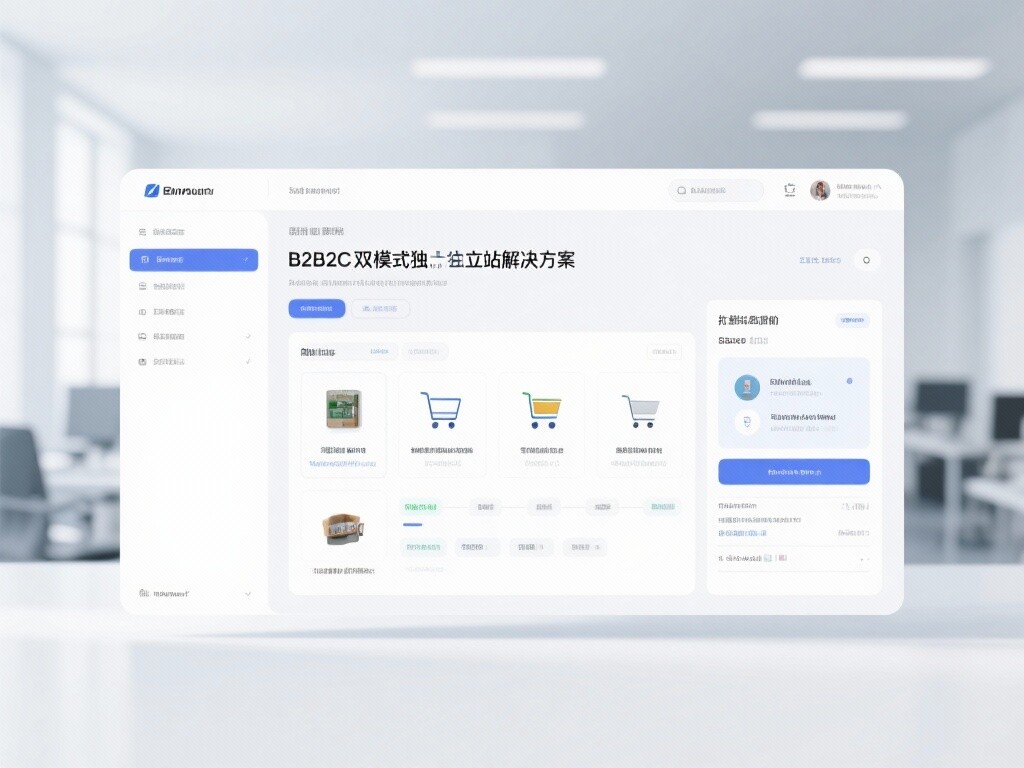
平台支持多语言、多币种、多渠道营销,内置AI智能翻译与SEO优化系统,适配东南亚、欧美、拉美、中东等主流市场,助力中国制造企业高效布局国际电商版图。 B2B2C双模式独立站解决方案易营宝推出的B2B2C双模式独立站解决方案,专为同时开展批发与零售业务的企业打造。平台支持商品价格展示、商品多规格管理、购物车与购物车弹窗、购物车总价计算,以及统一批量询价等功能,帮助企业以更高效、更直观的方式触达B端与C端客户。通过云建站、大数据分析与广告智能投放体系,助力企业打破渠道壁垒,实现国内外市场拓展与品牌价值提升。