- Un site indépendant pour le commerce extérieur dans le Zhejiang est-il encore pertinent aujourd’hui ? Analysez l’évolution du trafic et de l’acquisition de clientsJul 28, 2026Voir les détails
- Quels sont les nouveaux signaux dans les rapports marketing des solutions SaaS pour entreprises ?Jul 27, 2026Voir les détails
- Qu'est-ce qu'un prestataire mondial de services de trafic et d'écosystèmes ? Quels sont les différences avec une simple agence de publicité ?Jul 16, 2026Voir les détails
- À quoi faut-il prêter la plus grande attention dans le dernier rapport SaaS de services d’entreprise ? Des taux de renouvellement, des coûts de livraison aux opportunités de croissance à l’étrangerJul 12, 2026Voir les détails
- Dans le rapport sur les tendances du marketing transfrontalier, quels signaux méritent le plus d’attention ? Les entreprises B2B devraient examiner ces 6 points.Jul 11, 2026Voir les détails
- Comment lire un rapport de tendance du marketing transfrontalier ? Les 5 dimensions clés pour juger les opportunités de canalJul 11, 2026Voir les détails
Comment répartir le budget publicitaire Google ? Quelle part pour les mots-clés de marque, les mots-clés de recherche et le remarketing
Budget pour Google Ads, why can’t you look only at the total amount?

How Google Ads budget is allocated may seem like an ad spending issue, but in reality it is related to customer acquisition cost, cash flow rhythm, and approval judgments. In many projects, the problem is not that the budget is too small, but that the budget structure is imbalanced, causing stable traffic to be unstable, and making it difficult to scale up traffic that should be expanded.
In an integrated website + marketing services scenario, budget allocation is also affected by the website’s ability to handle traffic. Slow page loading, poor form experience, and unstable access from different regions can all magnify ineffective clicks, making Google Ads spending look “more and more expensive”.
A more common situation is that brand keywords, generic search terms, and remarketing are all placed under the same budget for evaluation. This is not conducive to approval, because the tasks borne by the three types of traffic are different, and the evaluation criteria should also be separated.
What problems do brand keywords, search terms, and remarketing each solve?
If you want to clearly explain Google Ads budget allocation, you must first understand the roles of the three types of traffic. Brand keywords are more like a “defensive budget”, with the core purpose of intercepting people who already know the company name or product line, so as to avoid natural traffic and competitor traffic being diverted.
Search term budget is usually an “incremental budget”. It is responsible for reaching people who do not yet know the company, but are actively looking for solutions, so the click cost, test cycle, and conversion fluctuations are often larger, and it also most tests keyword quality and landing page matching.
Remarketing budget tends to be a “recovery budget”. It is not for finding new people, but for bringing back people who have already visited the website, viewed pages, or downloaded materials, helping shorten the decision path and improve the utilization rate of early traffic.
For companies doing overseas independent sites and multilingual customer acquisition, these three types of budget work best together to form a complete funnel. Platforms like Yiyingbao, which have long focused on intelligent website building, SEO optimization, and integrated advertising services, usually plan website handling capacity, ad structure, and follow-up remarketing together, rather than looking only at the numbers in the ad backend.
Is there a common reference value for budget ratios? Look at this judgment table first
There is no single ratio that fits all industries, but when reviewing a budget, you can first use the idea of “brand base budget + search expansion budget + remarketing recovery budget” to establish a range. Having a reference first, and then fine-tuning based on data, is usually more stable than one-time rigid allocation.
If it is a new site cold start, the brand keyword ratio is often not too high, because search volume is limited. On the contrary, the search term budget needs to bear market testing tasks, while remarketing depends on whether front-end traffic is sufficient.
If the brand already has stable exposure, or offline exhibitions and channel cooperation can continuously bring search demand, the value of brand keywords will increase significantly. This kind of budget, although not large, is often the easiest part to prove results.
When reviewing a budget, what hidden costs are most easily ignored?
Many people only look at the single-click price, but ignore the loss after the click. For example, slow overseas access speed will directly increase bounce rates; unstable landing pages will make even the best keywords hard to convert. These all belong to hidden costs of Google Ads spending.
In actual application, website infrastructure has a bigger impact on budget efficiency than imagined. If an independent site targets multiple regions such as North America, Europe, Latin America, and the Middle East, server nodes, transmission protocols, and security protection will all affect ad performance and quality scores.
For example, adopting Yiyingbao global server deployment is not simply about “higher configuration”, but about enabling multilingual sites to maintain relatively stable access performance under global nodes. With global average TTFB controlled within 300ms, 99.99% availability, and HTTP/3 transmission efficiency improved by 30%, ad click loss can be reduced more easily from the source.
If a page loads every 100ms faster, the conversion rate may continue to improve, and ad quality score also has more room to rise. When reviewing a budget, incorporating these basic conditions together is often more effective than simply lowering the bid.
Are the budget ideas the same for new sites, mature sites, and foreign trade sites?
No, and the differences are usually quite large. For a new site doing Google Ads, the key point is to first verify the market and page handling capability, so the search term budget will be higher, while brand keywords mainly play a basic defensive role.
For a mature site, it depends on brand accumulation and historical data. If there is already stable organic traffic, a customer pool, and a relatively high inquiry conversion rate, the remarketing budget can be increased appropriately, because this part of the investment is more likely to produce a definite return.
Foreign trade sites also have a special point: click costs and access experience differ significantly across countries. Budget allocation cannot be judged only by the account-wide total; it must be split by region, language, and page type. Otherwise, some high-cost markets will “drag down” the overall data.
- New site: prioritize keyword and landing page matching verification, and search term budget can be a bit higher.
- Mature site: emphasize remarketing replenishment and brand keyword defense to stabilize high-intent traffic.
- Multilingual foreign trade site: split budget by market and calculate real customer acquisition cost by region.
For Yiyingbao’s long-term service to foreign trade enterprises and brand going-global projects, website building, advertising, SEO, and localized deployment are usually considered together. The reason is very straightforward: website handling and ad efficiency are inherently integrated and not suitable for separate judgment.
Which budget allocation mistakes make ad spending seem more and more expensive?
The first mistake is treating brand keywords as the main source of growth. Brand keywords have low cost and good conversion, but what they carry is existing awareness and is not enough to support new customer growth in the long term. If you rely on them excessively, the data will look good, but incremental growth will not be obvious.
The second mistake is setting the remarketing budget too low. Many sites spend a lot on search term costs at the front end, but do not continue tracking the people who have visited, which is equivalent to losing the attention that was already paid for once.
The third mistake is looking only at form volume and not at lead quality. Google Ads budget should match the business cycle. Industries with long inquiry cycles and slow decision-making often need to judge by a combination of follow-up quality, follow-up rate, and transaction cycle, rather than staring only at short-term cost.
Another common situation is that website infrastructure is poor, yet the budget keeps increasing. If the server switches slowly, security protection is weak, and pages fluctuate frequently, then no matter how much budget there is, it may only expand waste. As mentioned in the second point, Yiyingbao global server deployment is valuable because it makes ad landing pages more stable in global access, anti-attack protection, and automatic backup, thereby reducing budget loss from the source.
If you are preparing for budget review, how should you judge the next step more steadily?
A more stable approach is not to argue about whether the amount is high or low first, but to first define the budget structure, testing cycle, and acceptance path. In this way, future additions or adjustments will all have clear evidence.
You can first verify three things: first, whether brand keywords have already formed stable search demand; second, whether search terms are tested by market, language, and page separately; third, whether remarketing covers the people who have visited core pages.
If you want to refine further, it is recommended to put website loading speed, landing page bounce rate, inquiry effectiveness, and regional cost into the same table. This makes it easier to judge whether the budget issue is ultimately caused by the ad structure or by the website’s handling capacity.
In the end, Google Ads budget is not simple accounting, but a design for growth efficiency. Keep brand keywords in check, make search terms work, connect remarketing, and pair it with a stable website foundation and long-term optimization mechanism, and budget review will be more controllable, and subsequent scaling will be easier.
Articles connexes
 Comment estimer le tarif des publicités Yandex ? Décomposition des coûts, de l’ouverture du compte à la diffusion
 Par où commencer pour optimiser rapidement les conversions publicitaires grâce à l’IA
 Shopee et Lazada renforcent les exigences de certification des pages d’atterrissage de sites indépendants



Produits connexes
 EasyCamp SaaS Système intelligent de création de sites Web et de marketingSystème intelligent de marketing web E-Yingbao SaaS : création de sites web sans code, basée sur l'IA. Créez rapidement des sites e-commerce multilingues indépendants en seulement 10 minutes. L'accélération mondiale des serveurs et l'optimisation SEO basée sur l'IA permettent aux entreprises de se connecter efficacement aux marchés mondiaux. La fusion harmonieuse entre technologie et convivialité rend la création d'une présence e-commerce internationale remarquablement simple.
 Service d'optimisation du système double moteur AI+SEOLe système d'optimisation double moteur AI+SEO d'YiYingBao, grâce à l'exploitation intelligente de mots-clés par l'IA, la génération de contenu et une optimisation technique complète, aide les entreprises de commerce extérieur à obtenir un trafic naturel de haute qualité, améliorant considérablement le classement des recherches et le taux de conversion.
 Système de marketing publicitaire intelligent AI+SEMAI+SEM propulse une création publicitaire intelligente, permettant un marketing publicitaire précis sur toute la chaîne. Le système génère automatiquement des rapports hebdomadaires/mensuels, l'IA recommande des mots-clés et des pays de diffusion, surveille en temps réel les indicateurs clés et fournit des alertes intelligentes, lance en un clic des solutions de diffusion à haut taux de conversion, aidant à acquérir rapidement des clients et à améliorer le ROI.
 Système de marketing sur les réseaux sociaux AI+SNSSystème de marketing intelligent Yingyingbao AI+SNS pour les réseaux sociaux - Capture sociale précise pour l'ère des réseaux sociaux. Prend en charge la synchronisation du contenu en un clic sur les principales plateformes, notamment Facebook et LinkedIn. La réécriture des publications alimentée par l'IA améliore la localisation. Un service client intelligent disponible 24 h/24, 7 j/7 et l'analyse du profil des utilisateurs permettent aux entreprises de se développer efficacement sur les marchés mondiaux.
 Solutions marketing publicitaire IA+SEMLes solutions publicitaires SEM basées sur l'IA exploitent l'intelligence artificielle pour améliorer considérablement la gestion des campagnes SEM. Grâce à l'IA, elles génèrent des rapports hebdomadaires et mensuels qui présentent les données des comptes sous plusieurs angles, permettant ainsi une supervision complète des performances et des tendances publicitaires. L'IA fournit des recommandations précises sur les mots-clés et les pays cibles, rédige de manière intelligente des textes publicitaires à fort taux de conversion et lance des campagnes efficaces en un seul clic, accélérant ainsi l'acquisition de clients pour les entreprises. Parallèlement, le système surveille les indicateurs clés en temps réel, identifie intelligemment les fluctuations anormales et émet des alertes en temps opportun, garantissant ainsi des performances publicitaires stables et des rendements élevés.
 AI+SEO营销解决方案易营宝AI+SEO营销解决方案,通过AI批量写作、智能生成TDK、精准关键词扩词等功能,全面优化网站SEO效果,提升流量与转化率。助力企业构建高效智能网站新生态。
 Services de noms de domaineEasy Marketing propose des services professionnels de noms de domaine, comprenant la recherche intelligente, l'enregistrement en un clic, la protection de marque et la gestion complète du cycle de vie, aidant les entreprises à construire une image de marque numérique.
 EasySell B2C Place de Marché Transfrontalière, Site Indépendant易营宝B2C跨境商城独立站是由易营宝信息科技(北京)有限公司自主研发的智能建站与跨境电商一体化解决方案。系统专为中小型及大型出口企业打造,集“建站、运营、营销、投放、转化”于一体,帮助企业快速打造跨境电商独立站,实现品牌出海与全球销售增长。
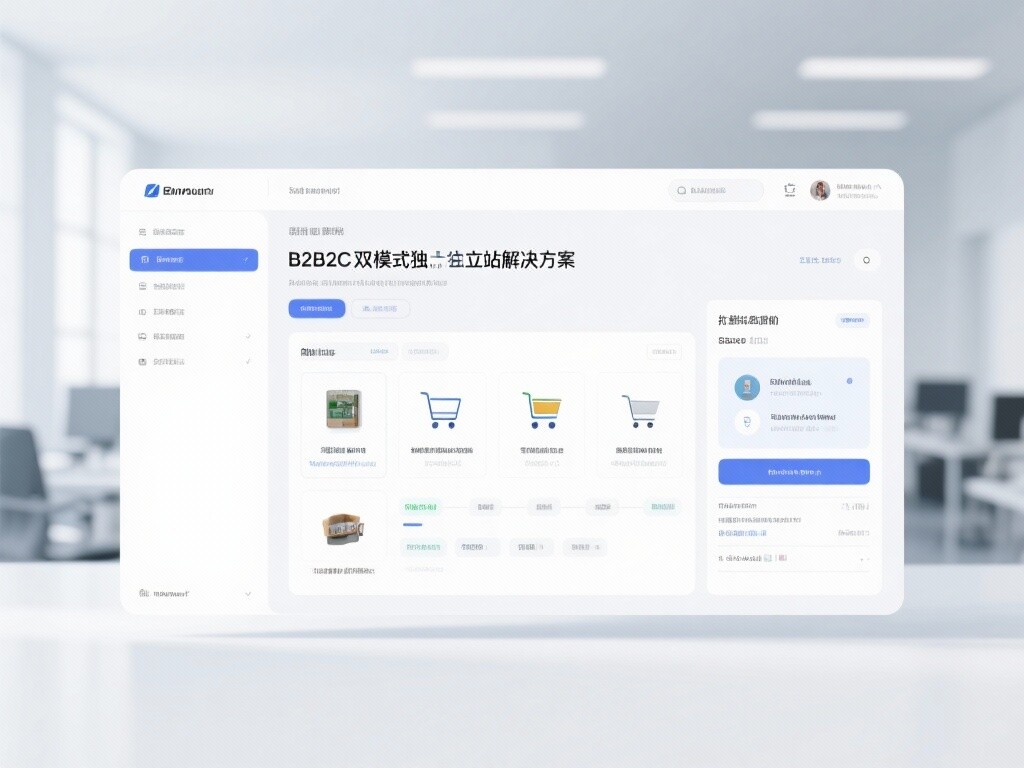
平台支持多语言、多币种、多渠道营销,内置AI智能翻译与SEO优化系统,适配东南亚、欧美、拉美、中东等主流市场,助力中国制造企业高效布局国际电商版图。 B2B2C双模式独立站解决方案易营宝推出的B2B2C双模式独立站解决方案,专为同时开展批发与零售业务的企业打造。平台支持商品价格展示、商品多规格管理、购物车与购物车弹窗、购物车总价计算,以及统一批量询价等功能,帮助企业以更高效、更直观的方式触达B端与C端客户。通过云建站、大数据分析与广告智能投放体系,助力企业打破渠道壁垒,实现国内外市场拓展与品牌价值提升。