









- How to view pricing in the global traffic ecosystem? Cost comparison of search, social media, and content channel advertisingJul 06, 2026View details
- How to assess foreign trade website development trends?Looking at 2026 changes from multilingual,AI content to conversion pathsJul 04, 2026View details
- What are the new trends in multilingual marketing data analytics tools in 2026? Focus on attribution、automation and complianceJul 04, 2026View details
- Is Brand Globalization Marketing Consulting Worth Buying? At What Stage Should Companies Bring It InJul 01, 2026View details
- Cross-Border Marketing Trend Research: Why More and More Companies Are Starting to Deploy AI Search and GEO OptimizationJun 30, 2026View details
- Cross-Border Marketing Trend Research: How Independent Sites, AI Content, and Short-Video Customer Acquisition Are ChangingJun 30, 2026View details
- How Can a Brand Updates Page Be Made More SEO-Friendly? Analysis of Update Frequency, Content Structure, and Internal Linking StrategyJun 28, 2026View details
- What stages does the cross-border services ecosystem include? How do website building, promotion, payment, and compliance work togetherJun 22, 2026View details
Rising European Shipping Costs Extend the Inquiry Conversion Cycle in Europe
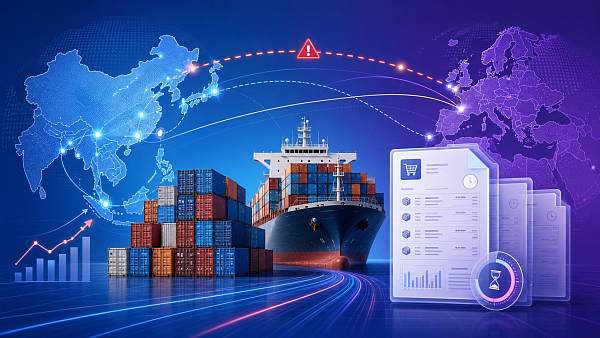
Amidst the shipping disruptions caused by the Red Sea crisis, a signal worthy of the industry's continued attention has emerged: since July, the average conversion cycle for inquiries on independent e-commerce platforms from China to Europe has increased by 5.2 days. While the exact timing of this event was not explicitly stated in the input information, confirmed data points to a correlation between freight rates, transit times, and port inspection procedures on the Asia-Europe route. For cross-border sellers, foreign trade companies, supply chain service providers, and European buyers targeting the European market, this is not merely a matter of fluctuating transportation costs, but is also impacting the pace of inquiries, approvals, sample confirmations, and order fulfillment.
What do the confirmed data changes indicate?
According to joint data from Alphaliner and the Shanghai Shipping Exchange, spot freight rates on the Asia-Europe route rose 37% week-on-week in the first week of July 2026. Meanwhile, the average voyage time was extended by 14 days due to the detour around the Cape of Good Hope.
With the transportation chain lengthening, the inspection rate at the destination port has increased, further increasing uncertainty after arrival. Correspondingly, European buyers, after submitting inquiries on independent websites, have generally extended the internal approval and sample confirmation period, resulting in an average increase of 5.2 days in the inquiry conversion cycle from China to Europe on independent websites.
Additional data shows that independent websites equipped with AI customer service and multilingual real-time logistics tracking modules have an inquiry-to-purchase conversion rate 22% higher than the industry average. This information is already confirmed in this news report.
The impact is spreading to the order front end and the fulfillment process.
Foreign trade and independent website sellers targeting the European market
From an industry perspective, these types of businesses are most directly affected. This is because rising freight costs and longer shipping times are no longer just reflected in shipping costs, but also extend to the pre-order evaluation process. The impact primarily affects quotation validity, delivery commitments, sample confirmation, and order conversion rates. Currently, it's more important to pay attention to whether customers extend approval processes due to logistical uncertainties, and whether websites have the ability to continuously respond to logistical issues.
European Procurement Parties and Channel Procurement Roles
From observation, the core impact on purchasers stems from weakened delivery expectations. With increased inspection rates at destination ports, procurement decisions are no longer solely based on product and price, but also increasingly consider internal approval times, sample confirmation arrangements, and the certainty of subsequent delivery. For these roles, the change primarily manifests as a longer decision-making chain after inquiry submission, with a focus on transportation transparency and contract performance explainability.
Supply chain services and fulfillment coordination
For logistics, customs clearance, and customer communication services, this information signifies an increasing demand for collaboration between front-end sales and back-end fulfillment. While the input information doesn't provide further service details, it confirms that longer transit times and higher inspection rates amplify the importance of delivery instructions, progress synchronization, and anomaly feedback. The information service providers need to focus on has expanded from simply executing transportation to supporting customer decision-making after receiving an inquiry.
Which aspects should we focus on more in our current business?
First, clarify the delivery expectations.
Based on the confirmed facts, the first thing businesses need to focus on is whether their delivery instructions to European customers are accurate enough. Increased freight costs and a 14-day extension in average transit time will directly impact customers' internal assessment of delivery dates. Analysis shows that if the initial quote, delivery date description, and actual logistics pace are out of sync, the extended inquiry period will not only increase waiting time but may also affect the subsequent processing of purchase orders (POs).
Incorporate sample confirmation and approval cycles into the sales process.
Since European buyers have generally extended their internal approval and sample confirmation cycles, companies need to incorporate this change into their normal sales rhythm when inquiring. The more pressing question now is whether sample delivery, confirmation feedback, and follow-up communication will further lengthen the overall transaction time, rather than relying on the original timelines to estimate customer decision-making speed.
Multilingualism and logistics visualization capabilities are impacting conversion.
Data shows that independent websites using AI customer service and multilingual real-time logistics tracking modules have an inquiry-to-purchase conversion rate 22% higher than the industry average. This indicates that with increased logistical uncertainty, customers are not only concerned with price, but also with whether they can receive timely and clear responses and continuously track logistics status. For businesses, this is more of a practical signal than simply a website functionality optimization issue.
Distinguishing the boundary between transportation disruptions and transaction issues
Observations suggest that some companies need to carefully distinguish whether the slower conversion rate is primarily due to price, delivery time, or internal customer approval processes. Because this news report explicitly mentions the correlation between increased inspection rates and extended approval and sample confirmation cycles, in actual business operations, not all slowdowns in sales can be simply attributed to changes in market demand.
This is more like a stress test of the front-end transaction rhythm.
As an observation rather than a conclusion, this information does not simply signal a rise in freight rates, but rather that fluctuations in Asia-Europe logistics are spreading to the upstream of the independent shipping transaction chain. In the past, many companies viewed shipping risks primarily as issues in the fulfillment phase, but this data shows that customer approval and confirmation processes after inquiries are also being lengthened.
Looking further, independent websites using AI customer service and multilingual real-time logistics tracking modules have conversion rates 22% higher than the industry average, indicating that during periods of transportation uncertainty, information transparency and response efficiency may be becoming key variables influencing transactions. A more accurate interpretation is that the industry is currently experiencing a re-differentiation in transaction efficiency triggered by logistical disruptions.
At this stage, it is more appropriate to view this signal rationally.
In summary, the industry significance of this news lies not only in the 37% month-on-month increase in freight rates on the Asia-Europe route, but also in its observable correlation with the approval pace of European buyers, sample confirmation timelines, and the conversion rate of inquiries from independent websites. For relevant companies, it is more appropriate to understand this as a phased signal that has already impacted the front end of their business, rather than simply a short-term fluctuation in the shipping sector.
Whether this will evolve into a longer-term shift in transaction patterns remains to be seen. However, based on current information, those who can address customer concerns about delivery dates and logistics uncertainties earlier are more likely to maintain relatively stable inquiry conversion rates.
Information in this article and directions for subsequent verification
This article is generated based on user-provided news titles, event times, and event summaries. Information used includes: the Red Sea crisis continuing to drive up freight rates on Asia-Europe routes; spot freight rates on Asia-Europe routes increasing by 37% month-on-month in the first week of July 2026; the detour around the Cape of Good Hope causing an average 14-day extension in transit time; increased inspection rates at destination ports; an average 5.2-day extension in the conversion cycle for inquiries from China to Europe on independent websites starting in July; and independent websites equipped with AI customer service and multilingual real-time logistics tracking modules achieving a 22% higher inquiry-to-PO conversion rate than the industry average.
The specific official source link was not provided in the input and will require further verification. For this type of information, it is generally advisable to cross-confirm with official announcements, company announcements, industry association information, authoritative media reports, and relevant business documents. Areas for continued monitoring include: whether freight rate changes on the Asia-Europe route continue, whether there are new changes in inspection conditions at destination ports, and whether the impact of independent website front-end communication and logistics transparency on transaction efficiency continues to expand.
Related Articles



Related Products
 EasyCamp SaaS Smart Website Marketing SystemE-Yingbao SaaS Smart Website Marketing System: AI-powered, zero-code website building. Rapidly launch multilingual independent e-commerce sites in just 10 minutes. Global server acceleration and AI-driven SEO optimization empower businesses to efficiently connect with global markets. The seamless integration of technology and user-friendly operation makes building e-commerce sites incredibly simple.
 AI+SEM Intelligent Advertising Marketing SystemAI+SEM drives intelligent ad creation, empowering full-funnel precision advertising marketing. The system automatically generates weekly/monthly reports, AI recommends keywords and target countries, monitors core metrics in real-time with intelligent alerts, and enables one-click high-conversion ad solutions to help quickly acquire customers and improve ROI.
 AI+SEO Dual Engine Optimization ServiceEasyWin AI+SEO Dual Engine Optimization System leverages AI-powered keyword mining, content generation, and comprehensive technical optimization to help foreign trade enterprises acquire high-quality organic traffic, significantly improving search rankings and conversion rates.
 AI+SNS Social Media Marketing SystemYingbao AI+SNS Social Media Marketing System - Precision social capture for the social media era. Supports one-click content synchronization across major platforms like Facebook and LinkedIn. AI intelligently rewrites posts for enhanced relevance. 24/7 AI customer service and user profiling analysis empower businesses to efficiently expand into global markets.
 AI+SEO营销解决方案易营宝AI+SEO营销解决方案,通过AI批量写作、智能生成TDK、精准关键词扩词等功能,全面优化网站SEO效果,提升流量与转化率。助力企业构建高效智能网站新生态。
 AI+SEM Advertising Marketing SolutionsAI+SEM Advertising Marketing Solution leverages AI technology to deeply empower SEM ad campaigns. It automatically generates weekly/monthly reports using AI, presenting account data across multiple dimensions for comprehensive insights into campaign performance and trends. The system precisely recommends keywords and target countries, intelligently generates high-conversion ad copy, and enables one-click activation of efficient campaign plans to help businesses rapidly acquire customers. Simultaneously, it monitors core metrics in real time, intelligently identifies abnormal fluctuations, and issues timely alerts to ensure stable, high-return advertising results.
 Domain Name ServicesEasyWin provides professional domain name services, including intelligent queries, one-stop registration, brand protection, and full lifecycle management, helping businesses build a digital brand image.
 EasyOperate B2C Cross-Border E-Commerce Platform & Independent WebsiteEasyStore B2C Cross-border E-commerce Independent Store is an intelligent website building and cross-border e-commerce integrated solution independently developed by EasyStore Information Technology (Beijing) Co., Ltd. The system is specially designed for small and medium-sized as well as large export enterprises, integrating 'website building, operation, marketing, advertising, and conversion' into one, helping enterprises quickly establish cross-border e-commerce independent stores to achieve brand globalization and global sales growth.
The platform supports multiple languages, multiple currencies, and multi-channel marketing, with built-in AI intelligent translation and SEO optimization systems, suitable for mainstream markets such as Southeast Asia, Europe and America, Latin America, and the Middle East, assisting Chinese manufacturing enterprises in efficiently deploying international e-commerce strategies. SSL证书易营宝提供专业SSL安全证书服务,包括单域名和泛域名证书,确保网站数据传输加密、身份验证和完整性保护,助力企业建立安全可信的在线业务环境。









