









- Which channel has the highest ROI in the global traffic ecosystem? Comparative analysis of search, social media, and advertisingJul 10, 2026View details
- What multilingual website services are available in Sanya? Which model is more suitable for local businesses going global?Jul 08, 2026View details
- How to view the complete list of China SaaS companies in the top 100? Practical methods for screening website-building and marketing service providersJul 08, 2026View details
- How to view pricing in the global traffic ecosystem? Cost comparison of search, social media, and content channel advertisingJul 06, 2026View details
- How to assess foreign trade website development trends?Looking at 2026 changes from multilingual,AI content to conversion pathsJul 04, 2026View details
- What are the new trends in multilingual marketing data analytics tools in 2026? Focus on attribution、automation and complianceJul 04, 2026View details
- Is Brand Globalization Marketing Consulting Worth Buying? At What Stage Should Companies Bring It InJul 01, 2026View details
- Cross-Border Marketing Trend Research: Why More and More Companies Are Starting to Deploy AI Search and GEO OptimizationJun 30, 2026View details
Which path is more effective for driving traffic from social platforms to your official website
Social platforms generate massive traffic, but the key to efficiently driving it to an official website is not “whether there is traffic,” but “whether the path is smooth.” As customer acquisition costs continue to rise, simply chasing exposure is no longer enough to sustain growth. When evaluating traffic generation from social platforms, it is even more important to assess cost per click, visit depth, lead quality, subsequent conversion, and long-term asset accumulation at the same time, so that it becomes clear which path is more efficient.
Driving traffic from social platforms to official websites is shifting from “competing for traffic” to “competing on the path”
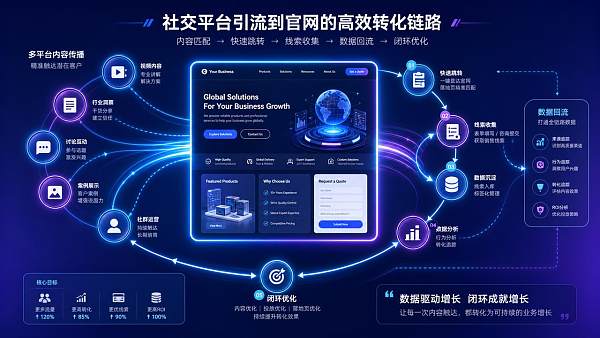
In the past, many companies treated social platforms as exposure channels. They posted more content and spread accounts more widely, believing this would bring stable traffic to their official websites. But now platform rules are more complex, user attention spans are more fragmented, and the friction of jumping across platforms is also greater. The traffic-driving efficiency of social platforms increasingly depends on journey design rather than one-off placement.
Especially in integrated website + marketing service scenarios, the official website is no longer just a corporate business card, but a key node for handling inquiries, collecting leads, accumulating data, and driving transactions. If social platforms cannot steadily deliver interested users to the official website and complete subsequent conversions, the value of traffic will be quickly diluted.
Several clear signals show that the standards for efficient traffic generation from social platforms have already changed
One obvious change is that users are less patient with direct redirects. If a landing page loads slowly or the content does not match, the bounce rate will rise rapidly. Another change is that platform content recommendation mechanisms place greater emphasis on interaction quality rather than simply the number of external links. Social platform content must first build interest and then complete the redirect; the logic is already different from a few years ago.
At the same time, companies are also raising their requirements for official websites. In the past, they only looked at traffic volume; now they focus more on source structure, time on site, conversion funnels, and revisit rates. If the traffic brought by social platforms cannot be turned into trackable, reusable, and remarketable data assets, it can hardly be called efficient.
Core factors driving this change
- Platform competition has intensified, and the cost of each reach has generally increased.
- The user decision-making journey has become longer, and a single click no longer equals a valid lead.
- The official website’s receiving experience directly affects subsequent inquiries and transactions.
- Data attribution requirements are higher, and companies place greater emphasis on full-funnel analysis.
- Search, social media, and advertising are beginning to work together instead of operating separately.
Across different social platform traffic paths, efficiency differences are mainly reflected in four types of models
To judge which path from a social platform to an official website is more efficient, it is not enough to look only at clicks. More importantly, which path can both reduce bounce and turn interest into effective action. Common models can generally be divided into the following four categories.
Overall, targeted ad landing pages and direct links from highly relevant content to official websites are usually the two more efficient types of social platform paths. The reason is that these two methods make it easier to control message consistency and are also more convenient for page testing, attribution analysis, and closed-loop remarketing.
What truly determines the efficiency of traffic generation from social platforms is not the entry point, but the official website’s ability to receive traffic
Many traffic-generation failures are not because the social platform content is not good enough, but because the official website’s receiving capability is too weak. After users click in from social platforms, if the page loads slowly, mobile adaptation is poor, language and currency settings are not user-friendly, or the information hierarchy is confusing, then no matter how outstanding the front-end content is, it will still be difficult to retain visitors.
This is especially obvious in cross-border or multi-region business. Social platform traffic is naturally dispersed, and users come from different devices, regions, and language environments. If the official website lacks multilingual adaptation, mobile experience, and a search-friendly structure, it will quickly lose the value of traffic after the redirect.
This is also why more and more companies are beginning to consider website building, SEO, advertising, and social media in an integrated way. Taking EasyAB B2C Cross-border Store and Independent Website as an example, this type of solution emphasizes automatic multilingual adaptation, multi-currency switching, global acceleration, intelligent SEO optimization, and integration with multi-channel marketing. In essence, it improves the receiving efficiency after social platform traffic enters the official website.
Efficient traffic receiving usually has these characteristics
- Fast page loading speed, reducing traffic loss during redirects from social platforms.
- Headlines, selling points, and call-to-action buttons are consistent with social media content.
- Smooth mobile reading experience and simple form filling.
- Trackable user sources, click behavior, and conversion paths.
- Support for subsequent remarketing and tiered user operations.
This change has had a direct impact on traffic operations, official website building, and lead conversion
First, the goals of social platform operations are changing. Looking only at likes, shares, and follower growth is no longer enough to support business judgment. A more effective approach is to layer social platform content by “interest generation, comparison, conversion,” and set different official website entry points and page receiving strategies for different content.
Second, official website building is shifting from static display to dynamic conversion. In the past, official websites mainly displayed company information, but today they need to work with social platforms to achieve rapid persuasion, lead collection, content recommendation, and automated follow-up. If an official website cannot combine user behavior for refined management, the traffic brought by social platforms will quickly lose momentum.
Third, data analysis has become the dividing line of efficiency. Whether a social platform traffic path is efficient cannot be judged by intuition; it must be evaluated by channel sources, landing page performance, dwell trajectories, conversion nodes, and repurchase contribution. Systems with global data visualization, customer profiling, and remarketing capabilities are often better suited for continuous optimization.
In response to changes in social platform traffic, companies should focus more on these five priorities
- First determine the goal: brand exposure or official website conversion.
- Set up independent tracking and dedicated landing pages for each social platform.
- Content must be highly consistent with the first-screen information on the official website.
- Value remarketing and do not let the first click go to waste.
- Treat the official website as a data asset center rather than just a display page.
If the business targets overseas markets, these priorities need to be further extended. For example, multilingual content, local payment awareness, mobile device adaptation, and a search-engine-friendly structure will all affect whether social platform traffic can truly turn into official website orders or inquiries. This is also an important reason why many companies choose to deploy website building and marketing systems in a unified way.
How to judge which social platform path is more worth investing in next
If you hope to turn traffic generation from social platforms into a long-term capability, it is recommended to first test the three combinations of “interest-driving content + official website topic page,” “targeted advertising + independent landing page,” and “private-domain interaction + official website deep page,” and then use data to identify the main path. For businesses that need to balance global reach and on-site conversion, they can also leverage integrated solutions such as EasyAB B2C Cross-border Store and Independent Website to shorten the conversion path from social platforms to the official website.
For efficient traffic generation from social platforms, the final competition is about a replicable growth loop
From the trend perspective, social platforms will not lose their traffic value, but the stage where “you can casually post something and drive traffic” is already over. The more efficient path in the future must be a coordinated closed loop of content, redirects, official websites, data, and remarketing, rather than isolated operations.
The next step can be to first sort out existing social platform entry points, calculate the bounce rate, dwell time, and conversion rate of each channel to the official website, and then conduct landing page tests for the two best-performing paths. Only by truly accumulating social platform traffic on the official website and forming a continuous optimization mechanism can traffic-generation efficiency improve steadily.
Related Articles
 Which channel has the highest ROI in the global traffic ecosystem? Comparative analysis of search, social media, and advertising
 The Era of Cross-Border Earthquakes in 2026: The Era of Blindly Testing FB Products Has Ended!
 Three key points of domestic-to-foreign trade most important, see if you really did your homework! Don’t take shortcuts.



Related Products
 EasyCamp SaaS Smart Website Marketing SystemE-Yingbao SaaS Smart Website Marketing System: AI-powered, zero-code website building. Rapidly launch multilingual independent e-commerce sites in just 10 minutes. Global server acceleration and AI-driven SEO optimization empower businesses to efficiently connect with global markets. The seamless integration of technology and user-friendly operation makes building e-commerce sites incredibly simple.
 AI+SEM Intelligent Advertising Marketing SystemAI+SEM drives intelligent ad creation, empowering full-funnel precision advertising marketing. The system automatically generates weekly/monthly reports, AI recommends keywords and target countries, monitors core metrics in real-time with intelligent alerts, and enables one-click high-conversion ad solutions to help quickly acquire customers and improve ROI.
 AI+SEO Dual Engine Optimization ServiceEasyWin AI+SEO Dual Engine Optimization System leverages AI-powered keyword mining, content generation, and comprehensive technical optimization to help foreign trade enterprises acquire high-quality organic traffic, significantly improving search rankings and conversion rates.
 AI+SNS Social Media Marketing SystemYingbao AI+SNS Social Media Marketing System - Precision social capture for the social media era. Supports one-click content synchronization across major platforms like Facebook and LinkedIn. AI intelligently rewrites posts for enhanced relevance. 24/7 AI customer service and user profiling analysis empower businesses to efficiently expand into global markets.
 AI+SEO营销解决方案易营宝AI+SEO营销解决方案,通过AI批量写作、智能生成TDK、精准关键词扩词等功能,全面优化网站SEO效果,提升流量与转化率。助力企业构建高效智能网站新生态。
 AI+SEM Advertising Marketing SolutionsAI+SEM Advertising Marketing Solution leverages AI technology to deeply empower SEM ad campaigns. It automatically generates weekly/monthly reports using AI, presenting account data across multiple dimensions for comprehensive insights into campaign performance and trends. The system precisely recommends keywords and target countries, intelligently generates high-conversion ad copy, and enables one-click activation of efficient campaign plans to help businesses rapidly acquire customers. Simultaneously, it monitors core metrics in real time, intelligently identifies abnormal fluctuations, and issues timely alerts to ensure stable, high-return advertising results.
 Domain Name ServicesEasyWin provides professional domain name services, including intelligent queries, one-stop registration, brand protection, and full lifecycle management, helping businesses build a digital brand image.
 EasyOperate B2C Cross-Border E-Commerce Platform & Independent WebsiteEasyStore B2C Cross-border E-commerce Independent Store is an intelligent website building and cross-border e-commerce integrated solution independently developed by EasyStore Information Technology (Beijing) Co., Ltd. The system is specially designed for small and medium-sized as well as large export enterprises, integrating 'website building, operation, marketing, advertising, and conversion' into one, helping enterprises quickly establish cross-border e-commerce independent stores to achieve brand globalization and global sales growth.
The platform supports multiple languages, multiple currencies, and multi-channel marketing, with built-in AI intelligent translation and SEO optimization systems, suitable for mainstream markets such as Southeast Asia, Europe and America, Latin America, and the Middle East, assisting Chinese manufacturing enterprises in efficiently deploying international e-commerce strategies. SSL证书易营宝提供专业SSL安全证书服务,包括单域名和泛域名证书,确保网站数据传输加密、身份验证和完整性保护,助力企业建立安全可信的在线业务环境。









