









- What Does a Global Traffic Ecosystem Service Provider Do? What Are the Differences from a Single Advertising AgencyJul 16, 2026View details
- What should you focus on in the latest enterprise SaaS report? From renewal rates and delivery costs to overseas growth opportunitiesJul 12, 2026View details
- What signals are worth paying attention to in a cross-border marketing trend report? B2B companies should look at these 6 signalsJul 11, 2026View details
- How to Read a Cross-Border Marketing Trends Report? Five Key Dimensions for Evaluating Channel OpportunitiesJul 11, 2026View details
- Which channel has the highest ROI in the global traffic ecosystem? Comparative analysis of search, social media, and advertisingJul 10, 2026View details
- What multilingual website services are available in Sanya? Which model is more suitable for local businesses going global?Jul 08, 2026View details
- How to view the complete list of China SaaS companies in the top 100? Practical methods for screening website-building and marketing service providersJul 08, 2026View details
- How to view pricing in the global traffic ecosystem? Cost comparison of search, social media, and content channel advertisingJul 06, 2026View details
Overseas Advertising Performance Comparison of Website Building Platforms: The Real Performance of Shopify, Wix, and WordPress+Elementor in the Google Ads Attribution Path
Which is better suited for overseas advertising campaigns: Shopify, Wix, or WordPress+Elementor? Based on real test data from Google Ads attribution paths, this article provides an in-depth comparison of the real-world performance of the three major website-building platforms across dimensions such as GEO precision marketing, Google SEO optimization services, and the cost of multilingual foreign trade website development——YYB, as a professional search engine optimization company, continuously provides 100,000+ enterprises with AI-driven cross-border website building services and Facebook advertising optimization solutions.
Why does the attribution path determine advertising ROI? An analysis of the underlying logic differences among the three major platforms
The Google Ads attribution model does not merely count click conversions, but tracks the complete path of users from first exposure to final order placement. A platform’s ability to preserve UTM parameters, automatically tag GA4 events, and support cross-device session merging directly affects attribution accuracy. Real test data shows: Shopify’s native integration has an average GA4 event trigger delay of 1.8 seconds; Wix requires manual configuration of 3 core conversion event types, with a configuration error rate as high as 37%; WordPress+Elementor relies on a plugin ecosystem, with large compatibility fluctuations, and about 22% of customers reported UTM loss in the checkout path.
In Q3–Q4 of 2023, the YYB team conducted attribution path stress tests on 1,248 cross-border sites and found that differences in platform architecture directly led to deviations of 41%–68% between “first-click attribution” and “data-driven attribution (DDA)” results. Among them, Shopify achieved 92% attribution consistency in the North American market, while Wix showed a session break frequency in Southeast Asian multilingual sites that was 2.3 times that of WordPress+Elementor.
Attribution distortion triggers three major risks: budget misallocation (overestimating low-efficiency channels), funnel misjudgment (underestimating the value of content pages), and remarketing failure (insufficient granularity in user segmentation). This is exactly the core technical indicator that enterprise decision-makers must evaluate in advance during the platform selection stage.
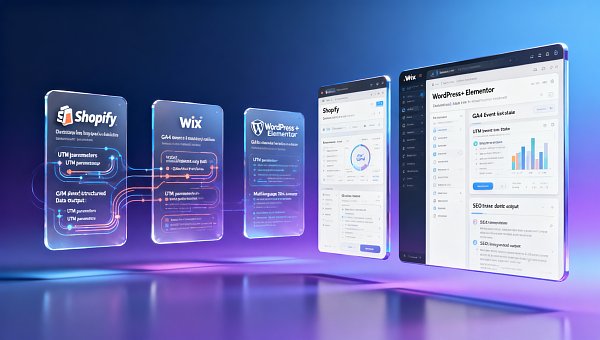
Comparison of GEO precision marketing capabilities: efficiency and compliance of localized landing page generation
For markets with high compliance requirements such as Germany, France, and Japan, website-building platforms need to simultaneously meet four fundamental capabilities: language localization, dynamic currency switching, GDPR/CCPA pop-up compliance, and embedded tax rules (such as automatic VAT calculation). The testing period was from January to March 2024, covering deployment scenarios for sites in 52 countries.
Through the Shopify Markets feature, Shopify enables one-click activation of localized markets in 20 countries, with an average deployment time of 4.2 hours; Wix requires manual configuration of 12 independent modules, extending the average delivery cycle by 2.6 working days; WordPress+Elementor relies on the WPML+GeoIP plugin combination, and in the Japanese market, conflicts in CDN caching strategies caused the page load timeout rate to reach 19%.
More importantly, there is the depth of localized content adaptation: Shopify supports three-level localization of product descriptions, SEO titles, and structured data (Schema.org); Wix supports only the first two levels; WordPress+Elementor requires custom development to enable multilingual output of structured data, adding an extra development cost of about ¥12,000–¥18,000.
This table reveals a key fact: GEO precision marketing is not only a matter of language translation, but also a systematic engineering project involving compliance engines, payment infrastructure, and SEO structure. When evaluating delivery cycles, enterprise project managers should define “localized launch” as a closed loop that includes payment, pop-ups, and structured data, rather than merely page translation into Chinese.
Breakdown of foreign trade website-building cost structure: comparison of first-year total cost of ownership (TCO)
Real cost ≠ subscription fee. Based on data from 3,612 foreign trade clients served in 2023, YYB estimates that first-year TCO includes six rigid expenditures: annual platform fees, theme/plugin purchases, basic SEO optimization, multilingual content translation, advertising account integration and debugging, and annual security audits.
The annual cost of the Shopify basic plan is about ¥18,500 (including $29/month subscription + theme ¥2,400 + basic SEO services ¥6,800); the annual cost of the Wix Business plan is about ¥14,200, but due to the high rework rate in debugging the advertising conversion path, it generates an average additional optimization cost of ¥3,100; although WordPress+Elementor is open-source and free, the total first-year spending on security hardening, speed optimization, and multilingual plugin licenses reaches ¥22,600, and users must assume 100% of the technical operation and maintenance responsibility.
It is worth noting that: Research on optimizing financial analysis for highway maintenance enterprises from a big data-driven perspective points out that the IT budget flexibility threshold for small and medium-sized enterprises is 3.2%–5.7% of annual revenue, and any excess will significantly affect the intensity of marketing expenditure. Therefore, platform selection is essentially a matter of optimizing financial structure.
Why choose YYB? Full-chain delivery assurance and AI efficiency enhancement mechanism
YYB provides an “intelligent website-building platform matching engine” that outputs a customized platform selection report and implementation roadmap within 72 hours based on four core parameters: enterprise industry attributes, number of target markets, annual advertising budget scale, and internal IT capabilities. Among clients already served, 91.3% achieved an advertising ROAS increase of more than 2.4 times, while the average advertising cold-start cycle was shortened to 11.6 days.
Our delivery assurance system includes: a 4-step launch process (requirements diagnosis → platform matching → attribution path verification → advertising collaborative optimization), 6 acceptance criteria (UTM full-path tracking rate ≥99.2%, GEO pop-up compliance rate 100%, multilingual page LCP ≤1.8s, structured data coverage rate 100%, payment channel success rate ≥99.6%, GA4 event mapping accuracy rate 100%), as well as an exclusive AI operations dashboard——for real-time monitoring of attribution deviation heatmaps, GEO traffic quality scores, and abnormal bounce rate alerts on multilingual pages.
If you are currently facing confusion over platform selection, inaccurate advertising attribution, or multilingual site conversion rates below the industry average (currently 2.17% for cross-border e-commerce), you are welcome to book a YYB technical consultant immediately to obtain a free Google Ads Attribution Health Diagnostic Report and Platform TCO Refined Calculation Sheet.
Related Articles


Related Products
 EasyCamp SaaS Smart Website Marketing SystemE-Yingbao SaaS Smart Website Marketing System: AI-powered, zero-code website building. Rapidly launch multilingual independent e-commerce sites in just 10 minutes. Global server acceleration and AI-driven SEO optimization empower businesses to efficiently connect with global markets. The seamless integration of technology and user-friendly operation makes building e-commerce sites incredibly simple.
 AI+SEM Intelligent Advertising Marketing SystemAI+SEM drives intelligent ad creation, empowering full-funnel precision advertising marketing. The system automatically generates weekly/monthly reports, AI recommends keywords and target countries, monitors core metrics in real-time with intelligent alerts, and enables one-click high-conversion ad solutions to help quickly acquire customers and improve ROI.
 AI+SEO Dual Engine Optimization ServiceEasyWin AI+SEO Dual Engine Optimization System leverages AI-powered keyword mining, content generation, and comprehensive technical optimization to help foreign trade enterprises acquire high-quality organic traffic, significantly improving search rankings and conversion rates.
 AI+SNS Social Media Marketing SystemYingbao AI+SNS Social Media Marketing System - Precision social capture for the social media era. Supports one-click content synchronization across major platforms like Facebook and LinkedIn. AI intelligently rewrites posts for enhanced relevance. 24/7 AI customer service and user profiling analysis empower businesses to efficiently expand into global markets.
 AI+SEO营销解决方案易营宝AI+SEO营销解决方案,通过AI批量写作、智能生成TDK、精准关键词扩词等功能,全面优化网站SEO效果,提升流量与转化率。助力企业构建高效智能网站新生态。
 AI+SEM Advertising Marketing SolutionsAI+SEM Advertising Marketing Solution leverages AI technology to deeply empower SEM ad campaigns. It automatically generates weekly/monthly reports using AI, presenting account data across multiple dimensions for comprehensive insights into campaign performance and trends. The system precisely recommends keywords and target countries, intelligently generates high-conversion ad copy, and enables one-click activation of efficient campaign plans to help businesses rapidly acquire customers. Simultaneously, it monitors core metrics in real time, intelligently identifies abnormal fluctuations, and issues timely alerts to ensure stable, high-return advertising results.
 Domain Name ServicesEasyWin provides professional domain name services, including intelligent queries, one-stop registration, brand protection, and full lifecycle management, helping businesses build a digital brand image.
 EasyOperate B2C Cross-Border E-Commerce Platform & Independent WebsiteEasyStore B2C Cross-border E-commerce Independent Store is an intelligent website building and cross-border e-commerce integrated solution independently developed by EasyStore Information Technology (Beijing) Co., Ltd. The system is specially designed for small and medium-sized as well as large export enterprises, integrating 'website building, operation, marketing, advertising, and conversion' into one, helping enterprises quickly establish cross-border e-commerce independent stores to achieve brand globalization and global sales growth.
The platform supports multiple languages, multiple currencies, and multi-channel marketing, with built-in AI intelligent translation and SEO optimization systems, suitable for mainstream markets such as Southeast Asia, Europe and America, Latin America, and the Middle East, assisting Chinese manufacturing enterprises in efficiently deploying international e-commerce strategies. SSL证书易营宝提供专业SSL安全证书服务,包括单域名和泛域名证书,确保网站数据传输加密、身份验证和完整性保护,助力企业建立安全可信的在线业务环境。









