









- How to view pricing in the global traffic ecosystem? Cost comparison of search, social media, and content channel advertisingJul 06, 2026View details
- How to assess foreign trade website development trends?Looking at 2026 changes from multilingual,AI content to conversion pathsJul 04, 2026View details
- What are the new trends in multilingual marketing data analytics tools in 2026? Focus on attribution、automation and complianceJul 04, 2026View details
- Is Brand Globalization Marketing Consulting Worth Buying? At What Stage Should Companies Bring It InJul 01, 2026View details
- Cross-Border Marketing Trend Research: Why More and More Companies Are Starting to Deploy AI Search and GEO OptimizationJun 30, 2026View details
- Cross-Border Marketing Trend Research: How Independent Sites, AI Content, and Short-Video Customer Acquisition Are ChangingJun 30, 2026View details
- How Can a Brand Updates Page Be Made More SEO-Friendly? Analysis of Update Frequency, Content Structure, and Internal Linking StrategyJun 28, 2026View details
- What stages does the cross-border services ecosystem include? How do website building, promotion, payment, and compliance work togetherJun 22, 2026View details
For ad campaign optimization, is it more effective to improve creatives first or refine audience targeting first
When ad campaign optimization hits a bottleneck, should you revise the creative first or adjust the audience first? Many practitioners want a single standard answer, but the truly effective way to judge is not to follow a “fixed order,” but to first see which layer the data is stuck at: is it that clicks are not coming in, or that clicks are not converting, or that conversion costs have suddenly surged. Only by locating the problem at the funnel stage can ad campaign optimization avoid repeated trial and error.
Conclusion first: in most cases, first determine which level the problem lies at, then decide whether to revise the creative first or adjust the audience first
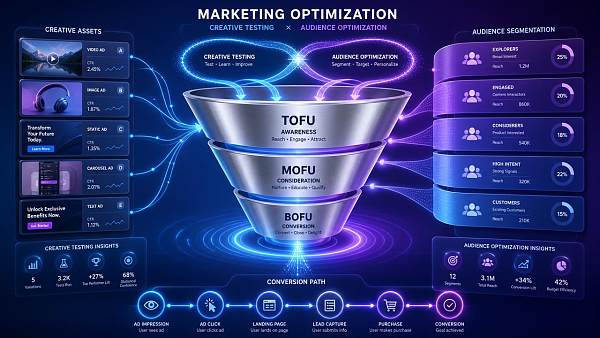
When users search for “ad campaign optimization,” their core intent is usually not to understand the concept, but to solve practical issues in active campaigns as quickly as possible, such as declining performance, costs going out of control, or unstable conversions. For execution teams, what they need most is not theory, but a practical decision-making sequence that can be implemented.
Simply put, if impressions are there but the click-through rate is low, usually review the creative first; if the click-through rate is acceptable but conversions are weak, first review the match between the landing page and the audience; if conversion costs keep rising, and frequency is high while the converting audience is getting exhausted, then audience and campaign structure should be prioritized for adjustment.
In other words, creative and audience are not in opposition, but affect different stages respectively. Which one to act on first depends on which segment of the data shows abnormalities first. Deciding “what to change first” without relying on data often lowers optimization efficiency and may even lead to misjudging the real problem.
The most common misconception among practitioners: attributing every problem to poor creatives
Once performance declines in many accounts, the team’s first reaction is to swap images, rewrite copy, or launch new videos. This is not entirely wrong, but if audience targeting has already seriously drifted off course, merely changing creatives can usually only improve clicks in the short term and is unlikely to truly improve conversion results.
Another common misconception is that as soon as the click-through rate drops, people immediately narrow the audience, trying to improve performance through “greater precision.” In reality, an overly narrow audience will limit system learning, increase frequency, and amplify cost fluctuations, ultimately pushing ad campaign optimization into a state where the more you adjust, the more expensive it becomes.
A truly mature optimization approach is to first break down the source of the problem: is the platform failing to deliver the ads to people willing to view them, is the ad content itself not attractive enough, or is the landing page inconsistent with the promise made by the ad. Different problems require completely different action sequences.
Three typical situations where you should revise the creative first
The first situation is when impressions are normal, but the click-through rate remains consistently low. This indicates that the platform has already provided a certain amount of exposure opportunities, but users are not persuaded by the content. At this point, the problem is mostly in the above-the-fold visual, the value point in the headline, the way the selling point is expressed, or an unclear call to action, so revising the creative first is more direct.
The second situation is the cold start phase of a new account. At this time, the platform has not yet fully identified high-quality audiences, and adjusting audiences too frequently too early can easily interfere with model learning. In comparison, first using multiple creative versions to test platform feedback makes it easier to quickly identify highly engaging assets and build a foundation for later scaling.
The third situation is when different audience segments all show similarly low click performance. This suggests that the problem is likely not the audience itself, but that the content lacks appeal across multiple groups. At this point, focus should be placed on testing value propositions, scenario-based messaging, the first 3 seconds of the video, headline hooks, and proof elements.
In execution, it is recommended to change only one core variable at a time, such as the main visual, opening copy, promotional offer wording, or CTA, rather than overturning everything at once. This makes it easier to know exactly which factor affected clicks and engagement, and avoids the situation of “changing a lot, but not knowing which change actually worked.”
Three typical situations where you should adjust the audience first
The first situation is when the click-through rate is not low, but the conversion rate is clearly weak. This means users are willing to click in, but they do not generate inquiries, registrations, or orders. In this case, the creative may simply be “attracting the wrong people,” so you need to go back and review targeting conditions, regions, interests, job-related tags, and the quality of lookalike audiences.
The second situation is when ad frequency continues to rise, and conversion costs increase at the same time. Especially when the creatives have not shown obvious fatigue, the issue is often not creative fatigue, but rather audience pools being overconsumed. At this point, you should expand the audience, separate high- and low-intent layers, or introduce new cold-start audience segments.
The third situation is when different creatives do not show large data differences, but certain audience segments consistently perform more steadily. This indicates that the system has already formed a relatively clear understanding of a specific audience. In this case, prioritizing optimization of audience structure, budget allocation, and exclusion logic will usually improve overall efficiency more than continuing to make major creative changes.
For B2B, foreign trade, or high-ticket businesses, audience adjustment is especially critical. Because these conversion journeys are long, the truly valuable people are not those who click the most, but those who have purchase intent, industry fit, and decision-making authority. Focusing only on clicks can easily cause the budget to be spent on low-quality traffic.
The most practical judgment method: decide the optimization sequence based on funnel data
If you want ad campaign optimization to be more stable, you can fix the decision sequence into four steps: first look at impressions, then clicks, then arrival, then conversions. Each step corresponds to different problems, and also determines whether you should act on the creative first, the audience first, or first check the page and tracking setup.
If impressions are low, first check bids, budget, learning status, and audience scope; if impressions are normal but clicks are low, prioritize revising the creative; if clicks are decent but on-page stay is poor, prioritize checking landing page continuity; if on-page stay is normal but conversions are weak, then review audience quality, the conversion path, and form design.
If it is a lead generation campaign, you also need to additionally look at lead quality. Because in some accounts, the cost per lead appears very low on the surface, but sales follow-up reveals that the invalid share is very high. In this case, you cannot simply conclude that the creative is effective; often the audience is too broad or the asset promise is overstated, attracting a large number of low-intent users.
At the execution level, it is best to establish a fixed weekly report template, placing CTR, CPC, CVR, CPA, frequency, landing page dwell time, and lead validity rate in the same table. This will help you more quickly identify whether the problem occurs before the click or after the click, instead of making decisions based on intuition.
How creative and audience should work together to avoid repeated trial and error
Efficient optimization is not about changing creatives today and cutting audiences tomorrow, but about making the two work as a set. Creative is responsible for increasing the probability of “wanting to click,” while audience is responsible for increasing the probability of “being willing to convert after clicking in.” The two have different roles, and their pacing should also be different.
A more reliable approach is to first use 2 to 3 core audience groups paired with 3 to 5 clearly differentiated creatives, and observe the first round of data. After confirming which type of asset drives clicks more effectively, continue refining the audience based on the effective assets. This reduces variable overlap and improves judgment accuracy.
If you manage multiple platforms at the same time, coordination between creative and audience becomes more complex. User behavior differs greatly across platforms, and the same piece of content may not necessarily work everywhere. Tools such as AI+SNS All-in-One Social Media Marketing System are suitable for multi-platform content adaptation, automated testing, and user profile analysis, helping practitioners more quickly identify whether the issue lies in the assets or the audience.
Especially in overseas promotion scenarios, platform formats, language expression, and audience characteristics differ significantly. By using AI to generate multilingual posts, automatically adapt to platform rules, and then combining professional profiles and engagement behavior for more precise audience identification, it is often possible to reduce situations where “the asset looks good, but the campaign still fails to deliver results.”
When ad campaign optimization gets stuck, it is recommended to troubleshoot in this order
First, confirm whether the data is sufficient to support a judgment. If the sample size is too small, the learning phase is unfinished, holiday fluctuations occur, or the budget changes suddenly, you may reach the wrong conclusion too early. Without sufficient data support, frequently changing creatives or audiences may disrupt the original rhythm.
Second, check which layer the abnormality belongs to among the core metrics. If CTR is weak, review the creative; if CVR is weak, review the audience and page; if CPA rises, review the overall structure; if lead quality is poor, review whether the audience and messaging promise are aligned. Do not use a single metric to determine the entire optimization direction.
Third, make small, fast adjustments instead of major changes all at once. Adjust one key variable at a time, and give the system the necessary learning time. Especially in an environment where automated advertising is becoming increasingly common, excessive manual intervention will make it difficult for the system to accumulate effective feedback.
Fourth, clearly define what “effective” means. For practitioners, success is not simply achieving a higher click-through rate, nor is optimization complete just because the number of form submissions has been increased. Truly effective ad campaign optimization means obtaining more stable and more likely-to-close conversion results within a reasonable budget.
Summary: it is not about revising the creative first or adjusting the audience first, but about first finding which layer the problem lies in
Returning to the original question, is it more effective to revise the creative first or adjust the audience first? The answer is: look at funnel data, not personal habit. If clicks are not coming in, in most cases revise the creative first; if clicks are there but conversions are weak, in most cases review the audience and follow-through first; if frequency is high and costs are rising, then prioritize adjusting the audience structure.
For frontline practitioners, the most important thing is not memorizing conclusions, but establishing a stable diagnostic framework. Only by clearly locating the problem can ad campaign optimization shift from “trial and error based on experience” to “efficiency improvement driven by data.” When you know which layer the problem occurs in, your optimization actions will naturally become more effective.
Related Articles



Related Products
 EasyCamp SaaS Smart Website Marketing SystemE-Yingbao SaaS Smart Website Marketing System: AI-powered, zero-code website building. Rapidly launch multilingual independent e-commerce sites in just 10 minutes. Global server acceleration and AI-driven SEO optimization empower businesses to efficiently connect with global markets. The seamless integration of technology and user-friendly operation makes building e-commerce sites incredibly simple.
 AI+SEM Intelligent Advertising Marketing SystemAI+SEM drives intelligent ad creation, empowering full-funnel precision advertising marketing. The system automatically generates weekly/monthly reports, AI recommends keywords and target countries, monitors core metrics in real-time with intelligent alerts, and enables one-click high-conversion ad solutions to help quickly acquire customers and improve ROI.
 AI+SEO Dual Engine Optimization ServiceEasyWin AI+SEO Dual Engine Optimization System leverages AI-powered keyword mining, content generation, and comprehensive technical optimization to help foreign trade enterprises acquire high-quality organic traffic, significantly improving search rankings and conversion rates.
 AI+SNS Social Media Marketing SystemYingbao AI+SNS Social Media Marketing System - Precision social capture for the social media era. Supports one-click content synchronization across major platforms like Facebook and LinkedIn. AI intelligently rewrites posts for enhanced relevance. 24/7 AI customer service and user profiling analysis empower businesses to efficiently expand into global markets.
 AI+SEO营销解决方案易营宝AI+SEO营销解决方案,通过AI批量写作、智能生成TDK、精准关键词扩词等功能,全面优化网站SEO效果,提升流量与转化率。助力企业构建高效智能网站新生态。
 AI+SEM Advertising Marketing SolutionsAI+SEM Advertising Marketing Solution leverages AI technology to deeply empower SEM ad campaigns. It automatically generates weekly/monthly reports using AI, presenting account data across multiple dimensions for comprehensive insights into campaign performance and trends. The system precisely recommends keywords and target countries, intelligently generates high-conversion ad copy, and enables one-click activation of efficient campaign plans to help businesses rapidly acquire customers. Simultaneously, it monitors core metrics in real time, intelligently identifies abnormal fluctuations, and issues timely alerts to ensure stable, high-return advertising results.
 Domain Name ServicesEasyWin provides professional domain name services, including intelligent queries, one-stop registration, brand protection, and full lifecycle management, helping businesses build a digital brand image.
 EasyOperate B2C Cross-Border E-Commerce Platform & Independent WebsiteEasyStore B2C Cross-border E-commerce Independent Store is an intelligent website building and cross-border e-commerce integrated solution independently developed by EasyStore Information Technology (Beijing) Co., Ltd. The system is specially designed for small and medium-sized as well as large export enterprises, integrating 'website building, operation, marketing, advertising, and conversion' into one, helping enterprises quickly establish cross-border e-commerce independent stores to achieve brand globalization and global sales growth.
The platform supports multiple languages, multiple currencies, and multi-channel marketing, with built-in AI intelligent translation and SEO optimization systems, suitable for mainstream markets such as Southeast Asia, Europe and America, Latin America, and the Middle East, assisting Chinese manufacturing enterprises in efficiently deploying international e-commerce strategies. SSL证书易营宝提供专业SSL安全证书服务,包括单域名和泛域名证书,确保网站数据传输加密、身份验证和完整性保护,助力企业建立安全可信的在线业务环境。









