









- What Does a Global Traffic Ecosystem Service Provider Do? What Are the Differences from a Single Advertising AgencyJul 16, 2026View details
- What should you focus on in the latest enterprise SaaS report? From renewal rates and delivery costs to overseas growth opportunitiesJul 12, 2026View details
- What signals are worth paying attention to in a cross-border marketing trend report? B2B companies should look at these 6 signalsJul 11, 2026View details
- How to Read a Cross-Border Marketing Trends Report? Five Key Dimensions for Evaluating Channel OpportunitiesJul 11, 2026View details
- Which channel has the highest ROI in the global traffic ecosystem? Comparative analysis of search, social media, and advertisingJul 10, 2026View details
- What multilingual website services are available in Sanya? Which model is more suitable for local businesses going global?Jul 08, 2026View details
- How to view the complete list of China SaaS companies in the top 100? Practical methods for screening website-building and marketing service providersJul 08, 2026View details
- How to view pricing in the global traffic ecosystem? Cost comparison of search, social media, and content channel advertisingJul 06, 2026View details
Factory Export Marketing: The Transition Cycle for B2B Leads from Google Ads to Organic Traffic
Factory foreign trade marketing is quietly undergoing a structural transformation: the path that previously relied on Google Ads to quickly acquire B2B inquiries is being replaced by a more resilient organic traffic growth logic with stronger compounding effects. This is not a simple channel switch, but a paradigm upgrade from “paid customer acquisition” to “asset accumulation”—companies are truly beginning to operate their independent websites as digital assets with accumulable, iterable, and scalable value. The length and quality of this transition period directly determine a factory’s long-term voice and risk resistance in overseas markets.
What is a real transition period?
The transition period is not a measure of time, but a rhythm of capability evolution. It begins when a website is no longer viewed merely as an advertising landing page, and ends when an organic traffic ecosystem jointly driven by content, structure, technology, and user behavior takes shape. Industry data shows that mature manufacturing B2B independent websites usually need 6–12 months to reach a key inflection point: the share of organic search traffic increases from less than 20% to a stable level of over 50%, while the customer acquisition cost per inquiry decreases by more than 35%.
This process does not progress linearly. The early stage (1–3 months) focuses on foundational construction: compliance of multilingual site architecture, semantic restructuring of core product pages, and GEO-localized keyword coverage; the mid-stage (4–8 months) enters the phase of content deepening and trust building, such as industry solution white papers, production line visualization videos, and in-depth analysis of customer cases; the later stage (from 9 months onward) is reflected in a positive feedback loop from algorithms—longer dwell time drives page ratings, high-quality backlinks strengthen authority, and AI search interfaces gradually recognize and prioritize the display of professional content.
Why must this transition start now?
Three practical pressures are accelerating the narrowing of the decision window. First, Google Ads CPC continues to rise, and the cost per click in the North American market for hardware and machinery categories has already exceeded $8, while conversion rates are declining year by year due to ad fatigue; second, the decision-making journey of overseas buyers has become significantly longer, with an average of 5.2 touchpoints needed before an inquiry is initiated, making pure ad exposure insufficient to support full trust building; third, AI search engines (such as Perplexity, Google SGE) are reshaping how information is obtained—they are more inclined to cite independent website content with clear structure, rich semantics, and contextual relevance, rather than ad snippets.
For industrial manufacturing companies, this is not only a cost issue, but also a matter of visibility sovereignty. When potential customers search for “CNC-machined stainless steel fasteners for automotive OEMs”, whether you can appear in the top three depends on whether your website has the ability to express expertise in a way that AI can understand, rather than on bid ranking.
Key execution supports for factory foreign trade marketing
Whether the transition succeeds depends on whether three irreplaceable supports are grasped:
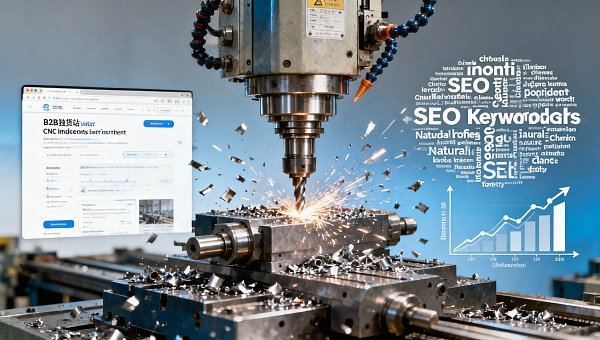
- Visual presentation of technical credibility—not a list of parameters, but restoring machining precision through macro photography and dynamic particle effects, and using production line videos to verify flexible delivery capabilities;
- Deep binding to industry scenarios—not broadly talking about “reliable quality”, but focusing on “how to provide webpage-level responses to medical device manufacturers’ batch traceability requirements under ISO 13485”;
- Silent optimization of the conversion path—embedding technical selection guidance logic into the inquiry form, so that customers complete preliminary matching while filling in requirements, reducing communication trial-and-error costs.
Among the tens of thousands of companies served by EasyBiz, factory clients using the AI+SEO/GEO optimization system have shortened the average indexing cycle of their core product pages to 11 days, with a first-year compound growth rate of 67% in organic traffic. This efficiency comes from unified modeling of website building, content, SEO, and localization strategies within the underlying system—for example, when a client deploys a precision machining, hardware fasteners product center, the system automatically generates multilingual Schema markup, GEO-adapted HREFLANG tags, and an industry terminology semantic graph in sync, avoiding signal attenuation caused by manually fragmented operations.
How to determine whether the transition has entered a healthy track?
Skip vanity metrics and focus on four hard signals:
Next step: move from evaluation to structured action
There is no need to wait for a perfect solution. It is recommended to use three months as a unit to complete one lightweight closed-loop validation: select 1–2 flagship products, complete semantic restructuring and GEO-localized deployment for technical parameter pages, and simultaneously launch 3 short pieces of content addressing typical procurement pain points (such as “How to verify the authenticity of fastener salt spray test reports”), then monitor the growth of organic traffic and changes in inquiry quality. Data will provide direction faster than experience.
EasyBiz’s AI+SEO/GEO optimization system is designed precisely for this kind of gradual upgrade—it does not assume that companies already have a complete team, but instead encapsulates the strategic accumulation from ten years of serving 100,000+ foreign trade companies into modular capabilities that are configurable, measurable, and traceable. When factory foreign trade marketing enters deep waters, what is truly scarce is no longer traffic, but the underlying operational logic that enables traffic to continue accumulating and amplifying through compounding.
Related Articles

Related Products
 EasyCamp SaaS Smart Website Marketing SystemE-Yingbao SaaS Smart Website Marketing System: AI-powered, zero-code website building. Rapidly launch multilingual independent e-commerce sites in just 10 minutes. Global server acceleration and AI-driven SEO optimization empower businesses to efficiently connect with global markets. The seamless integration of technology and user-friendly operation makes building e-commerce sites incredibly simple.
 AI+SEM Intelligent Advertising Marketing SystemAI+SEM drives intelligent ad creation, empowering full-funnel precision advertising marketing. The system automatically generates weekly/monthly reports, AI recommends keywords and target countries, monitors core metrics in real-time with intelligent alerts, and enables one-click high-conversion ad solutions to help quickly acquire customers and improve ROI.
 AI+SEO Dual Engine Optimization ServiceEasyWin AI+SEO Dual Engine Optimization System leverages AI-powered keyword mining, content generation, and comprehensive technical optimization to help foreign trade enterprises acquire high-quality organic traffic, significantly improving search rankings and conversion rates.
 AI+SNS Social Media Marketing SystemYingbao AI+SNS Social Media Marketing System - Precision social capture for the social media era. Supports one-click content synchronization across major platforms like Facebook and LinkedIn. AI intelligently rewrites posts for enhanced relevance. 24/7 AI customer service and user profiling analysis empower businesses to efficiently expand into global markets.
 AI+SEO营销解决方案易营宝AI+SEO营销解决方案,通过AI批量写作、智能生成TDK、精准关键词扩词等功能,全面优化网站SEO效果,提升流量与转化率。助力企业构建高效智能网站新生态。
 AI+SEM Advertising Marketing SolutionsAI+SEM Advertising Marketing Solution leverages AI technology to deeply empower SEM ad campaigns. It automatically generates weekly/monthly reports using AI, presenting account data across multiple dimensions for comprehensive insights into campaign performance and trends. The system precisely recommends keywords and target countries, intelligently generates high-conversion ad copy, and enables one-click activation of efficient campaign plans to help businesses rapidly acquire customers. Simultaneously, it monitors core metrics in real time, intelligently identifies abnormal fluctuations, and issues timely alerts to ensure stable, high-return advertising results.
 Domain Name ServicesEasyWin provides professional domain name services, including intelligent queries, one-stop registration, brand protection, and full lifecycle management, helping businesses build a digital brand image.
 EasyOperate B2C Cross-Border E-Commerce Platform & Independent WebsiteEasyStore B2C Cross-border E-commerce Independent Store is an intelligent website building and cross-border e-commerce integrated solution independently developed by EasyStore Information Technology (Beijing) Co., Ltd. The system is specially designed for small and medium-sized as well as large export enterprises, integrating 'website building, operation, marketing, advertising, and conversion' into one, helping enterprises quickly establish cross-border e-commerce independent stores to achieve brand globalization and global sales growth.
The platform supports multiple languages, multiple currencies, and multi-channel marketing, with built-in AI intelligent translation and SEO optimization systems, suitable for mainstream markets such as Southeast Asia, Europe and America, Latin America, and the Middle East, assisting Chinese manufacturing enterprises in efficiently deploying international e-commerce strategies. SSL证书易营宝提供专业SSL安全证书服务,包括单域名和泛域名证书,确保网站数据传输加密、身份验证和完整性保护,助力企业建立安全可信的在线业务环境。









