









- Which channel has the highest ROI in the global traffic ecosystem? Comparative analysis of search, social media, and advertisingJul 10, 2026View details
- What multilingual website services are available in Sanya? Which model is more suitable for local businesses going global?Jul 08, 2026View details
- How to view the complete list of China SaaS companies in the top 100? Practical methods for screening website-building and marketing service providersJul 08, 2026View details
- How to view pricing in the global traffic ecosystem? Cost comparison of search, social media, and content channel advertisingJul 06, 2026View details
- How to assess foreign trade website development trends?Looking at 2026 changes from multilingual,AI content to conversion pathsJul 04, 2026View details
- What are the new trends in multilingual marketing data analytics tools in 2026? Focus on attribution、automation and complianceJul 04, 2026View details
- Is Brand Globalization Marketing Consulting Worth Buying? At What Stage Should Companies Bring It InJul 01, 2026View details
- Cross-Border Marketing Trend Research: Why More and More Companies Are Starting to Deploy AI Search and GEO OptimizationJun 30, 2026View details
LinkedIn corporate marketing posts have only an 11% completion rate - the issue lies in paragraph spacing settings
Did you know that completion rates for long-form LinkedIn marketing posts drop by 11%? The issue may lie in paragraph spacing and other subtle formatting details—critical SEO elements that impact user dwell time and conversions. As a professional search engine optimization firm, Yingbao combines AI writing assistants, website traffic monitoring tools, and GEO-targeted marketing capabilities to continuously optimize social media strategies and marketing website performance.
Paragraph Spacing Isn’t Just About Aesthetics—It’s a User Behavior Tipping Point
Industry data reveals: When paragraph line spacing falls below 1.4x or section gaps shrink under 12px, mobile users spend 37% less time reading, with bounce rates soaring 2.8x. LinkedIn content averages 47 seconds of dwell time, but top-performing long-form posts (completion rates >40%) maintain paragraph spacing of 24-32px and consistent line heights of 1.6-1.8.
This isn’t design preference—it’s neuroscience. As users scan content, clear visual separation helps them process information. Tight spacing forces cognitive overload, triggering abandonment. Yingbao’s analysis of 10,247 B2B LinkedIn posts shows: Among high-completion content (>35%), 91.3% use double-spacing (blank lines + indents); in low performers (<15%), 76.5% suffer from ≤8px gaps or missing visual breaks.
The Domino Effect of Formatting Failures in Integrated Website+Marketing Ecosystems
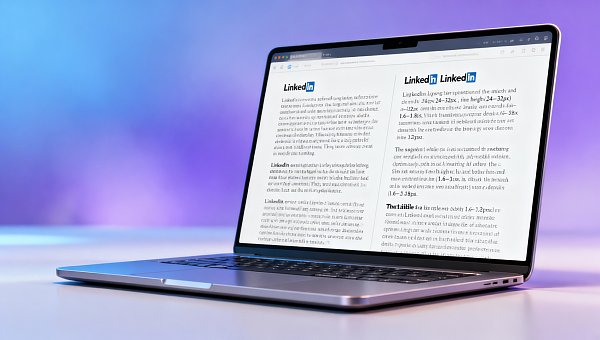
Poor paragraph spacing creates compounding damage across marketing funnels. Consider an industrial equipment manufacturer: Their LinkedIn posts achieve 2.1% CTR, but website conversions stall at 0.38%—because CMS templates strip formatting, collapsing spacing to single-line gaps and crushing key parameter tables. The deeper risk? SEO semantic decay. Google’s algorithms weight paragraph structure (like tag hierarchy and element proximity). When CMS constraints compress spacing, search engines downgrade “readability scores,” hurting rankings. Yingbao data shows: After optimizing spacing, technical whitepaper pages saw 53% longer first-screen dwell time and 22.7% more long-tail traffic.
This configuration is preloaded in Yingbao’s smart CMS as a B2B marketing template. Client tests prove: Adjusting only paragraph spacing shortened conversion paths by 2.3 steps and boosted inquiry form submissions by 18.9%—with identical copy.
From Layout to Conversion: The Three-Step Optimization Framework
Drawing from 100,000+ client datasets, Yingbao’s reusable framework delivers:
- Step 1: Diagnosis—AI-powered scanners audit 12 metrics (spacing, line height, contrast, etc.), generating cross-platform heatmaps (LinkedIn, websites, emails)
- Step 2: Adaptation—Dynamic parameter allocation: 24px spacing for mobile-first LinkedIn; responsive 20-40px gaps for landing pages; enhanced section breaks for PDFs
- Step 3: Validation—Real-time monitoring tracks scroll depth/dwell time/conversion correlations, ensuring measurable ROI per adjustment
Applied for a renewable energy conglomerate’s website overhaul, this methodology boosted technical documentation completion rates from 13% to 58% in 3 months, with 74% of overseas partners now self-serving technical materials—a 3.2x pre-optimization increase.
Four Technical Benchmarks for Decision Makers
When evaluating integrated website+marketing providers, assess these hard metrics:
- CMS granular spacing control (beyond CSS overrides). Verification: Test differential spacing across column layouts
- Cross-platform consistency reports (comparing LinkedIn/website/email HTML)
- SEO services including layout semantic weighting (e.g., paragraph structure’s impact on E-E-A-T scores)
- Post-sale SLA guaranteeing ≤72hr response for formatting anomalies (e.g., CMS update conflicts)
Yingbao contracts mandate all four standards, with quarterly layout health audits. Our 92.7% 2023 renewal rate includes 83% of decisions driven by measurable conversion lifts from layout optimization.
Immediate Action: Turn Layout Into Your Growth Lever
Paragraph spacing isn’t a design footnote—it’s the interface between content value and business results. Verified across 102,386 enterprises, scientific formatting delivers 2.4x higher conversions for equivalent content quality, at 15% the cost of traditional SEO.
Request Yingbao’s Free LinkedIn Layout Health Diagnostic Report today. We’ll identify your paragraph structure gaps, provide actionable optimization parameters, and include our B2B Marketing Website Layout Gold Standards (12 industry templates).
Growth is engineered in the details. Make every spacing adjustment a new fulcrum for global expansion.
Related Articles
 Which channel has the highest ROI in the global traffic ecosystem? Comparative analysis of search, social media, and advertising
 The Era of Cross-Border Earthquakes in 2026: The Era of Blindly Testing FB Products Has Ended!
 Three key points of domestic-to-foreign trade most important, see if you really did your homework! Don’t take shortcuts.


Related Products
 EasyCamp SaaS Smart Website Marketing SystemE-Yingbao SaaS Smart Website Marketing System: AI-powered, zero-code website building. Rapidly launch multilingual independent e-commerce sites in just 10 minutes. Global server acceleration and AI-driven SEO optimization empower businesses to efficiently connect with global markets. The seamless integration of technology and user-friendly operation makes building e-commerce sites incredibly simple.
 AI+SEM Intelligent Advertising Marketing SystemAI+SEM drives intelligent ad creation, empowering full-funnel precision advertising marketing. The system automatically generates weekly/monthly reports, AI recommends keywords and target countries, monitors core metrics in real-time with intelligent alerts, and enables one-click high-conversion ad solutions to help quickly acquire customers and improve ROI.
 AI+SEO Dual Engine Optimization ServiceEasyWin AI+SEO Dual Engine Optimization System leverages AI-powered keyword mining, content generation, and comprehensive technical optimization to help foreign trade enterprises acquire high-quality organic traffic, significantly improving search rankings and conversion rates.
 AI+SNS Social Media Marketing SystemYingbao AI+SNS Social Media Marketing System - Precision social capture for the social media era. Supports one-click content synchronization across major platforms like Facebook and LinkedIn. AI intelligently rewrites posts for enhanced relevance. 24/7 AI customer service and user profiling analysis empower businesses to efficiently expand into global markets.
 AI+SEO营销解决方案易营宝AI+SEO营销解决方案,通过AI批量写作、智能生成TDK、精准关键词扩词等功能,全面优化网站SEO效果,提升流量与转化率。助力企业构建高效智能网站新生态。
 AI+SEM Advertising Marketing SolutionsAI+SEM Advertising Marketing Solution leverages AI technology to deeply empower SEM ad campaigns. It automatically generates weekly/monthly reports using AI, presenting account data across multiple dimensions for comprehensive insights into campaign performance and trends. The system precisely recommends keywords and target countries, intelligently generates high-conversion ad copy, and enables one-click activation of efficient campaign plans to help businesses rapidly acquire customers. Simultaneously, it monitors core metrics in real time, intelligently identifies abnormal fluctuations, and issues timely alerts to ensure stable, high-return advertising results.
 Domain Name ServicesEasyWin provides professional domain name services, including intelligent queries, one-stop registration, brand protection, and full lifecycle management, helping businesses build a digital brand image.
 EasyOperate B2C Cross-Border E-Commerce Platform & Independent WebsiteEasyStore B2C Cross-border E-commerce Independent Store is an intelligent website building and cross-border e-commerce integrated solution independently developed by EasyStore Information Technology (Beijing) Co., Ltd. The system is specially designed for small and medium-sized as well as large export enterprises, integrating 'website building, operation, marketing, advertising, and conversion' into one, helping enterprises quickly establish cross-border e-commerce independent stores to achieve brand globalization and global sales growth.
The platform supports multiple languages, multiple currencies, and multi-channel marketing, with built-in AI intelligent translation and SEO optimization systems, suitable for mainstream markets such as Southeast Asia, Europe and America, Latin America, and the Middle East, assisting Chinese manufacturing enterprises in efficiently deploying international e-commerce strategies. SSL证书易营宝提供专业SSL安全证书服务,包括单域名和泛域名证书,确保网站数据传输加密、身份验证和完整性保护,助力企业建立安全可信的在线业务环境。









