









- What multilingual website services are available in Sanya? Which model is more suitable for local businesses going global?Jul 08, 2026View details
- How to view the complete list of China SaaS companies in the top 100? Practical methods for screening website-building and marketing service providersJul 08, 2026View details
- How to view pricing in the global traffic ecosystem? Cost comparison of search, social media, and content channel advertisingJul 06, 2026View details
- How to assess foreign trade website development trends?Looking at 2026 changes from multilingual,AI content to conversion pathsJul 04, 2026View details
- What are the new trends in multilingual marketing data analytics tools in 2026? Focus on attribution、automation and complianceJul 04, 2026View details
- Is Brand Globalization Marketing Consulting Worth Buying? At What Stage Should Companies Bring It InJul 01, 2026View details
- Cross-Border Marketing Trend Research: Why More and More Companies Are Starting to Deploy AI Search and GEO OptimizationJun 30, 2026View details
- Cross-Border Marketing Trend Research: How Independent Sites, AI Content, and Short-Video Customer Acquisition Are ChangingJun 30, 2026View details
How to Avoid Low-Quality Leads in Facebook Marketing Strategy
At a time when customer acquisition costs continue to rise, scientifically developing a Facebook marketing strategy has become key to reducing low-quality inquiries and improving conversion efficiency. For frontline operators, precise targeting, content filtering, and lead management are all indispensable.
First identify the core issue: low-quality inquiries are often not caused by “too little traffic”, but by “inaccurate traffic”
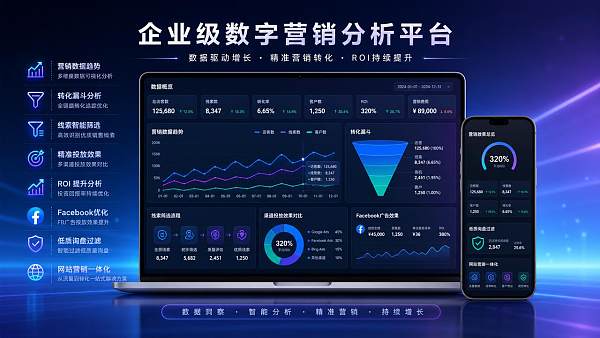
When executing a Facebook marketing strategy, the most common mistake many operators make is not that they fail to spend the budget, but that they spend it on the wrong audience and the wrong conversion path, ultimately resulting in a large number of ineffective direct messages, blank forms, and inquiries with no purchase intent.
When users search for “how to avoid low-quality inquiries in a Facebook marketing strategy”, their core intent is not to read a basic introduction to the platform, but to find methods that can be directly implemented: how to screen audiences, how to control volume, how to improve lead authenticity, and how to make sales willing to follow up on these leads.
For execution teams, there are usually four main concerns: why ads attract inaccurate audiences, where the landing page is going wrong, how the form should be designed to filter out invalid users, and how to determine through data which ad set should be stopped.
Therefore, the focus of this article should not remain on vague suggestions such as “post more content” and “keep optimizing”, but should center on five key stages: audience targeting, creative design, conversion path, form filtering, and lead grading, to help you truly reduce low-quality inquiries.
Why Facebook ads easily generate low-quality inquiries
The emergence of low-quality inquiries is usually not caused by a single factor, but by distortions occurring simultaneously across multiple stages. Especially on interest-based recommendation platforms like Facebook, even a slight deviation in setup can quickly cause the system to push the budget toward traffic that is “cheap but inaccurate.”
The first type of problem is overly broad targeting. Many accounts, in pursuit of lower form costs, habitually set age, region, and interests too broadly. Although this may increase the apparent volume of leads, the people entering the form do not necessarily match the actual customer profile.
The second type of problem is overly generic creative messaging. If the ad copy only emphasizes “free consultation” and “get a quote now” without clearly defining the product threshold, applicable industries, and cooperation model, it will easily attract a group of people who just want to learn more but do not have the conditions to make a purchase.
The third type of problem lies in the conversion path. If there is no screening mechanism between the user clicking the ad and submitting their information, a large amount of low-intent traffic will be able to submit information easily. The simpler the form, the larger the lead volume may be, but the sales quality is often worse.
The fourth type of problem is the lack of backend feedback. Many teams only look at front-end form costs and do not feed back deal quality or distinguish between high-quality and low-quality leads. Over time, the ad system continues learning from the wrong samples, causing low-quality inquiries to increase more and more.
Step 1: break down the “ideal customer profile” into actionable targeting criteria
A truly effective Facebook marketing strategy is not about choosing interest tags by intuition, but about making the customer profile specific. In practice, it is recommended to break it down across five dimensions: country/region, job attributes, industry characteristics, company size, and procurement stage.
If you serve business customers, do not stop at “interested in marketing.” A more effective approach is to layer professional identity, business scenarios, and behavioral signals, such as whether they follow business tools, whether they frequently visit industry websites, and whether they have management responsibilities.
In overseas campaigns, regional segmentation is especially important. Different countries have different purchasing habits, form acceptance levels, and inquiry languages. Mixing multiple markets into the same ad set often masks the real data and makes the source of low-quality inquiries impossible to identify.
It is recommended that execution teams build both “high-potential audience segments” and “exclusion audience segments.” The former is used to lock in combinations of interests and behaviors closer to converting users, while the latter is used to exclude job seekers, students, peers, low-relevance regions, and people who frequently browse free materials.
If the company is running both search ads and social media ads, cross-channel data can also be used to reverse-engineer the targeting logic. For example, identify which combinations of countries, keywords, and landing pages have higher conversion rates, and then use these results for Facebook audience segmentation to get closer to real business opportunities.
In terms of multi-channel coordination, some teams integrate AI+SEM smart ad bidding marketing system to reverse-calibrate audience strategies with keyword and regional performance, reducing deviations caused by relying purely on experience.
Step 2: use ad content to proactively “dissuade” unsuitable people
Many people mistakenly think the task of ad creatives is only to improve click-through rates, but when it comes to avoiding low-quality inquiries, the more important role of creatives is actually screening. Good content is not about attracting everyone, but about keeping the right people and letting the wrong people leave automatically.
The most direct method is to clearly define business boundaries in the ad. For example, if you serve enterprise-level customers, you should clearly state that it is suitable for B2B companies, cross-border brands, or long-term advertising teams, rather than vaguely writing “suitable for all overseas businesses.”
If the product or service has a minimum investment threshold, language requirements, or regional restrictions, these should also be stated as early as possible. Many low-quality inquiries are not malicious; users simply do not know whether they are suitable. The more vague your messaging is, the more ineffective communication you will face later.
In terms of copy structure, it is better to prioritize a format of “who it is for, what problem it solves, and how to get started” rather than endlessly emphasizing discounts. An overly promotion-oriented approach tends to attract price-sensitive users, but not necessarily customers who truly value delivery quality.
In terms of creative format, case-based materials are usually better than slogan-based materials at filtering traffic. This is because cases naturally reveal the industry, budget, cycle, and goals, so only people who are genuinely interested in similar scenarios are more likely to continue clicking and submitting inquiries.
Step 3: don’t let the form only collect information; it also needs to perform a screening function
Many low-quality Facebook inquiries stem from form design that excessively pursues a “low threshold.” Submitting with just three fields—name, email, and phone—may appear to improve the conversion rate, but in reality it shifts all the backend screening pressure onto the sales team.
A more reasonable approach is to add a small number of key questions so users complete an initial self-screening before submitting. For example, country, company type, demand type, expected cooperation timeline, and monthly budget range—these questions can significantly improve lead evaluability.
However, note that more questions are not always better. For execution teams, the optimal state is to retain the most critical business judgment fields without significantly lowering the submission rate. Usually, 3 to 5 high-value questions are enough to filter out a large number of invalid inquiries.
If your business requires higher-quality leads, you can change “submit now” to “apply for an evaluation” or “schedule a solution consultation.” This type of wording reduces impulsive submissions from purely curious users while increasing the conversion intent of users with genuine and clear needs.
The same applies to landing pages. Do not only describe advantages; also explain applicable conditions, cooperation methods, and common unsuitable scenarios. Setting expectations clearly is more time-saving than repeatedly explaining afterward, especially for frontline media buying teams handling a large lead volume.
Step 4: establish a lead grading mechanism, otherwise ad optimization will always stay superficial
Avoiding low-quality inquiries cannot rely only on front-end media buying. Even if targeting and creatives are well done, without lead grading and sales feedback, the system still cannot know which inquiries truly have value, and subsequent optimization will lose direction.
It is recommended to divide leads into at least three categories: invalid leads, follow-up leads, and high-intent leads. Invalid leads include empty numbers, non-target regions, personal needs, or users completely outside the scope of the business; high-intent leads should have clear needs and the conditions to move forward.
When you can continuously record the lead grade brought by different ad sets, you will find that some ads have very low apparent costs but an extremely poor share of high-intent leads; while some ads, although more expensive per lead, are more likely to convert into real customers.
At this point, the optimization basis is no longer just CPL, but “effective lead cost” and “high-intent lead share,” which are closer to business results. This is also the most obvious difference between a mature Facebook marketing strategy and broad, rough media buying.
If the team is doing long-term customer acquisition or multi-market campaigns, introducing automated monitoring tools will save more effort. For example, using the AI+SEM smart ad bidding marketing system together with data dashboards and alert mechanisms can help detect abnormal regions, distorted creatives, and downward trends in lead quality more quickly.
Step 5: identify “low-quality inquiry signals” from the data and cut losses in time
Many low-quality inquiries do not become obvious at the early stage of a campaign, but gradually amplify after scaling. Therefore, operators cannot focus only on the final number of submissions; they also need to pay attention to intermediate behavioral metrics and identify problems in advance.
For example, a high click-through rate but short landing page dwell time usually means the promise in the creative is inconsistent with the page content; a high form-open rate but no response after submission may indicate that users submitted impulsively and lacked genuine need; if certain regions suddenly scale up significantly, you should also be alert to traffic distortion.
Content in the comment section is also an important signal. If a large number of users are asking questions unrelated to your target business, it means the creative is not attracting your ideal customers. In this case, instead of forcing it, it is better to promptly adjust the copy, audience, or directly stop the corresponding ad set.
In addition, do not ignore subjective feedback from the sales side. Although it is not as standardized as platform data, frontline sales are the first to perceive whether leads are real. Structuring and recording this feedback often helps you identify low-quality sources better than looking at platform reports alone.
Optimization sequence that execution teams can directly apply
If you are currently facing the problem of too many low-quality inquiries, it is recommended not to change all settings at once, but to troubleshoot step by step by priority. First check regions and audiences, then review creative promises, then inspect form fields, and finally adjust bids and budgets.
In the first week, start with “subtraction” by stopping obviously mismatched countries, age groups, and interest combinations. In the second week, optimize creatives by clearly writing out the target audience, business boundaries, and cooperation threshold. In the third week, revise form questions and add key screening fields.
After completing the first three steps, retain high-quality ad sets based on lead grading results and then gradually scale up. The benefit of doing this is that you can clearly know which stage low-quality inquiries mainly come from, rather than losing the basis for judgment after multiple variables change at the same time.
For integrated service providers covering website development, SEO optimization, social media marketing, and ad placement, this kind of refined process is especially important. Because clients are often not just buying traffic, but valuing whether the entire growth solution can deliver stable and verifiable business opportunity quality.
Conclusion: a truly effective Facebook marketing strategy is about turning “traffic acquisition” into “lead screening”
The key to avoiding low-quality inquiries is not simply improving ad tactics, but re-understanding the campaign objective. For frontline operators, the core of a Facebook marketing strategy is not just getting more leads, but getting more worthwhile leads to follow up on with less budget.
When you can connect audience targeting, creative messaging, form design, lead grading, and data feedback into a closed loop, low-quality inquiries will naturally decline. Lead volume may not surge dramatically, but sales conversion efficiency, team collaboration efficiency, and budget utilization usually improve significantly.
If your account has long had the problem of “many forms, few deals,” you may want to first review these five stages one by one based on this article. In most cases, the problem is not complicated; it is simply that the focus has long been placed on “quantity” while “quality” has been overlooked.
Related Articles
 What multilingual website services are available in Sanya? Which model is more suitable for local businesses going global?
 How to view the complete list of China SaaS companies in the top 100? Practical methods for screening website-building and marketing service providers
 There are so many used heavy-duty construction machines for foreign trade. How exactly should we acquire customers?

Related Products
 EasyCamp SaaS Smart Website Marketing SystemE-Yingbao SaaS Smart Website Marketing System: AI-powered, zero-code website building. Rapidly launch multilingual independent e-commerce sites in just 10 minutes. Global server acceleration and AI-driven SEO optimization empower businesses to efficiently connect with global markets. The seamless integration of technology and user-friendly operation makes building e-commerce sites incredibly simple.
 AI+SEM Intelligent Advertising Marketing SystemAI+SEM drives intelligent ad creation, empowering full-funnel precision advertising marketing. The system automatically generates weekly/monthly reports, AI recommends keywords and target countries, monitors core metrics in real-time with intelligent alerts, and enables one-click high-conversion ad solutions to help quickly acquire customers and improve ROI.
 AI+SEO Dual Engine Optimization ServiceEasyWin AI+SEO Dual Engine Optimization System leverages AI-powered keyword mining, content generation, and comprehensive technical optimization to help foreign trade enterprises acquire high-quality organic traffic, significantly improving search rankings and conversion rates.
 AI+SNS Social Media Marketing SystemYingbao AI+SNS Social Media Marketing System - Precision social capture for the social media era. Supports one-click content synchronization across major platforms like Facebook and LinkedIn. AI intelligently rewrites posts for enhanced relevance. 24/7 AI customer service and user profiling analysis empower businesses to efficiently expand into global markets.
 AI+SEO营销解决方案易营宝AI+SEO营销解决方案,通过AI批量写作、智能生成TDK、精准关键词扩词等功能,全面优化网站SEO效果,提升流量与转化率。助力企业构建高效智能网站新生态。
 AI+SEM Advertising Marketing SolutionsAI+SEM Advertising Marketing Solution leverages AI technology to deeply empower SEM ad campaigns. It automatically generates weekly/monthly reports using AI, presenting account data across multiple dimensions for comprehensive insights into campaign performance and trends. The system precisely recommends keywords and target countries, intelligently generates high-conversion ad copy, and enables one-click activation of efficient campaign plans to help businesses rapidly acquire customers. Simultaneously, it monitors core metrics in real time, intelligently identifies abnormal fluctuations, and issues timely alerts to ensure stable, high-return advertising results.
 Domain Name ServicesEasyWin provides professional domain name services, including intelligent queries, one-stop registration, brand protection, and full lifecycle management, helping businesses build a digital brand image.
 EasyOperate B2C Cross-Border E-Commerce Platform & Independent WebsiteEasyStore B2C Cross-border E-commerce Independent Store is an intelligent website building and cross-border e-commerce integrated solution independently developed by EasyStore Information Technology (Beijing) Co., Ltd. The system is specially designed for small and medium-sized as well as large export enterprises, integrating 'website building, operation, marketing, advertising, and conversion' into one, helping enterprises quickly establish cross-border e-commerce independent stores to achieve brand globalization and global sales growth.
The platform supports multiple languages, multiple currencies, and multi-channel marketing, with built-in AI intelligent translation and SEO optimization systems, suitable for mainstream markets such as Southeast Asia, Europe and America, Latin America, and the Middle East, assisting Chinese manufacturing enterprises in efficiently deploying international e-commerce strategies. SSL证书易营宝提供专业SSL安全证书服务,包括单域名和泛域名证书,确保网站数据传输加密、身份验证和完整性保护,助力企业建立安全可信的在线业务环境。









