









- What Does a Global Traffic Ecosystem Service Provider Do? What Are the Differences from a Single Advertising AgencyJul 16, 2026View details
- What should you focus on in the latest enterprise SaaS report? From renewal rates and delivery costs to overseas growth opportunitiesJul 12, 2026View details
- What signals are worth paying attention to in a cross-border marketing trend report? B2B companies should look at these 6 signalsJul 11, 2026View details
- How to Read a Cross-Border Marketing Trends Report? Five Key Dimensions for Evaluating Channel OpportunitiesJul 11, 2026View details
- Which channel has the highest ROI in the global traffic ecosystem? Comparative analysis of search, social media, and advertisingJul 10, 2026View details
- What multilingual website services are available in Sanya? Which model is more suitable for local businesses going global?Jul 08, 2026View details
What are the key focuses of a foreign trade website solution for the machinery industry? CAD drawing downloads, CE certificate embedding, and OEM cooperation process visualization are the keys
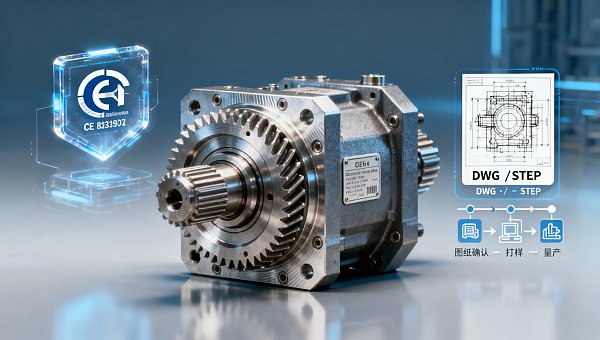
A Foreign Trade Website Solution for the Machinery Industry: What Truly Matters Is Not “Whether You Have One”, But “Whether It Actually Works”
How can a foreign trade website solution for the machinery industry truly drive overseas order conversion? One-click CAD drawing downloads, embedded CE certification in place, and visualized OEM cooperation workflows are becoming the core criteria project managers use when selecting website service providers.
Many teams spend a lot of money building multilingual websites, only to receive emails from customers asking: “Where can I check the CE certificate?” “Can the 3D model for this product be exported?”—while even the PDF link is buried three levels deep in the menu. It is not that the content is missing, but that there is no “engineering context.”
If you get just three of the following five things right, your website can turn from a “display window” into a “project accelerator.”
CAD drawings must support “one-click download” and include version numbers and update timestamps
- Visitors should be able to click and instantly obtain a package in DWG/SOLIDWORKS/STEP formats, automatically bundled with the BOM list + tolerance notes + material standards; permissions can be set in the backend (such as allowing downloads for registered users only) to prevent drawings from being shared casually.
- Do not stuff drawings into a compressed package inside a “Resource Center”—what customers want is the efficiency of being able to “open the email and send it directly to the workshop.” Yimingtongbao SaaS Intelligent Website Building Marketing SystemYimingtongbao SaaS Intelligent Website Building Marketing Systemsupports automatic file metadata synchronization. Each time a drawing is uploaded, the system automatically generates an independent download page with a version number and links it to the corresponding product SKU.
A CE certificate cannot just be posted as a scanned image; it must be embedded in a “trust position” on the product page
When European customers scan a product page, if the CE mark is placed in the footer or in a pop-up, trust is immediately discounted. The best positions are: below the product specification table, to the right of the technical specifications section, or inside a “Compliance Statement” collapsible panel—click to instantly view a high-definition PDF with the issuing body’s LOGO, number, and effective date, while also supporting online verification redirection.
Yimingtongbao’s AI+SEO/GEO optimization system automatically extracts key certificate fields and reinforces the structured markup for “CE certified [Product Name]” in Google search results, making inquiries more accurate from the very source of search traffic.
The OEM cooperation process cannot be written as plain text; it needs visual step diagrams + status tracking
- Turn “Requirement Alignment → Drawing Confirmation → Sampling → Testing → Mass Production” into a horizontal timeline, marking the average time required, deliverables, and responsible person’s email for each step (clickable to send a message), and reserve an entry for “Current Progress Inquiry”—customers only need to enter an order number to see “Sample shipped, estimated to arrive at the Port of Hamburg on May 12.”
- This is the detail project managers most often overlook: workflow visualization is not for showing off technology, but for reducing communication costs. Overseas customers are unfamiliar with the pace of domestic factories; one chart is better than ten explanatory emails.
Three High-Frequency “Pitfalls” That Hurt Conversion More Than Technical Problems
We have diagnosed hundreds of machinery factories and found that 90% of low inquiry rate problems do not appear at the code level, but at the “how people use it” level:
- English product pages are filled with machine-translated technical terms. For example, “液压缸行程” is translated literally as “hydraulic cylinder travel,” while European customers actually search for “stroke length”—causing SEO to fail and organic traffic to drop to zero.
- Multilingual switching relies on JS dynamic loading, but Google crawlers cannot capture the German/Spanish pages at all, making the effort pointless; the correct approach is to generate real subdirectories (/de/ /es/) combined with hreflang tags, which is exactly the underlying logic Yimingtongbao uses with the Google Neural Machine Translation (GNMT) engine.
- The homepage is packed with carousels and animation effects, but mobile loading exceeds 4 seconds—37% of European industrial purchasing decision-makers use their phones to check suppliers, and if they do not see the core parameters within the first 3 seconds, they close the page immediately.
Before Choosing a Solution, Ask Yourself These Three Questions First
Instead of comparing prices and templates, it is better to measure with these three yardsticks:
- Can the title, description, and keywords of the CAD download page be edited directly in the backend? Does it support automatically pushing different drawing versions based on the customer’s region (such as U.S. standard vs. European standard)?
- After a CE certificate is uploaded, does the system automatically generate schema markup and synchronize it to Google Merchant Center? Is there a function for one-click generation of multilingual compliance statements?
- Can the OEM workflow chart be linked to CRM work orders? When sales updates “Sample shipped” in the backend, does the client-side webpage refresh the status in real time?
These are not “advanced features,” but basic functions of a foreign trade website solution for the machinery industry. Among the 100,000 enterprises served by Yimingtongbao, customers exporting gearboxes, pumps and valves, and automated production lines have a repurchase rate 2.3 times higher than the industry average—the reason is simple: by the third month after launch, German customers were already saying, “Your website looks like it was built by our own engineering department.”
If you are currently pushing forward a new website project, you may as well open your existing website, visit a product page on your phone, and time the process from clicking to downloading the CAD drawing. More than 90 seconds? Then it is not that the website is slow, but that the solution does not truly “understand machinery” yet.
A truly effective foreign trade website solution for the machinery industry is not in the PPT, but in the 3 seconds where the customer’s mouse pauses, in the moment they nod while downloading the drawing, and in the instant they forward the OEM workflow chart to the purchasing director.
What should you do next? It is recommended to first run a full-site health check with Yimingtongbao’s free diagnostic tool—it will automatically detect 12 hard indicators such as whether the CAD download path is logical, the degree of CE information structuring, and the mobile usability of the OEM workflow page. Once the results are out, you can then decide whether to upgrade the solution, without acting blindly and without simply settling.
Related Articles
Related Products
 EasyCamp SaaS Smart Website Marketing SystemE-Yingbao SaaS Smart Website Marketing System: AI-powered, zero-code website building. Rapidly launch multilingual independent e-commerce sites in just 10 minutes. Global server acceleration and AI-driven SEO optimization empower businesses to efficiently connect with global markets. The seamless integration of technology and user-friendly operation makes building e-commerce sites incredibly simple.
 AI+SEM Intelligent Advertising Marketing SystemAI+SEM drives intelligent ad creation, empowering full-funnel precision advertising marketing. The system automatically generates weekly/monthly reports, AI recommends keywords and target countries, monitors core metrics in real-time with intelligent alerts, and enables one-click high-conversion ad solutions to help quickly acquire customers and improve ROI.
 AI+SEO Dual Engine Optimization ServiceEasyWin AI+SEO Dual Engine Optimization System leverages AI-powered keyword mining, content generation, and comprehensive technical optimization to help foreign trade enterprises acquire high-quality organic traffic, significantly improving search rankings and conversion rates.
 AI+SNS Social Media Marketing SystemYingbao AI+SNS Social Media Marketing System - Precision social capture for the social media era. Supports one-click content synchronization across major platforms like Facebook and LinkedIn. AI intelligently rewrites posts for enhanced relevance. 24/7 AI customer service and user profiling analysis empower businesses to efficiently expand into global markets.
 AI+SEO营销解决方案易营宝AI+SEO营销解决方案,通过AI批量写作、智能生成TDK、精准关键词扩词等功能,全面优化网站SEO效果,提升流量与转化率。助力企业构建高效智能网站新生态。
 AI+SEM Advertising Marketing SolutionsAI+SEM Advertising Marketing Solution leverages AI technology to deeply empower SEM ad campaigns. It automatically generates weekly/monthly reports using AI, presenting account data across multiple dimensions for comprehensive insights into campaign performance and trends. The system precisely recommends keywords and target countries, intelligently generates high-conversion ad copy, and enables one-click activation of efficient campaign plans to help businesses rapidly acquire customers. Simultaneously, it monitors core metrics in real time, intelligently identifies abnormal fluctuations, and issues timely alerts to ensure stable, high-return advertising results.
 Domain Name ServicesEasyWin provides professional domain name services, including intelligent queries, one-stop registration, brand protection, and full lifecycle management, helping businesses build a digital brand image.
 EasyOperate B2C Cross-Border E-Commerce Platform & Independent WebsiteEasyStore B2C Cross-border E-commerce Independent Store is an intelligent website building and cross-border e-commerce integrated solution independently developed by EasyStore Information Technology (Beijing) Co., Ltd. The system is specially designed for small and medium-sized as well as large export enterprises, integrating 'website building, operation, marketing, advertising, and conversion' into one, helping enterprises quickly establish cross-border e-commerce independent stores to achieve brand globalization and global sales growth.
The platform supports multiple languages, multiple currencies, and multi-channel marketing, with built-in AI intelligent translation and SEO optimization systems, suitable for mainstream markets such as Southeast Asia, Europe and America, Latin America, and the Middle East, assisting Chinese manufacturing enterprises in efficiently deploying international e-commerce strategies. SSL证书易营宝提供专业SSL安全证书服务,包括单域名和泛域名证书,确保网站数据传输加密、身份验证和完整性保护,助力企业建立安全可信的在线业务环境。









