









- Which channel has the highest ROI in the global traffic ecosystem? Comparative analysis of search, social media, and advertisingJul 10, 2026View details
- What multilingual website services are available in Sanya? Which model is more suitable for local businesses going global?Jul 08, 2026View details
- How to view the complete list of China SaaS companies in the top 100? Practical methods for screening website-building and marketing service providersJul 08, 2026View details
- How to view pricing in the global traffic ecosystem? Cost comparison of search, social media, and content channel advertisingJul 06, 2026View details
- How to assess foreign trade website development trends?Looking at 2026 changes from multilingual,AI content to conversion pathsJul 04, 2026View details
- What are the new trends in multilingual marketing data analytics tools in 2026? Focus on attribution、automation and complianceJul 04, 2026View details
Default content title displayed here
How many technical personnel are needed to maintain the SEO structure of a B2B website? First, consider the complexity of the site.
How many technical staff are needed for B2B website SEO structure maintenance? Many companies ask about the number of people right away, but that's the wrong order. What truly determines the investment isn't a fixed staffing level, but rather the amount of content, page size, number of languages supported, technical architecture, and the frequency of subsequent updates.
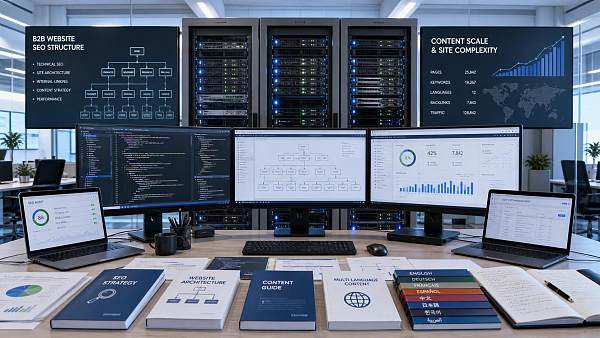
For a simple website with only a dozen or so pages, SEO structure maintenance often doesn't require a full technical team. However, once it enters a phase of multiple languages, multiple products, multiple directories, and multiple marketplaces operating in parallel, structure maintenance transforms from a one-time setup into an ongoing technical operation.
This explains why, even when running a foreign trade website, some companies can manage it with just one person, while others require collaboration between front-end, back-end, SEO, and content creation teams. The number of technical personnel needed for B2B website SEO structure maintenance is never a matter of guesswork or experience, but rather a matter of assessing the site's complexity.
What factors directly affect the allocation of technical personnel?
From a procurement and cost perspective, the following four types of variables are the most critical. If two or more of these variables are relatively complex, the investment in technology will increase significantly.
1. The amount of content determines the maintenance frequency.
If a website only has a brand page, product page, and contact page, structural issues are relatively few. However, when the content expands to include industry solutions, knowledge bases, case studies, news, and download pages, internal links, breadcrumbs, aggregation pages, pagination, and tag pages will all increase.
The more content you have, the more likely you are to encounter duplicate pages, isolated pages, wasted crawling, and inconsistent indexing. These problems cannot be solved simply by publishing articles; they definitely require underlying technical support.
2. Page size affects the difficulty of structural management.
For websites with dozens of pages, issues can be managed through manual inspection. However, for websites with hundreds to thousands of pages, link conventions, redirect logic, sitemaps, standardized tags, and parameter page management must be formalized and institutionalized.
If you then ask how many technical personnel are needed to maintain the SEO structure of a B2B website, the answer will usually change from "one part-time staff member" to "at least one person specifically responsible for it".
3. System complexity determines whether development involvement is necessary.
When using a mature website building system, many SEO structural capabilities are already built-in, such as URL rules, automatic sitemaps, tag control, and multi-language configuration. In this case, the technical investment is much lighter.
If it's a custom system, a legacy website, or a combination of multiple systems, the number of problems will increase significantly. Common issues include inconsistent paths, inconsistent templates, unstable mobile adaptation, and inflexible crawling rules.
4. Multiple languages and multiple regions will increase maintenance costs.
When B2B companies go global, it's often not just about having an English website. Different regions require different languages, different content focuses, and even different landing page structures.
At this point, hreflang, multi-region URLs, duplicate content control, and page synchronization mechanisms all impact SEO structure maintenance costs. Without technical collaboration, it can easily spiral out of control later on.
Approximately how many technical personnel are needed at different site stages?
To put it more directly, how many technical personnel are needed for B2B website SEO structure maintenance? The answer can be determined based on the site's stage, rather than simply by the company size.
This table isn't a hard and fast rule, but it's sufficient for initial budget assessments. The real way to save money isn't by reducing staff, but by avoiding repeated rework later.
Why do many companies underestimate the cost of SEO structure maintenance?
There are three common misconceptions. First, SEO is only understood as content updates. Second, the structure is only considered in the initial stage of website construction, and maintenance is neglected in the later stages. Third, technical issues are outsourced temporarily, resulting in a lack of continuous responsiveness.
The result is often that the website goes live quickly in the early stages, but later the indexing is unstable, the rankings fail to improve, the pages keep repeating, the redirect links are too long, and the efficiency of inquiries is ultimately slowed down.
Recent changes indicate that search engines are placing increasing emphasis on overall site structure when assessing site quality. Page speed, mobile responsiveness, information hierarchy, topic aggregation, and technical specifications are no longer supplementary but fundamental considerations.
A more prudent approach is to use platform capabilities to replace repetitive manual labor.
If businesses rely on manual handling of URLs, tags, redirects, maps, and multilingual synchronization every time, the number of technical personnel required for B2B website SEO structure maintenance will typically only increase.
A more reasonable approach is to delegate standardized, repetitive, and high-frequency SEO structural work to system capabilities, while focusing human effort on strategy and content.
Website and marketing integration platforms like YiYingBao offer value not only in their rapid website creation but also in their underlying structure, which is scalable, indexable, and sustainably maintainable. For foreign trade companies, manufacturing plants, cross-border brands, and multilingual websites, this platform-based approach significantly reduces long-term technical costs.
Especially when businesses also need to simultaneously optimize Google SEO, create advertising landing pages, drive traffic to social media, and improve AI search visibility, if the site structure cannot be managed uniformly, it will become increasingly difficult to handle subsequent traffic.
When making purchasing decisions, focus on these 5 questions.
In actual business operations, to determine how many technical personnel are needed for B2B website SEO structure maintenance, you can first ask about five things.
- How many pages and languages are planned to be added in the coming year?
- Does the current system support automated configuration of SEO rules?
- Is there a dedicated person continuously monitoring the data collection, capture, and technical anomalies?
- Can the marketing content, development team, and operations team collaborate smoothly?
- Does it need to support SEO, advertising, and multi-channel landing pages simultaneously?
If three out of these five questions have overly complex answers, then using the minimum configuration approach for budgeting is no longer suitable. Otherwise, while it may seem like you're saving on manpower, you're actually increasing customer acquisition costs.
The conclusion is simple: calculate the complexity first, then decide on the number of people.
How many technical personnel are needed for B2B website SEO structure maintenance? There's no single answer, but there's a stable logic. The more content, the larger the page, the more complex the system, and the more languages supported, the higher the level of technical support required.
For procurement decisions, what's more important than "how many people to allocate" is choosing a website building and marketing system that reduces repetitive maintenance costs. This not only controls investment but also ensures more stable growth in subsequent indexing, ranking, and inquiries.
First, clarify the complexity of the site, content plan, and market layout, and then decide on the technical staffing and platform solution. This is usually more cost-effective and more suitable for long-term growth than simply reducing manpower.
Related Articles
Related Products
 EasyCamp SaaS Smart Website Marketing SystemE-Yingbao SaaS Smart Website Marketing System: AI-powered, zero-code website building. Rapidly launch multilingual independent e-commerce sites in just 10 minutes. Global server acceleration and AI-driven SEO optimization empower businesses to efficiently connect with global markets. The seamless integration of technology and user-friendly operation makes building e-commerce sites incredibly simple.
 AI+SEM Intelligent Advertising Marketing SystemAI+SEM drives intelligent ad creation, empowering full-funnel precision advertising marketing. The system automatically generates weekly/monthly reports, AI recommends keywords and target countries, monitors core metrics in real-time with intelligent alerts, and enables one-click high-conversion ad solutions to help quickly acquire customers and improve ROI.
 AI+SEO Dual Engine Optimization ServiceEasyWin AI+SEO Dual Engine Optimization System leverages AI-powered keyword mining, content generation, and comprehensive technical optimization to help foreign trade enterprises acquire high-quality organic traffic, significantly improving search rankings and conversion rates.
 AI+SNS Social Media Marketing SystemYingbao AI+SNS Social Media Marketing System - Precision social capture for the social media era. Supports one-click content synchronization across major platforms like Facebook and LinkedIn. AI intelligently rewrites posts for enhanced relevance. 24/7 AI customer service and user profiling analysis empower businesses to efficiently expand into global markets.
 AI+SEO营销解决方案易营宝AI+SEO营销解决方案,通过AI批量写作、智能生成TDK、精准关键词扩词等功能,全面优化网站SEO效果,提升流量与转化率。助力企业构建高效智能网站新生态。
 AI+SEM Advertising Marketing SolutionsAI+SEM Advertising Marketing Solution leverages AI technology to deeply empower SEM ad campaigns. It automatically generates weekly/monthly reports using AI, presenting account data across multiple dimensions for comprehensive insights into campaign performance and trends. The system precisely recommends keywords and target countries, intelligently generates high-conversion ad copy, and enables one-click activation of efficient campaign plans to help businesses rapidly acquire customers. Simultaneously, it monitors core metrics in real time, intelligently identifies abnormal fluctuations, and issues timely alerts to ensure stable, high-return advertising results.
 Domain Name ServicesEasyWin provides professional domain name services, including intelligent queries, one-stop registration, brand protection, and full lifecycle management, helping businesses build a digital brand image.
 EasyOperate B2C Cross-Border E-Commerce Platform & Independent WebsiteEasyStore B2C Cross-border E-commerce Independent Store is an intelligent website building and cross-border e-commerce integrated solution independently developed by EasyStore Information Technology (Beijing) Co., Ltd. The system is specially designed for small and medium-sized as well as large export enterprises, integrating 'website building, operation, marketing, advertising, and conversion' into one, helping enterprises quickly establish cross-border e-commerce independent stores to achieve brand globalization and global sales growth.
The platform supports multiple languages, multiple currencies, and multi-channel marketing, with built-in AI intelligent translation and SEO optimization systems, suitable for mainstream markets such as Southeast Asia, Europe and America, Latin America, and the Middle East, assisting Chinese manufacturing enterprises in efficiently deploying international e-commerce strategies. SSL证书易营宝提供专业SSL安全证书服务,包括单域名和泛域名证书,确保网站数据传输加密、身份验证和完整性保护,助力企业建立安全可信的在线业务环境。









