









- How to assess foreign trade website development trends?Looking at 2026 changes from multilingual,AI content to conversion pathsJul 04, 2026View details
- What are the new trends in multilingual marketing data analytics tools in 2026? Focus on attribution、automation and complianceJul 04, 2026View details
- Is Brand Globalization Marketing Consulting Worth Buying? At What Stage Should Companies Bring It InJul 01, 2026View details
- Cross-Border Marketing Trend Research: Why More and More Companies Are Starting to Deploy AI Search and GEO OptimizationJun 30, 2026View details
- Cross-Border Marketing Trend Research: How Independent Sites, AI Content, and Short-Video Customer Acquisition Are ChangingJun 30, 2026View details
- How Can a Brand Updates Page Be Made More SEO-Friendly? Analysis of Update Frequency, Content Structure, and Internal Linking StrategyJun 28, 2026View details
Japan Launches JGTI Platform, Supplier Digital Trust Becomes a Pre-Procurement Signal
On July 4, 2026, Japan’s Ministry of Economy, Trade and Industry (METI) officially launched the “J-Global B2B Procurement Trust Index” (JGTI) platform and opened registration to global suppliers. For export enterprises conducting B2B business in the Japanese market, independent website operation teams, cross-border marketing service providers, and procurement liaison personnel, this move deserves attention, because the platform has directly incorporated digital performance such as website multilingual capabilities, Japanese localization, compliance disclosure, social media activity, and Google SEO visibility into the upfront reference scope for suppliers to be discovered and screened by Japanese importers, general trading companies, and JETRO.

Information Confirmed to Have Been Released by the JGTI Platform
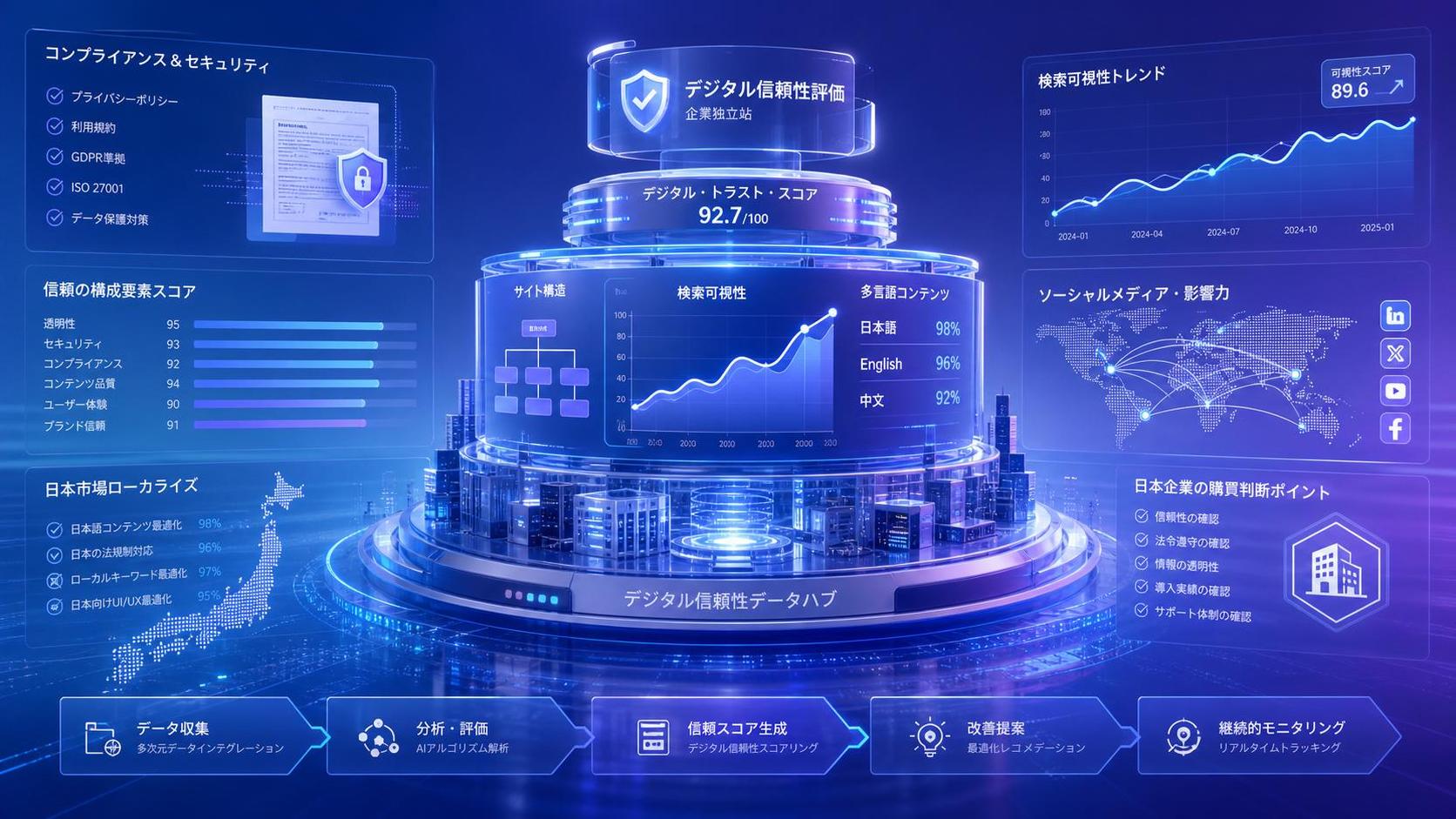
According to the information already provided, METI officially launched the JGTI platform on July 4, 2026, with registration open to global suppliers. The platform will generate dynamic scores based on 12 indicators, including the multilingual quality of a company’s independent website, the depth of GEO localization, the completeness of compliance information disclosure, social media activity, and Google SEO visibility.
At the application level, the platform will recommend high-scoring suppliers to Japanese importers, general trading companies, and JETRO. The general trading companies mentioned as examples include Mitsubishi Corporation and ITOCHU Corporation. Initial data shows that companies using Chinese-language websites but without Japanese GEO optimization have an average score below 42 points (out of 100), and this has been described as having a significant impact on the probability of receiving procurement invitations.
Who Will First Feel the Pressure from This Scoring Mechanism
Direct Trading Enterprises Shipping to Japan
From an industry perspective, this type of enterprise is affected most directly, because its customer acquisition entry points, inquiry conversion, and the buyer’s initial trust building may be influenced earlier by JGTI scoring results. The changes are mainly reflected in the stages where suppliers are searched, recommended, and included in preliminary communication lists. In particular, companies that originally relied on Chinese websites or general English pages to expand Japanese customers need to pay more attention to whether the quality of Japanese content and the depth of localization are sufficient to support procurement judgment.
Processing and Manufacturing Enterprises and Factory-Type Suppliers
For manufacturing enterprises, the platform’s inclusion of the completeness of compliance information disclosure in scoring means that the issue is not only whether there is a factory or whether delivery is possible, but also whether the company can clearly present its qualifications, processes, and external communication capabilities through online information. The impact is more likely to appear in background screening before sample inquiries, supplier directory selection, and cross-department evaluation stages.
Front-End Screening Processes of Japanese Buyers and General Trading Companies
From observation, buyers, importers, and general trading companies have obtained a more structured online screening reference. For these roles, the change may not necessarily occur at the final transaction stage, but is more likely to be reflected in narrowing the candidate pool at the front end, improving initial screening efficiency, and reducing communication costs. It should be noted that the platform’s recommendation logic is not completely equivalent to a company’s actual contract fulfillment capability, and procurement decisions may still leave room for further verification.
Cross-Border Website Building, SEO, and Localization Service Providers
For service providers, the impact mainly lies in changes to demand structure. In the past, companies may have viewed independent websites as brand display pages. Under the JGTI mechanism, however, website language quality, GEO localization, and Google SEO visibility are more clearly directed toward procurement opportunities. This will make service demand lean more toward procurement conversion and credibility building, rather than only the launch of pages themselves.
Practical Issues Companies Should Focus on Now
First Distinguish Between “Having Japanese Pages” and “Having Japanese Localization”
The known initial data has clearly indicated that companies using Chinese-language websites but without Japanese GEO optimization have relatively low average scores. For companies, what deserves more attention now is whether Japanese pages are merely a supplement at the translation level, or whether they already cover localized expression, information organization, and search visibility building for the Japanese procurement context.
Whether Compliance Disclosure Is Complete and Verifiable Enough
Since the platform includes the completeness of compliance information disclosure in scoring, companies need to attach importance to the completeness and consistency of externally disclosed materials. From an analytical perspective, the focus here is not only “what has been written,” but also whether buyers can quickly find and understand key company information, thereby reducing trust loss in early-stage communication.
Place Social Media Activity and Website Content Within the Same External Narrative
JGTI does not only look at the single-point performance of a website; social media activity is also within the indicator scope. Companies need to pay attention to whether website and social media information form a consistent expression, avoiding situations where official website content is outdated, social media updates are scattered, and the external image is inconsistent, because this type of fragmentation may weaken buyers’ first impression of supplier stability.
Continuously Track the Gap Between Official Statements and Actual Recommendation Results
The platform has already gone live and started opening registration to global suppliers, but from the perspective of business implementation, companies still need to continue observing the correspondence between platform scoring, recommendation logic, and actual procurement invitations. Especially for teams focusing on developing the Japanese market, subsequent official statements, rule refinements, and actual usage on the procurement side will all affect judgments on investment priorities.
This Is More Like a Digital Screening Signal at the Procurement Front End
Here, it is necessary to clearly distinguish facts from judgment. The fact is that METI has launched the JGTI platform, formed dynamic scoring based on 12 indicators, and at the same time recommends high-scoring suppliers to Japanese importers, general trading companies, and JETRO. From an analytical perspective, what this conveys is not merely a new display platform, but a signal that the weight of “online verifiable trustworthiness” is increasing at the front end of Japanese B2B procurement.
However, at present, it is more appropriate to understand this as a mechanism change on the procurement entry side, rather than as evidence that clear outcomes have already occurred in transaction logic across all industries. The initial data has given a clear direction, namely that the lack of Japanese GEO optimization will lower scores. However, whether different companies can ultimately obtain more procurement invitations as a result still needs to be continuously observed in combination with subsequent actual application.
Practical Implications for Foreign Trade and Supply Chain Stakeholders
Overall, the significance of this information does not lie in the addition of a simple registration platform, but in the fact that the Japanese market is incorporating suppliers’ digital presentation capabilities, language localization capabilities, and basic compliance expression into an earlier procurement judgment process. For related companies, it is currently not advisable to understand this only as a change at the marketing level, nor is it advisable to prematurely regard it as a finalized hard threshold for procurement.
A more rational way to understand it is: this is an implemented change in the screening mechanism, and also a long-term signal that requires continuous tracking. In the short term, the most obvious impact may be on front-end reach and initial screening for customer acquisition in the Japanese market; whether it will form more stable procurement standards in the medium and long term still depends on the subsequent evolution of platform rules, recommendation applications, and the degree of acceptance on the procurement side.
Basis of This Article and Directions for Subsequent Verification
This article is generated based on the information title, event occurrence time, and event summary provided by the user. The currently referable types of information usually include official announcements, corporate announcements, industry association information, authoritative media reports, and related standardization documents.
It should be noted that specific official source links were not provided in the input, and this article has not supplemented external links or expanded facts on that basis. Continuous verification is still required. If continuing to track this development, the directions worth paying attention to include whether JGTI’s subsequent indicator descriptions will be adjusted, whether the platform recommendation mechanism will provide clearer explanations, and the actual adoption of the scoring results by the procurement side.
Related Articles
 What types of companies are GEO generative engine optimization services suitable for?Analysis of differences from traditional SEO
 Japan Launches JGTI Platform, Supplier Digital Trust Becomes a Pre-Procurement Signal
 How to Optimize Structured Data for Better Indexing? A Practical Guide to Product, Article, and FAQ Markup


Related Products
 EasyCamp SaaS Smart Website Marketing SystemE-Yingbao SaaS Smart Website Marketing System: AI-powered, zero-code website building. Rapidly launch multilingual independent e-commerce sites in just 10 minutes. Global server acceleration and AI-driven SEO optimization empower businesses to efficiently connect with global markets. The seamless integration of technology and user-friendly operation makes building e-commerce sites incredibly simple.
 AI+SEM Intelligent Advertising Marketing SystemAI+SEM drives intelligent ad creation, empowering full-funnel precision advertising marketing. The system automatically generates weekly/monthly reports, AI recommends keywords and target countries, monitors core metrics in real-time with intelligent alerts, and enables one-click high-conversion ad solutions to help quickly acquire customers and improve ROI.
 AI+SEO Dual Engine Optimization ServiceEasyWin AI+SEO Dual Engine Optimization System leverages AI-powered keyword mining, content generation, and comprehensive technical optimization to help foreign trade enterprises acquire high-quality organic traffic, significantly improving search rankings and conversion rates.
 AI+SNS Social Media Marketing SystemYingbao AI+SNS Social Media Marketing System - Precision social capture for the social media era. Supports one-click content synchronization across major platforms like Facebook and LinkedIn. AI intelligently rewrites posts for enhanced relevance. 24/7 AI customer service and user profiling analysis empower businesses to efficiently expand into global markets.
 AI+SEO营销解决方案易营宝AI+SEO营销解决方案,通过AI批量写作、智能生成TDK、精准关键词扩词等功能,全面优化网站SEO效果,提升流量与转化率。助力企业构建高效智能网站新生态。
 AI+SEM Advertising Marketing SolutionsAI+SEM Advertising Marketing Solution leverages AI technology to deeply empower SEM ad campaigns. It automatically generates weekly/monthly reports using AI, presenting account data across multiple dimensions for comprehensive insights into campaign performance and trends. The system precisely recommends keywords and target countries, intelligently generates high-conversion ad copy, and enables one-click activation of efficient campaign plans to help businesses rapidly acquire customers. Simultaneously, it monitors core metrics in real time, intelligently identifies abnormal fluctuations, and issues timely alerts to ensure stable, high-return advertising results.
 Domain Name ServicesEasyWin provides professional domain name services, including intelligent queries, one-stop registration, brand protection, and full lifecycle management, helping businesses build a digital brand image.
 EasyOperate B2C Cross-Border E-Commerce Platform & Independent WebsiteEasyStore B2C Cross-border E-commerce Independent Store is an intelligent website building and cross-border e-commerce integrated solution independently developed by EasyStore Information Technology (Beijing) Co., Ltd. The system is specially designed for small and medium-sized as well as large export enterprises, integrating 'website building, operation, marketing, advertising, and conversion' into one, helping enterprises quickly establish cross-border e-commerce independent stores to achieve brand globalization and global sales growth.
The platform supports multiple languages, multiple currencies, and multi-channel marketing, with built-in AI intelligent translation and SEO optimization systems, suitable for mainstream markets such as Southeast Asia, Europe and America, Latin America, and the Middle East, assisting Chinese manufacturing enterprises in efficiently deploying international e-commerce strategies. SSL证书易营宝提供专业SSL安全证书服务,包括单域名和泛域名证书,确保网站数据传输加密、身份验证和完整性保护,助力企业建立安全可信的在线业务环境。









