









- What Does a Global Traffic Ecosystem Service Provider Do? What Are the Differences from a Single Advertising AgencyJul 16, 2026View details
- What should you focus on in the latest enterprise SaaS report? From renewal rates and delivery costs to overseas growth opportunitiesJul 12, 2026View details
- What signals are worth paying attention to in a cross-border marketing trend report? B2B companies should look at these 6 signalsJul 11, 2026View details
- How to Read a Cross-Border Marketing Trends Report? Five Key Dimensions for Evaluating Channel OpportunitiesJul 11, 2026View details
- Which channel has the highest ROI in the global traffic ecosystem? Comparative analysis of search, social media, and advertisingJul 10, 2026View details
- What multilingual website services are available in Sanya? Which model is more suitable for local businesses going global?Jul 08, 2026View details
- How to view the complete list of China SaaS companies in the top 100? Practical methods for screening website-building and marketing service providersJul 08, 2026View details
- How to view pricing in the global traffic ecosystem? Cost comparison of search, social media, and content channel advertisingJul 06, 2026View details
Is Renewing a Website Building Platform Really Expensive?
Is renewing a website-building platform expensive? What many businesses really want to know is not the renewal fee itself, but whether it is worth the money. For companies building a brand website, an overseas trade website, or a cross-border e-commerce store, renewal costs cannot be evaluated separately from features, maintenance, security, promotion, and future customer acquisition capabilities.
If a platform offers a very low price in the first year but begins charging extra for plugins, restricting traffic, providing weak SEO capabilities, and making redesigns difficult from the second year onward, renewal will seem increasingly expensive. Conversely, if the platform can continuously support content updates, search indexing, advertising campaigns, and inquiry conversions, renewal is more like a stable investment in growth.
Why do businesses struggle with the question “Is renewing a website-building platform expensive?”
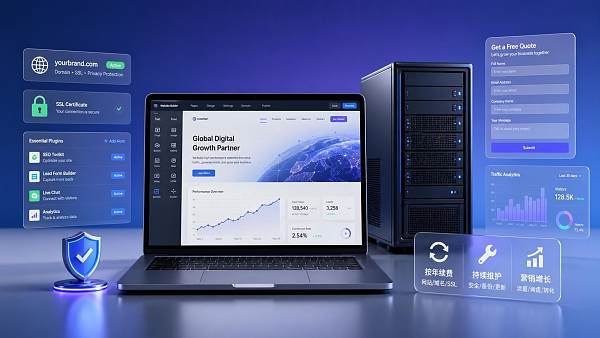
When choosing a website-building platform, businesses often focus more on the initial website development cost while overlooking the ongoing investment required in the second and third years. After the website goes live, they may discover that the domain name, server, templates, plugins, SSL, security maintenance, technical support, and feature upgrades can all affect the renewal cost.
This is why “Is renewing a website-building platform expensive?” has become a question that many managers and operations staff search for repeatedly. Their concern is not only a price increase, but also becoming locked into the platform: switching may be costly, while failing to renew may affect normal website access and marketing performance.
You cannot determine whether renewal is expensive by looking only at the quotation
Looking only at the renewal fee can easily lead to an incorrect judgment. A platform that costs several thousand yuan per year may appear affordable, but if the website loads slowly, overseas access is unstable, and multilingual support is weak, it will ultimately affect Google indexing, advertising landing-page conversions, and the experience of overseas customers.
For businesses, the real comparison should be the “total cost of ownership.” In addition to the renewal price, you should also consider whether you need to purchase additional plugins, hire technical personnel to fix problems, perform SEO structural optimization separately, or frequently rebuild pages to accommodate marketing campaigns.
If the platform provides complete core capabilities, businesses can reduce many hidden expenses. Built-in mobile responsiveness, SEO settings, multilingual management, inquiry forms, visual page editing, and data analytics, for example, can all reduce subsequent operation, maintenance, and marketing execution costs.
Which costs most easily make renewal seem increasingly expensive?
The first category is separate charges for features. Some platforms provide only basic pages in the first year. When forms, advanced templates, e-commerce stores, memberships, marketing pop-ups, and data analytics are actually needed, each item must be purchased separately, and these features will also be included in the total cost at renewal.
The second category is traffic and performance restrictions. After a business begins content marketing, SEO optimization, or advertising campaigns, traffic may increase. If the platform's hosting performance is insufficient, the plan must be upgraded. On the surface, this appears to be a renewal price increase, but in essence it means that the platform's underlying resource design is not suitable for business growth.
The third category is the cost of outsourcing technical services. If a platform is difficult to use, businesses often need to hire third parties to handle page adjustments, code modifications, speed optimization, website security, and multilingual issues. These costs can sometimes exceed the platform's annual fee itself and deserve particular attention.
What businesses should focus on most is not affordability, but whether renewal can continue to generate inquiries
For foreign trade businesses, manufacturing factories, and cross-border brands, an official website is not merely a display page but a customer acquisition tool. If a website is inexpensive to renew but cannot be effectively indexed by Google, has weak page conversion performance, or provides poor support for advertising traffic, even a very low renewal fee can hardly be considered cost-effective.
By contrast, a platform with a seemingly higher renewal price may be more likely to continuously generate qualified customers if it supports SEO content planning, rapid creation of advertising landing pages, multilingual site management, and inquiry form tracking. Such costs are closer to an operating investment.
Therefore, managers should reframe the question: can this renewal fee help the business continue gaining exposure, acquiring customers, and improving brand credibility? As long as the answer is yes, the price cannot simply be defined as “expensive.”
The answer to whether renewal is expensive varies across different business scenarios
If you are only building a very simple informational website, update it infrequently, and do not rely on search engines or advertising for customer acquisition, choosing a lower-cost platform and controlling the renewal budget is reasonable. The prerequisites are basic security, stable access, and a business image that does not become outdated.
However, if you are building a B2B foreign trade inquiry website, a B2C independent website, or a multilingual brand website, platform renewal cannot be measured solely by the standards for an “informational website.” These types of websites are responsible for customer acquisition, conversion, brand development, and international market expansion, and therefore have higher requirements for the platform.
Businesses that need to balance Google SEO optimization, advertising campaigns, social media traffic acquisition, and AI search visibility should pay particular attention to whether the platform can support long-term operations. A renewal price that matches the platform's marketing capabilities is a more realistic way to evaluate the cost.
How can you determine whether renewing a website-building platform is truly worthwhile?
First, find out what is included after renewal. Clarify whether the fee includes the server, SSL certificate, data backups, security protection, technical support, template usage rights, feature updates, and guarantees for normal website access. Looking only at the total price while ignoring the scope of services can easily lead to a distorted assessment.
Second, determine whether the platform supports ongoing operations. This includes whether pages can be added easily, content can be updated conveniently, SEO titles and descriptions can be controlled, images and code affect loading speed, and multilingual content is easy to maintain. These factors all determine the website's subsequent operating efficiency.
Third, examine its migration and expansion capabilities. If a platform is highly closed, data cannot be exported, page structures are nonstandard, and new features cannot be integrated later, the renewal fee may not appear high, but the business will pay a higher switching cost once it wants to upgrade its operations.
What is the right way for business managers to make comparisons?
Managers do not need to focus only on “how much renewal costs this year.” They should consider “what results this annual expense produces.” If a website can continuously handle brand traffic, increase search exposure, support advertising campaigns, and generate stable inquiries throughout the year, this represents quantifiable business value.
A more practical comparison method is to break renewal costs down into several dimensions: platform usage fees, labor costs for operations and maintenance, outsourced technical service costs, marketing coordination efficiency, and potential customer acquisition returns. After these dimensions are combined, many platforms that appear inexpensive may not actually be more cost-effective.
For businesses seeking overseas growth in particular, an official website is no longer a one-time project but a long-term digital asset. The significance of platform renewal is not merely keeping the website online; it also means maintaining the business's content hub, brand hub, and traffic entry point in global markets.
Why can an integrated platform make renewal investment more likely to generate returns?
When website development, SEO, advertising, social media, and data analytics are spread across different systems, businesses face not only high communication costs but also a greater risk of breaks in the execution process. Slow page redesigns, slow campaign response, and untimely content updates can all weaken website performance and amplify the perceived “cost” of renewal.
The advantage of an integrated platform is that website development and subsequent marketing can form a closed loop. The website structure is designed from the outset around indexing, promotion, and conversion. After renewal, the platform not only keeps the site running but also supports ongoing SEO planning, advertising landing-page creation, and traffic acquisition across multiple channels.
AI-driven website development and marketing platforms designed for foreign trade and overseas expansion businesses typically place greater emphasis on a website's promotability, indexability, and conversion potential. This renewal model differs from traditional template-based website development; it is closer to ongoing investment in a business digital growth system.
Conclusion: Whether renewing a website-building platform is expensive depends on whether it serves growth
There is no universal answer to whether renewing a website-building platform is expensive without considering the business context. What truly deserves attention is not the price itself, but the missing features, restricted marketing capabilities, and hidden later expenses behind a low price. What is truly worth investing in is a platform that can support long-term customer acquisition and brand growth.
For businesses, the key to determining whether renewal is worthwhile is not “is it cheap?” but “after renewal, can the website continue to create value?” As long as the platform runs stably, is easy to optimize, supports promotion, and generates customers, renewal is not a burden but a reasonable investment.
Related Articles

Related Products
 EasyCamp SaaS Smart Website Marketing SystemE-Yingbao SaaS Smart Website Marketing System: AI-powered, zero-code website building. Rapidly launch multilingual independent e-commerce sites in just 10 minutes. Global server acceleration and AI-driven SEO optimization empower businesses to efficiently connect with global markets. The seamless integration of technology and user-friendly operation makes building e-commerce sites incredibly simple.
 AI+SEM Intelligent Advertising Marketing SystemAI+SEM drives intelligent ad creation, empowering full-funnel precision advertising marketing. The system automatically generates weekly/monthly reports, AI recommends keywords and target countries, monitors core metrics in real-time with intelligent alerts, and enables one-click high-conversion ad solutions to help quickly acquire customers and improve ROI.
 AI+SEO Dual Engine Optimization ServiceEasyWin AI+SEO Dual Engine Optimization System leverages AI-powered keyword mining, content generation, and comprehensive technical optimization to help foreign trade enterprises acquire high-quality organic traffic, significantly improving search rankings and conversion rates.
 AI+SNS Social Media Marketing SystemYingbao AI+SNS Social Media Marketing System - Precision social capture for the social media era. Supports one-click content synchronization across major platforms like Facebook and LinkedIn. AI intelligently rewrites posts for enhanced relevance. 24/7 AI customer service and user profiling analysis empower businesses to efficiently expand into global markets.
 AI+SEO营销解决方案易营宝AI+SEO营销解决方案,通过AI批量写作、智能生成TDK、精准关键词扩词等功能,全面优化网站SEO效果,提升流量与转化率。助力企业构建高效智能网站新生态。
 AI+SEM Advertising Marketing SolutionsAI+SEM Advertising Marketing Solution leverages AI technology to deeply empower SEM ad campaigns. It automatically generates weekly/monthly reports using AI, presenting account data across multiple dimensions for comprehensive insights into campaign performance and trends. The system precisely recommends keywords and target countries, intelligently generates high-conversion ad copy, and enables one-click activation of efficient campaign plans to help businesses rapidly acquire customers. Simultaneously, it monitors core metrics in real time, intelligently identifies abnormal fluctuations, and issues timely alerts to ensure stable, high-return advertising results.
 Domain Name ServicesEasyWin provides professional domain name services, including intelligent queries, one-stop registration, brand protection, and full lifecycle management, helping businesses build a digital brand image.
 EasyOperate B2C Cross-Border E-Commerce Platform & Independent WebsiteEasyStore B2C Cross-border E-commerce Independent Store is an intelligent website building and cross-border e-commerce integrated solution independently developed by EasyStore Information Technology (Beijing) Co., Ltd. The system is specially designed for small and medium-sized as well as large export enterprises, integrating 'website building, operation, marketing, advertising, and conversion' into one, helping enterprises quickly establish cross-border e-commerce independent stores to achieve brand globalization and global sales growth.
The platform supports multiple languages, multiple currencies, and multi-channel marketing, with built-in AI intelligent translation and SEO optimization systems, suitable for mainstream markets such as Southeast Asia, Europe and America, Latin America, and the Middle East, assisting Chinese manufacturing enterprises in efficiently deploying international e-commerce strategies. SSL证书易营宝提供专业SSL安全证书服务,包括单域名和泛域名证书,确保网站数据传输加密、身份验证和完整性保护,助力企业建立安全可信的在线业务环境。









