









- What multilingual website services are available in Sanya? Which model is more suitable for local businesses going global?Jul 08, 2026View details
- How to view the complete list of China SaaS companies in the top 100? Practical methods for screening website-building and marketing service providersJul 08, 2026View details
- How to view pricing in the global traffic ecosystem? Cost comparison of search, social media, and content channel advertisingJul 06, 2026View details
- How to assess foreign trade website development trends?Looking at 2026 changes from multilingual,AI content to conversion pathsJul 04, 2026View details
- What are the new trends in multilingual marketing data analytics tools in 2026? Focus on attribution、automation and complianceJul 04, 2026View details
- Is Brand Globalization Marketing Consulting Worth Buying? At What Stage Should Companies Bring It InJul 01, 2026View details
- Cross-Border Marketing Trend Research: Why More and More Companies Are Starting to Deploy AI Search and GEO OptimizationJun 30, 2026View details
- Cross-Border Marketing Trend Research: How Independent Sites, AI Content, and Short-Video Customer Acquisition Are ChangingJun 30, 2026View details
What Management Risks Can Multi-Platform Distribution Tools Bring
Although multi-platform distribution tools can improve content delivery efficiency, they may also introduce management risks such as loss of permission control, data leakage, and workflow disorder. For quality control and security management, the key to balancing efficiency and security is to identify hidden risks in advance and establish standardized mechanisms.
Why multi-platform distribution tools are prone to management risks
The core value of multi-platform distribution tools lies in centrally managing multiple websites, social media accounts, and content channels.
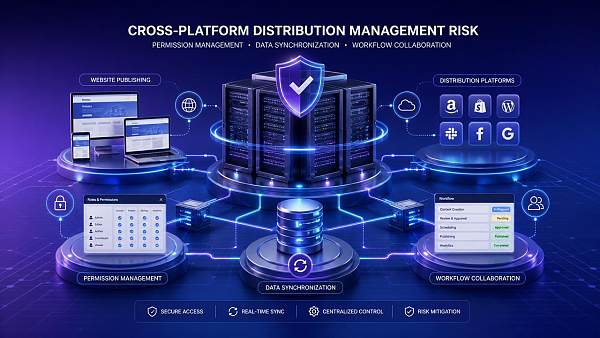
However, the more platforms there are, the more complex the integrations become, the more fragmented the backends are, the longer the management chain becomes, and the more risk points increase accordingly.
In integrated website + marketing service scenarios, content not only needs to be published, but also synchronized with pages, forms, tracking codes, and lead data.
Once multi-platform distribution tools lack unified standards, issues such as account sharing, version confusion, misused assets, and permission spillover may occur.
Many problems are not caused by defects in the tools themselves, but by unclear usage boundaries, ambiguous responsibility allocation, and insufficient audit mechanisms.
Therefore, understanding the risks of multi-platform distribution tools is not just about judging the strength of their functions, but also about whether governance capabilities are in place at the same time.
What are the most common risks of multi-platform distribution tools
1. How does loss of permission control occur
The most common hidden risk is that multiple people share administrator accounts, or permissions are not revoked for employees who have left or changed positions for a long time.
When one distribution backend is connected at the same time to the official website, landing pages, social media, and advertising accounts, a single point of exposure will amplify the overall risk.
2. Where does data leakage usually begin
Data leakage is not always caused by hacker attacks; in many cases, it comes from incorrect exports, incorrect synchronization, or third-party plugin calls.
If the distribution tool connects to customer lists, form information, and access logs, the data boundaries must be clear and traceable.
3. What consequences can workflow disorder cause
When multiple versions of the same content exist in parallel, it is easy for situations to occur where the official website has been updated, social media has not, and advertising copy still contains old errors.
This will directly affect brand messaging consistency, may also trigger compliance wording errors, and may even lead to customer complaints.
4. Why tracking distortion deserves attention
Multi-platform distribution tools are often used together with analytics code, conversion links, and automated tagging rules.
Once parameters are configured incorrectly, marketing attribution will be distorted, and subsequent campaign optimization will also be built on incorrect data.
- Account permissions are too broad, with no tiered approval
- Too many content versions, with no single source of publishing
- Too many third-party integrations, with no security audit
- Inconsistent statistical standards, affecting marketing judgment
In which scenarios are the risks of multi-platform distribution tools amplified
When enterprises operate official websites, campaign pages, cross-platform social media, and advertising accounts at the same time, distribution efficiency does indeed improve significantly.
However, the more complex the scenario is, the higher the requirements multi-platform distribution tools place on organizational collaboration capabilities.
Cross-regional, multilingual websites
Different regions have different content standards, publishing schedules, and legal requirements. If unified distribution lacks localized review, the risk is even higher.
Periods with intensive marketing activities
During major promotions, launch events, and trade shows, content is updated quickly and approval time is short, making misposts and incorrect links most likely to occur.
Parallel collaboration among multiple people and external operators
When internal teams and external service providers access the backend at the same time, responsibility boundaries and operation records must be more refined.
Otherwise, multi-platform distribution tools will turn from efficiency engines into problem amplifiers.
How to determine whether multi-platform distribution tools are in a controllable state
Rather than fixing problems after they occur, it is better to establish a set of daily evaluation standards and continuously check the status of the tools.
If the above problems exist for a long time, then the efficiency gains brought by multi-platform distribution tools will often be offset by management costs.
How to reduce the management risks brought by multi-platform distribution tools
The first step is not to blindly replace the system, but to first sort out the relationships among content, accounts, domains, data, and delivery.
Under an integrated website + marketing service system, it is recommended to govern the following five aspects at the same time.
- Establish tiered permissions and grant the minimum necessary permissions based on roles.
- Set standard workflows so that publishing, modification, and removal all leave records.
- Unify the asset library and version numbers to avoid old content being reused.
- Regularly verify integrations and tracking parameters to reduce attribution bias.
- Strengthen website security properly to prevent the distribution chain from being intercepted.
In particular, for official websites, membership systems, and form pages, transmission encryption must be treated as a basic configuration, not a patch added after launch.
For example, an SSL certificate that supports SHA-256, 2048-bit keys, HSTS, and automated deployment can help websites reduce security exposure during data transmission, and is suitable for scenarios such as e-commerce platforms, corporate official websites, and API interfaces.
This kind of foundational security capability, when used together with multi-platform distribution tools, can ensure that efficiency improvements do not deviate from the underlying security baseline.
What misunderstandings are easy to fall into when choosing multi-platform distribution tools
When evaluating multi-platform distribution tools, many teams only look at whether they can achieve “one-click publishing”, while overlooking governance and audit capabilities.
Misunderstanding 1: The more functions, the better
The more functions there are, the broader the integration scope becomes, and the higher the subsequent maintenance and training costs will be, so they may not necessarily suit the current stage.
Misunderstanding 2: Automation can replace review
Automation is suitable for execution, but not for making final judgments, especially when it involves brand, policy, and legal wording.
Misunderstanding 3: Only manage publishing, not website security
Distribution tools often direct traffic to official websites and landing pages. If the website lacks certificates, encryption, and redirect strategies, the risk still remains.
Misunderstanding 4: Launch means completion
What truly matters is inspection, review, and optimization after launch, rather than the surface-level smoothness at the moment the tool is connected.
How to quickly troubleshoot issues related to multi-platform distribution tools
E-Marketing Information Technology (Beijing) Co., Ltd. has long focused on coordinated scenarios involving intelligent website building, SEO optimization, social media marketing, and advertising delivery.
In multi-channel growth practices, truly sustainable efficiency is not about publishing content quickly, but about delivering the right content securely, stably, and traceably.
If you are evaluating multi-platform distribution tools, it is recommended to first conduct an inventory of accounts, workflows, data, and website security, and then decide how to optimize the system combination.
Only by managing risks in advance can multi-platform distribution tools truly become a driver of growth rather than a hidden burden.
Related Articles
 What multilingual website services are available in Sanya? Which model is more suitable for local businesses going global?
 How to view the complete list of China SaaS companies in the top 100? Practical methods for screening website-building and marketing service providers
 There are so many used heavy-duty construction machines for foreign trade. How exactly should we acquire customers?



Related Products
 EasyCamp SaaS Smart Website Marketing SystemE-Yingbao SaaS Smart Website Marketing System: AI-powered, zero-code website building. Rapidly launch multilingual independent e-commerce sites in just 10 minutes. Global server acceleration and AI-driven SEO optimization empower businesses to efficiently connect with global markets. The seamless integration of technology and user-friendly operation makes building e-commerce sites incredibly simple.
 AI+SEM Intelligent Advertising Marketing SystemAI+SEM drives intelligent ad creation, empowering full-funnel precision advertising marketing. The system automatically generates weekly/monthly reports, AI recommends keywords and target countries, monitors core metrics in real-time with intelligent alerts, and enables one-click high-conversion ad solutions to help quickly acquire customers and improve ROI.
 AI+SEO Dual Engine Optimization ServiceEasyWin AI+SEO Dual Engine Optimization System leverages AI-powered keyword mining, content generation, and comprehensive technical optimization to help foreign trade enterprises acquire high-quality organic traffic, significantly improving search rankings and conversion rates.
 AI+SNS Social Media Marketing SystemYingbao AI+SNS Social Media Marketing System - Precision social capture for the social media era. Supports one-click content synchronization across major platforms like Facebook and LinkedIn. AI intelligently rewrites posts for enhanced relevance. 24/7 AI customer service and user profiling analysis empower businesses to efficiently expand into global markets.
 AI+SEO营销解决方案易营宝AI+SEO营销解决方案,通过AI批量写作、智能生成TDK、精准关键词扩词等功能,全面优化网站SEO效果,提升流量与转化率。助力企业构建高效智能网站新生态。
 AI+SEM Advertising Marketing SolutionsAI+SEM Advertising Marketing Solution leverages AI technology to deeply empower SEM ad campaigns. It automatically generates weekly/monthly reports using AI, presenting account data across multiple dimensions for comprehensive insights into campaign performance and trends. The system precisely recommends keywords and target countries, intelligently generates high-conversion ad copy, and enables one-click activation of efficient campaign plans to help businesses rapidly acquire customers. Simultaneously, it monitors core metrics in real time, intelligently identifies abnormal fluctuations, and issues timely alerts to ensure stable, high-return advertising results.
 Domain Name ServicesEasyWin provides professional domain name services, including intelligent queries, one-stop registration, brand protection, and full lifecycle management, helping businesses build a digital brand image.
 EasyOperate B2C Cross-Border E-Commerce Platform & Independent WebsiteEasyStore B2C Cross-border E-commerce Independent Store is an intelligent website building and cross-border e-commerce integrated solution independently developed by EasyStore Information Technology (Beijing) Co., Ltd. The system is specially designed for small and medium-sized as well as large export enterprises, integrating 'website building, operation, marketing, advertising, and conversion' into one, helping enterprises quickly establish cross-border e-commerce independent stores to achieve brand globalization and global sales growth.
The platform supports multiple languages, multiple currencies, and multi-channel marketing, with built-in AI intelligent translation and SEO optimization systems, suitable for mainstream markets such as Southeast Asia, Europe and America, Latin America, and the Middle East, assisting Chinese manufacturing enterprises in efficiently deploying international e-commerce strategies. SSL证书易营宝提供专业SSL安全证书服务,包括单域名和泛域名证书,确保网站数据传输加密、身份验证和完整性保护,助力企业建立安全可信的在线业务环境。









