









- What should you focus on in the latest enterprise SaaS report? From renewal rates and delivery costs to overseas growth opportunitiesJul 12, 2026View details
- What signals are worth paying attention to in a cross-border marketing trend report? B2B companies should look at these 6 signalsJul 11, 2026View details
- How to Read a Cross-Border Marketing Trends Report? Five Key Dimensions for Evaluating Channel OpportunitiesJul 11, 2026View details
- Which channel has the highest ROI in the global traffic ecosystem? Comparative analysis of search, social media, and advertisingJul 10, 2026View details
- What multilingual website services are available in Sanya? Which model is more suitable for local businesses going global?Jul 08, 2026View details
- How to view the complete list of China SaaS companies in the top 100? Practical methods for screening website-building and marketing service providersJul 08, 2026View details
Is an AI B2B platform suitable for cross-border e-commerce? A comparison of lead generation, sales cycle, and independent site model
Why Re-Evaluate AI B2B Platforms for Cross-Border E-Commerce
Whether an AI B2B platform for cross-border e-commerce is worth investing in has become a frequently asked question in the past two years. The reason is not complicated: traffic costs keep rising, platform rules change faster, and relying solely on third-party channels is becoming increasingly difficult to build stable growth.

What really needs to be compared is not whether there is traffic, but the quality of leads behind that traffic, the transaction cycle, repeat purchase potential, and whether it can be accumulated as a long-term asset. For many export businesses, this is even more critical than short-term clicks.
From this perspective, an AI B2B platform for cross-border e-commerce is not a simple platform selection issue, but a redesign of the customer acquisition structure. It involves website construction, content reach, channel coordination, and the subsequent conversion path, which is naturally related to the capabilities of website + marketing service integration.
If a business wants to get inquiries faster while gradually reducing dependence on a single platform, then the combination of AI capabilities and independent website capabilities is indeed worth evaluating separately.
First Understand the Real Role of AI B2B Platforms in Cross-Border Scenarios
Many discussions treat AI B2B platforms for cross-border e-commerce as a new traffic entry point, but this understanding is only half right. More accurately, it is both a lead generation tool and a filtering mechanism, and it can even affect the subsequent conversion path.
In B2B transaction scenarios, customers usually do not place an order immediately after a single exposure. Search, comparison, certification checks, sample communication, payment terms, and delivery timeline evaluation all determine that the transaction cycle is naturally long.
This means that the value of an AI platform is not only to bring more conversations, but also to help companies enter the shortlist of potential customers faster and reduce ineffective communication through more accurate information matching.
If product standardization is strong and price transparency is high, platform traffic conversion will be more direct. If the business involves customization, order quantities, complex certification, and long-term cooperation, the independent website’s capacity to carry information becomes even more important.
Lead Acquisition Efficiency: Where the Difference Between Platform Model and Independent Website Model Lies
The most attractive thing about AI B2B platforms for cross-border e-commerce is the speed of activation. The platform itself gathers a group of users who clearly have purchasing or inquiry intent, so inquiries are easier to see in the early stage.
But having inquiries does not mean the leads are effective. Many companies later find that although platform traffic is concentrated, it can easily lead to repeated price comparisons, low-quality inquiries, and overly strong price orientation.
Independent website traffic usually grows more slowly, especially when relying on SEO, advertising, and content development. But the visitors it brings often actively search under brand, solution, or product keywords, with clearer intent.
Simply put, platforms are suitable for market validation and rapid buyer access; independent websites are more suitable for incorporating search traffic, advertising traffic, and brand content into your own system to gradually improve lead quality.
Transaction Cycle: Model Selection Cannot Be Judged Only by Front-End Inquiries
Whether an AI B2B platform for cross-border e-commerce is suitable also depends on the transaction cycle. If the business involves low unit order value, strong standardization, and clear delivery, the platform model is often more likely to generate short-cycle conversions.
But for manufacturing, customization, and project-based export businesses, customers often need to look at factory capabilities, case studies, certifications, delivery processes, and multilingual communication capabilities. These contents are difficult to fully present within a platform.
At this point, the independent website is not only a showcase window, but also a trust accelerator. It can support sample requests, material downloads, case browsing, advertising landing pages, and localized versions for different regions, shortening the customer verification path.
What Signals Indicate That an Independent Website Becomes More Important
- Customers repeatedly review company background, case studies, and qualification documents.
- Different national markets require different languages and different content entry points.
- After advertising, high-match landing pages are needed to carry search intent.
- The company hopes to accumulate search rankings rather than continuously purchase platform exposure.
Therefore, the longer the transaction cycle, the less it makes sense to focus only on inquiry volume. More attention should be given to evaluating the content support and reach depth each lead needs to enter a transaction.
Long-Term ROI Often Lies in the Independent Website’s Accumulation Capability
When many companies evaluate AI B2B platforms for cross-border e-commerce in the early stage, they only calculate platform fees and inquiry volume, overlooking the accumulated value of content assets, data assets, and search assets.
The advantage of the platform model is that it is replicable and can be tested quickly, but renewal pressure and rule dependency are also obvious. Once traffic allocation tightens, the historical accumulation may not necessarily be fully converted into controllable assets.
The initial investment in an independent website model is more like infrastructure construction. Especially when multilingual website development, SEO layout, advertising landing pages, and social media traffic generation are combined, lead sources become more balanced and anti-volatility becomes stronger.
This is also why website + marketing service integration is becoming more and more valued. If a website is only an “online business card,” its value is limited; once it is linked with SEO, advertising, social media, and AI search visibility, it becomes a hub for continuous customer acquisition.
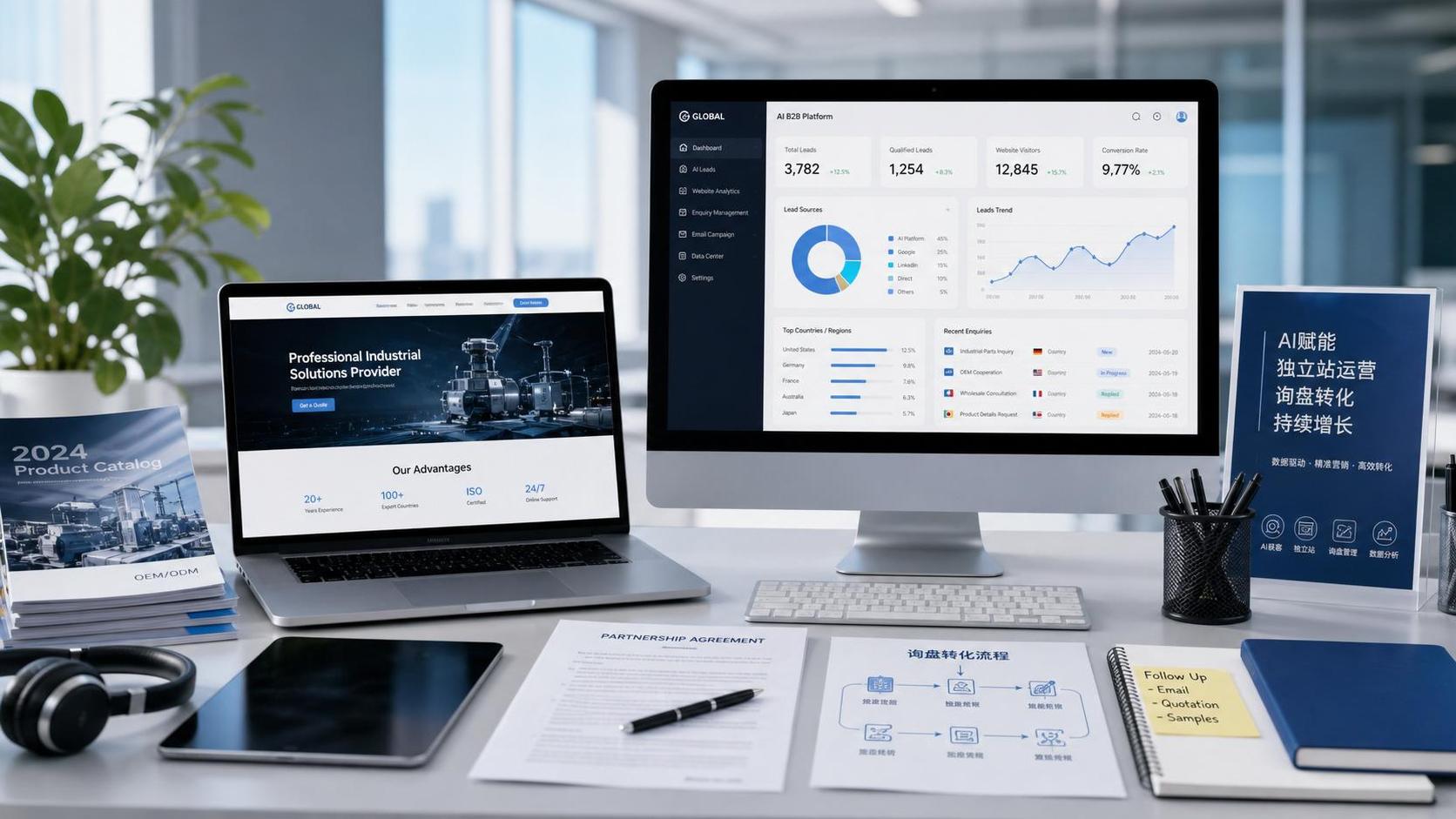
Taking AI-driven platforms such as YiYingBao as an example, its cloud intelligent website-building, cross-border e-commerce mall, AI advertising marketing, and AI+SEO/GEO optimization capabilities are not just about “building a website,” but about giving the website the conditions to be discovered, indexed, and converted.
Which Cross-Border Scenarios Favor Platforms, and Which Favor Websites
There is no single answer for AI B2B platforms in cross-border e-commerce. Different industries, order values, and regional strategies create large differences in suitability. Usually, the judgment can be made based on business goals.
Situations More Suitable for Platform Priority
- New product categories going overseas for the first time and needing market demand validation.
- Clear SKU, strong price competition, and short communication paths.
- The internal team wants to obtain inquiry samples first and then optimize the sales script.
Situations More Suitable for Website Priority
- The business relies on brand trust and long-term cooperation.
- Multilingual official websites, case pages, and localized content are required.
- The goal is to synchronize Google SEO, advertising, and social media traffic generation.
The more common and more stable approach is actually a combined strategy. The platform is responsible for short-term reach, while the independent website is responsible for content carry and asset accumulation; together, the two create clearer investment decisions through data feedback.
What Metrics Should Be Focused on During Evaluation
Rather than broadly discussing whether AI B2B platforms for cross-border e-commerce are “good or not,” it is more effective to establish a set of comparable metrics. Only then can channel popularity and real returns be separated.
- Inquiry efficiency: not the number of leads, but the proportion entering quotation or sample stages.
- Average transaction cycle: how long it takes from first contact to first order.
- Customer acquisition structure: whether the proportions of platform, organic search, advertising, and social media are healthy.
- Content carrying capacity: whether the website can support multilingual, multi-page, and multi-scenario conversions.
- Long-term marginal cost: whether customer acquisition cost shows a downward trend as content accumulates.
If existing channels already show rising costs, declining effective leads, or insufficient brand search volume, it indicates that the single-platform model may be nearing its limit and that a new independent website and marketing system needs to be configured.
The Better Next Step Is Not Either-Or
Returning to the original question, whether an AI B2B platform for cross-border e-commerce is suitable for growth usually does not have an absolute yes-or-no answer. It is more like a puzzle piece, and the value depends on what kind of growth structure it is placed in.
If the goal is to obtain market feedback as quickly as possible, the platform can be used first; if the goal is to build a more controllable overseas customer acquisition system, the independent website must be planned in parallel, especially with multilingual development, SEO, landing pages, and AI search visibility in mind.
A more practical approach is to first sort out three things: where current leads come from, which stage the transaction stalls at, and which content most drives customer decisions. Once these three points are clear, comparing platform investment and website investment will produce a judgment closer to real ROI.
When website development and the marketing system can operate in coordination, cross-border growth is no longer just about “buying traffic,” but about gradually building one’s own customer entry point, content assets, and conversion rhythm. This is the core issue worth putting on the table when evaluating AI B2B platforms for cross-border e-commerce.
Related Articles
 How to Choose an SEO Optimization System? A Checklist and Evaluation Criteria for Multi-Site Operations Teams
 Is an AI B2B platform suitable for cross-border e-commerce? A comparison of lead generation, sales cycle, and independent site model
 How to choose a responsive website development company in Zhejiang's foreign trade sector? Look at quotations, case studies, and after-sales service for these key points


Related Products
 EasyCamp SaaS Smart Website Marketing SystemE-Yingbao SaaS Smart Website Marketing System: AI-powered, zero-code website building. Rapidly launch multilingual independent e-commerce sites in just 10 minutes. Global server acceleration and AI-driven SEO optimization empower businesses to efficiently connect with global markets. The seamless integration of technology and user-friendly operation makes building e-commerce sites incredibly simple.
 AI+SEM Intelligent Advertising Marketing SystemAI+SEM drives intelligent ad creation, empowering full-funnel precision advertising marketing. The system automatically generates weekly/monthly reports, AI recommends keywords and target countries, monitors core metrics in real-time with intelligent alerts, and enables one-click high-conversion ad solutions to help quickly acquire customers and improve ROI.
 AI+SEO Dual Engine Optimization ServiceEasyWin AI+SEO Dual Engine Optimization System leverages AI-powered keyword mining, content generation, and comprehensive technical optimization to help foreign trade enterprises acquire high-quality organic traffic, significantly improving search rankings and conversion rates.
 AI+SNS Social Media Marketing SystemYingbao AI+SNS Social Media Marketing System - Precision social capture for the social media era. Supports one-click content synchronization across major platforms like Facebook and LinkedIn. AI intelligently rewrites posts for enhanced relevance. 24/7 AI customer service and user profiling analysis empower businesses to efficiently expand into global markets.
 AI+SEO营销解决方案易营宝AI+SEO营销解决方案,通过AI批量写作、智能生成TDK、精准关键词扩词等功能,全面优化网站SEO效果,提升流量与转化率。助力企业构建高效智能网站新生态。
 AI+SEM Advertising Marketing SolutionsAI+SEM Advertising Marketing Solution leverages AI technology to deeply empower SEM ad campaigns. It automatically generates weekly/monthly reports using AI, presenting account data across multiple dimensions for comprehensive insights into campaign performance and trends. The system precisely recommends keywords and target countries, intelligently generates high-conversion ad copy, and enables one-click activation of efficient campaign plans to help businesses rapidly acquire customers. Simultaneously, it monitors core metrics in real time, intelligently identifies abnormal fluctuations, and issues timely alerts to ensure stable, high-return advertising results.
 Domain Name ServicesEasyWin provides professional domain name services, including intelligent queries, one-stop registration, brand protection, and full lifecycle management, helping businesses build a digital brand image.
 EasyOperate B2C Cross-Border E-Commerce Platform & Independent WebsiteEasyStore B2C Cross-border E-commerce Independent Store is an intelligent website building and cross-border e-commerce integrated solution independently developed by EasyStore Information Technology (Beijing) Co., Ltd. The system is specially designed for small and medium-sized as well as large export enterprises, integrating 'website building, operation, marketing, advertising, and conversion' into one, helping enterprises quickly establish cross-border e-commerce independent stores to achieve brand globalization and global sales growth.
The platform supports multiple languages, multiple currencies, and multi-channel marketing, with built-in AI intelligent translation and SEO optimization systems, suitable for mainstream markets such as Southeast Asia, Europe and America, Latin America, and the Middle East, assisting Chinese manufacturing enterprises in efficiently deploying international e-commerce strategies. SSL证书易营宝提供专业SSL安全证书服务,包括单域名和泛域名证书,确保网站数据传输加密、身份验证和完整性保护,助力企业建立安全可信的在线业务环境。









