









- What stages does the cross-border services ecosystem include? How do website building, promotion, payment, and compliance work togetherJun 22, 2026View details
- How will email marketing costs change in 2026Jun 22, 2026View details
- The China-US tariff arrangement has reached a preliminary consensus, and the trade association will be establishedJun 15, 2026View details
- Should overseas brand marketing start with ads or contentJun 21, 2026View details
- What determines B2C cross-border e-commerce website development costs? A breakdown of features, interfaces, and deployment methodsJun 17, 2026View details
- China-Morocco zero-tariff access, a breakthrough in the cost of Moroccan goods exports to ChinaJun 11, 2026View details
- What signal should be released for the suspension of exports to JapanJun 10, 2026View details
- China's May LNG imports rebounded, with increased volumes from Russia and Canada filling the Middle East supply gapJun 10, 2026View details
India soybean export tax post, compliance label as foreign trade site front-end item
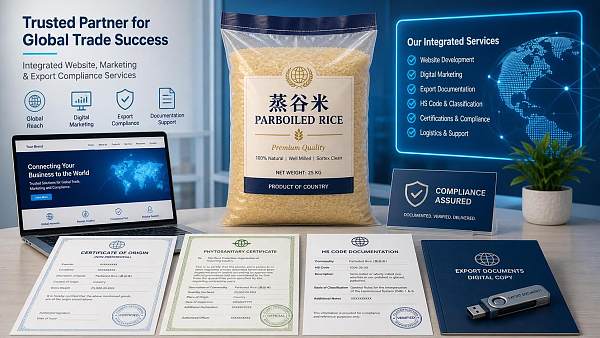
Starting June 15, 2026, India will impose a 20% export tariff on boiled rice. Against the backdrop of the previous ban on broken rice and the 20% export tariff on white rice, this change will not only affect the pace of U.S. agricultural trade, but also make the review of country of origin certificates, phytosanitary certificates, and HS code compliance at the import end even stricter. For exporters, buyers, supply chain service providers, and enterprises building foreign trade websites, what matters now is no longer just price and delivery arrangements, but whether product information display, electronic certificate management, and compliance verification capabilities can keep pace.
Contents of this change that have been clearly implemented
The confirmed information shows that the Indian government will impose a 20% export tariff on boiled rice starting June 15, 2026. This measure, when added to the previous ban on broken rice and the 20% export tariff on white rice, means that the rules governing rice-related exports to the United States will continue to tighten. At the same time, the event summary also clearly states that global rice supply chain restructuring is accelerating, and importing countries are increasingly strict in reviewing country of origin certificates, phytosanitary certificates, and HS code compliance. Foreign trade websites need to embed verifiable compliance metadata on product pages and provide an entry point for electronic certificate downloads.
The impact is spreading along the trade and delivery chain
Export businesses are first facing tighter document and declaration synchronization
From an industry perspective, enterprises directly engaged in exports may feel the impact first. The reason lies not only in the tariff itself, but also in the cumulative effect of the rules related to boiled rice, broken rice, and white rice. Product classification, HS code usage, customs declaration data preparation, and contract execution all require more rigorous cross-checking. For such enterprises, the impact is mainly reflected in quotation logic, document preparation, customer explanation costs, and compliance review before delivery.
Purchasers and channel-side companies are paying more attention to verifiable source information
For purchasers and channel-distribution companies, policy changes will be directly transmitted to supplier screening and order confirmation. Observably, when importing countries tighten their review of country of origin certificates and phytosanitary certificates, purchasers usually pay more attention to whether the materials are complete, whether the information is consistent, and whether downloads are convenient. If product pages only provide basic descriptions and lack verifiable compliance metadata, subsequent inquiries, comparisons, and internal approvals may slow down.
Supply chain service providers need to take on more compliance validation work
For supply chain service companies that handle customs declarations, certificate circulation, and delivery coordination, such policy changes mean increased pressure in both front-end consultation and back-end review. Their focus is not only on whether goods flow smoothly, but also on whether information such as country of origin certificates, phytosanitary certificates, and HS codes can remain consistent across different documents and systems, so as to reduce the risk of repeated confirmation during delivery.
Website development and digital presentation are no longer just a marketing issue
The event summary has already given a clear signal: foreign trade websites need to embed verifiable compliance metadata and an electronic certificate download entry on product pages. Analysis shows that this means product pages on foreign trade websites for agricultural products are moving from simple display pages toward compliance interfaces. For enterprises using AI website building or batch-generated product pages, tag fields, certificate associations, document version management, and download permission settings all need to be included in the development scope, rather than remaining only at the level of images, parameters, and price descriptions.
Which practical areas should enterprises supplement now
First check whether product pages have compliance fields
What is most worth paying attention to at present is whether the boiled-rice-related pages on the enterprise website have already reserved key information fields such as country of origin, phytosanitary inspection, and HS code, and whether these fields can be called, updated, and verified stably. If the page structure cannot carry this information, then even if offline materials are complete, online presentation may still become a bottleneck for inquiry conversion and compliance communication.
Incorporate electronic certificate entry into delivery preparation
From the perspective of the requirements for electronic certificate download entry, this means the boundary between product display and delivery support is shrinking. Enterprises can focus on certificate file naming conventions, version updates, invalid replacement, and access path management to avoid issues where customers encounter inconsistent or untraceable materials when retrieving files. Since the input information does not provide a more detailed execution path, this is more suitable as a prompt item rather than a fixed conclusion.
Synchronously review the consistency between HS codes and page descriptions
Under the backdrop of overlapping rules, whether the product name, specification description, declaration elements, and HS code expressions on the page are consistent will affect customer understanding and subsequent document handoff. For export enterprises, procurement coordination teams, and website service providers, what should be emphasized now is whether the content management mechanism can support unified updates, rather than simply adding a few tag fields.
Continue to pay attention to subsequent execution path changes
Observationally, this event has already shown a clear execution signal, but the review scope in different markets, for different customers, and in different document scenarios still requires continued observation. When arranging procurement plans, delivery cycles, and customer communication, enterprises should leave room to respond to changes in documentary requirements and avoid treating execution details that are not yet fully clear as fixed rules too early.
This is more like an execution signal for another round of compliance advancement
From an observational and judgmental perspective, the meaning of this piece of information is not only that “India is imposing a tariff on boiled rice,” but that compliance review in agricultural trade is moving a step further forward. In the past, some enterprises viewed country of origin certificates, phytosanitary certificates, and HS codes as issues at the customs declaration or shipment stage, but from the information released in this summary, the related requirements have extended to the customer pre-screening stage, website product page presentation, and electronic material retrieval process. A more appropriate understanding is that policy changes are pushing enterprises to turn compliance information into content that is searchable, downloadable, and verifiable, rather than merely internal archive documents.
Practical implications for market participants
Taken together, this change is clearly a policy move already implemented, and as for the specific execution method around country of origin certificates, phytosanitary certificates, HS code review, and website compliance tag development, it still needs to be continuously observed in combination with subsequent market feedback. For relevant enterprises, it is now more appropriate to understand it as an execution signal that has already begun to affect the front end of transactions and delivery preparation: while attaching importance to the tariff change itself, they must also keep pace with product information, electronic certificate, and compliance presentation capabilities.
Basis of this article and direction for subsequent verification
This article was generated based on the title, the time of occurrence, and the event summary provided by the user, with the content expanded around the information already provided. Such events can usually be verified further by combining official announcements, information released by regulatory agencies, customs or trade authorities, industry association information, standard organization documents, and reports from authoritative media. It should be noted that no specific official source link was provided in the input, so the relevant details, certification execution path, changes in tender documents, industry feedback, and actual enterprise implementation still require further tracking and confirmation.
Related Articles
 Are you really hitting the right target with Google FB for truck bed exports?
 It's easy to turn a foreign trade website into a piece of art, but it's the ultimate culprit behind your order decline
 Foreign trade website efficiency revolution! Yiyingbao component upgrade + inquiry optimization, inquiries surge!



Related Products
 EasyCamp SaaS Smart Website Marketing SystemE-Yingbao SaaS Smart Website Marketing System: AI-powered, zero-code website building. Rapidly launch multilingual independent e-commerce sites in just 10 minutes. Global server acceleration and AI-driven SEO optimization empower businesses to efficiently connect with global markets. The seamless integration of technology and user-friendly operation makes building e-commerce sites incredibly simple.
 AI+SEM Intelligent Advertising Marketing SystemAI+SEM drives intelligent ad creation, empowering full-funnel precision advertising marketing. The system automatically generates weekly/monthly reports, AI recommends keywords and target countries, monitors core metrics in real-time with intelligent alerts, and enables one-click high-conversion ad solutions to help quickly acquire customers and improve ROI.
 AI+SEO Dual Engine Optimization ServiceEasyWin AI+SEO Dual Engine Optimization System leverages AI-powered keyword mining, content generation, and comprehensive technical optimization to help foreign trade enterprises acquire high-quality organic traffic, significantly improving search rankings and conversion rates.
 AI+SNS Social Media Marketing SystemYingbao AI+SNS Social Media Marketing System - Precision social capture for the social media era. Supports one-click content synchronization across major platforms like Facebook and LinkedIn. AI intelligently rewrites posts for enhanced relevance. 24/7 AI customer service and user profiling analysis empower businesses to efficiently expand into global markets.
 AI+SEO营销解决方案易营宝AI+SEO营销解决方案,通过AI批量写作、智能生成TDK、精准关键词扩词等功能,全面优化网站SEO效果,提升流量与转化率。助力企业构建高效智能网站新生态。
 AI+SEM Advertising Marketing SolutionsAI+SEM Advertising Marketing Solution leverages AI technology to deeply empower SEM ad campaigns. It automatically generates weekly/monthly reports using AI, presenting account data across multiple dimensions for comprehensive insights into campaign performance and trends. The system precisely recommends keywords and target countries, intelligently generates high-conversion ad copy, and enables one-click activation of efficient campaign plans to help businesses rapidly acquire customers. Simultaneously, it monitors core metrics in real time, intelligently identifies abnormal fluctuations, and issues timely alerts to ensure stable, high-return advertising results.
 Domain Name ServicesEasyWin provides professional domain name services, including intelligent queries, one-stop registration, brand protection, and full lifecycle management, helping businesses build a digital brand image.
 EasyOperate B2C Cross-Border E-Commerce Platform & Independent WebsiteEasyStore B2C Cross-border E-commerce Independent Store is an intelligent website building and cross-border e-commerce integrated solution independently developed by EasyStore Information Technology (Beijing) Co., Ltd. The system is specially designed for small and medium-sized as well as large export enterprises, integrating 'website building, operation, marketing, advertising, and conversion' into one, helping enterprises quickly establish cross-border e-commerce independent stores to achieve brand globalization and global sales growth.
The platform supports multiple languages, multiple currencies, and multi-channel marketing, with built-in AI intelligent translation and SEO optimization systems, suitable for mainstream markets such as Southeast Asia, Europe and America, Latin America, and the Middle East, assisting Chinese manufacturing enterprises in efficiently deploying international e-commerce strategies. SSL证书易营宝提供专业SSL安全证书服务,包括单域名和泛域名证书,确保网站数据传输加密、身份验证和完整性保护,助力企业建立安全可信的在线业务环境。









