









- How to view pricing in the global traffic ecosystem? Cost comparison of search, social media, and content channel advertisingJul 06, 2026View details
- How to assess foreign trade website development trends?Looking at 2026 changes from multilingual,AI content to conversion pathsJul 04, 2026View details
- What are the new trends in multilingual marketing data analytics tools in 2026? Focus on attribution、automation and complianceJul 04, 2026View details
- Is Brand Globalization Marketing Consulting Worth Buying? At What Stage Should Companies Bring It InJul 01, 2026View details
- Cross-Border Marketing Trend Research: Why More and More Companies Are Starting to Deploy AI Search and GEO OptimizationJun 30, 2026View details
- Cross-Border Marketing Trend Research: How Independent Sites, AI Content, and Short-Video Customer Acquisition Are ChangingJun 30, 2026View details
- How Can a Brand Updates Page Be Made More SEO-Friendly? Analysis of Update Frequency, Content Structure, and Internal Linking StrategyJun 28, 2026View details
- What stages does the cross-border services ecosystem include? How do website building, promotion, payment, and compliance work togetherJun 22, 2026View details
Where to Start with an Enterprise Self-Service Website Builder Tutorial Without Taking Detours
Want to learn an enterprise self-service website building system tutorial, but always get stuck by processes, configurations, and marketing coordination, and often the problem is not that the tool is too difficult, but that the starting sequence is wrong. For integrated website + marketing service scenarios, website building is not just about putting a few pages online independently, but about simultaneously considering customer acquisition, conversion, content management, and subsequent optimization. This article will start from real application scenarios and sort out the correct way to get started with an enterprise self-service website building system tutorial, helping make the building process clearer and the site more useful after launch.
First determine which website building scenario you are in, then start the enterprise self-service website building system tutorial
When many people learn an enterprise self-service website building system tutorial, the first step they take is to directly choose a template, buy a domain name, and fill in content. This may seem convenient, but it often leads to rework later. The real way to avoid detours is to first determine what type of business scenario you currently belong to, and then decide the website structure and feature priorities.
Common differences often come from different business goals. Some people focus more on brand presentation, some focus more on acquiring inquiries, and others need to undertake advertising traffic, build a multilingual layout, and even simultaneously connect search optimization and content operations.
This is also why an enterprise self-service website building system tutorial cannot only talk about technical operations. It is more like a complete path for business implementation. Especially under the trend of integrated marketing services, a website is both a content hub and a data entry point and conversion tool.
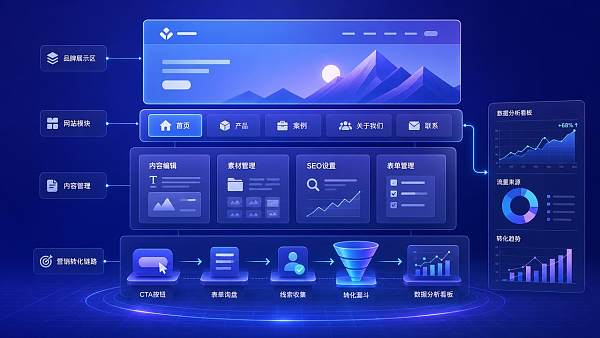
Scenario 1: Brand showcase website, with a focus on image and trust
If the main goal is to showcase corporate strength, then the focus of the enterprise self-service website building system tutorial should be on section planning, case presentation, visual consistency, and mobile experience. The homepage does not need to pile up too many features, but it must clearly convey business scope, service advantages, and cooperation value.
In this scenario, a common misunderstanding is having many pages but very few key points. After visitors enter the website, they see news, galleries, and announcements, but cannot find the core services for a long time. As a result, the website goes online, but the brand is not truly remembered.
Scenario 2: Lead generation and conversion website, with a focus on inquiries and lead capture
If the website goal leans toward lead generation, then the enterprise self-service website building system tutorial should first be built around the conversion path. Landing pages, forms, consultation buttons, case proof, service processes, and FAQs are all indispensable.
In this type of scenario, the homepage is not the only focus. More importantly, every traffic entry point should be able to quickly lead to the corresponding page, and the lead submission or consultation action should be completed within two to three steps, avoiding loss caused by an overly long path.
Scenario 3: Content growth website, with a focus on SEO and continuous updates
If the website undertakes the task of growing search traffic, then the enterprise self-service website building system tutorial cannot ignore section hierarchy, article categorization, tag logic, link structure, and the basics of page indexing. If the content system is built incorrectly, then no matter how many articles are written later, it will still be difficult to form effective accumulation.
For example, title standards, description settings, internal link layout, and topic aggregation pages are all important details that affect subsequent organic traffic. Yiyingbao Information Technology (Beijing) Co., Ltd. has long been deeply engaged in coordinated solutions for intelligent website building, SEO optimization, social media marketing, and advertising placement, precisely because only when a website is combined with the marketing funnel can it more easily form sustained growth.
Under different business scenarios, where are the requirement differences in an enterprise self-service website building system tutorial
Although both involve website building, different scenarios have different requirements for system functions. First understand the differences, then make configuration choices, which can significantly reduce repeated adjustments.
In actual deployment, the part of the enterprise self-service website building system tutorial that is most easily misunderstood is treating “the more features, the better” as the standard. In fact, features should be increased or decreased around business goals, rather than blindly stacking modules.
Breaking down the enterprise self-service website building system tutorial step by step, which step should be done first
If you truly want to avoid detours, you can proceed in the following order. This sequence applies to most practical scenarios of an enterprise self-service website building system tutorial.
- First define the goal: brand showcase, lead generation and conversion, or content growth.
- Then define the structure: homepage, service pages, case pages, article pages, and contact page.
- When choosing a template, look at scalability, not just aesthetics.
- Improve the basic settings: domain name, navigation, forms, and mobile adaptation.
- Set up SEO simultaneously to avoid rework after launch.
- Integrate marketing actions, such as consultation, tracking, and conversion statistics.
Among these, the most important step is the second step, structure planning. Because the final implementation effect of the enterprise self-service website building system tutorial depends to a large extent on whether the information architecture is reasonable. If the structure is clear, subsequent content, optimization, and advertising can all connect smoothly.
When organizing content, some enterprises also simultaneously research materials on operations, finance and taxation, or management topics, such as referring to A Brief Discussion on Problems and Countermeasures in Corporate Tax Planning, helping the on-site content better align with real business scenarios, thereby improving professionalism and page readability.
Facing integrated marketing needs, how should the enterprise self-service website building system tutorial adapt
Simply building the website only completes half the work. A truly effective enterprise self-service website building system tutorial must also consider how the website and marketing tools work together. Otherwise, even if traffic comes after the pages go live, it will still be difficult to accumulate.
- Search optimization scenario: article pages, topic pages, and keyword layout must be designed in advance.
- Advertising placement scenario: different advertising campaigns correspond to different landing pages.
- Social media traffic-driving scenario: mobile loading speed and form simplicity are more critical.
- Repeat-visit operation scenario: message submission, callbacks, and secondary conversion entry points should be retained.
As a global digital marketing service provider driven by artificial intelligence and big data, Yiyingbao Information Technology (Beijing) Co., Ltd. has long served a variety of enterprise scenarios, and experience shows that if websites, SEO, social media, and advertising are separated from each other, customer acquisition costs are usually higher; if integrated planning is carried out in the early stage of website building, subsequent growth efficiency will be more stable.
Which misjudgments are most likely to lead the enterprise self-service website building system tutorial astray
The first misjudgment is treating website building as a one-time task. In fact, what an enterprise self-service website building system tutorial corresponds to is the building of continuous operational capability, especially since content updates, data observation, and page iteration all require long-term execution.
The second misjudgment is only looking at backend functions and not frontend conversion. Many systems seem to have many configurations, but visitors cannot find key buttons, pages load slowly, and the mobile experience is poor, ultimately affecting real results.
The third misjudgment is ignoring content preparation. The most time-consuming part of an enterprise self-service website building system tutorial is usually not clicking modules, but organizing service selling points, cases, qualifications, Q&A, and articles. If the content is not prepared in advance, the launch time is often repeatedly delayed.
To implement the enterprise self-service website building system tutorial, the next step can be done directly like this
If you are now preparing to start website construction, you can first complete three things. First, clearly list the website goals; second, draw out five to eight core pages; third, determine whether SEO, advertising, or social media traffic generation should be carried out simultaneously after launch.
Then when you enter the study of the enterprise self-service website building system tutorial, you will not be led by templates, plugins, and backend settings, but will be able to make correct judgments around business scenarios. Building the website quickly is very important, but even more important is that after launch, it can continuously bring display, inquiries, and growth.
In summary, if you want to avoid detours in an enterprise self-service website building system tutorial, the key is not having more techniques, but having the right sequence. First look at the scenario, then define the needs; first build the structure, then assign functions; first consider marketing, then talk about expansion. By firmly laying these foundations, a corporate website can more easily become a truly operable and growth-oriented digital asset.
Related Articles



Related Products
 EasyCamp SaaS Smart Website Marketing SystemE-Yingbao SaaS Smart Website Marketing System: AI-powered, zero-code website building. Rapidly launch multilingual independent e-commerce sites in just 10 minutes. Global server acceleration and AI-driven SEO optimization empower businesses to efficiently connect with global markets. The seamless integration of technology and user-friendly operation makes building e-commerce sites incredibly simple.
 AI+SEM Intelligent Advertising Marketing SystemAI+SEM drives intelligent ad creation, empowering full-funnel precision advertising marketing. The system automatically generates weekly/monthly reports, AI recommends keywords and target countries, monitors core metrics in real-time with intelligent alerts, and enables one-click high-conversion ad solutions to help quickly acquire customers and improve ROI.
 AI+SEO Dual Engine Optimization ServiceEasyWin AI+SEO Dual Engine Optimization System leverages AI-powered keyword mining, content generation, and comprehensive technical optimization to help foreign trade enterprises acquire high-quality organic traffic, significantly improving search rankings and conversion rates.
 AI+SNS Social Media Marketing SystemYingbao AI+SNS Social Media Marketing System - Precision social capture for the social media era. Supports one-click content synchronization across major platforms like Facebook and LinkedIn. AI intelligently rewrites posts for enhanced relevance. 24/7 AI customer service and user profiling analysis empower businesses to efficiently expand into global markets.
 AI+SEO营销解决方案易营宝AI+SEO营销解决方案,通过AI批量写作、智能生成TDK、精准关键词扩词等功能,全面优化网站SEO效果,提升流量与转化率。助力企业构建高效智能网站新生态。
 AI+SEM Advertising Marketing SolutionsAI+SEM Advertising Marketing Solution leverages AI technology to deeply empower SEM ad campaigns. It automatically generates weekly/monthly reports using AI, presenting account data across multiple dimensions for comprehensive insights into campaign performance and trends. The system precisely recommends keywords and target countries, intelligently generates high-conversion ad copy, and enables one-click activation of efficient campaign plans to help businesses rapidly acquire customers. Simultaneously, it monitors core metrics in real time, intelligently identifies abnormal fluctuations, and issues timely alerts to ensure stable, high-return advertising results.
 Domain Name ServicesEasyWin provides professional domain name services, including intelligent queries, one-stop registration, brand protection, and full lifecycle management, helping businesses build a digital brand image.
 EasyOperate B2C Cross-Border E-Commerce Platform & Independent WebsiteEasyStore B2C Cross-border E-commerce Independent Store is an intelligent website building and cross-border e-commerce integrated solution independently developed by EasyStore Information Technology (Beijing) Co., Ltd. The system is specially designed for small and medium-sized as well as large export enterprises, integrating 'website building, operation, marketing, advertising, and conversion' into one, helping enterprises quickly establish cross-border e-commerce independent stores to achieve brand globalization and global sales growth.
The platform supports multiple languages, multiple currencies, and multi-channel marketing, with built-in AI intelligent translation and SEO optimization systems, suitable for mainstream markets such as Southeast Asia, Europe and America, Latin America, and the Middle East, assisting Chinese manufacturing enterprises in efficiently deploying international e-commerce strategies. SSL证书易营宝提供专业SSL安全证书服务,包括单域名和泛域名证书,确保网站数据传输加密、身份验证和完整性保护,助力企业建立安全可信的在线业务环境。









