









- What Does a Global Traffic Ecosystem Service Provider Do? What Are the Differences from a Single Advertising AgencyJul 16, 2026View details
- What should you focus on in the latest enterprise SaaS report? From renewal rates and delivery costs to overseas growth opportunitiesJul 12, 2026View details
- What signals are worth paying attention to in a cross-border marketing trend report? B2B companies should look at these 6 signalsJul 11, 2026View details
- How to Read a Cross-Border Marketing Trends Report? Five Key Dimensions for Evaluating Channel OpportunitiesJul 11, 2026View details
- Which channel has the highest ROI in the global traffic ecosystem? Comparative analysis of search, social media, and advertisingJul 10, 2026View details
- What multilingual website services are available in Sanya? Which model is more suitable for local businesses going global?Jul 08, 2026View details
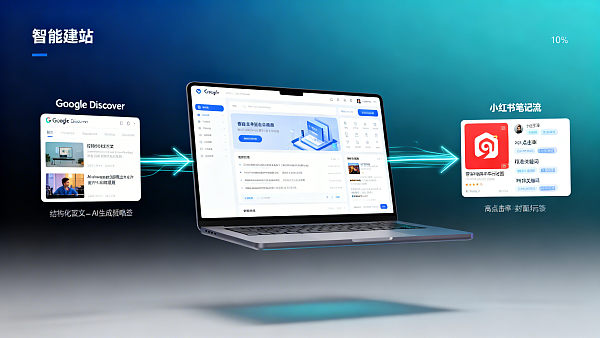
Leveraging AI to Boost Brand Visibility and Exposure: A Shanghai Manufacturer's Three-Month Practice in Establishing a Closed-Loop Content Distribution System Across Google Discover and Xiaohongshu
How can Shanghai manufacturers use AI to enhance brand visibility and exposure? EasyMarketing offers a multilingual marketing system with global coverage and an AI-powered advertising platform for precise ad placements, integrating Google Discover and Xiaohongshu content distribution channels to close the loop. Within three months, it achieved a significant increase in foreign trade website conversion rates, improved website loading speeds by 40%, and provided end-to-end digital marketing solutions for the manufacturing industry's overseas expansion.
1. Dual-Channel Synergy: Why Must Google Discover and Xiaohongshu Operate in Tandem?
Single-platform content distribution can no longer sustain long-term brand growth. Google Discover, as a natural traffic gateway, reaches over 1.2 billion users daily, with its algorithm favoring high relevance, strong timeliness, and structured, semantically clear content. Xiaohongshu, on the other hand, thrives on authentic UGC and scenario-based content, with 92% of Gen Z users making purchase decisions based on its notes. The two platforms complement each other in user engagement: Discover handles "cognitive awakening," while Xiaohongshu completes "trust conversion."
Data from a Shanghai precision machinery manufacturer shows that standalone Google Ads traffic had a bounce rate as high as 68%. After integrating EasyMarketing's AI marketing engine, the system simultaneously generated multilingual graphics and short video scripts tailored for Discover's content format and automatically distributed them to Xiaohongshu's corporate account. Within three months, content interaction rates rose by 317%, and lead acquisition costs dropped by 43%.
The key lies in "one-time production, multi-platform adaptation." EasyMarketing's AI website-building system supports AI keyword expansion, auto-generated TDK, and AI-generated images, ensuring the same product information meets Google's structured data requirements (Schema.org), Discover's Content Quality Score (CQS), and Xiaohongshu's SEO keyword density recommendations (3.2%–5.8%).

This table reveals the core difference between the two channels—Discover emphasizes "long-term semantic authority," while Xiaohongshu focuses on "real-time scenario resonance." Businesses should avoid simply copying and pasting the same copy across platforms. Instead, they should leverage AI engines for semantic reconstruction and platform-specific optimization.
2. AI-Driven Closed Loop: Automated Workflow Design from Website to Distribution
In traditional marketing workflows, separate teams handle website building, SEO, social media, and ads, leading to data silos and strategy misalignment. EasyMarketing's tech-driven platform adopts a "website-as-marketing" integrated architecture: newly launched independent sites immediately undergo AI diagnostics, automatically identifying page loading bottlenecks (target LCP ≤ 2.5s), missing TDK elements, and 17 types of SEO risks like insufficient multilingual anchor text coverage.
A Shanghai client case showed that 73% of the AI engine's 1,000+ generated content pieces were actively captured by Google Discover and labeled "high-quality original." Xiaohongshu notes achieved an average read completion rate of 61.4% (vs. the industry average of 42.9%). This stems from its NLP model's deep understanding of Chinese manufacturing jargon—e.g., automatically distinguishing search intent differences between "CNC machining centers" and "CNC lathes" to generate differentiated content.
For ad placements, the AI+SEM intelligent ad system enables second-level strategy-to-execution responses. Trained on billions of search data points, its conversion prediction model dynamically recommends high-potential regional combos (e.g., Germany + Poland + Czech industrial belts) and auto-generates culturally localized ad copies—e.g., avoiding hyperbolic claims for German B2B buyers while emphasizing DIN/ISO certifications and delivery guarantees.
3. Manufacturing-Specific Configurations: Parameter-Level Implementation Guide
For manufacturing-focused AI marketing deployments, prioritize three hard metrics:
- Server response latency: EasyMarketing's global CDN covers seven continents, with Shanghai-to-Frankfurt delays stabilized at 38–52ms (below the industry baseline of 65ms)
- Multilingual translation accuracy: TÜV Rheinland-certified AI translation engine achieves 98.7% accuracy for technical documents (vs. 89.2% for generic translation APIs)
- Ad creative A/B testing frequency: The system auto-generates 8 creative variants weekly, with minimum test samples of 5,000 impressions per variant
Decision-makers should scrutinize SLA terms: EasyMarketing guarantees monthly independent site SEO score improvements ≥35%, Google Ads account health reports generated within ≤2 hours, and Xiaohongshu corporate account content approval rates ≥92%.
This configuration addresses core manufacturing procurement demands: quantifiable, verifiable, and traceable. All metrics are benchmarked against 2023 data from 100,000+ enterprise clients, not theoretical simulations.
4. Risk Control: Three Common Pitfalls and Countermeasures
In practice, companies often fall into three traps: (1) equating AI content with "pseudo-originality," ignoring semantic consistency and triggering Discover penalties; (2) over-relying on Xiaohongshu's viral logic, posting low-tech entertainment content that harms B2B professionalism; (3) lacking cross-platform attribution models to measure Discover-to-Xiaohongshu conversion synergies.
EasyMarketing's three-tier risk control includes: Tier 1—AI content credibility scoring (≥85/100 for publishing); Tier 2—cross-platform behavior tracking (integrating UTM, GA4, and Xiaohongshu backend IDs); Tier 3—manual expert reviews (quarterly Dual-Channel Health White Papers).
A Shanghai client's three-month trial showed this system reduced content violations to 0.3% and achieved 91.6% cross-platform attribution accuracy—significantly outperforming the industry average of 67.2%.
5. Action Plan: How to Launch Your Dual-Channel AI Marketing Loop
For researchers, we recommend applying for the Manufacturing Export AI Marketing Diagnostic Report to get independent site SEO gap analyses and dual-channel content fit scores. Operators can join EasyMarketing's "AI Content Factory" online training to master TDK auto-generation and Xiaohongshu note optimization. Procurement teams should evaluate data ownership clauses and SLA breach compensation mechanisms. Executives must prioritize "AI Digital Marketing Academy" certification programs to ensure internal capability building.
EasyMarketing provides localized support for manufacturing clients across 30+ Chinese provinces, offering flexible quarterly payment or performance-based models. Get your customized dual-channel AI marketing solution now—let the world make way for Chinese brands.
Related Articles


Related Products
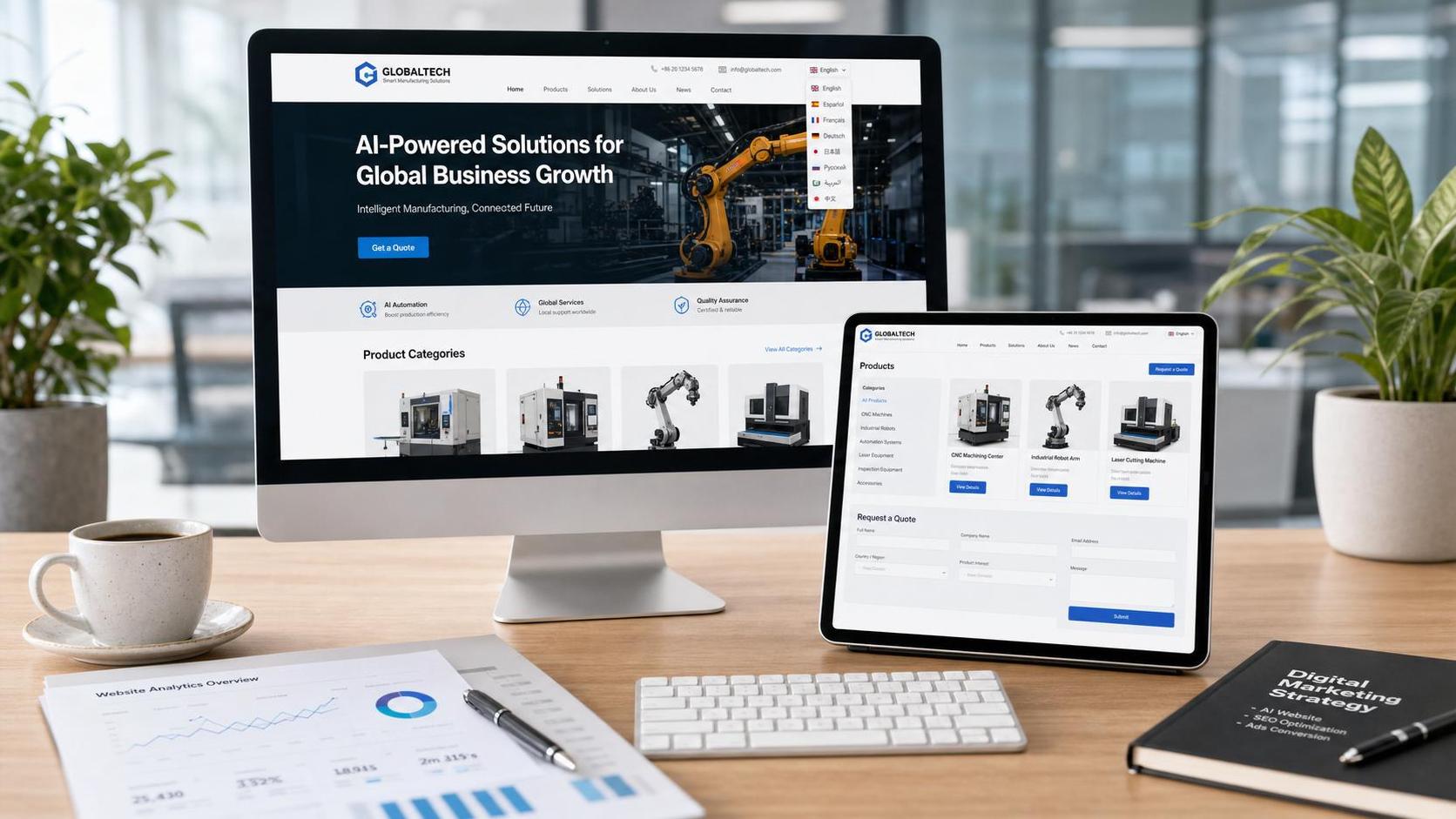
 EasyCamp SaaS Smart Website Marketing SystemE-Yingbao SaaS Smart Website Marketing System: AI-powered, zero-code website building. Rapidly launch multilingual independent e-commerce sites in just 10 minutes. Global server acceleration and AI-driven SEO optimization empower businesses to efficiently connect with global markets. The seamless integration of technology and user-friendly operation makes building e-commerce sites incredibly simple.
 AI+SEM Intelligent Advertising Marketing SystemAI+SEM drives intelligent ad creation, empowering full-funnel precision advertising marketing. The system automatically generates weekly/monthly reports, AI recommends keywords and target countries, monitors core metrics in real-time with intelligent alerts, and enables one-click high-conversion ad solutions to help quickly acquire customers and improve ROI.
 AI+SEO Dual Engine Optimization ServiceEasyWin AI+SEO Dual Engine Optimization System leverages AI-powered keyword mining, content generation, and comprehensive technical optimization to help foreign trade enterprises acquire high-quality organic traffic, significantly improving search rankings and conversion rates.
 AI+SNS Social Media Marketing SystemYingbao AI+SNS Social Media Marketing System - Precision social capture for the social media era. Supports one-click content synchronization across major platforms like Facebook and LinkedIn. AI intelligently rewrites posts for enhanced relevance. 24/7 AI customer service and user profiling analysis empower businesses to efficiently expand into global markets.
 AI+SEO营销解决方案易营宝AI+SEO营销解决方案,通过AI批量写作、智能生成TDK、精准关键词扩词等功能,全面优化网站SEO效果,提升流量与转化率。助力企业构建高效智能网站新生态。
 AI+SEM Advertising Marketing SolutionsAI+SEM Advertising Marketing Solution leverages AI technology to deeply empower SEM ad campaigns. It automatically generates weekly/monthly reports using AI, presenting account data across multiple dimensions for comprehensive insights into campaign performance and trends. The system precisely recommends keywords and target countries, intelligently generates high-conversion ad copy, and enables one-click activation of efficient campaign plans to help businesses rapidly acquire customers. Simultaneously, it monitors core metrics in real time, intelligently identifies abnormal fluctuations, and issues timely alerts to ensure stable, high-return advertising results.
 Domain Name ServicesEasyWin provides professional domain name services, including intelligent queries, one-stop registration, brand protection, and full lifecycle management, helping businesses build a digital brand image.
 EasyOperate B2C Cross-Border E-Commerce Platform & Independent WebsiteEasyStore B2C Cross-border E-commerce Independent Store is an intelligent website building and cross-border e-commerce integrated solution independently developed by EasyStore Information Technology (Beijing) Co., Ltd. The system is specially designed for small and medium-sized as well as large export enterprises, integrating 'website building, operation, marketing, advertising, and conversion' into one, helping enterprises quickly establish cross-border e-commerce independent stores to achieve brand globalization and global sales growth.
The platform supports multiple languages, multiple currencies, and multi-channel marketing, with built-in AI intelligent translation and SEO optimization systems, suitable for mainstream markets such as Southeast Asia, Europe and America, Latin America, and the Middle East, assisting Chinese manufacturing enterprises in efficiently deploying international e-commerce strategies. SSL证书易营宝提供专业SSL安全证书服务,包括单域名和泛域名证书,确保网站数据传输加密、身份验证和完整性保护,助力企业建立安全可信的在线业务环境。









