









- What Does a Global Traffic Ecosystem Service Provider Do? What Are the Differences from a Single Advertising AgencyJul 16, 2026View details
- What should you focus on in the latest enterprise SaaS report? From renewal rates and delivery costs to overseas growth opportunitiesJul 12, 2026View details
- What signals are worth paying attention to in a cross-border marketing trend report? B2B companies should look at these 6 signalsJul 11, 2026View details
- How to Read a Cross-Border Marketing Trends Report? Five Key Dimensions for Evaluating Channel OpportunitiesJul 11, 2026View details
- Which channel has the highest ROI in the global traffic ecosystem? Comparative analysis of search, social media, and advertisingJul 10, 2026View details
- What multilingual website services are available in Sanya? Which model is more suitable for local businesses going global?Jul 08, 2026View details
- How to view the complete list of China SaaS companies in the top 100? Practical methods for screening website-building and marketing service providersJul 08, 2026View details
- How to view pricing in the global traffic ecosystem? Cost comparison of search, social media, and content channel advertisingJul 06, 2026View details
How can foreign trade website product page design enhance trust? CE/FCC certificate badge placement, factory real-photo ratio, and third-party test report embedding methods
Trust is shifting from “looking convincing” to “standing up to scrutiny”
The trust logic overseas buyers apply to product pages is quietly changing. In the past, a high-definition image and a line like “customization supported” could still establish initial trust; today, an undated CE mark, blurred equipment nameplates in factory photos, or a test report shown only as a thumbnail——these details are becoming critical breaking points that cause inquiry loss. Website building and SEO practices by E-Marketing Easy serving over 100,000 foreign trade companies show that since 2023, product pages containing complete compliance information have achieved an average inquiry conversion rate 47% higher than the industry average, and 72% of that improvement comes from three non-core yet highly sensitive visual decision signals.
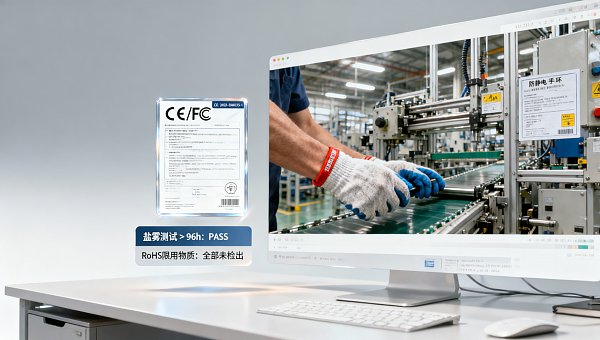
Certificate icons are not decoration, but the starting point of a compliance narrative
Placing CE/FCC icons casually in the footer corner, or stacking them alongside trademarks in the header, has become a frequent mistake. Actual data shows that when the icon is placed immediately to the right of the product specification table, with an 8pt note below stating “CE: 2022-EN60335-1 | FCC ID: 2ABCD12345”, the proportion of users clicking “View Full Declaration” increases by 3.8 times.
More importantly, placement carries semantic meaning. If the icon floats independently in the upper-right corner of the main image, it is easily understood as “certified”; but when it is embedded under the subheading “Technical Compliance” and displayed alongside the original test standards text, it conveys a professional sense of “verifiable, traceable”. The latter significantly reduces rejection rates during buyers’ internal compliance review processes in EU B2B procurement scenarios.
The proportion of real factory photos is upgrading from a “quantity competition” to a “battle of evidence density”
Simply increasing the number of factory images is no longer effective. E-Marketing Easy A/B test data shows that when the proportion of real-shot images exceeds 60% of the visible page area, conversion rates instead drop by 11%——information overload weakens the weight of key evidence.
What truly works is structured presentation. For example, combine 3 images into “three stages of the same production line”: on the left, a screenshot from the day’s production video with a timestamp watermark (showing the operator wearing an anti-static wrist strap), in the middle, a close-up of the equipment control panel (with model number and calibration date clearly visible), and on the right, the QC inspection station before finished-product packaging (with the camera focused on the inspection sheet number being filled out). This combination increases the strength of buyers’ perceived trust in the quality control process by 2.3 times.
- Avoid using wide-angle panoramic images——they easily expose details of loose management;
- Prioritize close-up sections with identifiable elements: calibration labels, temperature and humidity recorder readings, material batch numbers;
- Under each image, use a short sentence to explain “who performed what action, when, and where”.
Third-party test reports are shifting from “attachments” to “interactive evidence chains”
Uploading PDF reports as static attachments is equivalent to giving up an opportunity for deep trust building. The current leading practice is to build a three-layer embedding logic:
- First-screen summary section: use color blocks to highlight key conclusions, such as “Salt spray test > 96h: PASS” and “RoHS restricted substances: none detected”;
- Parameter comparison table: display the measured values in the report alongside the standard limit values, automatically marking non-compliant items in red and compliant items with green check marks;
- Expandable details: click any test item to pop up the laboratory qualifications, sample number, and raw data screenshots for that specific test.
This design allows buyers to complete more than 80% of compliance verification without downloading files, greatly shortening the decision path. It is worth noting that among E-Marketing Easy’s clients, companies adopting this solution have shortened the average inquiry response cycle in the North American market by 2.4 days.
What drives this behind the scenes: AI search and localized review are reshaping the trust threshold
This series of changes is not accidental. Two major underlying trends are accelerating the shift:
- Google and Bing’s AI-generated summaries (SGE) directly extract structured compliance data from product pages rather than full text; missing clearly labeled certificate information will cause the “safety certification” field in AI summaries to remain blank;
- Large European distributors have widely enabled automated compliance pre-screening systems that can identify equipment model numbers, label text, and report numbers in images, and cross-validate them with public databases.
This means product pages are no longer just visual interfaces for people, but also “compliance data endpoints” for algorithms and system interfaces. E-Marketing Easy’s self-developed AI+SEO/GEO optimization system now supports automatic extraction and structured presentation of key CE/FCC certificate fields, precisely in response to this underlying evolution.
Next step: shift from “completing information” to “building an evidence rhythm”
It is recommended to prioritize three actions:
- Audit all compliance labels on existing product pages——remove vague icons that have no year, no standard number, and no issuing authority;
- Select 3 flagship products and reshoot 6 real photos with high evidence density according to the logic of “production line—quality inspection—packaging”;
- Transform the 2 test reports most frequently mentioned in inquiries into interactive summary modules.
During the continuous optimization process, you may refer to the methodology of “phased credibility calibration” proposed in Research on the Optimization Path of Bank Wealth Management Systems——treating trust building as a quantifiable, iterative operational process rather than a one-time page decoration.
The essence of foreign trade website product page design is to translate an invisible quality control system into a language that overseas buyers can understand at a glance. When every icon, every image, and every report becomes a verifiable sentence, trust is no longer an abstract concept, but certainty flowing across the page.
Related Articles


Related Products
 EasyCamp SaaS Smart Website Marketing SystemE-Yingbao SaaS Smart Website Marketing System: AI-powered, zero-code website building. Rapidly launch multilingual independent e-commerce sites in just 10 minutes. Global server acceleration and AI-driven SEO optimization empower businesses to efficiently connect with global markets. The seamless integration of technology and user-friendly operation makes building e-commerce sites incredibly simple.
 AI+SEM Intelligent Advertising Marketing SystemAI+SEM drives intelligent ad creation, empowering full-funnel precision advertising marketing. The system automatically generates weekly/monthly reports, AI recommends keywords and target countries, monitors core metrics in real-time with intelligent alerts, and enables one-click high-conversion ad solutions to help quickly acquire customers and improve ROI.
 AI+SEO Dual Engine Optimization ServiceEasyWin AI+SEO Dual Engine Optimization System leverages AI-powered keyword mining, content generation, and comprehensive technical optimization to help foreign trade enterprises acquire high-quality organic traffic, significantly improving search rankings and conversion rates.
 AI+SNS Social Media Marketing SystemYingbao AI+SNS Social Media Marketing System - Precision social capture for the social media era. Supports one-click content synchronization across major platforms like Facebook and LinkedIn. AI intelligently rewrites posts for enhanced relevance. 24/7 AI customer service and user profiling analysis empower businesses to efficiently expand into global markets.
 AI+SEO营销解决方案易营宝AI+SEO营销解决方案,通过AI批量写作、智能生成TDK、精准关键词扩词等功能,全面优化网站SEO效果,提升流量与转化率。助力企业构建高效智能网站新生态。
 AI+SEM Advertising Marketing SolutionsAI+SEM Advertising Marketing Solution leverages AI technology to deeply empower SEM ad campaigns. It automatically generates weekly/monthly reports using AI, presenting account data across multiple dimensions for comprehensive insights into campaign performance and trends. The system precisely recommends keywords and target countries, intelligently generates high-conversion ad copy, and enables one-click activation of efficient campaign plans to help businesses rapidly acquire customers. Simultaneously, it monitors core metrics in real time, intelligently identifies abnormal fluctuations, and issues timely alerts to ensure stable, high-return advertising results.
 Domain Name ServicesEasyWin provides professional domain name services, including intelligent queries, one-stop registration, brand protection, and full lifecycle management, helping businesses build a digital brand image.
 EasyOperate B2C Cross-Border E-Commerce Platform & Independent WebsiteEasyStore B2C Cross-border E-commerce Independent Store is an intelligent website building and cross-border e-commerce integrated solution independently developed by EasyStore Information Technology (Beijing) Co., Ltd. The system is specially designed for small and medium-sized as well as large export enterprises, integrating 'website building, operation, marketing, advertising, and conversion' into one, helping enterprises quickly establish cross-border e-commerce independent stores to achieve brand globalization and global sales growth.
The platform supports multiple languages, multiple currencies, and multi-channel marketing, with built-in AI intelligent translation and SEO optimization systems, suitable for mainstream markets such as Southeast Asia, Europe and America, Latin America, and the Middle East, assisting Chinese manufacturing enterprises in efficiently deploying international e-commerce strategies. SSL证书易营宝提供专业SSL安全证书服务,包括单域名和泛域名证书,确保网站数据传输加密、身份验证和完整性保护,助力企业建立安全可信的在线业务环境。









