









- How to view pricing in the global traffic ecosystem? Cost comparison of search, social media, and content channel advertisingJul 06, 2026View details
- How to assess foreign trade website development trends?Looking at 2026 changes from multilingual,AI content to conversion pathsJul 04, 2026View details
- What are the new trends in multilingual marketing data analytics tools in 2026? Focus on attribution、automation and complianceJul 04, 2026View details
- Is Brand Globalization Marketing Consulting Worth Buying? At What Stage Should Companies Bring It InJul 01, 2026View details
- Cross-Border Marketing Trend Research: Why More and More Companies Are Starting to Deploy AI Search and GEO OptimizationJun 30, 2026View details
- Cross-Border Marketing Trend Research: How Independent Sites, AI Content, and Short-Video Customer Acquisition Are ChangingJun 30, 2026View details
- How Can a Brand Updates Page Be Made More SEO-Friendly? Analysis of Update Frequency, Content Structure, and Internal Linking StrategyJun 28, 2026View details
- What stages does the cross-border services ecosystem include? How do website building, promotion, payment, and compliance work togetherJun 22, 2026View details
New EU mandatory AI content labeling rules take effect, B2B marketing websites must adapt immediately
On May 12, 2026, the implementing rules supporting the EU AI Act officially came into effect, for the first time extending transparency obligations for AI-generated content across the entire B2B digital marketing chain. This requirement does not distinguish between technology providers and end users, and directly binds all overseas operating entities that publish digital content to enterprise users within the EU, creating substantial compliance pressure on Chinese foreign trade companies’ official website development, content production workflows, and marketing automation systems.
Event Overview
Starting May 12, 2026, the implementing rules supporting the EU AI Act officially took effect, requiring that all B2B digital marketing content published to EU users, including website copy, product page descriptions, social media ads, email marketing, and more, if generated by AI, must clearly and indelibly indicate its source. Non-compliant companies may face fines of up to 4% of global annual revenue. This requirement directly affects Chinese foreign trade companies’ website development, SEO content strategies, and marketing automation deployment for European customers.
Which Market Segments Will Be Affected
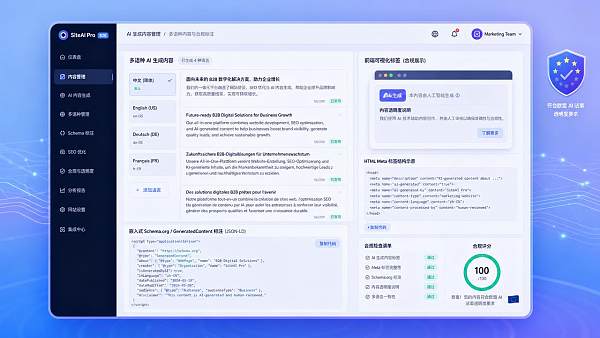
Direct trading companies: As the first touchpoint for EU buyers, their website product introductions, quotation sheet explanations, case showcase pages, and other materials rely heavily on AI-generated multilingual content. If verifiable machine-readable labels, such as schema.org/GeneratedContent markup, are not embedded at the HTML source code level, they will be deemed non-compliant; the impact is mainly reflected in reduced trust from EU customers, lower click-through rates caused by the more visible “AI-generated” label in Google search results, and failed onboarding reviews on EU B2B platforms, such as EUROPAGES and Kompass.
Raw material procurement companies: Although they do not directly face end customers, documents they provide to downstream European manufacturers, such as technical parameter sheets, declarations of conformity, and RoHS/REACH appendix summaries, also fall within the regulatory scope if generated through AI summarization or translation; the impact is reflected in added review obligations for AI labeling clauses in procurement contracts, as well as EU buyers treating missing AI labels as a due diligence defect, thereby affecting order confirmation cycles and payment terms.
Processing and manufacturing companies: Their website sections such as “custom services” and “OEM/ODM support” often use AI-generated content including process comparison copy and production line capability descriptions; the new rules require labeling not only for text, but also for AI-generated charts, explanatory text for 3D renderings, and even video subtitles; the impact lies in the fact that existing CMS content management systems lack labeling interfaces and require reconstruction of content publishing workflows, otherwise targeted promotional campaigns in the EU market may be forced to stop.
Supply chain service companies: Including cross-border logistics service providers, certification consulting firms, and multilingual localization companies, the official websites, email sequences, and LinkedIn ad campaigns they operate on behalf of clients are all subject to joint liability; the impact is reflected in the need to clearly define the boundaries of AI tool usage and the attribution of labeling responsibilities in service agreements, and EU clients have already begun adding a dedicated review item for “AI content traceability mechanisms” in RFPs.
Key Focus Areas and Response Measures for Relevant Companies or Practitioners
Immediately conduct an audit of AI-generated traces in website content
Review whether the current Chinese and English bilingual pages on the official website, exported copy from the product database, automated email templates, and similar materials contain AI-generated content; focus on identifying unsigned mass-generated content, such as brief specification descriptions for 100 products, and establish a content source ledger—this action not only meets disclosure requirements, but is also the foundation for clarifying internal content responsibilities.
Upgrade CMS and marketing automation toolchains
Existing platforms such as WordPress, Shopify, or HubSpot need to integrate labeling modules compliant with the EN 301 549 v3.2.1 standard through plugins or APIs, ensuring that AI-generated content displays an “AI-generated” label on the front end while embedding machine-readable provenance fields in HTML meta tags; avoid adopting purely CSS-hidden labeling, because EU regulators explicitly require it to be “indelible” and “perceptible to users.”
Reconstruct the B2B content production SOP
Embed the AI labeling process into the content approval workflow: AI draft → manual verification and fact-checking → completion of labeling fields → legal and compliance review → publication; it is prohibited to treat labeling as a “post-publication remedial action,” because regulatory traceability is based on the first public release time of the content.
Carefully assess liability clauses of third-party AI tool vendors
Current mainstream AI writing tools, such as Jasper, Copy.ai, and the domestic enterprise version of ERNIE Bot, do not yet generally provide standardized labeling output interfaces that meet EU requirements; companies need to review the provisions in service agreements regarding “responsibility for compliant output” and should not assume by default that tool providers have already covered all legal obligations.
Editorial Viewpoint / Industry Observation
Observably, this regulation does not aim to restrict AI adoption, but to recalibrate accountability in automated communication — the labeling requirement functions as a transparency anchor, not a technical barrier. Analysis shows that early-adopter firms are treating compliance not as a cost center, but as a trust-signaling upgrade: EU procurement teams now report higher engagement with vendors whose product pages include both human-edited summaries and machine-generated spec tables — provided both are clearly attributed. From an industry perspective, the real bottleneck lies not in labeling capability, but in legacy CMS architectures that lack metadata extensibility; this may accelerate consolidation toward headless CMS solutions among mid-sized exporters.
Conclusion
This new regulation is not an isolated technical regulatory move, but a key step in the EU’s effort to build a “trusted AI commercial environment.” For Chinese B2B companies, what deserves greater attention is that the compliance adaptation process will force the structuring of content assets, the auditability of production workflows, and the explicit definition of human-machine collaboration roles. In essence, this is an organizational capability upgrade for entering high-trust international markets, rather than merely a technical patching task.
Information Source Notes
Official announcement of the European Commission (COM/2026/287 final), Annex VI of the implementing rules of the AI Act (Regulation (EU) 2026/1123), and the European Data Protection Board (EDPB) AI Transparency Enforcement Guidelines v2.1 (updated in April 2026). Note: The specific enforcement approaches, technical verification methods, and exemption scenarios in member state regulatory details, such as those of Germany’s Federal Network Agency BNetzA and France’s National Commission on Informatics and Liberty CNIL, are still to be released successively in the third quarter of 2026 and require continued observation.
Related Articles



Related Products
 EasyCamp SaaS Smart Website Marketing SystemE-Yingbao SaaS Smart Website Marketing System: AI-powered, zero-code website building. Rapidly launch multilingual independent e-commerce sites in just 10 minutes. Global server acceleration and AI-driven SEO optimization empower businesses to efficiently connect with global markets. The seamless integration of technology and user-friendly operation makes building e-commerce sites incredibly simple.
 AI+SEM Intelligent Advertising Marketing SystemAI+SEM drives intelligent ad creation, empowering full-funnel precision advertising marketing. The system automatically generates weekly/monthly reports, AI recommends keywords and target countries, monitors core metrics in real-time with intelligent alerts, and enables one-click high-conversion ad solutions to help quickly acquire customers and improve ROI.
 AI+SEO Dual Engine Optimization ServiceEasyWin AI+SEO Dual Engine Optimization System leverages AI-powered keyword mining, content generation, and comprehensive technical optimization to help foreign trade enterprises acquire high-quality organic traffic, significantly improving search rankings and conversion rates.
 AI+SNS Social Media Marketing SystemYingbao AI+SNS Social Media Marketing System - Precision social capture for the social media era. Supports one-click content synchronization across major platforms like Facebook and LinkedIn. AI intelligently rewrites posts for enhanced relevance. 24/7 AI customer service and user profiling analysis empower businesses to efficiently expand into global markets.
 AI+SEO营销解决方案易营宝AI+SEO营销解决方案,通过AI批量写作、智能生成TDK、精准关键词扩词等功能,全面优化网站SEO效果,提升流量与转化率。助力企业构建高效智能网站新生态。
 AI+SEM Advertising Marketing SolutionsAI+SEM Advertising Marketing Solution leverages AI technology to deeply empower SEM ad campaigns. It automatically generates weekly/monthly reports using AI, presenting account data across multiple dimensions for comprehensive insights into campaign performance and trends. The system precisely recommends keywords and target countries, intelligently generates high-conversion ad copy, and enables one-click activation of efficient campaign plans to help businesses rapidly acquire customers. Simultaneously, it monitors core metrics in real time, intelligently identifies abnormal fluctuations, and issues timely alerts to ensure stable, high-return advertising results.
 Domain Name ServicesEasyWin provides professional domain name services, including intelligent queries, one-stop registration, brand protection, and full lifecycle management, helping businesses build a digital brand image.
 EasyOperate B2C Cross-Border E-Commerce Platform & Independent WebsiteEasyStore B2C Cross-border E-commerce Independent Store is an intelligent website building and cross-border e-commerce integrated solution independently developed by EasyStore Information Technology (Beijing) Co., Ltd. The system is specially designed for small and medium-sized as well as large export enterprises, integrating 'website building, operation, marketing, advertising, and conversion' into one, helping enterprises quickly establish cross-border e-commerce independent stores to achieve brand globalization and global sales growth.
The platform supports multiple languages, multiple currencies, and multi-channel marketing, with built-in AI intelligent translation and SEO optimization systems, suitable for mainstream markets such as Southeast Asia, Europe and America, Latin America, and the Middle East, assisting Chinese manufacturing enterprises in efficiently deploying international e-commerce strategies. SSL证书易营宝提供专业SSL安全证书服务,包括单域名和泛域名证书,确保网站数据传输加密、身份验证和完整性保护,助力企业建立安全可信的在线业务环境。









