









- What should you focus on in the latest enterprise SaaS report? From renewal rates and delivery costs to overseas growth opportunitiesJul 12, 2026View details
- What signals are worth paying attention to in a cross-border marketing trend report? B2B companies should look at these 6 signalsJul 11, 2026View details
- How to Read a Cross-Border Marketing Trends Report? Five Key Dimensions for Evaluating Channel OpportunitiesJul 11, 2026View details
- Which channel has the highest ROI in the global traffic ecosystem? Comparative analysis of search, social media, and advertisingJul 10, 2026View details
- What multilingual website services are available in Sanya? Which model is more suitable for local businesses going global?Jul 08, 2026View details
- How to view the complete list of China SaaS companies in the top 100? Practical methods for screening website-building and marketing service providersJul 08, 2026View details
- How to view pricing in the global traffic ecosystem? Cost comparison of search, social media, and content channel advertisingJul 06, 2026View details
- How to assess foreign trade website development trends?Looking at 2026 changes from multilingual,AI content to conversion pathsJul 04, 2026View details
How SEO Content Optimization Can Avoid Low-Quality Content
As search quality improves,SEO content optimization needs to establish standards like quality control,so as to prevent low-quality content from affecting indexing,rankings and conversions。
First Determine:The Risk of Low-Quality Content Is Not Just Ranking Decline
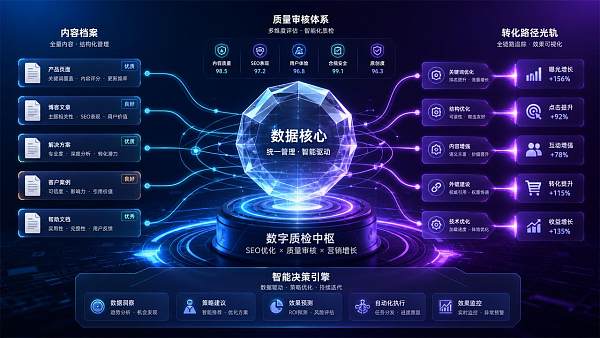
Users searching for “How SEO Content Optimization Can Avoid Low-Quality Content” usually do not want conceptual explanations,but want to know how to establish executable standards to prevent content production from getting out of control。
For quality control personnel and safety management personnel,low-quality content is similar to hidden hazard points on a production site。It may not cause an accident immediately,but it will continuously lower website credibility and inquiry quality。
What truly deserves attention is not whether an article is long,but whether the content is accurate,verifiable,able to solve user problems,and compliant with corporate brand and compliance requirements。
Therefore,SEO content optimization should be upgraded from “writing articles” to “content quality management”。Standards,processes,checklists and review mechanisms are more important than simply chasing hot topics。
Where Low-Quality Content Usually Appears
The first type of problem is topic defocus。The title says it is a solution,but the body is filled with industry background,and after reading it,users still do not know how to judge,choose or execute。
The second type of problem is unreliable information。Data has no source,conclusions have no conditions,and cases have no process。This type of content is easily ignored by both search engines and real customers。
The third type of problem is repetitive production。Multiple pages are rewritten around the same keyword,with similar viewpoints and identical structures,eventually causing internal site competition and instead weakening the authority of core pages。
The fourth type of problem is conversion disconnect。An article has traffic,but there is no clear next-step path,so users cannot understand service capabilities,case evidence or consultation entry points。
Set Content Acceptance Standards Like Quality Control
To avoid low-quality content,there must first be quantifiable acceptance standards。It is recommended to check from five dimensions:search intent,professional accuracy,original value,structural completeness and conversion path。
Search intent requires checking whether the content answers the user’s real question。For example,if users care about “how to avoid”,the body must provide judgment methods,processes and checklist points。
Professional accuracy requires that expressions involving technology,regulations,equipment,safety or management in the content must not be vague。When necessary,they should be reviewed by business,quality control or legal personnel。
Original value does not simply require that the wording is not repeated,but requires providing the company’s own experience,cases,processes,tools or judgment frameworks,so that the content has differentiation。
Structural completeness requires every article to have a clear opening,layered subheadings,key conclusions and action recommendations,so users do not have to look for answers in a pile of information。
How the Execution Process of SEO Content Optimization Should Be Implemented
The first step is keyword grading。Core terms are used to build pillar pages,long-tail terms are used to solve specific problems,and brand terms are used to carry trust and conversions。
The second step is to build a topic library。Each topic must be marked with target audience,search intent,business relevance,content depth and expected conversion action,so as to avoid random writing。
The third step is content outline review。At the outline stage,it is necessary to confirm whether user questions are covered,whether there are duplicate pages,and whether the company’s service capabilities can be reflected。
The fourth step is pre-publication quality inspection。Check the consistency between title and body,keyword naturalness,factual accuracy,internal link rationality,page loading experience and mobile reading effect。
The fifth step is post-publication review。Observe indexing,rankings,click-through rate,dwell time,bounce rate and inquiry quality,and decide whether to update,merge or remove content based on data。
How to Make Content Comply with Search Rules While Promoting Conversions
High-quality content cannot serve only search engines,but must also make potential customers willing to continue learning about the company。When judging value,both traffic quality and business results should be considered。
For example,an integrated website building and marketing services company can naturally present the synergy among website development,SEO,social media and advertising in its content。
When customers search for industry solutions,they are often more concerned about “whether they can quickly understand product value”。At this time,page structure and visual expression will directly affect trust。
Taking the heavy machinery equipment,heavy industry page as an example,a modular streamlined layout,industry-scale scenario banner,core data indicators and high-contrast inquiry entry points can transform complex parameters into clear decision-making information。
This type of design is not simply about beautifying the page,but about helping users quickly confirm application scenarios,service commitments and brand endorsement,thereby shortening the path from browsing to consultation。
Which Indicators Should Quality Control and Safety Management Personnel Focus On
From the perspective of quality management,content indicators cannot focus only on rankings。Rankings represent exposure opportunities,while real quality also depends on whether users continue reading and take action。
It is recommended to focus on three categories of indicators。The first is inclusion and indexing status,to determine whether the content is recognized by search engines as a valid page。
The second is behavioral indicators,including click-through rate,average dwell time,scroll depth and bounce rate,which can reflect whether the content matches search intent。
The third is conversion indicators,including consultation volume,form submissions,phone clicks,document downloads and sales feedback,used to determine whether the content brings real business value。
If an article has rankings but no inquiries,it may be because the content is too broad,trust evidence is insufficient,or the conversion entry point is not obvious。Page-level optimization should be prioritized。
Which Content Should Reduce Investment to Avoid Becoming a Quality Burden
Corporate websites should not continuously publish low-value articles merely for update frequency。Content without clear search demand,business relevance or professional added value should be produced with caution。
Content that simply rewrites news,stuffs keywords,or generally introduces industry trends is unlikely to obtain stable rankings in the long term,and is also difficult to support sales team communication。
It is also necessary to avoid batch-generating a large number of pages using the same template。In the short term,it may seem to cover keywords,but in the long term,it may cause content dilution and lower the quality score of the entire site。
A more reasonable approach is to reduce inefficient updates and concentrate resources on core pages,solution pages,case pages,FAQ pages and high-intent long-tail content。
Building a Long-Term Content Quality Mechanism Is the Real Moat of SEO
SEO content optimization is not a one-time project,but a continuously iterative management system。Search rules will change,customer needs will change,and corporate services will also be upgraded。
Eyingbao Information Technology takes artificial intelligence and big data as its core driving forces,providing full-chain services covering intelligent website building,SEO optimization,social media marketing and advertising。
For enterprises,the value of choosing integrated services lies in reducing fragmentation。Website structure,content strategy,traffic acquisition and conversion paths can be planned in a unified way。
When content production is incorporated into standardized processes,enterprises can not only reduce the risk of low-quality content,but also enable every article to carry clear customer acquisition and brand-building tasks。
Conclusion:Create SEO Content with a Quality Management Mindset
The key to avoiding low-quality content is not to pursue more articles,but to build a quality closed loop from topic selection,review,publication to post-analysis。
For quality control and safety management personnel,SEO content optimization can be understood as a digital quality control system,with the goals of reducing risks,enhancing trust and promoting conversions。
As long as content remains centered on user problems,based on professional facts,and oriented toward business results,it will not stop at “being found in search”,but will truly create growth value。
Related Articles



Related Products
 EasyCamp SaaS Smart Website Marketing SystemE-Yingbao SaaS Smart Website Marketing System: AI-powered, zero-code website building. Rapidly launch multilingual independent e-commerce sites in just 10 minutes. Global server acceleration and AI-driven SEO optimization empower businesses to efficiently connect with global markets. The seamless integration of technology and user-friendly operation makes building e-commerce sites incredibly simple.
 AI+SEM Intelligent Advertising Marketing SystemAI+SEM drives intelligent ad creation, empowering full-funnel precision advertising marketing. The system automatically generates weekly/monthly reports, AI recommends keywords and target countries, monitors core metrics in real-time with intelligent alerts, and enables one-click high-conversion ad solutions to help quickly acquire customers and improve ROI.
 AI+SEO Dual Engine Optimization ServiceEasyWin AI+SEO Dual Engine Optimization System leverages AI-powered keyword mining, content generation, and comprehensive technical optimization to help foreign trade enterprises acquire high-quality organic traffic, significantly improving search rankings and conversion rates.
 AI+SNS Social Media Marketing SystemYingbao AI+SNS Social Media Marketing System - Precision social capture for the social media era. Supports one-click content synchronization across major platforms like Facebook and LinkedIn. AI intelligently rewrites posts for enhanced relevance. 24/7 AI customer service and user profiling analysis empower businesses to efficiently expand into global markets.
 AI+SEO营销解决方案易营宝AI+SEO营销解决方案,通过AI批量写作、智能生成TDK、精准关键词扩词等功能,全面优化网站SEO效果,提升流量与转化率。助力企业构建高效智能网站新生态。
 AI+SEM Advertising Marketing SolutionsAI+SEM Advertising Marketing Solution leverages AI technology to deeply empower SEM ad campaigns. It automatically generates weekly/monthly reports using AI, presenting account data across multiple dimensions for comprehensive insights into campaign performance and trends. The system precisely recommends keywords and target countries, intelligently generates high-conversion ad copy, and enables one-click activation of efficient campaign plans to help businesses rapidly acquire customers. Simultaneously, it monitors core metrics in real time, intelligently identifies abnormal fluctuations, and issues timely alerts to ensure stable, high-return advertising results.
 Domain Name ServicesEasyWin provides professional domain name services, including intelligent queries, one-stop registration, brand protection, and full lifecycle management, helping businesses build a digital brand image.
 EasyOperate B2C Cross-Border E-Commerce Platform & Independent WebsiteEasyStore B2C Cross-border E-commerce Independent Store is an intelligent website building and cross-border e-commerce integrated solution independently developed by EasyStore Information Technology (Beijing) Co., Ltd. The system is specially designed for small and medium-sized as well as large export enterprises, integrating 'website building, operation, marketing, advertising, and conversion' into one, helping enterprises quickly establish cross-border e-commerce independent stores to achieve brand globalization and global sales growth.
The platform supports multiple languages, multiple currencies, and multi-channel marketing, with built-in AI intelligent translation and SEO optimization systems, suitable for mainstream markets such as Southeast Asia, Europe and America, Latin America, and the Middle East, assisting Chinese manufacturing enterprises in efficiently deploying international e-commerce strategies. SSL证书易营宝提供专业SSL安全证书服务,包括单域名和泛域名证书,确保网站数据传输加密、身份验证和完整性保护,助力企业建立安全可信的在线业务环境。









