









- Which channel has the highest ROI in the global traffic ecosystem? Comparative analysis of search, social media, and advertisingJul 10, 2026View details
- What multilingual website services are available in Sanya? Which model is more suitable for local businesses going global?Jul 08, 2026View details
- How to view the complete list of China SaaS companies in the top 100? Practical methods for screening website-building and marketing service providersJul 08, 2026View details
- How to view pricing in the global traffic ecosystem? Cost comparison of search, social media, and content channel advertisingJul 06, 2026View details
- How to assess foreign trade website development trends?Looking at 2026 changes from multilingual,AI content to conversion pathsJul 04, 2026View details
- What are the new trends in multilingual marketing data analytics tools in 2026? Focus on attribution、automation and complianceJul 04, 2026View details
What does YiYingBao GDPR compliance service include? Cookie, form, and data authorization scope explanation
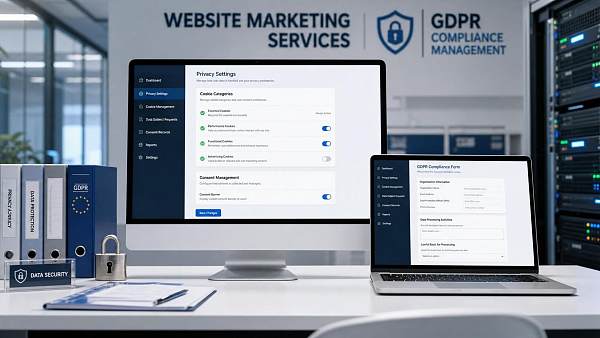
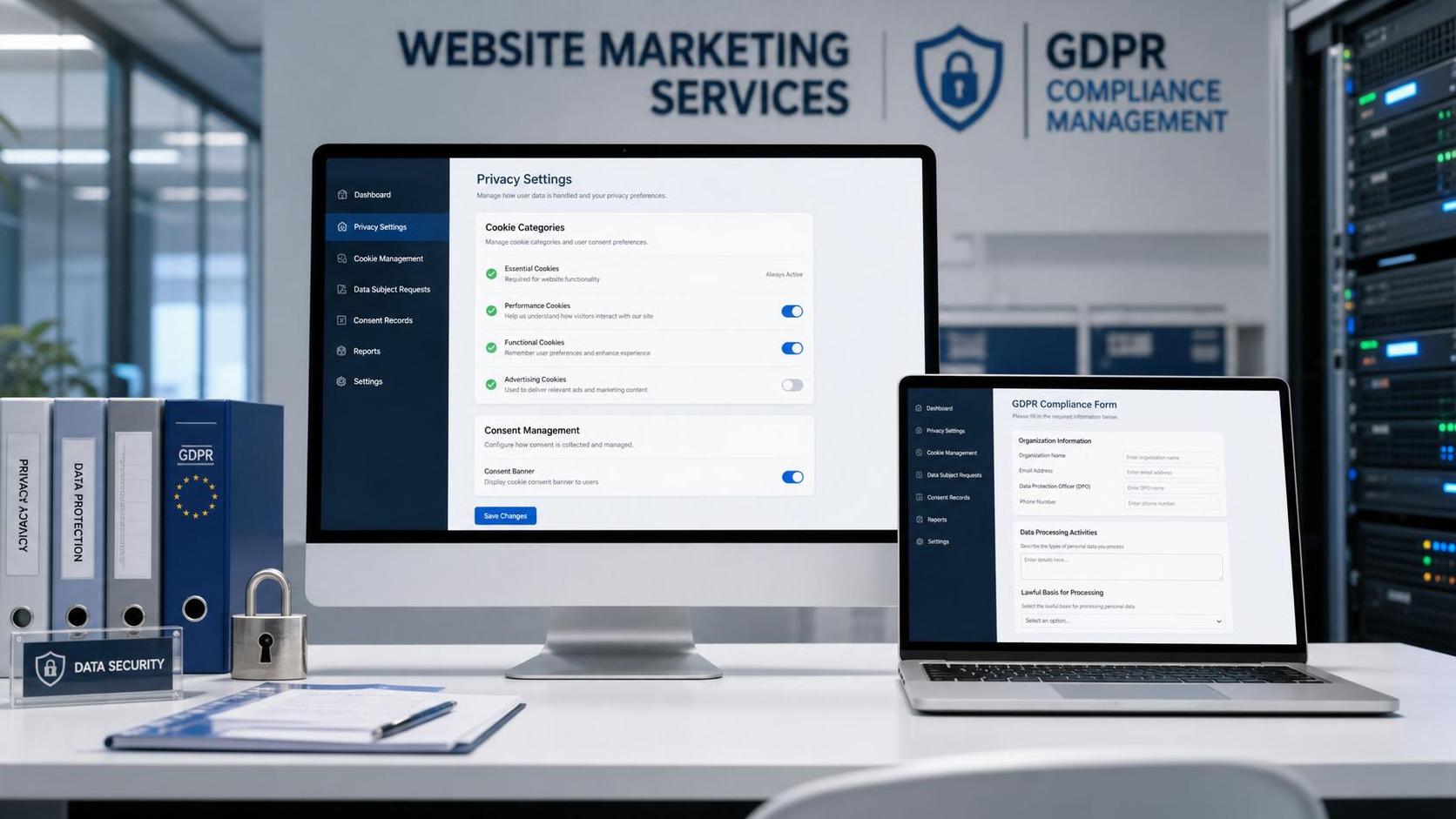
Yiyingbao GDPR Compliance Services: It’s usually more than just showing a cookie notice
When a corporate website is aimed at European visitors, GDPR compliance is often no longer optional. This is especially true in website building, SEO, advertising campaigns, and social media traffic acquisition scenarios, where cookies, forms, and data authorization often occur at the same time, and the risks can overlap.
Many people search for “what does Yiyingbao GDPR compliance service include,” but what they really care about is not the concept itself; it is which parts of the website need to be controlled after launch, which data can be collected, and which actions require prior consent.
Based on the practical needs of multilingual official websites, cross-border e-commerce stores, advertising landing pages, and overseas lead-generation pages, Yiyingbao GDPR compliance services usually focus on three things: cookie management mechanisms, compliant form design, and data authorization scope sorting, and then implement these requirements across pages, systems, and processes.
For websites that promote overseas businesses over the long term, the value of this kind of service is not only reducing complaint risks, but also making the boundaries of marketing activities, data collection, and follow-up tracking clearer.
What does Yiyingbao GDPR compliance service include, and how should the core boundaries be understood?
Simply put, what Yiyingbao GDPR compliance service includes mainly depends on whether it covers these core actions: “notice, consent, record, restriction, and withdrawal,” rather than just making a privacy page that looks compliant on the surface.
In a website + marketing services integrated scenario, common service content generally includes the following:
- Sorting out the types of cookies involved on the website, including necessary cookies, analytics cookies, and marketing cookies.
- Configuring cookie consent banners and preference centers to avoid default opt-in and default tracking.
- Reviewing authorization copy and checkbox logic in inquiry forms, registration forms, and download forms.
- Clearly defining the purpose of data collection, storage period, transmission objects, and processing scope.
- Coordinating privacy policies, authorization records, and withdrawal mechanisms to facilitate later evidence collection and audits.
A more common misconception is treating GDPR as a legal-document issue. In fact, it directly affects SEO analytics, ad retargeting, lead capture, and CRM integration. If a platform like Yiyingbao also provides website building, advertising, and marketing automation capabilities, compliance services must be designed together with business processes and cannot be handled separately.
What exactly does cookie management control, and why is it so prone to problems?
Cookies are one of the easiest things to overlook because, before the user clicks consent, analytics code, ad pixels, or third-party tracking scripts may already have been triggered. This is not uncommon in overseas independent sites, landing pages, and cross-border e-commerce stores.
If you want to answer what Yiyingbao GDPR compliance service includes, cookie management must at least cover two layers. The first layer is categorization, and the second layer is control.
Categorization is meant to let the website know which ones are necessary for site operation, which ones are for analyzing visitor behavior, and which ones are for advertising and retargeting. Control means preventing non-essential cookies from being loaded before consent is obtained.
In practical applications, if Yiyingbao services cover Google advertising, Facebook advertising, and SEO analysis, cookie control cannot just stop at a front-end popup; it also needs to work together with tag management, analytics tools, and ad account pixels.
How should forms be designed to be compliant without affecting conversions?
This is one of the issues most companies care about. The answer is not to make forms more complicated for the sake of safety, but to make required fields, authorization statements, and subsequent usage purposes clear, while reducing unnecessary collection as much as possible.
A compliant inquiry or download form usually needs to answer three questions: what is collected, why it is collected, and who will receive it after collection. As long as the logic is clear, conversion does not necessarily decrease; instead, lead quality may improve.
For example, when downloading a white paper, only an email address and company name are usually required, which is more reasonable than asking for a phone number, country, budget, and job title all at once. If marketing content still needs to be sent later, the authorization for “material delivery” and “marketing subscription” must be separated and cannot be combined into one checkbox.
- Keep required fields limited to only the information needed for the current business.
- State the purpose of authorization clearly and avoid vague wording.
- Do not pre-check the marketing subscription box.
- Provide a privacy policy entry before submission.
- Keep a record of the authorization version after submission whenever possible.
If the website uses Yiyingbao’s intelligent website building system or multilingual form components, this type of compliant form design is usually better configured uniformly at the template level, so as to avoid inconsistent page standards across different countries and make later review easier.
How detailed does the data authorization scope need to be to avoid being considered “default collection”?
The core of data authorization scope statements is not how long they are, but whether the boundaries are clear. Many websites write privacy policies but describe the purposes too broadly, such as “for service improvement and business cooperation,” which is often not enough to support specific marketing actions.
A more stable approach is to break it down by business scenario. For example, inquiry replies, quotation follow-up, material delivery, marketing emails, ad retargeting, and on-site behavior analysis should each be described separately, and consent should be obtained separately when necessary.
For the question “what does Yiyingbao GDPR compliance service include,” the data authorization scope statement usually also extends to third-party processors. This is because many marketing websites are not running a single system, but are connected to CRM, email platforms, advertising platforms, customer service tools, and analytics tools.
What needs to be confirmed in advance is who the data will be transferred to, whether the transfer crosses borders, how long it will be stored, and how users can withdraw consent or request deletion. These are not optional items; they are the basic conditions that determine whether the website can operate stably in the long term.
How can you tell before launch whether the service is complete enough, and where are the most common omissions?
Many problems do not come from the system itself, but from execution details. This is especially true when a website is doing SEO, advertising, social media traffic acquisition, and multilingual operations at the same time, because page growth is fast, scripts change frequently, and front-end and back-end inconsistencies are easy to appear.
Before launch, you can use a simplified checklist to review:
From an implementation perspective, platforms like Yiyingbao that cover website building, advertising, and AI marketing have the advantage of being able to check page setup, script management, and data paths within the same system, reducing ambiguity about responsibility between multiple vendors.
Besides compliance itself, what practical value can it bring?
Many companies initially see GDPR as a cost, but after implementation, they find that it also helps sort out data assets. Which data is truly useful, and which collection is only habitual behavior, becomes clearer through compliance transformation.
For overseas marketing websites, what Yiyingbao GDPR compliance services include is ultimately not only reflected in “avoiding mistakes,” but also in three aspects: data collection becomes more controllable, advertising and analytics paths become clearer, and page and form management standards become more unified.
Yiyingbao has long served multilingual official websites, cross-border e-commerce stores, and overseas promotion projects, and this kind of experience is better suited to handling cross-region, multi-page, and multi-channel parallel scenarios. Especially when targeting European, North American, and similar markets, incorporating compliance design into website building and marketing processes earlier can reduce later adjustment costs.
If you want to make the next judgment, it is recommended to first list the current website’s cookies, form fields, privacy policy, and third-party tool list, and then review item by item according to purpose, authorization method, and record mechanism. In this way, when looking again at what Yiyingbao GDPR compliance service includes, you are not just checking feature items, but can directly determine whether it truly matches the current website’s risk boundaries and growth needs.
Related Articles

Related Products
 EasyCamp SaaS Smart Website Marketing SystemE-Yingbao SaaS Smart Website Marketing System: AI-powered, zero-code website building. Rapidly launch multilingual independent e-commerce sites in just 10 minutes. Global server acceleration and AI-driven SEO optimization empower businesses to efficiently connect with global markets. The seamless integration of technology and user-friendly operation makes building e-commerce sites incredibly simple.
 AI+SEM Intelligent Advertising Marketing SystemAI+SEM drives intelligent ad creation, empowering full-funnel precision advertising marketing. The system automatically generates weekly/monthly reports, AI recommends keywords and target countries, monitors core metrics in real-time with intelligent alerts, and enables one-click high-conversion ad solutions to help quickly acquire customers and improve ROI.
 AI+SEO Dual Engine Optimization ServiceEasyWin AI+SEO Dual Engine Optimization System leverages AI-powered keyword mining, content generation, and comprehensive technical optimization to help foreign trade enterprises acquire high-quality organic traffic, significantly improving search rankings and conversion rates.
 AI+SNS Social Media Marketing SystemYingbao AI+SNS Social Media Marketing System - Precision social capture for the social media era. Supports one-click content synchronization across major platforms like Facebook and LinkedIn. AI intelligently rewrites posts for enhanced relevance. 24/7 AI customer service and user profiling analysis empower businesses to efficiently expand into global markets.
 AI+SEO营销解决方案易营宝AI+SEO营销解决方案,通过AI批量写作、智能生成TDK、精准关键词扩词等功能,全面优化网站SEO效果,提升流量与转化率。助力企业构建高效智能网站新生态。
 AI+SEM Advertising Marketing SolutionsAI+SEM Advertising Marketing Solution leverages AI technology to deeply empower SEM ad campaigns. It automatically generates weekly/monthly reports using AI, presenting account data across multiple dimensions for comprehensive insights into campaign performance and trends. The system precisely recommends keywords and target countries, intelligently generates high-conversion ad copy, and enables one-click activation of efficient campaign plans to help businesses rapidly acquire customers. Simultaneously, it monitors core metrics in real time, intelligently identifies abnormal fluctuations, and issues timely alerts to ensure stable, high-return advertising results.
 Domain Name ServicesEasyWin provides professional domain name services, including intelligent queries, one-stop registration, brand protection, and full lifecycle management, helping businesses build a digital brand image.
 EasyOperate B2C Cross-Border E-Commerce Platform & Independent WebsiteEasyStore B2C Cross-border E-commerce Independent Store is an intelligent website building and cross-border e-commerce integrated solution independently developed by EasyStore Information Technology (Beijing) Co., Ltd. The system is specially designed for small and medium-sized as well as large export enterprises, integrating 'website building, operation, marketing, advertising, and conversion' into one, helping enterprises quickly establish cross-border e-commerce independent stores to achieve brand globalization and global sales growth.
The platform supports multiple languages, multiple currencies, and multi-channel marketing, with built-in AI intelligent translation and SEO optimization systems, suitable for mainstream markets such as Southeast Asia, Europe and America, Latin America, and the Middle East, assisting Chinese manufacturing enterprises in efficiently deploying international e-commerce strategies. SSL证书易营宝提供专业SSL安全证书服务,包括单域名和泛域名证书,确保网站数据传输加密、身份验证和完整性保护,助力企业建立安全可信的在线业务环境。









