









- What multilingual website services are available in Sanya? Which model is more suitable for local businesses going global?Jul 08, 2026View details
- How to view the complete list of China SaaS companies in the top 100? Practical methods for screening website-building and marketing service providersJul 08, 2026View details
- How to view pricing in the global traffic ecosystem? Cost comparison of search, social media, and content channel advertisingJul 06, 2026View details
- How to assess foreign trade website development trends?Looking at 2026 changes from multilingual,AI content to conversion pathsJul 04, 2026View details
- What are the new trends in multilingual marketing data analytics tools in 2026? Focus on attribution、automation and complianceJul 04, 2026View details
- Is Brand Globalization Marketing Consulting Worth Buying? At What Stage Should Companies Bring It InJul 01, 2026View details
The EU will extend EPR requirements to B2B marketing tools
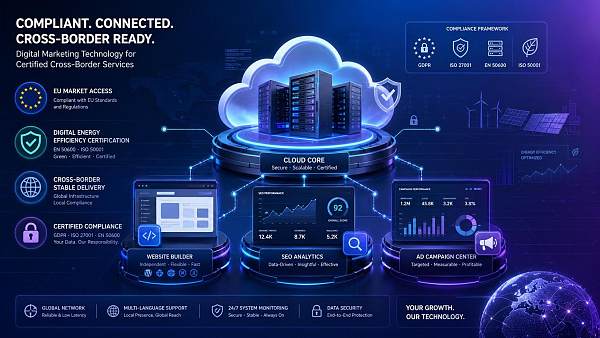
On July 8, 2026, the European Commission updated the Sustainable Product Ecodesign Regulation (EU 2026/1142), for the first time bringing certain B2B digital marketing services offered to European businesses under EPR's regulatory purview. Based on disclosed information, services such as independent website building systems, SEO tools, and advertising platforms that have not passed EN IEC 63000:2025 digital service energy efficiency certification will be unable to offer paid subscription services in the EU market. This change warrants industry attention, not only because the regulatory focus has expanded from traditional physical liability to digital services, but also because it will directly impact service providers' market access, procurement decisions, compliance reviews, and delivery arrangements.
What mandatory requirements were confirmed in this update?
The confirmed information includes three points. First, the update date is July 8, 2026, and the relevant rules come from the European Commission's updated Ecodesign Regulation on Sustainable Products (EU 2026/1142). Second, the regulatory scope now covers B2B digital marketing services for the first time, including independent website building systems, SEO tools, and advertising platforms for European businesses. Third, to offer paid subscriptions in the EU market, these services must pass EN IEC 63000:2025 digital service energy efficiency certification; failure to meet this condition will prohibit the offering of paid subscription services.
It's not just the tool providers that are affected.
Platform and software vendors providing services to European businesses
Analysis shows that these entities are most directly affected, as the rule changes have directly linked certification to the ability to continue providing paid subscription services. The impact on their businesses primarily lies in product listing, contract signing, renewal arrangements, service delivery, and compliance with EU market regulations. Currently, it is more important for these companies to verify whether their services fall within the scope of the B2B digital marketing services mentioned above, and to prepare certification, technical documentation, and compliance statements in accordance with EN IEC 63000:2025.
Purchasers and European companies using these tools
From the procurement perspective, rule changes will affect companies' selection criteria for marketing technology vendors. For the procuring party, the impact extends beyond simply whether tools can continue to be used; it also involves contract renewals, budget execution, vendor replacement, and service continuity. The key changes to watch are whether vendor qualification documents, certification status, contract terms, and service deliverability have been adjusted, especially in paid subscription scenarios where compliance may become part of the pre-procurement review process.
Certification, testing and compliance service organizations
Observations suggest that this rule change will also drive increased demand in the certification and compliance support环节. This is because service providers wishing to continue operating in the EU market will need to prepare documentation regarding certification standards, technical documents, review processes, and supporting materials. For relevant service organizations, the impact may manifest in consultation, document review, standard comprehension, and client delivery schedules. While the current summary does not provide more detailed implementation guidelines, the market is likely to first focus on confirming whether it applies, how to prove it, and when it will be completed.
Channel, integration and outsourced operation services
For sales channels, system integrators, and outsourced service providers, the impact is primarily reflected in changes to project selection and delivery responsibilities. If their delivery solutions include the aforementioned tools or platforms, the procurement list, tender documents, service packages, and subsequent operation and maintenance commitments may all require simultaneous review. A key focus should be on whether the introduced third-party services have a verifiable compliance status to avoid the risk of subscription restrictions or service interruptions at the delivery stage.
What practical issues need to be focused on next?
First, determine whether the product or service falls within the scope of application.
The first thing businesses should do is not to discuss the impact in general, but to verify item by item whether the services they provide or purchase fall under the category of B2B digital marketing services for European companies. For categories already mentioned, such as independent website building systems, SEO tools, and advertising platforms, internal reviews should be prioritized, and distinctions should be made between free features, paid subscriptions, add-on modules, and cross-border delivery arrangements.
Incorporate certification preparation into the sales and renewal process.
Analysis shows that the certification requirements are directly linked to the prohibition of offering paid subscription services. This means it's not just a legal or compliance issue, but also affects business renewals and revenue recognition. Companies should pay attention to whether their certification materials, technical documentation, external compliance statements, and contract update arrangements are aligned with the existing sales cycle. For service providers already operating subscription businesses in the EU, renewal windows and new projects especially need to be reviewed in advance.
Pay attention to changes in procurement documents and supplier qualification review.
From a practical perspective, both the procuring entity and the project contractor should increase their sensitivity to supplier qualification documents. Going forward, it's worth noting not only the existence of certifications themselves, but also whether tender documents, procurement terms, supplier eligibility requirements, and project delivery attachments begin to include explicit requirements regarding EN IEC 63000:2025 or related compliance documentation. Since the input information lacks uniform implementation details, it's currently more appropriate to treat it as a key verification item rather than assuming complete uniformity.
Pay attention to subsequent official statements and market implementation feedback.
While current public information clarifies the regulatory direction and entry requirements, it lacks further implementation details. Companies need to continuously monitor subsequent official statements, enforcement boundaries, interpretations of certification applicability, and market feedback regarding contracts and procurement. Especially in cross-border digital service scenarios, rule implementation often manifests first in changes to customer inquiries, bidding requirements, and legal clauses.
This message clearly signals the regulatory authorities' intentions.
From an editorial perspective, the most noteworthy aspect of this news is not the addition of an abstract policy concept, but rather its direct link between market access for digital marketing services and specific certification requirements. For the industry, this appears more like a rule change that has already signaled its implementation, rather than simply remaining at the level of directional discussion. At the same time, since existing inputs do not provide more detailed operational guidelines, transitional arrangements, or enforcement guidelines, the industry still needs to remain cautious and continue to monitor whether certification implementation, customer acceptance, and changes to procurement documents are further refined.
It is more appropriate to understand this as moving the entry threshold forward.
In summary, the core change reflected in this update is that the EU's regulatory requirements for B2B digital services are shifting forward to market access and subscription fees. For service providers, purchasers, and related compliance agencies, the focus should not be on broadening the interpretation of these requirements, but rather on quickly confirming whether their business operations cross the regulatory boundaries and whether certification requirements will affect contract signing and delivery. Currently, it's more appropriate to understand this information as a clear shift in compliance thresholds, while also recognizing the dynamic nature of subsequent implementation details, certification standards, and market feedback, which still require continuous monitoring.
This article is based on the direction of subsequent verification.
This article was generated based on user-provided news titles, event dates, and event summaries. The core basis for this is: On July 8, 2026, the European Commission updated the Sustainable Product Ecodesign Regulation (EU 2026/1142), bringing certain B2B digital marketing services under EPR regulation. These services must pass EN IEC 63000:2025 digital service energy efficiency certification before they can be offered as paid subscriptions in the EU market. For such events, further verification is typically required, combining official announcements, regulatory body releases, industry association information, standards organization documents, and authoritative media reports. Since no specific official source link was provided in the input, this article could not further cross-check the original publication page; continued monitoring of policy details, certification implementation guidelines, changes in tender documents, industry feedback, and actual corporate implementation is still necessary.
Related Articles

Related Products
 EasyCamp SaaS Smart Website Marketing SystemE-Yingbao SaaS Smart Website Marketing System: AI-powered, zero-code website building. Rapidly launch multilingual independent e-commerce sites in just 10 minutes. Global server acceleration and AI-driven SEO optimization empower businesses to efficiently connect with global markets. The seamless integration of technology and user-friendly operation makes building e-commerce sites incredibly simple.
 AI+SEM Intelligent Advertising Marketing SystemAI+SEM drives intelligent ad creation, empowering full-funnel precision advertising marketing. The system automatically generates weekly/monthly reports, AI recommends keywords and target countries, monitors core metrics in real-time with intelligent alerts, and enables one-click high-conversion ad solutions to help quickly acquire customers and improve ROI.
 AI+SEO Dual Engine Optimization ServiceEasyWin AI+SEO Dual Engine Optimization System leverages AI-powered keyword mining, content generation, and comprehensive technical optimization to help foreign trade enterprises acquire high-quality organic traffic, significantly improving search rankings and conversion rates.
 AI+SNS Social Media Marketing SystemYingbao AI+SNS Social Media Marketing System - Precision social capture for the social media era. Supports one-click content synchronization across major platforms like Facebook and LinkedIn. AI intelligently rewrites posts for enhanced relevance. 24/7 AI customer service and user profiling analysis empower businesses to efficiently expand into global markets.
 AI+SEO营销解决方案易营宝AI+SEO营销解决方案,通过AI批量写作、智能生成TDK、精准关键词扩词等功能,全面优化网站SEO效果,提升流量与转化率。助力企业构建高效智能网站新生态。
 AI+SEM Advertising Marketing SolutionsAI+SEM Advertising Marketing Solution leverages AI technology to deeply empower SEM ad campaigns. It automatically generates weekly/monthly reports using AI, presenting account data across multiple dimensions for comprehensive insights into campaign performance and trends. The system precisely recommends keywords and target countries, intelligently generates high-conversion ad copy, and enables one-click activation of efficient campaign plans to help businesses rapidly acquire customers. Simultaneously, it monitors core metrics in real time, intelligently identifies abnormal fluctuations, and issues timely alerts to ensure stable, high-return advertising results.
 Domain Name ServicesEasyWin provides professional domain name services, including intelligent queries, one-stop registration, brand protection, and full lifecycle management, helping businesses build a digital brand image.
 EasyOperate B2C Cross-Border E-Commerce Platform & Independent WebsiteEasyStore B2C Cross-border E-commerce Independent Store is an intelligent website building and cross-border e-commerce integrated solution independently developed by EasyStore Information Technology (Beijing) Co., Ltd. The system is specially designed for small and medium-sized as well as large export enterprises, integrating 'website building, operation, marketing, advertising, and conversion' into one, helping enterprises quickly establish cross-border e-commerce independent stores to achieve brand globalization and global sales growth.
The platform supports multiple languages, multiple currencies, and multi-channel marketing, with built-in AI intelligent translation and SEO optimization systems, suitable for mainstream markets such as Southeast Asia, Europe and America, Latin America, and the Middle East, assisting Chinese manufacturing enterprises in efficiently deploying international e-commerce strategies. SSL证书易营宝提供专业SSL安全证书服务,包括单域名和泛域名证书,确保网站数据传输加密、身份验证和完整性保护,助力企业建立安全可信的在线业务环境。









