









- AI Products Drive Hong Kong Exports Up 64.9% in September, Fastest Growth in Over 40 YearsNov 17, 2026View details
- National Bureau of Statistics: Foreign trade grew rapidly in October, providing stable support for global tradeNov 17, 2026View details
- The U.S. has ended the $800 de minimis exemption for non-postal shipments; express courier packages must be formally declared.Nov 16, 2026View details
- ASEAN Signs Digital Economy Framework Agreement, Moving Toward Harmonized Cross-Border E-Commerce RulesNov 15, 2026View details
- Shenzhen Becomes the First City in Mainland China to Exceed RMB 5 Trillion in Foreign TradeNov 15, 2026View details
- Fujian Announces the First Batch of Provincial-Level Cross-Border E-Commerce Industrial Parks and Key Brands for CultivationNov 14, 2026View details
Why Is It Difficult to Close Deals Despite Generating Leads Through Digital Marketing Services?
The sales team receives form submissions, inquiries, or direct messages every day. The number of leads shown in reports is not bad, yet they rapidly decline after entering the quotation, sample, and contract stages, ultimately being attributed only to “insufficiently qualified customers.” For lead generation through digital marketing services, a high volume of leads with low conversion rates is usually not caused by the failure of a single channel, but by gaps between traffic promises, landing page information, lead identification, sales follow-up, and conversion content.
First, here is the conclusion: as long as leads continue to come in but are difficult to advance into qualified business opportunities, do not rush to increase the budget first. First determine whether the issue lies in “attracting the wrong audience at the lead generation front end,” “a lack of qualifying information during the inquiry stage,” or “the inability to follow up promptly and accurately after sales receives the lead.” Problems at different stages cannot usually be solved by increasing advertising spend, expanding keywords, or requiring sales staff to make more calls; these actions often only amplify ineffective workloads.
First, identify exactly which stage is holding up the lead
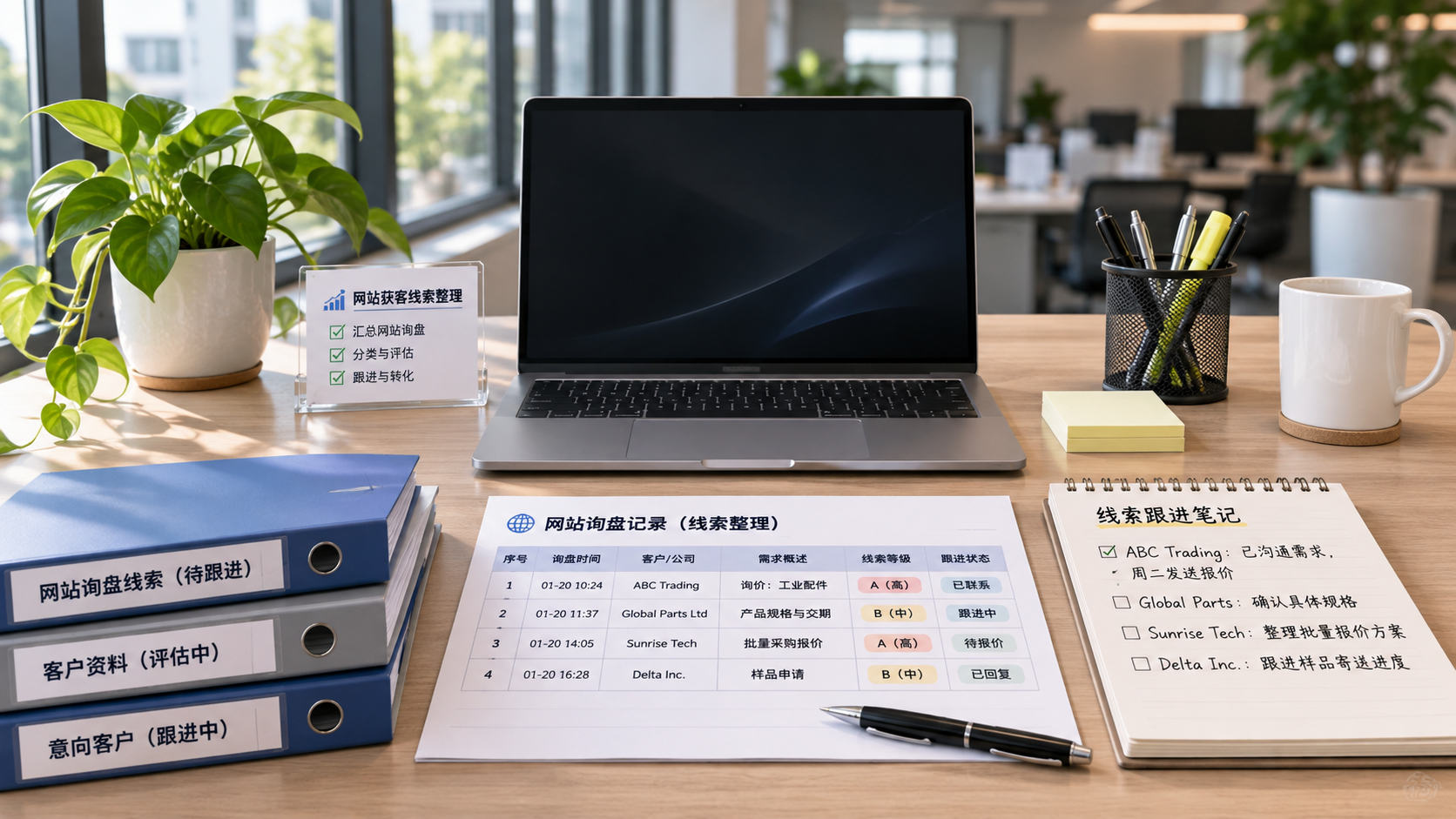
Companies often count all form submissions, material downloads, and direct-message inquiries as leads, but the purchase intent behind these actions varies significantly. Some people are simply learning about product specifications, some are comparing prices, and others already have clear purchasing plans. Without a unified classification system, the marketing department may believe that “leads have been delivered,” while the sales department may believe that “there are almost no customers worth following up,” leaving neither side able to identify the issue.
Start by breaking down and reviewing the actual conversion path rather than looking only at the total lead volume:
The most easily overlooked point here is that form submission is not the end of a sales opportunity, but merely the beginning of an information exchange. Especially in B2B business, where purchasing cycles are longer and more people are involved, treating ordinary visitors as high-intent customers too early will directly undermine sales teams’ trust in lead generation through digital marketing services.

Traffic may appear targeted but actually attracts the “wrong demand”
Visits generated through advertising and SEO may not be ineffective, but they may not match the customers the company actually wants. For example, pages centered on content such as “prices,” “free solutions,” or “downloadable guides” often attract information seekers, while the company may actually need customers with purchasing volume, application scenarios, and delivery requirements. Both types of visitors may leave their contact details, but the quality of subsequent conversion is completely different.
To determine whether traffic is misaligned, do not look only at geography, devices, or keywords. Also review what promise attracted customers in the first place. Search terms, ad copy, social media content, and the above-the-fold messaging on landing pages should all address the same business problem. If an ad says “Get a quote quickly” while the page mainly introduces the company’s history, or if a content article explains selection methods while the form asks visitors to schedule a demo immediately, this will create a psychological gap after the click.
Use page content to complete an initial round of qualification in advance
A high-conversion page does not mean compressing all information into “Contact Us Now.” For complex products or services, the page should enable visitors to make basic judgments before submitting: whether it suits their industry or business model, what materials they need to prepare, what stages the project typically involves, and under what conditions they can receive a valid quotation.
- Clearly state the core application scenarios and avoid vague expressions such as “high quality” and “professional service”;
- Present the key conditions that affect the solution or quotation upfront, such as quantity, specifications, target market, and delivery time;
- Show verifiable information, such as service processes, delivery scope, and frequently asked questions, rather than merely stacking advantage-oriented terms;
- Provide different entry points for different levels of intent, such as obtaining materials, discussing requirements, and scheduling a consultation, so that all visitors do not enter the same path.
This may reduce some low-threshold submissions, but it can make the information entering the sales process more complete. A short-term decline in lead volume does not necessarily mean that lead generation capability has weakened; if the proportion of effective conversations and quotation progress increases, it instead indicates that front-end qualification is beginning to work.
Forms that are too short or too long both affect subsequent conversion
If a form collects only a name, phone number, and email address, the submission rate may be high, but sales receives only contact details and must still confirm requirements from scratch during the first conversation. Conversely, requiring visitors to provide too many technical parameters, budgets, and project details in the form may cause visitors who are still in the evaluation stage to leave directly.
A more reasonable approach is to distinguish between “initial identification information” and “in-depth requirement information.” The initial form should retain fields that help determine priority, such as contact person, company, requirement type, target market, or purchasing stage. Detailed parameters related to quotations can be gradually supplemented through automated replies, requirement questionnaires, or sales communications. The value of fields does not lie in collecting as much as possible, but in ensuring that each item can influence subsequent actions.
For example, the sales team should at least be able to determine whether this is an end customer, trader, or industry peer; whether the requirement is a short-term project or long-term procurement; whether the customer is concerned with customization capabilities, delivery cycles, or cost; and whether the customer’s market is within the company’s service scope. Without this basic information, lead allocation can only rely on manual guesswork, and even fast response times make it difficult to establish effective conversations.
Slow sales follow-up is often not caused by “insufficient staff”
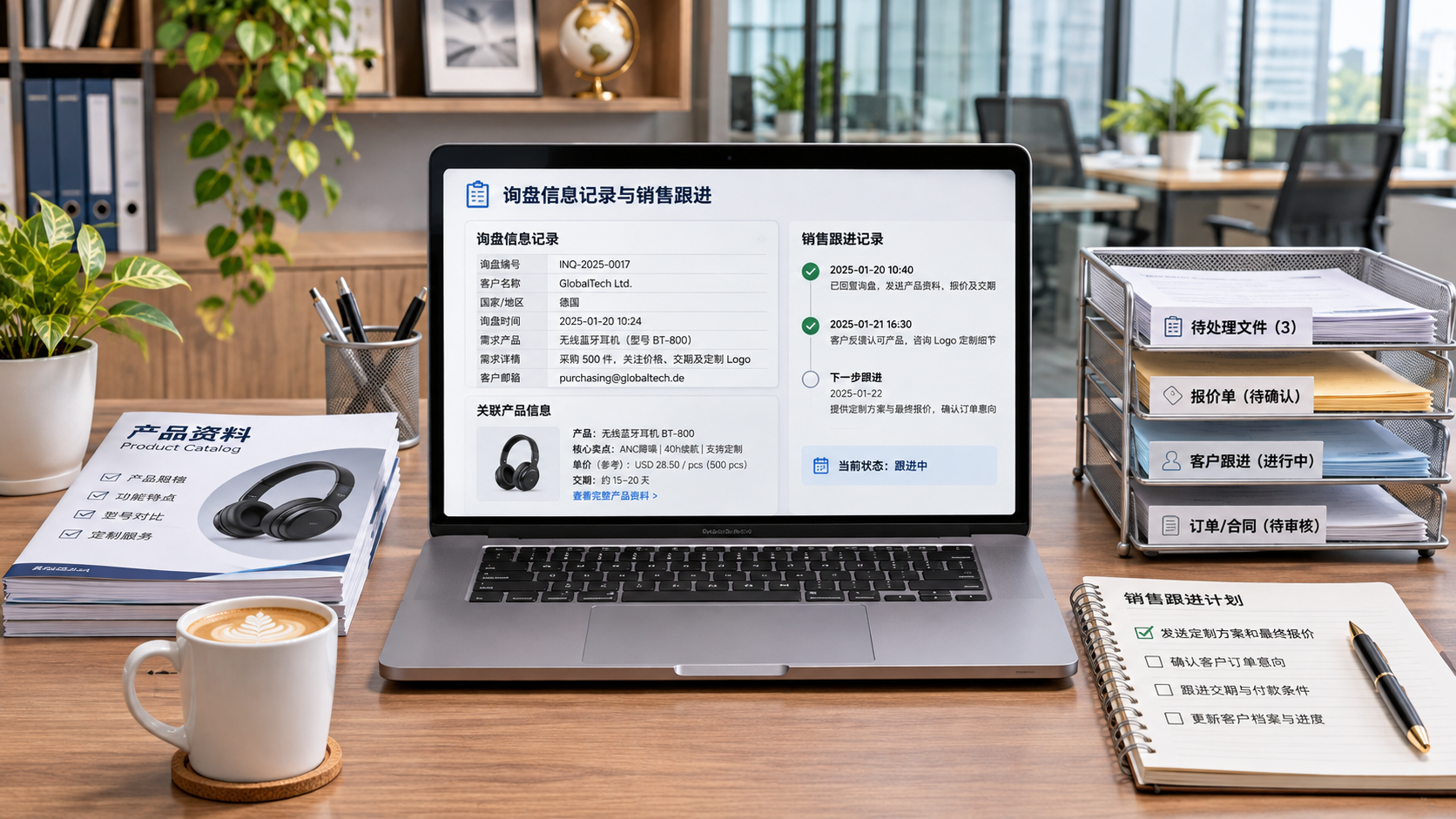
After a customer submits an inquiry, the initial communication window is very short. If leads first enter a shared mailbox and are then manually sorted, assigned, and forwarded, the customer may receive a response only after already contacting multiple suppliers. However, simply requiring sales teams to “contact customers quickly” is not enough. Sales also needs to know which page, type of ad, or piece of content the customer came from, as well as what the customer has already viewed.
Marketing and sales should establish at least one executable handover process: which leads can be assigned directly and which require further nurturing; how quickly the first response should be completed; what information the first response should provide; and how to re-engage leads that could not be reached. Visitors who are not yet ready to purchase should not simply be marked as invalid. Instead, relevant materials, application explanations, or selection information can be sent based on the content they viewed, while waiting for their needs to mature.
The key here is to break “no conversion” into actionable statuses instead of placing all such cases on an unresponsive list. No budget, unclear requirements, decision-makers not involved, and mismatched delivery conditions all require different follow-up strategies. The more ambiguous the status, the more difficult it is for marketing data to feed back into channel optimization.
A slowdown at the quotation stage often means the basis for closing was not established earlier
When customers do not respond after receiving a quotation, it does not necessarily mean they are merely negotiating price. It may also be that the quotation does not help them explain internally why they should choose the company. Especially for projects involving customization, cross-border delivery, or ongoing services, customers usually also need to confirm capability boundaries, delivery responsibilities, communication methods, and risk handling. If a quotation contains only an amount and a simple project name, the company can easily be placed into a purely price-based comparison.
Communications before and after the quotation should supplement the information customers need to make a decision: whether the requirements are understood accurately, what is and is not included in the solution, how key milestones will be confirmed, and what materials the customer still needs to provide. For businesses with longer decision-making chains, concise materials that can be easily forwarded should also be prepared to help business contacts explain the solution to procurement, technical, or management teams, rather than requiring them to repeat it themselves.
Use one review cycle to identify the area that should be improved first
Do not change the website, switch channels, redo sales messaging, and expand advertising all at once. First, select leads that did not convert during a certain period, categorize them by source, page, industry, requirement type, and stage of attrition, and then compare them with leads that entered the quotation stage or remained in ongoing communication. If a certain source generates many submissions but few effective conversations, first adjust targeting and promises; if leads from multiple channels are lost after the first conversation, review form information and response methods; if leads generally stop at the quotation stage, return to solution presentation and customer decision-making materials.
What truly needs to be optimized in lead generation through digital marketing services is not “bringing in more people,” but enabling the right people to enter the right communication path with sufficient information. When channels, websites, and sales processes can connect, lead quality becomes a manageable issue rather than a result that can only be judged by intuition.
Related Articles
 Fujian Releases White Paper on Talent Shortages in Cross-Border E-Commerce, Focusing on Industry Talent Challenges
 What Features Should an Inquiry Form on a B2B Export Website Support?
 How Should Customer Conversion Performance Be Measured on a B2B Standalone Website?

Related Products
 Yiyingbao SaaS Intelligent Website Building and Marketing SystemYiyingbao SaaS Intelligent Website Building and Marketing System, AI-powered no-code website building, rapid creation of multilingual B2B international websites in 10 minutes, global server acceleration, AI-powered SEO optimization, helping businesses connect efficiently with global markets. The perfect integration of technology and operation makes building an international trade website remarkably simple
 AI+SEM Intelligent Advertising Marketing SystemAI+SEM drives intelligent ad creation, empowering full-funnel precision advertising marketing. The system automatically generates weekly/monthly reports, AI recommends keywords and target countries, monitors core metrics in real-time with intelligent alerts, and enables one-click high-conversion ad solutions to help quickly acquire customers and improve ROI.
 AI+SEO Dual-Engine System Optimization ServicesYiyingbao’s AI+SEO dual-engine optimization system helps foreign trade enterprises acquire high-quality organic traffic through AI-powered keyword research, content generation, and comprehensive technical optimization, significantly improving search rankings and conversion rates.
 AI+SNS Social Media Marketing SystemYingbao AI+SNS Social Media Marketing System - Precision social capture for the social media era. Supports one-click content synchronization across major platforms like Facebook and LinkedIn. AI intelligently rewrites posts for enhanced relevance. 24/7 AI customer service and user profiling analysis empower businesses to efficiently expand into global markets.
 AI+SEO营销解决方案易营宝AI+SEO营销解决方案,通过AI批量写作、智能生成TDK、精准关键词扩词等功能,全面优化网站SEO效果,提升流量与转化率。助力企业构建高效智能网站新生态。
 AI+SEM Advertising Marketing SolutionsAI+SEM Advertising Marketing Solution leverages AI technology to deeply empower SEM ad campaigns. It automatically generates weekly/monthly reports using AI, presenting account data across multiple dimensions for comprehensive insights into campaign performance and trends. The system precisely recommends keywords and target countries, intelligently generates high-conversion ad copy, and enables one-click activation of efficient campaign plans to help businesses rapidly acquire customers. Simultaneously, it monitors core metrics in real time, intelligently identifies abnormal fluctuations, and issues timely alerts to ensure stable, high-return advertising results.
 Domain Name ServicesEasyWin provides professional domain name services, including intelligent queries, one-stop registration, brand protection, and full lifecycle management, helping businesses build a digital brand image.
 EasyOperate B2C Cross-Border E-Commerce Platform & Independent WebsiteEasyStore B2C Cross-border E-commerce Independent Store is an intelligent website building and cross-border e-commerce integrated solution independently developed by EasyStore Information Technology (Beijing) Co., Ltd. The system is specially designed for small and medium-sized as well as large export enterprises, integrating 'website building, operation, marketing, advertising, and conversion' into one, helping enterprises quickly establish cross-border e-commerce independent stores to achieve brand globalization and global sales growth.
The platform supports multiple languages, multiple currencies, and multi-channel marketing, with built-in AI intelligent translation and SEO optimization systems, suitable for mainstream markets such as Southeast Asia, Europe and America, Latin America, and the Middle East, assisting Chinese manufacturing enterprises in efficiently deploying international e-commerce strategies. SSL证书易营宝提供专业SSL安全证书服务,包括单域名和泛域名证书,确保网站数据传输加密、身份验证和完整性保护,助力企业建立安全可信的在线业务环境。









