









- Which customer acquisition channels will be affected by cross-border marketing trends in 2026?Sep 06, 2026View details
- Which homogenization risks should be considered in an analysis of the AI-powered website building industry?Aug 30, 2026View details
- How Will AI Marketing Trends 2026 Change Advertising Budget AllocationAug 28, 2026View details
- Is the EV SSL certificate market shrinking or upgrading? How should companies assess certificate procurement?Aug 11, 2026View details
- Why the old AMP SEO 2020 practices no longer work and what has changed in current optimization prioritiesAug 02, 2026View details
- How to Choose Topics for an Industry News Section to Attract More Organic Search TrafficJul 29, 2026View details
Why Do Dongguan Website Development Quotes Vary So Much?
Website development quotes in Dongguan range from several thousand yuan to tens of thousands of yuan or even higher. The difference is usually not simply about “how many pages are built,” but whether the delivery is a display website or a website system that can be used long term, is easy to promote, and supports business conversion.
A low quote is not necessarily unusable, and a high quote is not necessarily reasonable. To determine whether the cost is appropriate, the key is to see whether the website objectives, functional scope, technical implementation, content investment, and subsequent services are clearly defined. Comparing only homepage visual mockups or the number of pages often overlooks the factors that have the greatest impact on later costs.
Even when both are called “corporate websites,” the deliverables may be completely different
Some low-cost solutions are essentially template-based: the company name, images, and product text are replaced, and a basic domain name and server are configured. Such websites are suitable for companies with limited budgets that only need an online business card or short-term information display. Their advantage is fast launch, but the page structure, mobile details, expandable functions, and room for subsequent promotion are usually limited.
Another type is planned according to business requirements. The website provider first organizes product categories, customer access paths, inquiry actions, and content hierarchy, then completes page design, front-end development, back-end management, form integration, and basic search optimization. The cost of such projects is naturally higher because the investment includes not only page production time, but also information architecture and usability for subsequent operations.
If the website also requires multilingual content, membership systems, product filtering, online quotations, distributor management, payment and ordering, or ERP or CRM data integration, it is normal for quotes to vary further. Even when function names appear the same, differences in interaction logic, data rules, and exception handling can result in significant differences in development workload.
What often widens the price gap is the work you cannot see
Visual design is the most readily perceived item, but it is not necessarily the most costly. The time required differs depending on whether a page directly uses a template or is redesigned around industry products, brand guidelines, and conversion paths. More importantly, whether an approved design can be accurately implemented on desktop computers, mobile phones, and tablets, and whether images, fonts, buttons, and forms remain stable across different screens, all affect development costs.
The technical foundation also determines the price. Using a mature SaaS website-building system can usually reduce repetitive development and provide basic security maintenance, component updates, and back-end capabilities; fully customized development offers greater flexibility, but launch, maintenance, and subsequent modifications all require greater investment. Neither approach is absolutely better or worse. The difference lies in whether the company genuinely needs unique processes and whether it can sustainably maintain a custom system.
In addition, a website is not a file that is finished once it is published. Domain name resolution, server environment, HTTPS certificates, backups, vulnerability fixes, form email delivery, traffic analytics, and permission management are all part of actual use. If a quotation only states “maintenance included” without specifying the maintenance period, response scope, and responsibility boundaries, these can easily become additional chargeable items later.

A website intended for promotion cannot be measured only by “website-building costs”
For companies that need to obtain leads through search, advertising, or social media, the website serves as a landing page and conversion destination. In this case, whether search engines can understand the pages, whether product content can be published continuously, whether forms make it easy to track sources, and whether loading speed is stable will all affect the efficiency of subsequent marketing investment.
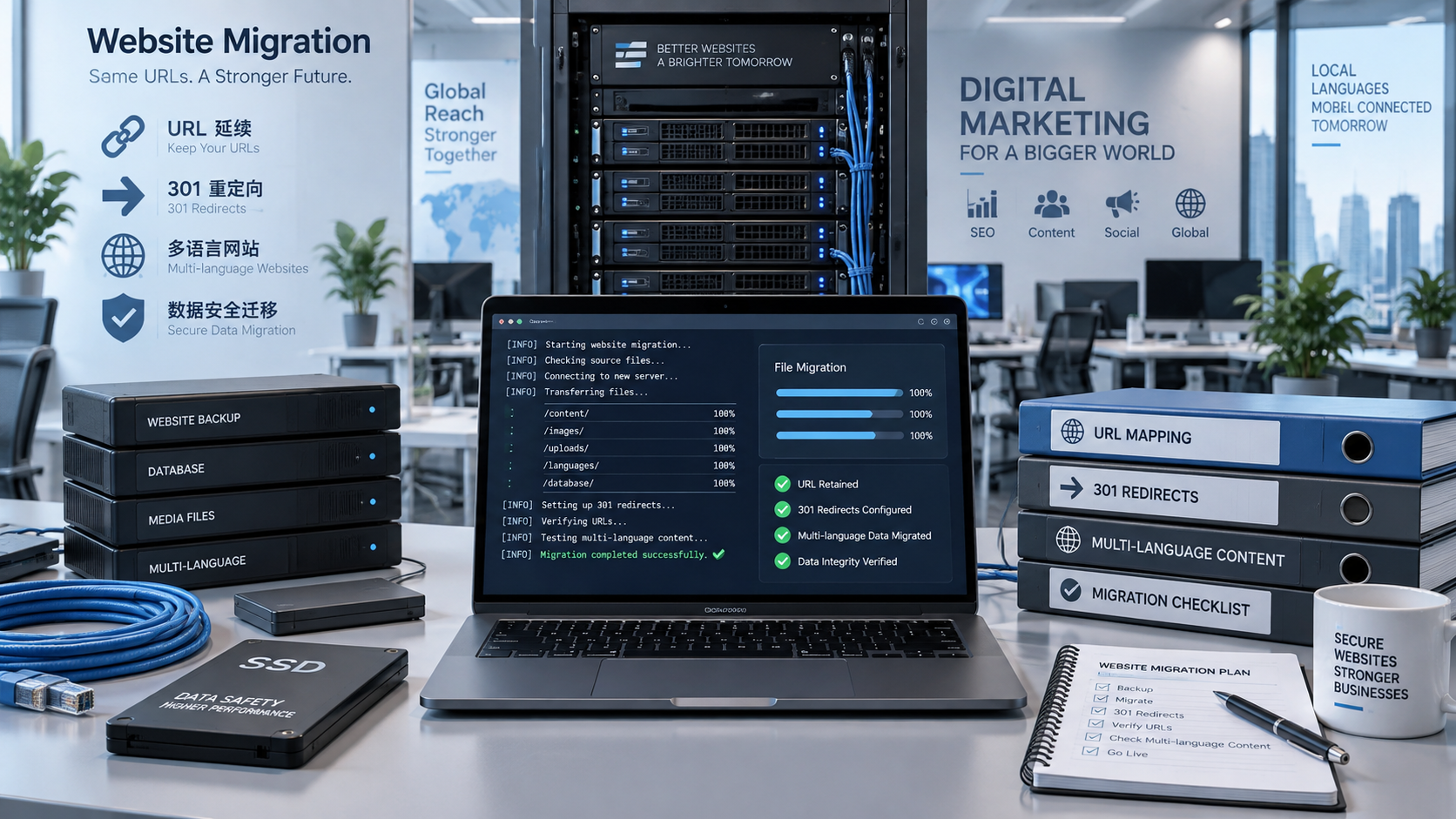
This is why some Dongguan website development solutions include keyword planning, URL rules, title and description settings, sitemaps, image optimization, 301 redirects, and analytics tool configuration within the delivery scope. These may not directly guarantee rankings or inquiry volume, but they can prevent discovering after launch that the basic website structure is unsuitable for SEO and requires rework.
Export-oriented manufacturing companies should also pay additional attention to multilingual logic. Simply translating pages is not the same as configuring language versions, product content, inquiry entry points, and search indexing structures for different markets. If the plan is to continuously acquire customers in overseas markets, choosing an integrated platform or service model with multilingual website building, SEO, advertising landing pages, and data tracking capabilities is often easier for controlling overall costs than “build the site first and add promotion later.” AIYingBao's intelligent website-building and marketing services for overseas expansion scenarios are suitable for companies that want to consider Google SEO, advertising, and overseas social media conversion at the website-building stage; if only a basic domestic display website is needed, there is no need to allocate budget for capabilities that will not be used.
The six items that should be confirmed one by one in a quotation
- Page and content scope: The number of pages is only the foundation. The number of product entries, who provides the copy, whether images are processed, and whether multilingual content is included should all be specified.
- Design and revision rules: Confirm whether this involves template adjustments or custom design, whether homepage and inner pages are designed separately, how many revision rounds are included, and how work beyond the scope is calculated.
- Back-end ownership and editable scope: Confirm whether news, products, SEO titles, and images can be updated independently after launch, and who holds the back-end account.
- Ownership of domain names, hosting, and source code: The domain name should be registered under an account controlled by the company. When using a SaaS system, understand the data export, renewal, and migration methods; for custom development, the scope of source code delivery should be specified.
- Basic promotion configuration: If search promotion or advertising is planned, confirm whether analytics code, conversion events, form notifications, and basic SEO settings are included.
- Specific after-sales service content: Distinguish between fault repairs, content update services, added functions, and server renewals. They are not the same type of service, so do not judge solely by the words “free maintenance.”
The three most common pitfalls of low prices
The first is treating “website production” as a one-time buyout. A low-cost contract may cover only the initial launch, while adding sections, replacing images, or adjusting mobile styles later will all be charged separately. Including common changes within the scope before the project begins is more effective than negotiating each item after launch.
The second is overlooking content costs. The website provider can build the structure, but the company still needs to provide or jointly organize product selling points, specifications, application scenarios, and brand materials. If content remains absent over the long term, even the best system will struggle to create a credible presentation and search entry point.
The third is judging a solution by the idea that “the more functions, the better the value.” Unused multi-level membership systems, complex online stores, and appointment systems not only increase initial costs but also add training and maintenance burdens. Functions should serve proven business processes rather than make the quotation appear more comprehensive.
Define the website's purpose first, then compare prices
When receiving multiple quotations, requirements can first be divided into three categories: “required at launch,” “possibly needed within six months,” and “not currently needed.” Basic display, product publishing, and inquiry collection usually belong to the first category; multilingual content, content marketing, advertising tracking, and online transactions depend on the business plan. Asking providers to quote separately for these three categories makes it easier to see which costs are currently necessary investments and which can be postponed.
Ultimately, prices should be compared based on the same delivery checklist, rather than directly comparing the total price of a template website with that of a custom marketing website. For businesses focused mainly on corporate website display, stability, ease of maintenance, and complete materials are usually more valuable than complex functions; for businesses that rely on online customer acquisition or overseas market expansion, website structure, content management, and marketing integration capabilities are more worthy of upfront investment. Price differences themselves are not the problem. Unclear requirements, unclear responsibilities, and unclear subsequent costs are what truly make website projects likely to get out of control.
Related Articles

Related Products
 Yiyingbao SaaS Intelligent Website Building and Marketing SystemYiyingbao SaaS Intelligent Website Building and Marketing System, AI-powered no-code website building, rapid creation of multilingual B2B international websites in 10 minutes, global server acceleration, AI-powered SEO optimization, helping businesses connect efficiently with global markets. The perfect integration of technology and operation makes building an international trade website remarkably simple
 AI+SEM Intelligent Advertising Marketing SystemAI+SEM drives intelligent ad creation, empowering full-funnel precision advertising marketing. The system automatically generates weekly/monthly reports, AI recommends keywords and target countries, monitors core metrics in real-time with intelligent alerts, and enables one-click high-conversion ad solutions to help quickly acquire customers and improve ROI.
 AI+SEO Dual-Engine System Optimization ServicesYiyingbao’s AI+SEO dual-engine optimization system helps foreign trade enterprises acquire high-quality organic traffic through AI-powered keyword research, content generation, and comprehensive technical optimization, significantly improving search rankings and conversion rates.
 AI+SNS Social Media Marketing SystemYingbao AI+SNS Social Media Marketing System - Precision social capture for the social media era. Supports one-click content synchronization across major platforms like Facebook and LinkedIn. AI intelligently rewrites posts for enhanced relevance. 24/7 AI customer service and user profiling analysis empower businesses to efficiently expand into global markets.
 AI+SEO营销解决方案易营宝AI+SEO营销解决方案,通过AI批量写作、智能生成TDK、精准关键词扩词等功能,全面优化网站SEO效果,提升流量与转化率。助力企业构建高效智能网站新生态。
 AI+SEM Advertising Marketing SolutionsAI+SEM Advertising Marketing Solution leverages AI technology to deeply empower SEM ad campaigns. It automatically generates weekly/monthly reports using AI, presenting account data across multiple dimensions for comprehensive insights into campaign performance and trends. The system precisely recommends keywords and target countries, intelligently generates high-conversion ad copy, and enables one-click activation of efficient campaign plans to help businesses rapidly acquire customers. Simultaneously, it monitors core metrics in real time, intelligently identifies abnormal fluctuations, and issues timely alerts to ensure stable, high-return advertising results.
 Domain Name ServicesEasyWin provides professional domain name services, including intelligent queries, one-stop registration, brand protection, and full lifecycle management, helping businesses build a digital brand image.
 EasyOperate B2C Cross-Border E-Commerce Platform & Independent WebsiteEasyStore B2C Cross-border E-commerce Independent Store is an intelligent website building and cross-border e-commerce integrated solution independently developed by EasyStore Information Technology (Beijing) Co., Ltd. The system is specially designed for small and medium-sized as well as large export enterprises, integrating 'website building, operation, marketing, advertising, and conversion' into one, helping enterprises quickly establish cross-border e-commerce independent stores to achieve brand globalization and global sales growth.
The platform supports multiple languages, multiple currencies, and multi-channel marketing, with built-in AI intelligent translation and SEO optimization systems, suitable for mainstream markets such as Southeast Asia, Europe and America, Latin America, and the Middle East, assisting Chinese manufacturing enterprises in efficiently deploying international e-commerce strategies. SSL证书易营宝提供专业SSL安全证书服务,包括单域名和泛域名证书,确保网站数据传输加密、身份验证和完整性保护,助力企业建立安全可信的在线业务环境。









