









- CBP Finalizes Electronic Rail Export Manifest Rule, Effective October 26, 2026Oct 26, 2026View details
- Amazon’s 2026 peak season surcharge takes effect on October 25Oct 26, 2026View details
- AI Is Eating SaaS: Three Real-World Cases in One AfternoonOct 25, 2026View details
- Exiger CEO: The SaaS Apocalypse Is Real, but It Means Something DifferentOct 25, 2026View details
- Hengqin Cooperation Zone Shares Cross-Border E-Commerce Developments, Focusing on Macao-Hengqin Collaboration and International MarketsOct 24, 2026View details
- A Shenyang study highlights the development of the “cross-border e-commerce + industrial cluster” modelOct 24, 2026View details
How Can Foreign Trade Video Marketing Consistently Generate Qualified Inquiries?
Many foreign trade teams encounter this situation: they publish quite a few videos, and view counts are occasionally good, yet the sales department still feels that “there are no customers to follow up with.” The problem is usually not insufficient filming effort, but rather the lack of a continuous operational path connecting videos, traffic, and inquiries. Foreign trade marketing video operations are not simply about publishing content; they require continuous optimization around customer needs, channel distribution, and lead capture so that exposure can gradually turn into stable, qualified inquiries.
For those responsible for overseas market operations, the real questions are not “What should we film today?” but rather: Who will watch this video? At which stage of the purchasing decision are they? Where should they go after watching to learn about the product? And can sales obtain sufficiently clear information about their needs? Only by linking these stages together can videos become a growth bridge between an independent website, Google Search, advertising campaigns, and social media accounts.
Redefine a “qualified inquiry”: Leaving an email address does not mean success
In B2B foreign trade scenarios, a genuinely valuable inquiry usually contains at least three signals: the customer's market or company type is basically a match; the inquiry relates to the product, application, or project; and the contact details and purchase intent can be further verified by sales. Likes, general comments, or even just “Please send price” do not need to be treated as results of video operations too quickly.
Therefore, before production, operations personnel should confirm lead criteria with sales. For example, industrial equipment companies place greater importance on capacity requirements, material parameters, project delivery schedules, and after-sales service regions; suppliers of customized components should guide customers to submit drawings, materials, quantities, and tolerances. The call to action at the end of the video, landing page form fields, and the first customer service response should all support the acquisition of this key information.
A common misconception is to direct all videos to the homepage. The homepage is suitable for building brand awareness, but may not be suitable for capturing specific needs. Videos focused on a particular model, process, or industry application are best linked to a dedicated product page, solution page, or inquiry landing page, so visitors do not need to repeatedly search through the website.
Content topics should start with purchasing questions, not company news
Overseas buyers do not usually develop purchasing interest because a company has relocated, executives attended an exhibition, or holiday greetings were posted. When they open a video, they are more likely trying to confirm, “Can this supplier solve my problem?” Foreign trade marketing video operations should prioritize high-frequency questions throughout the purchasing process and arrange content according to the strength of purchase intent.
- Awareness-stage content: Showcase product application scenarios, common industry challenges, and material or process trends to help unfamiliar customers understand product value.
- Evaluation-stage content: Break down differences in specifications, production processes, quality inspection, packaging and transportation, and customization capabilities to reduce customers' concerns about supply risks.
- Conversion-stage content: Produce short videos around specific models, delivery processes, sample applications, and quotation preparation requirements, directly guiding users to the inquiry page.
For manufacturing companies, for example, a video showing “from raw material inspection to finished-product packing” often builds more trust than a neat aerial shot of the factory; an explanation of “how to choose materials based on the operating environment” is also more likely to attract targeted visits than a general statement that “our products are of excellent quality.” Content does not need to pursue a cinematic feel, but the visuals, subtitles, English wording, and key information must be clear to target customers.
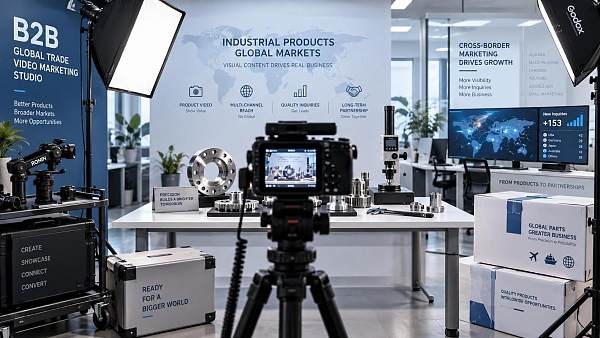
One video should accomplish at least three things: be seen, understood, and acted upon
The first few seconds of a short video determine whether users stay, but foreign trade videos cannot focus only on attracting attention. The opening can directly present a usage scenario or purchasing pain point, such as “Need a corrosion-resistant fitting for marine projects?”, followed by product details, testing footage, or real applications that address the question. For highly specialized products, information such as dimensions, standards, and certification applicability in the subtitles should be verified by business personnel to avoid follow-up communication costs caused by unclear wording.
The middle section needs to help customers understand the boundaries of supply capabilities: what can be done, what is not recommended, and which markets or industries are suitable. Presenting these boundaries honestly can instead help filter out mismatched traffic. The ending should not simply say “Contact us,” but should provide a more specific next step, such as “Download specification sheet,” “Send your drawing for review,” or “Get a sample plan.” The clearer the action, the easier it is for customers to take the first step.
At the same time, content on different platforms should retain its own rhythm. YouTube is suitable for videos that can be searched over the long term, such as product explanations, factory audits, and installation tutorials; LinkedIn is better suited for industry viewpoints, project experience, and interpretations by technical personnel; channels such as Facebook, Instagram, and TikTok can expand reach through fast-paced content and then direct high-intent users to the independent website. Copying and pasting exactly the same video often reduces platform distribution effectiveness.
Bring video traffic back to a trackable independent website path
Receiving inquiries only through social media direct messages can easily result in scattered leads, unclear attribution, and difficulties in sales handover. A more reliable approach is to use videos as entry points and guide users to corresponding pages on a multilingual independent website. The page should remain consistent with the video topic: if the video discusses a solution for a certain industry, the landing page should continue to present application cases, technical parameters, FAQs, and a form, rather than suddenly directing users to a broad product catalog.
Form design also requires restraint. With too few fields, sales cannot assess the requirements; with too many fields, customers may leave immediately. A B2B inquiry page can retain basic fields such as name, company email, country, and requirement description, while adding product model, estimated quantity, purchasing timeframe, or drawing upload according to business needs. For markets using different languages, page language, units, contact methods, and privacy notices should also be adjusted accordingly.
The AI-powered website building, multilingual website development, and cross-border marketing tools provided by Yiyingbao can bring the product pages, advertising landing pages, and inquiry forms supported by videos into one unified website operation system. Operations personnel do not need to manage website, SEO, and social media content separately; instead, they can continuously update page content around the same keywords and customer questions, and, together with Google SEO, advertising campaigns, and overseas social media distribution, gradually determine which topics generate visits that are closer to genuine purchasing needs.
Data review is not only about views; identify the “breakpoints”
The value of video operations often lies in the middle of the funnel. High view counts but few link clicks may mean a disconnect between the content and the call to action; many clicks but few form submissions may indicate insufficient landing page information, slow loading speed, or an audience brought in by the video that is not targeted enough; many form submissions but no qualified opportunities require a review of targeting, topic selection, and form screening fields.
It is recommended to create a concise monthly operations record: video topic, publishing channel, viewing completion rate, link clicks, page dwell time, form submissions, number of qualified inquiries, and number of leads that ultimately enter the quotation or sample-making stage. Do not rush to draw conclusions from one or two videos; instead, observe how the same topic performs in different formats. For example, do customers prefer watching explanations from real engineers, or do they prefer staying on actual testing footage? Which prompt, “Get a catalog” or “Submit a drawing,” generates higher-quality inquiries?
When producing content continuously, do not turn the account into a “product photo album”
The most common fatigue in foreign trade video production is repeatedly filming product rotations, warehouse stockpiles, and factory entrances every week. After customers have seen them once, it is difficult for them to gain new information. More sustainable content sources should come from sales chat records, customer emails, after-sales questions, exhibition questions, and on-site website search terms. These real questions are themselves the most valuable topic library.
A complex topic can be divided into a series: one video explains common application misconceptions, another shows the testing process, another explains selection methods, and then one video guides customers to the complete solution page. This not only reduces the pressure of each production session, but also allows the account to gradually develop professional themes instead of scattered updates.
Ultimately, the goal of foreign trade marketing video operations is not to make every piece of content go viral, but to ensure that the right overseas buyers can find trustworthy information when they need it and smoothly enter an inquiry process that can be followed up. When content planning, channel distribution, independent website conversion, and data review begin to work together, videos can evolve from “brand presentation materials” into business assets that continuously support overseas customer acquisition.
Related Articles
 Does social media content for the European market need to be localized by country?
 How to Develop a Facebook Marketing Strategy for Overseas Distributors?
 How can you tell whether leads provided by a social media lead generation vendor are valid?


Related Products
 Yiyingbao SaaS Intelligent Website Building and Marketing SystemYiyingbao SaaS Intelligent Website Building and Marketing System, AI-powered no-code website building, rapid creation of multilingual B2B international websites in 10 minutes, global server acceleration, AI-powered SEO optimization, helping businesses connect efficiently with global markets. The perfect integration of technology and operation makes building an international trade website remarkably simple
 AI+SEM Intelligent Advertising Marketing SystemAI+SEM drives intelligent ad creation, empowering full-funnel precision advertising marketing. The system automatically generates weekly/monthly reports, AI recommends keywords and target countries, monitors core metrics in real-time with intelligent alerts, and enables one-click high-conversion ad solutions to help quickly acquire customers and improve ROI.
 AI+SEO Dual-Engine System Optimization ServicesYiyingbao’s AI+SEO dual-engine optimization system helps foreign trade enterprises acquire high-quality organic traffic through AI-powered keyword research, content generation, and comprehensive technical optimization, significantly improving search rankings and conversion rates.
 AI+SNS Social Media Marketing SystemYingbao AI+SNS Social Media Marketing System - Precision social capture for the social media era. Supports one-click content synchronization across major platforms like Facebook and LinkedIn. AI intelligently rewrites posts for enhanced relevance. 24/7 AI customer service and user profiling analysis empower businesses to efficiently expand into global markets.
 AI+SEO营销解决方案易营宝AI+SEO营销解决方案,通过AI批量写作、智能生成TDK、精准关键词扩词等功能,全面优化网站SEO效果,提升流量与转化率。助力企业构建高效智能网站新生态。
 AI+SEM Advertising Marketing SolutionsAI+SEM Advertising Marketing Solution leverages AI technology to deeply empower SEM ad campaigns. It automatically generates weekly/monthly reports using AI, presenting account data across multiple dimensions for comprehensive insights into campaign performance and trends. The system precisely recommends keywords and target countries, intelligently generates high-conversion ad copy, and enables one-click activation of efficient campaign plans to help businesses rapidly acquire customers. Simultaneously, it monitors core metrics in real time, intelligently identifies abnormal fluctuations, and issues timely alerts to ensure stable, high-return advertising results.
 Domain Name ServicesEasyWin provides professional domain name services, including intelligent queries, one-stop registration, brand protection, and full lifecycle management, helping businesses build a digital brand image.
 EasyOperate B2C Cross-Border E-Commerce Platform & Independent WebsiteEasyStore B2C Cross-border E-commerce Independent Store is an intelligent website building and cross-border e-commerce integrated solution independently developed by EasyStore Information Technology (Beijing) Co., Ltd. The system is specially designed for small and medium-sized as well as large export enterprises, integrating 'website building, operation, marketing, advertising, and conversion' into one, helping enterprises quickly establish cross-border e-commerce independent stores to achieve brand globalization and global sales growth.
The platform supports multiple languages, multiple currencies, and multi-channel marketing, with built-in AI intelligent translation and SEO optimization systems, suitable for mainstream markets such as Southeast Asia, Europe and America, Latin America, and the Middle East, assisting Chinese manufacturing enterprises in efficiently deploying international e-commerce strategies. SSL证书易营宝提供专业SSL安全证书服务,包括单域名和泛域名证书,确保网站数据传输加密、身份验证和完整性保护,助力企业建立安全可信的在线业务环境。









