









- Which customer acquisition channels will be affected by cross-border marketing trends in 2026?Sep 06, 2026View details
- Which homogenization risks should be considered in an analysis of the AI-powered website building industry?Aug 30, 2026View details
- How Will AI Marketing Trends 2026 Change Advertising Budget AllocationAug 28, 2026View details
- Is the EV SSL certificate market shrinking or upgrading? How should companies assess certificate procurement?Aug 11, 2026View details
- Why the old AMP SEO 2020 practices no longer work and what has changed in current optimization prioritiesAug 02, 2026View details
- How to Choose Topics for an Industry News Section to Attract More Organic Search TrafficJul 29, 2026View details
How to Choose AI Translation Software? A Multilingual Localization Evaluation Checklist for Foreign Trade Websites
How to Choose AI Translation Software: A Localization Evaluation Checklist for Multilingual Foreign Trade Websites
For websites targeting overseas markets, translation has never been as simple as replacing Chinese sentences with foreign-language equivalents one by one. When procurement professionals visit a supplier's website, they often decide within a very short time whether the company understands industry terminology, can meet specification requirements, communicates smoothly, and has controllable cooperation risks. If translations of product parameters, customization processes, quality inspection instructions, and inquiry forms are unclear, potential customers may leave even if the page design is good.
Therefore, when choosing AI translation software, it is not advisable to compare only how many languages it supports or how fast a single translation can be completed. What truly needs to be evaluated is whether it can be integrated into the content production, review, publishing, and marketing workflow of a foreign trade website, while maintaining terminology consistency, page structure integrity, and stable search visibility across multiple markets. For B2B companies, this is a website capability rather than simply a copywriting tool purchase.
First, distinguish between machine translation, AI translation, and website localization
Basic machine translation primarily solves sentence conversion. Current generative AI translation can usually adjust wording based on context, rewrite titles, and assist with longer content. Website localization goes further: it involves language, units of measurement, date formats, commonly used market expressions, page buttons, text in images, form fields, payment or logistics prompts, and how product claims are understood in different regions.
For example, “customization” on a manufacturing website may refer to production based on drawings, specification adjustments, or private labeling. If it is uniformly translated into English as “customized,” purchasers still will not know exactly which service the company provides. A more appropriate approach is to clearly present design support, minimum order requirements, sampling steps, lead-time communication, and quality control information on the relevant page. A translation engine can generate a first draft, but the business scope must be defined by the company itself.
When evaluating AI translation software, first examine terminology and context control
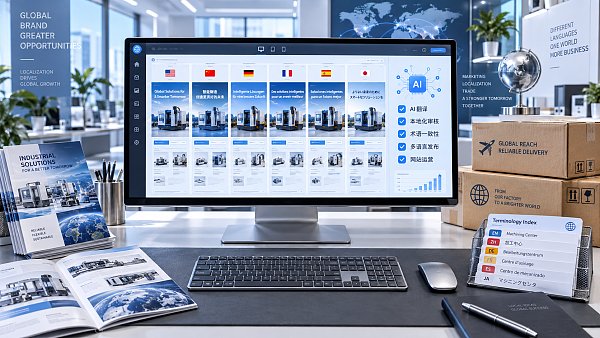
The biggest concern for foreign trade websites is having “the same term translated into multiple versions.” Once product names, materials, processes, certification names, model rules, and after-sales terminology become inconsistent, customers may question the company's information management capabilities, while sales follow-up will incur additional explanation costs. During selection, suppliers should be asked to demonstrate terminology databases, do-not-translate terms, brand name protection, and memory mechanisms for human revisions, rather than simply assessing whether a general promotional paragraph is translated fluently.
Its ability to recognize page context should also be tested. Short terms in navigation menus, technical paragraphs in product details, and call-to-action buttons on advertising landing pages cannot use the same translation logic. A practical testing method is to select three types of real content: a product detail page, an OEM capability introduction page, and an inquiry form, then check the terminology, tone, and meaning of the fields separately. If the system can only process isolated sentences, subsequent maintenance will usually be difficult.
Do not overlook the connection between pages, SEO, and publishing
Many companies follow this approach: first export text using AI translation software, then have staff copy it into pages in different languages. This may be manageable for a small volume of content, but once products are updated frequently and multiple regions are covered, common problems tend to emerge: the Chinese content is changed but foreign-language pages are not synchronized; changes in title length disrupt the layout; the same product uses duplicate or misaligned links on pages in different languages; and language versions lack separate page titles, descriptions, and URL planning.
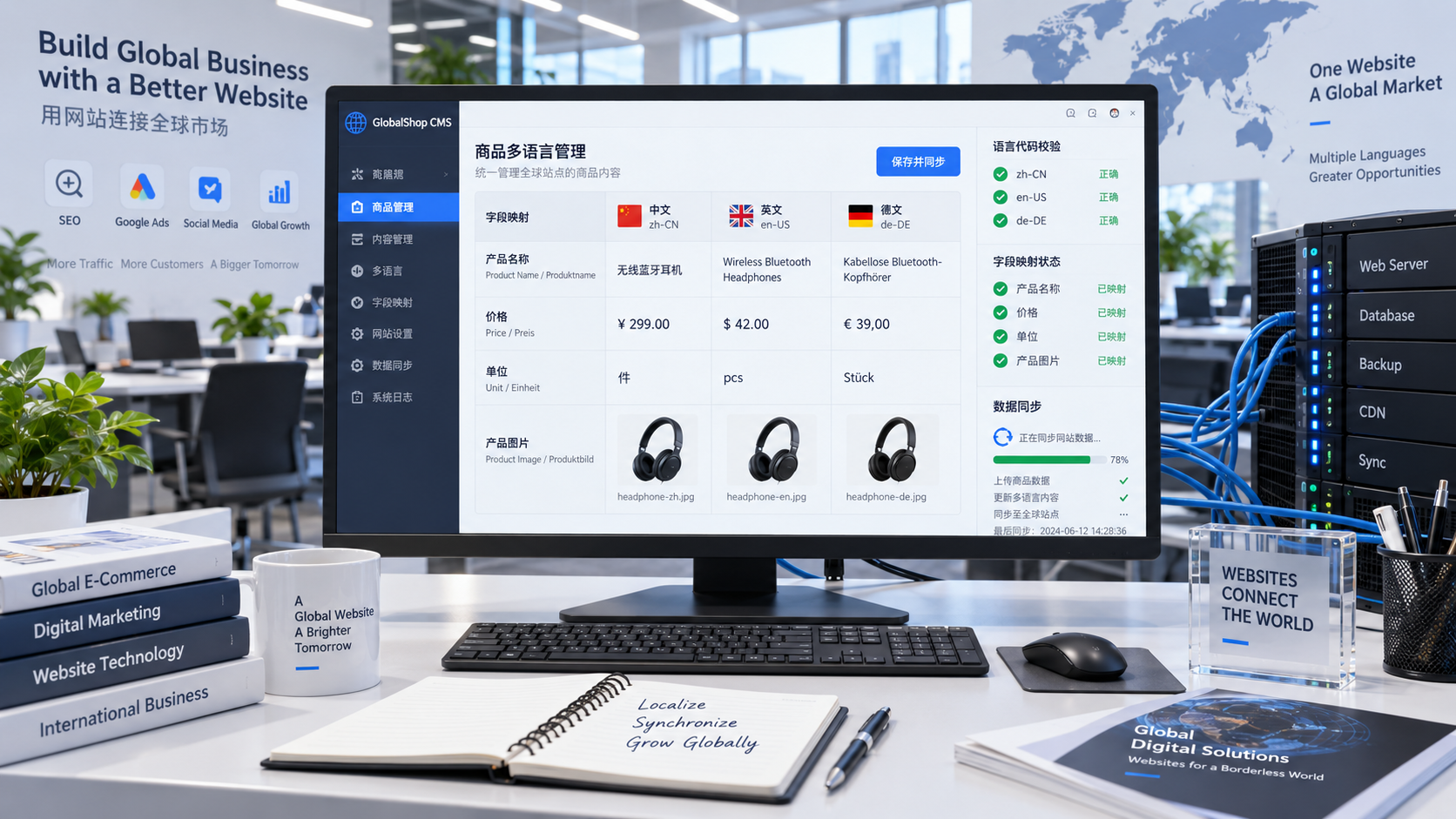
This is also why software evaluation cannot be separated from the website-building system. During procurement, key questions may include: Can translation be completed within the content management backend? Does it support review by page, module, or field? Can it identify content pending updates after the source text is modified? Can multilingual versions be edited independently? Can image replacements, form prompts, and product attributes be managed by language version? For websites that rely on organic search to acquire customers, it is also necessary to confirm whether the indexing settings, language-version associations, and sitemap handling for multilingual pages are controllable.
Different markets require more than simply changing the language
The same language does not mean the same purchasing habits. When English pages target North America, the United Kingdom, or the Middle East, the focus of product descriptions, the wording of delivery commitments, and common inquiry questions may differ. Spanish, French, Arabic, and other pages may also involve regional variants or reading direction. AI can help improve first-draft efficiency, but target market priorities should be determined by sales leads, the distribution of existing customers, logistics capabilities, and product suitability.
Especially when content involves food contact, cosmetic claims, medical uses, chemical ingredients, or safety performance, translation results cannot be treated as compliance conclusions. Software can help standardize wording, but specific labels, statements, and market access requirements must still be verified in conjunction with the sales region and product documentation. Systems that can flag content pending review and retain version records are usually more suitable for long-term operations than those that simply pursue “one-click generation of all pages.”
Test whether content can truly facilitate communication through business scenarios
In industries such as fragrances, personal care, and beauty products, where sensory experience and packaging presentation are emphasized, translation quality can particularly affect brand perception. A website targeting wholesalers, brand owners, or OEM buyers must accurately convey fragrance profiles, formulation concepts, and packaging processes, while enabling customers to quickly find information on sampling, customization, production capacity, and quality control. Page solutions such as fragrances, personal care, and beauty products combine extensive white space, visual product matrices, and clear vertical content hierarchy, while using timelines to break down OEM processes and data dashboards and comparison cards to present production and quality information, making them better suited to the reading journey of B2B customers.
The key here is not to “make the page more elaborate,” but whether the translated content can continue to support this journey: brand messaging in banners must not be overly literal; product grids need to retain the logic for specification filtering; every step of the OEM process must align with services that sales teams can actually deliver; and buttons, forms, and attachment prompts on mobile devices must also read naturally. When language, visuals, and conversion actions are disconnected, a website may appear complete but struggle to advance an effective inquiry.
A more practical selection checklist
- Can it establish and maintain a corporate terminology database, locking brand names, models, materials, and do-not-translate terms?
- Can it distinguish among different content scenarios, such as product pages, blogs, advertising pages, and forms, while retaining an entry point for human review?
- Is it integrated with the website backend and capable of supporting source-content update reminders, version comparison, batch processing, and permission management?
- Can multilingual pages independently optimize titles, descriptions, links, and calls to action, rather than simply copying the Chinese structure?
- Does it support the languages required by target markets, as well as front-end adaptation for right-to-left layouts and changes in character length?
- How is data stored and accessed, and are there clear permission and processing rules for sensitive quotations, customer information, and technical documents?
Yiyingbao Information Technology (Beijing) Co., Ltd. has provided services in intelligent website building and overseas digital marketing since 2013. Its business covers multilingual website development, SEO optimization, advertising placement, social media operations, and AI search visibility optimization. For companies that need to continuously update their overseas websites, what deserves greater attention is not the speed of individual translations, but whether translation, website building, content optimization, and customer acquisition channels can work together within the same operational framework. The benefit is that content teams, sales teams, and marketing teams see the same set of product information rather than multiple language versions that increasingly diverge.
Before making a final decision, it is recommended to conduct a small-scale pilot using the company's existing pages: select one core product page, one capability page, and one inquiry page; establish terminology rules; and have business personnel, foreign-language reviewers, and website operations personnel check them together. Only AI translation software that can withstand testing with real content is more likely to reduce subsequent maintenance costs and make a multilingual website a stable gateway for overseas communication.
Related Articles
Related Products
 Yiyingbao SaaS Intelligent Website Building and Marketing SystemYiyingbao SaaS Intelligent Website Building and Marketing System, AI-powered no-code website building, rapid creation of multilingual B2B international websites in 10 minutes, global server acceleration, AI-powered SEO optimization, helping businesses connect efficiently with global markets. The perfect integration of technology and operation makes building an international trade website remarkably simple
 AI+SEM Intelligent Advertising Marketing SystemAI+SEM drives intelligent ad creation, empowering full-funnel precision advertising marketing. The system automatically generates weekly/monthly reports, AI recommends keywords and target countries, monitors core metrics in real-time with intelligent alerts, and enables one-click high-conversion ad solutions to help quickly acquire customers and improve ROI.
 AI+SEO Dual-Engine System Optimization ServicesYiyingbao’s AI+SEO dual-engine optimization system helps foreign trade enterprises acquire high-quality organic traffic through AI-powered keyword research, content generation, and comprehensive technical optimization, significantly improving search rankings and conversion rates.
 AI+SNS Social Media Marketing SystemYingbao AI+SNS Social Media Marketing System - Precision social capture for the social media era. Supports one-click content synchronization across major platforms like Facebook and LinkedIn. AI intelligently rewrites posts for enhanced relevance. 24/7 AI customer service and user profiling analysis empower businesses to efficiently expand into global markets.
 AI+SEO营销解决方案易营宝AI+SEO营销解决方案,通过AI批量写作、智能生成TDK、精准关键词扩词等功能,全面优化网站SEO效果,提升流量与转化率。助力企业构建高效智能网站新生态。
 AI+SEM Advertising Marketing SolutionsAI+SEM Advertising Marketing Solution leverages AI technology to deeply empower SEM ad campaigns. It automatically generates weekly/monthly reports using AI, presenting account data across multiple dimensions for comprehensive insights into campaign performance and trends. The system precisely recommends keywords and target countries, intelligently generates high-conversion ad copy, and enables one-click activation of efficient campaign plans to help businesses rapidly acquire customers. Simultaneously, it monitors core metrics in real time, intelligently identifies abnormal fluctuations, and issues timely alerts to ensure stable, high-return advertising results.
 Domain Name ServicesEasyWin provides professional domain name services, including intelligent queries, one-stop registration, brand protection, and full lifecycle management, helping businesses build a digital brand image.
 EasyOperate B2C Cross-Border E-Commerce Platform & Independent WebsiteEasyStore B2C Cross-border E-commerce Independent Store is an intelligent website building and cross-border e-commerce integrated solution independently developed by EasyStore Information Technology (Beijing) Co., Ltd. The system is specially designed for small and medium-sized as well as large export enterprises, integrating 'website building, operation, marketing, advertising, and conversion' into one, helping enterprises quickly establish cross-border e-commerce independent stores to achieve brand globalization and global sales growth.
The platform supports multiple languages, multiple currencies, and multi-channel marketing, with built-in AI intelligent translation and SEO optimization systems, suitable for mainstream markets such as Southeast Asia, Europe and America, Latin America, and the Middle East, assisting Chinese manufacturing enterprises in efficiently deploying international e-commerce strategies. SSL证书易营宝提供专业SSL安全证书服务,包括单域名和泛域名证书,确保网站数据传输加密、身份验证和完整性保护,助力企业建立安全可信的在线业务环境。









