









- How to Choose Topics for an Industry News Section to Attract More Organic Search TrafficJul 29, 2026View details
- Can Zhejiang foreign trade independent websites still be developed today? Look at changes in traffic and lead generationJul 28, 2026View details
- What New Signals Are Emerging in Enterprise Services SaaS Marketing ReportsJul 27, 2026View details
- What Does a Global Traffic Ecosystem Service Provider Do? What Are the Differences from a Single Advertising AgencyJul 16, 2026View details
- What should you focus on in the latest enterprise SaaS report? From renewal rates and delivery costs to overseas growth opportunitiesJul 12, 2026View details
- What signals are worth paying attention to in a cross-border marketing trend report? B2B companies should look at these 6 signalsJul 11, 2026View details
How Can Brands Appear in AI Assistant Answers? How Should Corporate Website Content Be Structured
Corporate Websites Are Becoming the Main Entry Point for AI Assistants to Cite Brands
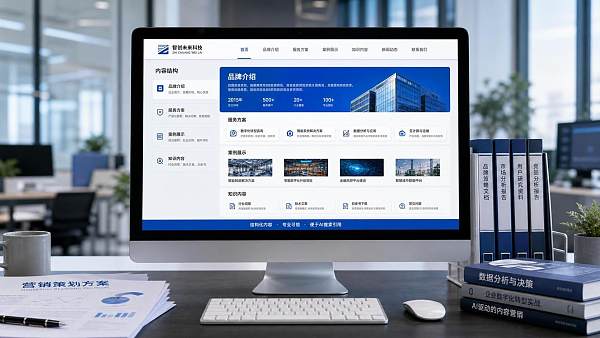
How a brand appears in AI assistant answers is no longer just a matter of content publishing frequency. Many companies have found that although their ads receive impressions and their search rankings are visible, their corporate websites are not prioritized for citation when AI assistants generate answers. The reasons often lie in unclear website content layout, loose information architecture, and insufficient trust signals.
A corporate website has always been responsible for brand explanation, product interpretation, and conversion support. Now this role has gained another layer: providing AI with information sources that are understandable, verifiable, and citable. Whoever can make official website content easier to recognize will have a better chance of having the brand appear in AI assistant answers.
In the practical business of integrated website + marketing services, this does not conflict with traditional SEO. On the contrary, it requires the corporate website, search optimization, content operations, and multi-channel advertising to move forward in coordination. The reason digital marketing platforms like 易营宝, which have served global markets for the long term, emphasize the synergy of intelligent website building, SEO, and GEO is essentially to solve the question of how corporate websites can simultaneously serve search engines, users, and AI search.
In Different Business Scenarios, the Layout Priorities of Corporate Websites Are Not the Same
When discussing how a brand appears in AI assistant answers, the judgment criteria vary greatly across different business models. Not all official websites need the same content structure, and display-oriented pages should not be confused with customer-acquisition pages.
More commonly, B2B official websites rely more on professional explanations, qualification presentation, and solution logic; cross-border e-commerce sites rely more on product page data, transaction information, and after-sales rules; multilingual websites must also consider consistency across regional versions. If a corporate website does not divide content levels by scenario, even if an AI assistant crawls the information, it will still be difficult to form accurate answers.
Inquiry-Oriented Official Websites Focus More on “Whether They Can Be Accurately Explained”
This type of scenario is common in foreign trade lead generation, manufacturing corporate websites, and solution-based businesses. Visitors usually first ask about capability scope, delivery methods, and applicable industries before deciding whether to continue communication. When answering related questions, AI assistants also prioritize pages that can fully explain business boundaries.
Therefore, a corporate website cannot simply pile up product names or case screenshots. Instead, it needs to clearly explain “what the company does, who it is suitable for, how delivery is handled, and which markets it covers.” For this type of page, structure is more important than polished copywriting.
E-commerce-Style Official Websites Focus More on “Whether Information Is Standardized”
If the business leans toward cross-border retail or a branded independent site, AI assistants are more likely to cite product specifications, shipping policies, payment methods, return and exchange rules, and brand descriptions. The issue here is not whether content exists, but whether the content is consistent, whether it is scattered, and whether it contradicts itself.
Many corporate websites have very detailed product detail pages, but their FAQ, logistics descriptions, policy pages, and brand pages use inconsistent wording. Once AI detects conflicting information, its willingness to cite that source will decline. This is also why standardized website-building systems and structured content templates are becoming increasingly important.
In High-Frequency Applications, AI Is More Likely to Crawl These Types of Corporate Website Content
From practical applications, how a brand appears in AI assistant answers often depends on whether the official website has several key content layers. More pages are not necessarily better; what matters is that core information is centralized, clear, and cross-verifiable.
- Brand introduction page: explains the company background, establishment time, main business direction, service regions, and core advantages.
- Product or service pages: answer what can be provided, which scenarios it applies to, and where the delivery boundaries are.
- Case or results pages: provide real projects, industry types, implementation results, and verifiable details.
- Knowledge content pages: explain solution differences, implementation conditions, and common misunderstandings around question-based search terms.
- Trust information pages: include qualifications, cooperation scope, contact methods, privacy policy, and terms of service.
Taking the scenarios covered by 易营宝, such as multilingual website building, Google SEO, advertising, and GEO optimization, as examples, if the official website can clearly express website-building capabilities, the marketing chain, target markets, and service processes, AI assistants will be more likely to cite related content in questions such as “how to acquire customers overseas,” “how to structure an independent website,” and “how can a brand appear in AI assistant answers and how should a corporate website be built.”
Even for the Same Corporate Website, Different Pages Take on Different Tasks
Many misjudgments happen here. Treating the homepage as the complete answer, treating case pages as trust endorsements, and treating blog pages as traffic entry points are not wrong in themselves. However, without a clear division of page responsibilities, both AI and users will feel that the information is incomplete.
A truly effective corporate website is usually not one where a single page is especially long, but one where each type of page takes on a clear task and is interconnected and mutually substantiated. This is beneficial for SEO and better aligned with the citation logic of AI assistants.
Before Implementation, Focus More on Content Structure Instead of Simply Pursuing Article Quantity
Some companies, in order to see faster results in getting their brand to appear in AI assistant answers, start by updating a large number of articles. However, in actual application, if a corporate website does not have a clear content framework, the more new content is added, the more information noise is created.
A more reliable approach is to first sort out the main content framework and then expand question-based pages. For example, first unify the brand introduction, service capabilities, regional markets, customer cases, FAQ, and policy descriptions, and then extend content around segmented keywords. This makes it easier for AI to determine which pages represent the official statement when crawling.
For multilingual corporate websites, it is especially important to confirm that factual information is consistent across all language versions. Many brands have different statements across their Chinese site, English site, and landing pages, which directly weakens the credibility of the corporate website. The value of platforms like 易营宝, which have multilingual website-building and global marketing experience, lies in processing content organization, search visibility, and regional adaptation within the same system, rather than separating them into isolated tasks.
Common Misjudgments Often Come from Treating “Readable” as “Citable”
A visually attractive corporate website does not mean it is suitable for AI understanding. The key to how a brand appears in AI assistant answers is not the visual layer, but the information layer. Several easily overlooked issues often have the greatest impact on results.
- Focusing only on homepage design while neglecting inner-page logic, making it impossible for AI to extract specific answers.
- Focusing only on keyword coverage without unifying factual information, causing conflicts between pages.
- Focusing only on short-term advertising while failing to strengthen the content foundation of the official website, making it difficult to retain value even when traffic arrives.
- Creating only article sections without service explanation pages, resulting in insufficient expression of business value.
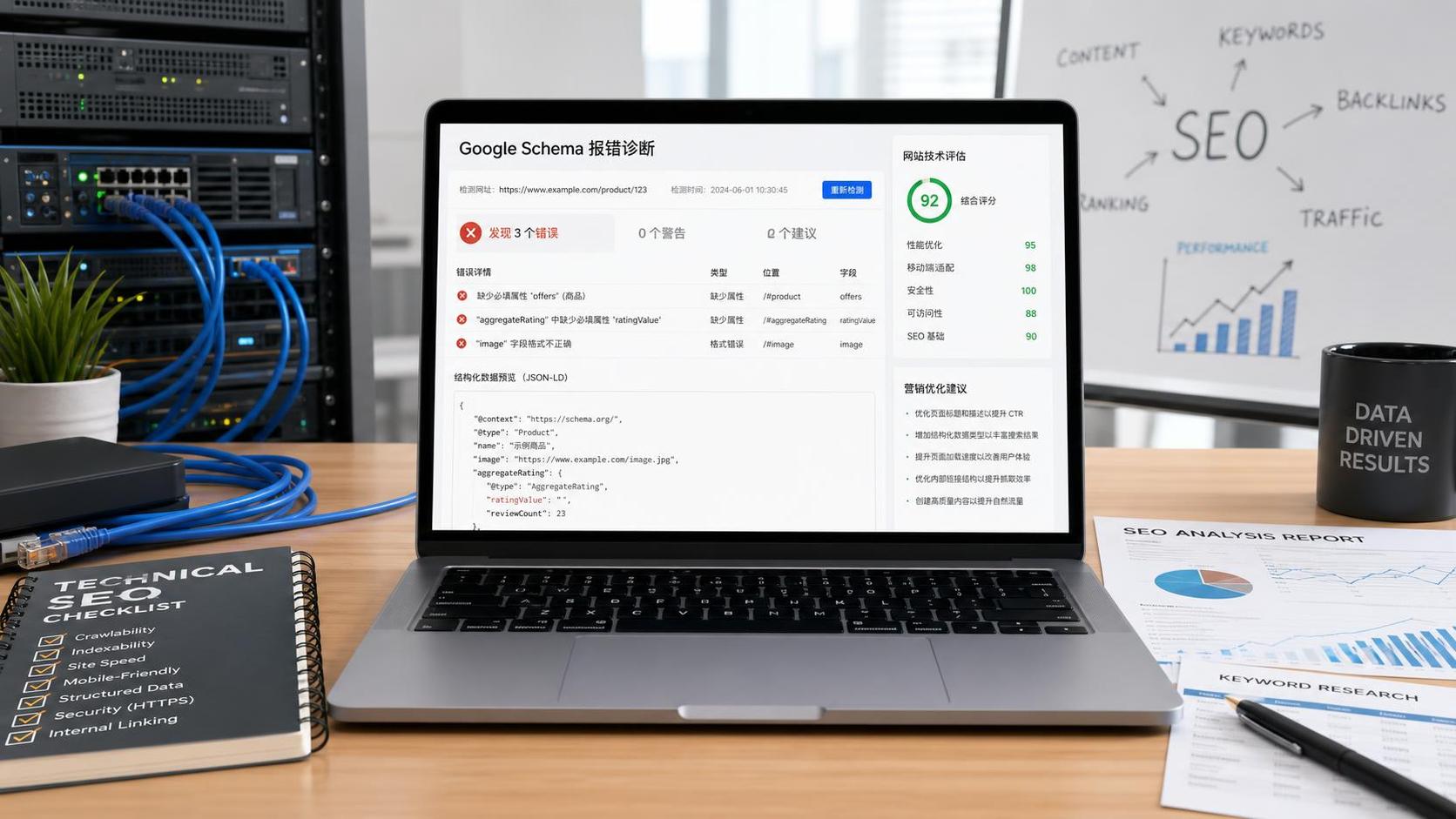
- Ignoring data structure, section naming, and page relationships, making the corporate website difficult to identify systematically.
These issues already existed in the traditional search stage, but in the AI search environment, their impact is further amplified. This is because AI relies more on clear, trustworthy, and attributable content sources rather than fragmented information splicing.
Layouts with Real Execution Value Usually Start with These Steps
To improve the appearance rate of a corporate website in AI answers, companies can start with practical and executable actions instead of pursuing a complex system from the very beginning.
- First define the core pages of the official website and clarify the respective roles of the brand page, service pages, case pages, and knowledge pages.
- Then unify factual information, including establishment time, core capabilities, market coverage, and service boundaries.
- Expand content around high-frequency questions, and include question terms, comparison terms, and scenario terms in indexable pages.
- Check whether the wording is consistent among multilingual versions, landing pages, and the main site.
- Coordinate SEO, advertising, social media traffic acquisition, and GEO optimization under the same content strategy.
Ultimately, how a brand appears in AI assistant answers depends not on isolated techniques, but on whether the corporate website has the ability to continuously output authoritative information. When the website layout is done correctly, SEO becomes more stable, advertising traffic is supported more smoothly, and brand visibility in AI search becomes easier to build.
The next more worthwhile step is to first sort out the content hierarchy, page responsibilities, and information consistency of the existing corporate website, and then evaluate which pages are suitable for adding structured content and which sections need to be rewritten around real business scenarios. Only by making this step solid can a brand’s opportunity to appear in AI assistant answers shift from accidental to sustainable.
Related Articles

Related Products
 Yiyingbao SaaS Intelligent Website Building and Marketing SystemYiyingbao SaaS Intelligent Website Building and Marketing System, AI-powered no-code website building, rapid creation of multilingual B2B international websites in 10 minutes, global server acceleration, AI-powered SEO optimization, helping businesses connect efficiently with global markets. The perfect integration of technology and operation makes building an international trade website remarkably simple
 AI+SEM Intelligent Advertising Marketing SystemAI+SEM drives intelligent ad creation, empowering full-funnel precision advertising marketing. The system automatically generates weekly/monthly reports, AI recommends keywords and target countries, monitors core metrics in real-time with intelligent alerts, and enables one-click high-conversion ad solutions to help quickly acquire customers and improve ROI.
 AI+SEO Dual-Engine System Optimization ServicesYiyingbao’s AI+SEO dual-engine optimization system helps foreign trade enterprises acquire high-quality organic traffic through AI-powered keyword research, content generation, and comprehensive technical optimization, significantly improving search rankings and conversion rates.
 AI+SNS Social Media Marketing SystemYingbao AI+SNS Social Media Marketing System - Precision social capture for the social media era. Supports one-click content synchronization across major platforms like Facebook and LinkedIn. AI intelligently rewrites posts for enhanced relevance. 24/7 AI customer service and user profiling analysis empower businesses to efficiently expand into global markets.
 AI+SEO营销解决方案易营宝AI+SEO营销解决方案,通过AI批量写作、智能生成TDK、精准关键词扩词等功能,全面优化网站SEO效果,提升流量与转化率。助力企业构建高效智能网站新生态。
 AI+SEM Advertising Marketing SolutionsAI+SEM Advertising Marketing Solution leverages AI technology to deeply empower SEM ad campaigns. It automatically generates weekly/monthly reports using AI, presenting account data across multiple dimensions for comprehensive insights into campaign performance and trends. The system precisely recommends keywords and target countries, intelligently generates high-conversion ad copy, and enables one-click activation of efficient campaign plans to help businesses rapidly acquire customers. Simultaneously, it monitors core metrics in real time, intelligently identifies abnormal fluctuations, and issues timely alerts to ensure stable, high-return advertising results.
 Domain Name ServicesEasyWin provides professional domain name services, including intelligent queries, one-stop registration, brand protection, and full lifecycle management, helping businesses build a digital brand image.
 EasyOperate B2C Cross-Border E-Commerce Platform & Independent WebsiteEasyStore B2C Cross-border E-commerce Independent Store is an intelligent website building and cross-border e-commerce integrated solution independently developed by EasyStore Information Technology (Beijing) Co., Ltd. The system is specially designed for small and medium-sized as well as large export enterprises, integrating 'website building, operation, marketing, advertising, and conversion' into one, helping enterprises quickly establish cross-border e-commerce independent stores to achieve brand globalization and global sales growth.
The platform supports multiple languages, multiple currencies, and multi-channel marketing, with built-in AI intelligent translation and SEO optimization systems, suitable for mainstream markets such as Southeast Asia, Europe and America, Latin America, and the Middle East, assisting Chinese manufacturing enterprises in efficiently deploying international e-commerce strategies. SSL证书易营宝提供专业SSL安全证书服务,包括单域名和泛域名证书,确保网站数据传输加密、身份验证和完整性保护,助力企业建立安全可信的在线业务环境。









