









- Which customer acquisition channels will be affected by cross-border marketing trends in 2026?Sep 06, 2026View details
- Which homogenization risks should be considered in an analysis of the AI-powered website building industry?Aug 30, 2026View details
- How Will AI Marketing Trends 2026 Change Advertising Budget AllocationAug 28, 2026View details
- Is the EV SSL certificate market shrinking or upgrading? How should companies assess certificate procurement?Aug 11, 2026View details
- Why the old AMP SEO 2020 practices no longer work and what has changed in current optimization prioritiesAug 02, 2026View details
- How to Choose Topics for an Industry News Section to Attract More Organic Search TrafficJul 29, 2026View details
Why is SEM advertising burning through budget but not generating leads? An account structure audit and insights sharing
SEM ad spend is a money pit; don't rush to add budget yet, the problem is often hidden in the structure
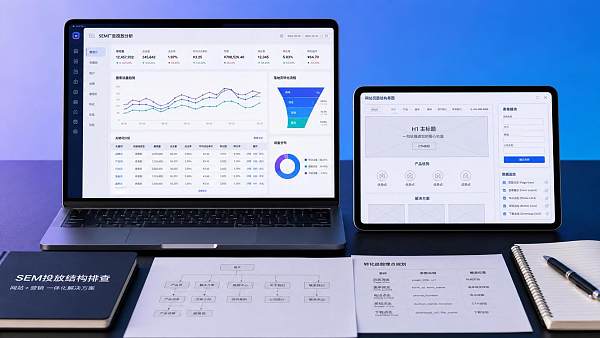
When SEM advertising fails to convert, it is often not because too little money was spent, but because the account structure was set up incorrectly. Poor planning, overly broad keywords, mismatched creative, and weak landing page continuity can all make clicks look decent while leads lag behind.
In a website + marketing services integrated scenario, this issue becomes even more obvious. Because advertising is not an isolated action, it must be evaluated together with website speed, page content, form design, and data tracking before you can identify the real bottleneck in conversion.
In actual troubleshooting, a more effective approach is not to focus on a single metric, but to break the path down step by step along the chain of "traffic entry—click generated—page engagement—form submission". This is especially true in overseas promotion scenarios, where traffic sources are more complex and search intent varies greatly, so SEM ad placement relies even more on a clear structure.
Platforms like 易营宝, which focus on long-term overseas growth through digital marketing, usually handle intelligent website building, SEO optimization, advertising, and multilingual pages in a coordinated way. The reason is simple: poor account performance is often not caused by a single mistake, but by the front-end and back-end links not being aligned.
Why are there clicks and exposure, but SEM ads still do not generate orders?
Let's start with a common misconception: many accounts equate "having traffic" with "having conversion opportunities". But the essence of search ads is not to buy clicks, but to buy the right people reaching the right page at the right stage. If even one link is off, the budget will keep being consumed.
There are four relatively common situations. The first is that the keywords are too broad, attracting a large amount of generic demand. The second is that the ad copy promises a lot, but the landing page does not match the content. The third is that the form is too long, so visitors leave before trust is established. The fourth is incomplete conversion tracking, so inquiries are generated but not recognized.
If the account has already been running for a period of time, you can first use a simple diagnostic table to locate the problem more quickly.
This step is very important. Because the biggest fear in SEM ad optimization is "changing bids on one side while guessing the reason on the other", which eventually makes the account more and more complicated without forming a clear judgment.
How should account structure be checked? Should you look at the campaign level first or the keyword level first?
The more stable order is to look at the campaign first, then the ad group, and finally the keywords. Because once the structure is misplaced, the later bidding, creative, and negative keywords are all difficult to refine.
At the campaign level, three things should be confirmed first: whether the region is split, whether the product or service is split, and whether the intent stage is split. If brand terms, generic terms, competitor terms, and inquiry terms are all stuffed into the same campaign, SEM ad placement can easily lead to budget cannibalization, and ultimately high-value terms may not get exposure.
The ad group level looks at theme concentration. If an ad group contains different intent terms such as "price, solution, case study, tutorial, manufacturer" at the same time, the creative cannot be written precisely, and the quality score is usually not high either.
The keyword level should focus on search term reports. Do not just look at what terms were added; pay more attention to what terms were actually triggered. Many accounts look precise on the surface, but in reality run a lot of irrelevant traffic because of expanded matching logic or missing negative keywords.
- Build brand terms in a separate campaign to avoid budget being crowded out by generic terms.
- Separate high-intent terms from informational terms so creative and pages can handle them separately.
- Keep each ad group centered on one theme; do not mix different search intents.
- Review search terms every week and continuously add negative keywords.
If the website itself is paired with independent site development, structural optimization will have a greater advantage. Because pages can be broken down by keyword group, there is no need to direct all traffic to the same homepage, which is also a basic action that 易营宝 often performs when coordinating website building and advertising.
Creative is not bad, so why do SEM ads still fail to keep people after the click?
The common problem here is often not that the copy is not good enough, but that "what the ad says" and "what the page gives" are not the same thing. For example, the ad emphasizes fast quoting, but the landing page has no quotation process; the ad emphasizes multilingual coverage, but the page only has a single version. This kind of disconnect will directly affect conversion.
Page engagement can be judged from three angles. First, whether the above-the-fold area answers the searcher's most important question. Second, whether the trust information is sufficient, such as cases, credentials, scope of delivery, and response mechanisms. Third, whether the conversion action is clear, whether it is submitting a form, making an online inquiry, or getting a proposal.
Many SEM advertising accounts burn through budget because they are actually burning it on the "wrong page". In particular, directing all ads to the company homepage means that after entering, visitors still have to find the content themselves, so the bounce rate will naturally remain high.
In practical application, if the website system and the advertising system can be linked, troubleshooting becomes much easier. For example, multilingual page loading speed, mobile form length, button placement, and inquiry tracking points are all details that affect lead cost. Recently, some teams have also been drawing inspiration fromthe strategy discussion on power company fund management optimization based on cash flow forecasting when refining landing page logic. The core idea is the same: first identify where resources are being wasted, then add more budget.
Budget keeps running; how do you tell whether it is a traffic problem or a conversion path problem?
A useful method is to split SEM advertising optimization into front-end metrics and back-end metrics. The front end looks at impressions, CTR, average CPC, and search term quality; the back end looks at dwell time, conversion rate, qualified lead rate, and sales cycle.
If CTR is low, the likely issue is with the traffic source; if CTR is normal and traffic volume is there, but dwell time is short and conversion rate is low, then the problem is more likely in the landing page; if the number of forms is not low, but the subsequent close rate is poor, then you need to go back and check whether the keyword intent is too early in the funnel.
At this point, do not rush to lower bids across the board. A more common judgment method is to keep a small amount of high-intent keyword budget first, temporarily pause low-quality traffic, and then optimize the pages for high-cost terms. This makes it easier to tell whether the problem is "bad traffic" or "poor landing page continuity".
- If search terms are too broad, narrow the match type and add negative keywords first.
- If clicks are still okay, prioritize fixing the landing page above-the-fold area and form.
- If there are inquiries but no deals, review keyword intent and filtering conditions.
- If the data disconnect is obvious, first fill the conversion tracking gaps before continuing optimization.
In SEM ad placement optimization, which actions are most easily overlooked?
The first is unclear conversion definitions. Whether a submitted form counts as a conversion, or only a valid inquiry counts as a conversion, this path must be unified first. Otherwise, the account may look low-cost, but the business will not feel the results.
The second is optimizing only the ads while not optimizing the website. For a website + marketing services integrated business, SEM advertising performance and the website experience are inherently connected. Slow page loading, misaligned mobile layouts, and content that lacks localized expression will directly affect ad return.
The third is focusing only on short-term cost and not on cumulative data. Some terms convert less in the early stage, but later the deal quality is higher; some terms look cheap, but bring a large amount of ineffective communication. Whether to continue investing should not be judged by one day's spend alone.
If long-term optimization is needed, it is recommended to put the account, pages, tracking, and inquiry quality into the same review table. That way, each adjustment is based on evidence rather than intuition. For integrated services like 易营宝 that cover website building, SEO, social media, and advertising, this is also where the core value lies: reducing link fragmentation and improving optimization decision efficiency.
After troubleshooting the account, what should be done next to make it more stable?
If SEM advertising has already shown "continuous burn and weak conversion", the most stable action is not a one-time major overhaul, but to first lock onto one core campaign for a small-scale validation. Compress the keywords, rewrite the creative, and match the landing page one-to-one, then watch the data changes over one to two conversion cycles.
Then you can continue advancing in three directions: first, restructure the account hierarchy to avoid budget mixing; second, improve page continuity so the ad promise matches the website content; third, establish more granular data feedback so that at least ordinary leads and high-quality leads can be distinguished.
When SEM advertising, independent site construction, SEO content, and multilingual pages are coordinated, the results are usually much more stable than simply adjusting bids. If necessary, you can also refer to resource allocation methods from different business lines, such asthe strategy discussion on power company fund management optimization based on cash flow forecasting, first separating primary and secondary inputs, and then deciding the optimization order.
In the end, when SEM advertising burns money without generating orders, what truly needs to be checked is not "where did the money go", but "why the traffic did not make it to the conversion step". Put account structure, search intent, creative expression, website continuity, and data tracking on the same map, and every subsequent optimization step will become clearer, and it will also be easier to achieve steady growth.
Related Articles


Related Products
 Yiyingbao SaaS Intelligent Website Building and Marketing SystemYiyingbao SaaS Intelligent Website Building and Marketing System, AI-powered no-code website building, rapid creation of multilingual B2B international websites in 10 minutes, global server acceleration, AI-powered SEO optimization, helping businesses connect efficiently with global markets. The perfect integration of technology and operation makes building an international trade website remarkably simple
 AI+SEM Intelligent Advertising Marketing SystemAI+SEM drives intelligent ad creation, empowering full-funnel precision advertising marketing. The system automatically generates weekly/monthly reports, AI recommends keywords and target countries, monitors core metrics in real-time with intelligent alerts, and enables one-click high-conversion ad solutions to help quickly acquire customers and improve ROI.
 AI+SEO Dual-Engine System Optimization ServicesYiyingbao’s AI+SEO dual-engine optimization system helps foreign trade enterprises acquire high-quality organic traffic through AI-powered keyword research, content generation, and comprehensive technical optimization, significantly improving search rankings and conversion rates.
 AI+SNS Social Media Marketing SystemYingbao AI+SNS Social Media Marketing System - Precision social capture for the social media era. Supports one-click content synchronization across major platforms like Facebook and LinkedIn. AI intelligently rewrites posts for enhanced relevance. 24/7 AI customer service and user profiling analysis empower businesses to efficiently expand into global markets.
 AI+SEO营销解决方案易营宝AI+SEO营销解决方案,通过AI批量写作、智能生成TDK、精准关键词扩词等功能,全面优化网站SEO效果,提升流量与转化率。助力企业构建高效智能网站新生态。
 AI+SEM Advertising Marketing SolutionsAI+SEM Advertising Marketing Solution leverages AI technology to deeply empower SEM ad campaigns. It automatically generates weekly/monthly reports using AI, presenting account data across multiple dimensions for comprehensive insights into campaign performance and trends. The system precisely recommends keywords and target countries, intelligently generates high-conversion ad copy, and enables one-click activation of efficient campaign plans to help businesses rapidly acquire customers. Simultaneously, it monitors core metrics in real time, intelligently identifies abnormal fluctuations, and issues timely alerts to ensure stable, high-return advertising results.
 Domain Name ServicesEasyWin provides professional domain name services, including intelligent queries, one-stop registration, brand protection, and full lifecycle management, helping businesses build a digital brand image.
 EasyOperate B2C Cross-Border E-Commerce Platform & Independent WebsiteEasyStore B2C Cross-border E-commerce Independent Store is an intelligent website building and cross-border e-commerce integrated solution independently developed by EasyStore Information Technology (Beijing) Co., Ltd. The system is specially designed for small and medium-sized as well as large export enterprises, integrating 'website building, operation, marketing, advertising, and conversion' into one, helping enterprises quickly establish cross-border e-commerce independent stores to achieve brand globalization and global sales growth.
The platform supports multiple languages, multiple currencies, and multi-channel marketing, with built-in AI intelligent translation and SEO optimization systems, suitable for mainstream markets such as Southeast Asia, Europe and America, Latin America, and the Middle East, assisting Chinese manufacturing enterprises in efficiently deploying international e-commerce strategies. SSL证书易营宝提供专业SSL安全证书服务,包括单域名和泛域名证书,确保网站数据传输加密、身份验证和完整性保护,助力企业建立安全可信的在线业务环境。









