









- How to Choose Topics for an Industry News Section to Attract More Organic Search TrafficJul 29, 2026View details
- Can Zhejiang foreign trade independent websites still be developed today? Look at changes in traffic and lead generationJul 28, 2026View details
- What New Signals Are Emerging in Enterprise Services SaaS Marketing ReportsJul 27, 2026View details
- What Does a Global Traffic Ecosystem Service Provider Do? What Are the Differences from a Single Advertising AgencyJul 16, 2026View details
- What should you focus on in the latest enterprise SaaS report? From renewal rates and delivery costs to overseas growth opportunitiesJul 12, 2026View details
- What signals are worth paying attention to in a cross-border marketing trend report? B2B companies should look at these 6 signalsJul 11, 2026View details
What determines overseas ad spend? Platform setup, creative testing, and conversion costs broken down
What determines overseas ad spending?
Overseas ad spending is not a fixed number, but is jointly driven up or down by platform account setup, creative testing, audience competition, and conversion costs. For people doing budget approvals, understanding the cost structure first is more important than simply looking at “how much per day.”
In a website + marketing service integrated scenario, ad costs are also affected by independent site quality, landing page conversion rate, language versions, and the completeness of data tracking. The better the website can absorb traffic, the easier it is to keep overseas ad spending within a reasonable range.
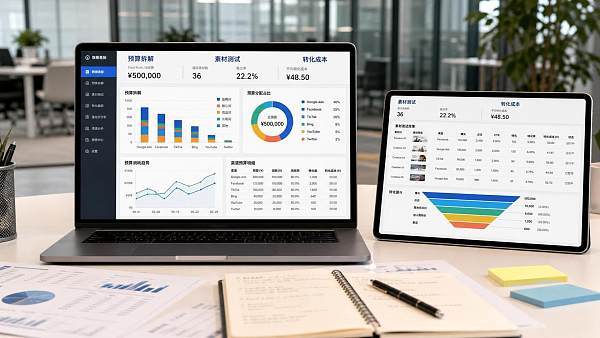
For YiYingBao’s long-term service to foreign trade companies, cross-border sellers, and brand overseas projects, the usual decision logic is not to ask “how much will it cost first,” but to ask “which stage will the money be spent in most likely to generate valid inquiries or deals.” This is also the core point that financial approval needs to focus on.
Why does platform account setup cost affect total spending?
Platform account setup seems to be just a front-end step, but it directly affects the efficiency of subsequent ad delivery. The account setup thresholds, review cycle, security deposit, and agency service fees of different platforms will all be included in the first overseas ad spending.
More importantly, if the account structure is not set up clearly after opening, you will later need to supplement domain verification, pixel installation, conversion event configuration, and landing page adjustments. These hidden costs are often more likely to be underestimated than the account setup itself.
How are common cost components broken down?
- Platform account setup or managed operation service fees
- Initial top-up and consumption budget
- Tracking code, pixel, and event configuration
- Multilingual landing pages and form adaptation
If the independent site itself supports multiple regions, multiple currencies, and multiple languages, the testing efficiency after account setup is usually higher. For solutions like YiYingBao that place website building, SEO, and ad delivery in the same system, a common advantage is reducing duplicate configurations so that the budget can enter the effective testing stage earlier.
Why does the creative testing stage often “spend fast” but get no results?
Creative testing is the stage where overseas ad spending fluctuates the most. Because early on you are not “buying results,” but “buying data.” Ad copy, images, videos, value propositions, and language versions all affect click-through rate and interaction costs.
If the creative and the landing page are inconsistent, clicks may come in, but conversions cannot keep up, and the budget will be consumed quickly. Many overseas ad spending cases are expensive not because the platform is costly, but because the test samples are too scattered and the iteration is too slow.
In practical application, more creative testing is not better; the key is whether the core assumptions can be validated faster. For budget approval, the focus should be on “whether the testing spend has yielded reusable creative conclusions” rather than only the cost per click.
How much do audience competition and targeting regions affect costs?
The same overseas ad spending can vary greatly across different countries and industries. Competition in North America and Europe is usually higher, so click costs and conversion costs are more likely to rise; Southeast Asia, some parts of the Middle East, and emerging markets may more easily obtain initial data with lower budgets.
But low cost does not equal high value. What really matters is the target market’s customer unit price, payback period, purchase frequency, and subsequent repurchase capacity. If the website supports multilingual content and localized landing pages, the cost pressure brought by audience competition is more likely to be dispersed.
YiYingBao covers markets such as North America, Europe, Southeast Asia, Japan and South Korea, and the Middle East. The common approach is to first use the site structure and content hierarchy, then test ad performance by region, so it is easier to judge whether the cost is ultimately spent on “expensive traffic” or “weak carrying capacity.”
Why is conversion cost the final standard for judgment?
What truly determines whether overseas ad spending is reasonable is not the cost per click, but the cost of the final transaction or valid inquiry. In other words, conversion cost is the result indicator that financial approval should pay the most attention to.
If the ad brings a lot of visits, but the website loads slowly, the information is unclear, and the form is too long, the conversion rate will be low. Continuing to increase the budget at this point will often only magnify the loss. On the contrary, if the ad is consistent with the independent site content and the conversion path is smooth, the overall cost will be more controllable.
This is also why many projects put Google Ads, Facebook Ads, SEO, and GEO optimization together. Ads are responsible for short-term customer acquisition, while the website and content are responsible for acceptance and accumulation, making the overall cost easier to keep at a reasonable level.
How do you judge whether an overseas advertising budget is worth approving?
To judge whether a budget is worth approving, you cannot just look at the total amount. You need to see whether there is a clear cost breakdown, stage goals, and exit conditions. A reliable plan will usually separate account setup, creative testing, regional delivery, and conversion tracking.
You can quickly screen using the following set of criteria:
- Whether the purpose of each overseas ad spending item can be explained
- Whether there is a clear testing cycle and stop-loss line
- Whether inquiries, registrations, or transactions can be tracked
- Whether it is optimized in sync with the website’s conversion capacity
If these conditions are not clear, even a low budget may still be high-cost; if the conditions are clear, a slightly higher budget may actually be more cost-effective.
For common questions, first look at this comparison table
The table below is suitable for quickly aligning understanding before approval, so you can judge which stage overseas ad spending is actually stuck in.
If you break down overseas ad spending, you will find that it is more like a chain cost, rather than a single ad bill. Platform account setup determines the starting point, creative testing determines efficiency, audience competition determines price, and conversion cost determines the result.
A more stable approach is to plan the website, ads, and data tracking together first, and then verify step by step according to different markets. This not only makes costs easier to control, but also makes it easier to judge whether subsequent investment is still worthwhile.
Related Articles

Related Products
 Yiyingbao SaaS Intelligent Website Building and Marketing SystemYiyingbao SaaS Intelligent Website Building and Marketing System, AI-powered no-code website building, rapid creation of multilingual B2B international websites in 10 minutes, global server acceleration, AI-powered SEO optimization, helping businesses connect efficiently with global markets. The perfect integration of technology and operation makes building an international trade website remarkably simple
 AI+SEM Intelligent Advertising Marketing SystemAI+SEM drives intelligent ad creation, empowering full-funnel precision advertising marketing. The system automatically generates weekly/monthly reports, AI recommends keywords and target countries, monitors core metrics in real-time with intelligent alerts, and enables one-click high-conversion ad solutions to help quickly acquire customers and improve ROI.
 AI+SEO Dual-Engine System Optimization ServicesYiyingbao’s AI+SEO dual-engine optimization system helps foreign trade enterprises acquire high-quality organic traffic through AI-powered keyword research, content generation, and comprehensive technical optimization, significantly improving search rankings and conversion rates.
 AI+SNS Social Media Marketing SystemYingbao AI+SNS Social Media Marketing System - Precision social capture for the social media era. Supports one-click content synchronization across major platforms like Facebook and LinkedIn. AI intelligently rewrites posts for enhanced relevance. 24/7 AI customer service and user profiling analysis empower businesses to efficiently expand into global markets.
 AI+SEO营销解决方案易营宝AI+SEO营销解决方案,通过AI批量写作、智能生成TDK、精准关键词扩词等功能,全面优化网站SEO效果,提升流量与转化率。助力企业构建高效智能网站新生态。
 AI+SEM Advertising Marketing SolutionsAI+SEM Advertising Marketing Solution leverages AI technology to deeply empower SEM ad campaigns. It automatically generates weekly/monthly reports using AI, presenting account data across multiple dimensions for comprehensive insights into campaign performance and trends. The system precisely recommends keywords and target countries, intelligently generates high-conversion ad copy, and enables one-click activation of efficient campaign plans to help businesses rapidly acquire customers. Simultaneously, it monitors core metrics in real time, intelligently identifies abnormal fluctuations, and issues timely alerts to ensure stable, high-return advertising results.
 Domain Name ServicesEasyWin provides professional domain name services, including intelligent queries, one-stop registration, brand protection, and full lifecycle management, helping businesses build a digital brand image.
 EasyOperate B2C Cross-Border E-Commerce Platform & Independent WebsiteEasyStore B2C Cross-border E-commerce Independent Store is an intelligent website building and cross-border e-commerce integrated solution independently developed by EasyStore Information Technology (Beijing) Co., Ltd. The system is specially designed for small and medium-sized as well as large export enterprises, integrating 'website building, operation, marketing, advertising, and conversion' into one, helping enterprises quickly establish cross-border e-commerce independent stores to achieve brand globalization and global sales growth.
The platform supports multiple languages, multiple currencies, and multi-channel marketing, with built-in AI intelligent translation and SEO optimization systems, suitable for mainstream markets such as Southeast Asia, Europe and America, Latin America, and the Middle East, assisting Chinese manufacturing enterprises in efficiently deploying international e-commerce strategies. SSL证书易营宝提供专业SSL安全证书服务,包括单域名和泛域名证书,确保网站数据传输加密、身份验证和完整性保护,助力企业建立安全可信的在线业务环境。









