









- APEC Shenzhen Spotlight: Cross-Border E-Commerce Orders Promote Asia-Pacific Trade and Economic CooperationNov 08, 2026View details
- China-Europe Railway Express and CIIE Hold Business Matchmaking Event, Focusing on Cross-Border E-commerce B2B ExportsNov 07, 2026View details
- China’s Ministry of Commerce Responds to Additional Charges on Low-Value Imports Imposed by the EUNov 06, 2026View details
- Two Internet Development Reports Released at the 2026 World Internet ConferenceNov 05, 2026View details
- Internet Business Revenue of Enterprises Above the Designated Size Reached RMB 1.716 Trillion in the First Three Quarters, with Profits Up 17.6%Nov 05, 2026View details
- Shopify's Third-Quarter Revenue and GMV Fall Short of Expectations, Sending Shares Tumbling Before the Market OpensNov 04, 2026View details
How to Coordinate Multilingual Creative Assets for Overseas Advertising
For multilingual creatives in overseas advertising to collaborate efficiently, the key is not only translation, but also the linkage of strategy, creativity, and media buying. When many companies compare whether Google Ads managed services or running ads in-house is more cost-effective, they often overlook creative localization and team collaboration efficiency.
For foreign trade companies, cross-border brands, and manufacturing factories, advertising is no longer as simple as “making a few images and translating several versions of copy.” A campaign targeting North America, Europe, and Southeast Asia often involves at least 3 types of channels, 5 language versions, 2 landing page paths, and continuous data iteration over 7 days to 30 days.
If the creative collaboration mechanism is immature, the common results are inaccurate translation, inconsistent brand messaging, and disconnected campaign pacing, ultimately leading to lower click-through rates and higher conversion costs. Especially when companies are considering whether Google Ads managed services or running ads in-house is more cost-effective, they should include “whether multilingual creatives can collaborate efficiently” at the core of decision-making.
Why Multilingual Creative Collaboration Determines the Success or Failure of Overseas Advertising
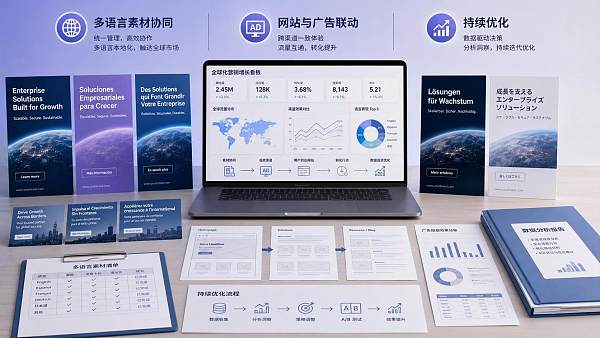
In an integrated website + marketing services scenario, advertising creatives do not exist in isolation. They must work in sync with the independent website structure, landing page conversion paths, keyword strategy, audience targeting, and remarketing mechanisms. If any link is disconnected, even large volumes of front-end traffic may lose 20% to 50% of valid leads during back-end conversion.
4 Common Collaboration Breakpoints in Multilingual Advertising
- Only literal translation is done, without adjusting headlines and selling points based on local search habits and cultural context.
- Ad copy, landing page content, and form fields are expressed inconsistently, reducing user trust.
- The design team, advertising team, and website development team are separated, and version updates are usually delayed by 3 days to 7 days.
- There is no unified creative naming and review mechanism, making it impossible to quickly determine which language version performs better.
When many companies run Google Ads on their own, the first issue they encounter is often not an account issue, but a creative system issue. For example, the English ad focuses on “fast delivery,” while the German landing page emphasizes “industrial reliability.” After users click through to the page, the perceived gap is obvious, and the conversion rate naturally declines.
Correct Translation Does Not Equal Effective Advertising
Overseas advertising creatives must complete at least 3 levels of adaptation: the first level is linguistic accuracy, the second level is market context matching, and the third level is consistency with conversion goals. Truly effective multilingual collaboration is not just changing Chinese into English, Spanish, or Japanese, but restructuring “selling points, scenarios, and calls to action” into expressions that local users are more likely to respond to.
The table below can help companies quickly identify the differences in execution efficiency and results among different collaboration methods, and also make a more rational judgment on whether Google Ads managed services or running ads in-house is more cost-effective.
If a company only targets a single market and a single language, running ads in-house has a certain degree of feasibility; but when the business enters a multilingual, multi-region, and multi-channel stage, the value of integrated collaboration will quickly increase. At this point, when judging whether Google Ads managed services or running ads in-house is more cost-effective, the core is no longer just account service fees, but overall execution efficiency and conversion stability.
To Decide Whether Google Ads Managed Services or Running Ads In-House Is More Cost-Effective, Look at These 5 Cost Dimensions
Many managers only look at “managed service fees” and “labor costs,” while ignoring hidden costs. In fact, overseas advertising should be evaluated from at least 5 dimensions: manpower, trial and error, creative response, data analysis, and landing page linkage. The best choice is not the same for companies at different stages.
When Is It Suitable for Companies to Run Ads In-House?
- The budget is relatively small, with monthly ad spend below 20,000 yuan, and the priority is to first verify market feasibility.
- The target market is concentrated, usually involving only 1 to 2 countries or language regions.
- The internal team has at least 1 person who understands the advertising backend and 1 person who can create landing pages.
- The company can accept the learning and trial-and-error costs of the first 2 weeks to 4 weeks.
When Is Choosing Managed Services More Suitable?
- You need to operate Google Search Ads, Display Ads, remarketing, and social media traffic acquisition simultaneously.
- There are multilingual creative needs beyond English, such as German, French, Spanish, Japanese, and other languages.
- You have requirements for inquiry quality and want leads from forms, WhatsApp, emails, and other channels to be uniformly returned.
- You want to complete the closed loop of website building, advertising, tracking, and first-round optimization within 30 days.
To compare more intuitively whether Google Ads managed services or running ads in-house is more cost-effective, the following breaks down several indicators that B2B companies going global care about most.
On paper, running ads in-house seems to save more money; but if poor creative collaboration causes customer acquisition costs to rise by 15% to 40%, it is not actually cost-effective. Especially for industries with long inquiry cycles and high order values, reducing invalid clicks and improving lead matching quality are often more important than cutting service fees.
Multilingual Creative Collaboration Should Be Implemented in Three Layers: “Website + Ads + Data”
Truly efficient overseas advertising collaboration should not focus only on the advertising backend, but should integrate the independent website, landing pages, creative library, and conversion tracking. For companies targeting multiple overseas markets, it is recommended to establish at least a 3-layer collaboration architecture to prevent creatives and traffic from operating separately.
Layer 1: Unify the Website Structure First, Then Distribute by Language
The foundation of multilingual ad conversion is not creatives, but site architecture. It is recommended to first determine the main domain, language directory or sub-site plan, and then configure product pages, industry pages, inquiry pages, and policy pages. Usually, a standard B2B independent website should include at least 10 to 20 core pages to support both advertising and SEO efforts.
Page Consistency Is the Foundation of Conversion Rate
Whatever the ad headline promises, the first screen of the page must respond to it. For example, if the main focus is “custom manufacturing,” then the first 3 screens of the landing page must show customization capabilities, delivery time range, MOQ information, or case scenarios. Otherwise, users may leave within the first 5 seconds after entering the page.
Layer 2: Establish a Modular Mechanism for Creative Production
It is recommended that companies break advertising creatives into 5 modules: core selling points, trust elements, main visual image, action button, and market variables. In this way, when switching to English, French, Spanish, or Arabic markets, there is no need to redo the entire set. Only 20% to 40% of localized content needs to be replaced, which will significantly improve efficiency.
- First establish a master brand proposition template to unify value messaging.
- Then split versions by market into price-oriented, delivery-oriented, or quality-oriented versions.
- Finally, combine search terms and audience intent to generate creatives for different ad groups.
If a company is struggling with whether Google Ads managed services or running ads in-house is more cost-effective, it can first ask itself one question: does the internal team have the ability to continuously generate multiple versions of creatives, quickly replace low-performing copy, and update landing pages simultaneously? If the answer is no, the value of managed services is usually higher than that of simple media buying support.
Layer 3: Data Feedback Must Support Continuous Optimization
Multilingual creative collaboration must ultimately be evaluated with data. At least 6 core metrics should be monitored: impressions, click-through rate, average cost per click, page dwell time, form conversion rate, and valid lead rate. For B2B companies, looking only at clicks and form volume is far from enough; they also need to distinguish inquiry quality and follow-up results.
The advantage of an integrated website + marketing services platform like 易营宝 lies in placing AI website building, multilingual page management, Google Ads delivery, SEO optimization, and data tracking within one collaborative framework. In this way, when companies expand into markets such as North America, Europe, and Southeast Asia, they do not need to repeatedly switch service providers, and it is easier to control execution rhythm.
3 Types of Risks Companies Most Easily Overlook During Implementation
Even with sufficient budget, overseas advertising may still fail to scale if basic processes are ignored. Especially in a multilingual environment, the risk is often not “not knowing how to run ads,” but “inconsistent execution, untimely revisions, and review processes that do not form a closed loop.”
Risk 1: Treating Multilingual Work as a Translation Project Instead of a Growth Project
If the team focuses on whether the translation is accurate but does not pay attention to whether users will click or be willing to submit their information, the creatives will find it difficult to generate growth value. It is recommended to prepare at least 2 to 3 sets of selling point versions for each market and complete the first round of A/B testing within the first 14 days.
Risk 2: The Website and Ads Belong to Different Teams, Causing Updates to Become Disconnected
This is the most common problem among manufacturing companies and traditional foreign trade companies. The advertising team discovers that a certain headline has a high click-through rate, but the website team has to wait for scheduling to modify the page. By the time the update is completed, the best testing window may already have been missed. For high-frequency optimization projects, completing a response within 48 hours is a relatively ideal rhythm.
Risk 3: Looking Only at Surface Costs Instead of Overall Customer Acquisition Efficiency
When comparing whether Google Ads managed services or running ads in-house is more cost-effective, what should truly be compared is “cost per valid lead” and “team output per unit of time.” If the internal team spends 6 hours to 10 hours each week coordinating creatives, pages, data, and translation, the hidden cost often already exceeds the external collaboration service fee.
Practical Recommendation: Use 4 Steps to Build a Replicable Collaboration Process
- First determine market priorities, focusing on 1 to 2 key language regions first instead of expanding blindly.
- Unify creative naming, version management, and page update rules.
- Connect advertising, website, SEO, and social media data to the same analytics system as much as possible.
- Review creative performance once every 7 days and re-evaluate lead quality every 30 days.
For companies that are building overseas independent websites, preparing to launch Google Ads, or expanding into multilingual markets, creative collaboration capability is no longer a nice-to-have, but a key capability that determines advertising efficiency and lead quality. Whether choosing to build an in-house team or introduce managed services, companies should not look only at individual fees, but at whether they can form an integrated closed loop of “website building, content, advertising, and optimization.”
Relying on one-stop capabilities such as AI intelligent website building, multilingual website development, Google Ads delivery, SEO and GEO optimization, 易营宝 can help companies reduce cross-team communication loss, accelerate multi-market launch speed, and enable creatives, pages, and traffic to truly collaborate. If you are evaluating whether Google Ads managed services or running ads in-house is more cost-effective, or want to improve the execution efficiency of multilingual creatives for overseas advertising, please contact us now to obtain a customized solution more suitable for your business stage.
Related Articles
 What is the difference between phrase match and exact match in Google Ads?
 How should you allocate your TikTok advertising budget?
 Google Ads Update: DSA Upgraded to AI Max, PMax to Extract Images by Default
Related Products
 Yiyingbao SaaS Intelligent Website Building and Marketing SystemYiyingbao SaaS Intelligent Website Building and Marketing System, AI-powered no-code website building, rapid creation of multilingual B2B international websites in 10 minutes, global server acceleration, AI-powered SEO optimization, helping businesses connect efficiently with global markets. The perfect integration of technology and operation makes building an international trade website remarkably simple
 AI+SEM Intelligent Advertising Marketing SystemAI+SEM drives intelligent ad creation, empowering full-funnel precision advertising marketing. The system automatically generates weekly/monthly reports, AI recommends keywords and target countries, monitors core metrics in real-time with intelligent alerts, and enables one-click high-conversion ad solutions to help quickly acquire customers and improve ROI.
 AI+SEO Dual-Engine System Optimization ServicesYiyingbao’s AI+SEO dual-engine optimization system helps foreign trade enterprises acquire high-quality organic traffic through AI-powered keyword research, content generation, and comprehensive technical optimization, significantly improving search rankings and conversion rates.
 AI+SNS Social Media Marketing SystemYingbao AI+SNS Social Media Marketing System - Precision social capture for the social media era. Supports one-click content synchronization across major platforms like Facebook and LinkedIn. AI intelligently rewrites posts for enhanced relevance. 24/7 AI customer service and user profiling analysis empower businesses to efficiently expand into global markets.
 AI+SEO营销解决方案易营宝AI+SEO营销解决方案,通过AI批量写作、智能生成TDK、精准关键词扩词等功能,全面优化网站SEO效果,提升流量与转化率。助力企业构建高效智能网站新生态。
 AI+SEM Advertising Marketing SolutionsAI+SEM Advertising Marketing Solution leverages AI technology to deeply empower SEM ad campaigns. It automatically generates weekly/monthly reports using AI, presenting account data across multiple dimensions for comprehensive insights into campaign performance and trends. The system precisely recommends keywords and target countries, intelligently generates high-conversion ad copy, and enables one-click activation of efficient campaign plans to help businesses rapidly acquire customers. Simultaneously, it monitors core metrics in real time, intelligently identifies abnormal fluctuations, and issues timely alerts to ensure stable, high-return advertising results.
 Domain Name ServicesEasyWin provides professional domain name services, including intelligent queries, one-stop registration, brand protection, and full lifecycle management, helping businesses build a digital brand image.
 EasyOperate B2C Cross-Border E-Commerce Platform & Independent WebsiteEasyStore B2C Cross-border E-commerce Independent Store is an intelligent website building and cross-border e-commerce integrated solution independently developed by EasyStore Information Technology (Beijing) Co., Ltd. The system is specially designed for small and medium-sized as well as large export enterprises, integrating 'website building, operation, marketing, advertising, and conversion' into one, helping enterprises quickly establish cross-border e-commerce independent stores to achieve brand globalization and global sales growth.
The platform supports multiple languages, multiple currencies, and multi-channel marketing, with built-in AI intelligent translation and SEO optimization systems, suitable for mainstream markets such as Southeast Asia, Europe and America, Latin America, and the Middle East, assisting Chinese manufacturing enterprises in efficiently deploying international e-commerce strategies. SSL证书易营宝提供专业SSL安全证书服务,包括单域名和泛域名证书,确保网站数据传输加密、身份验证和完整性保护,助力企业建立安全可信的在线业务环境。









