









- 21st Century Business Herald: AI and CTV Become Core Growth Engines for Digital Marketing in Overseas MarketsNov 18, 2026View details
- China Presents 25 Cooperation Outcomes in Areas Including Cross-Border E-Commerce During APECNov 18, 2026View details
- AI Products Drive Hong Kong Exports Up 64.9% in September, Fastest Growth in Over 40 YearsNov 17, 2026View details
- National Bureau of Statistics: Foreign trade grew rapidly in October, providing stable support for global tradeNov 17, 2026View details
- The U.S. has ended the $800 de minimis exemption for non-postal shipments; express courier packages must be formally declared.Nov 16, 2026View details
- ASEAN Signs Digital Economy Framework Agreement, Moving Toward Harmonized Cross-Border E-Commerce RulesNov 15, 2026View details
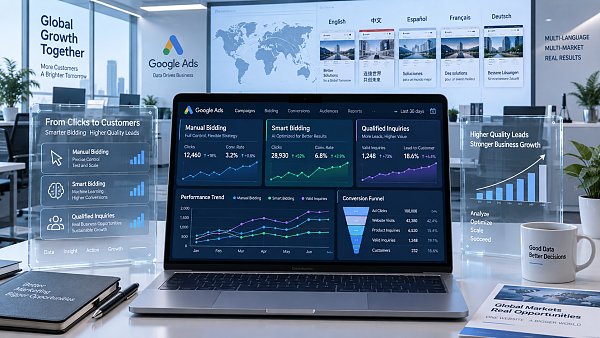
How to Choose a Google Ads Bidding Strategy: When to Use Smart Bidding vs. Manual Bidding
Choosing the wrong Google Ads bidding strategy may fail to generate qualified inquiries, no matter how high the budget is. The issue with many accounts is not that “bids are too low,” but that data that has not yet stabilized is handed over to fully automated system management, or that manual bid adjustments are still made frequently during the stage when the algorithm should be allowed to optimize. Smart bidding and manual bidding are not inherently superior to one another. The key is whether they match the account data, conversion quality, product decision-making cycle, and landing page conversion capability.
For export-oriented manufacturers, cross-border brands, and B2B service providers, Google Ads bidding is often not simply about selling a single product, but about generating form submissions, WhatsApp inquiries, phone calls, sample requests, and even subsequent sales opportunities. A “conversion” shown in the ad platform does not necessarily mean that the sales team has received a qualified lead. Therefore, before selecting a bidding method, operators must first answer a more practical question: what specific outcome is the system bidding for?
Before Choosing a Strategy, Check Whether Conversion Signals Are Reliable
Smart bidding relies on conversion data. If conversion actions are set too broadly—for example, if page views, time on page, and email clicks are all counted as primary conversions—the system will quickly find “people who are likely to take action,” but these users may not necessarily have purchase intent. This is especially true for industrial products, custom equipment, and bulk purchasing projects, where low-threshold actions can easily lead the algorithm off track.
A more reliable approach is to distinguish between primary and secondary conversions. Submitting a valid inquiry form, initiating a phone call, and completing checkout can be treated as primary goals; downloading a catalog, viewing a case study page, and clicking an instant messaging tool may retain value for observation, but should not be treated the same as genuine inquiries in the early stages. B2B accounts should also feed back sales-side information whenever possible, such as marking invalid inquiries, initially qualified leads, or sales opportunities. Without this step, the system optimizes only for “the number of forms,” rather than lead acquisition quality.
This is somewhat similar to the logic of internal risk control: if metrics focus only on surface-level completion rates, the execution process may appear effective while the results deviate from the objective. Teams interested in process design and responsibility boundaries may also refer to the ideas of risk identification and process control in Research on the Development of Internal Control Systems for Public Institutions Based on Risk Prevention and Control. Advertising does not simply replicate management systems, but the principle of “defining valid outcomes first, then allocating resources” is the same.
Which Google Ads Bidding Scenarios Are Suitable for Manual Bidding
The value of manual bidding is not to have people monitor bid differences of a few cents every day, but to allow new accounts to retain control when information is insufficient. It is more suitable for the testing stage: when entering a new national market, launching ads in a new language, validating product and industry keywords, or putting a landing page live for the first time, manual management can more quickly identify which search terms are irrelevant to the business, which regions generate many clicks but no inquiries, and which devices deliver clearly lower-quality traffic.
For example, when ads for exported machinery and equipment cover terms such as “supplier,” “manufacturer,” “used,” and “repair” at the same time, they may all appear industry-related, but their commercial intent differs significantly. During the manual bidding stage, negative keywords can be continuously added through search term reports, while budget can be prioritized for terms closer to inquiries, such as product models, purchasing purposes, and specification parameters. For small-budget accounts, this type of cleanup is usually more important than blindly expanding keyword volume.
However, manual bidding also has its limits. It is difficult to comprehensively assess users’ devices, locations, times of day, audience characteristics, and historical conversion probability in real time. As the account grows, operators who still rely on experience to set bids for every keyword often fall into a state of “constantly adjusting but unable to make sound judgments.” Manual management is not naturally more refined; it requires the team to have sufficient time to understand the data and conduct reviews at a fixed cadence, rather than raising bids today and lowering them tomorrow.
Conditions Where Smart Bidding Is Truly Suitable
Once an account has accumulated relatively stable and clearly defined conversion signals, smart bidding is generally more worthwhile to try. For example, “Maximize Conversions” is suitable for campaigns seeking more valid actions within a set budget; “Target CPA” is more suitable when a business already has a general understanding of the acceptable cost per lead; e-commerce businesses or operations that can assign different values to different inquiries can further evaluate “Maximize Conversion Value” or target ROAS.
It should be noted that a lower target cost is not always better. Setting Target CPA far below the account’s historical normal level may cause the system to significantly reduce traffic. Ads may appear to be “saving money,” but they are actually losing exposure. Conversely, if the target is set too broadly, the system may pay more for low-quality traffic. Adjustments should be evaluated over a complete conversion cycle to avoid changing the target in the morning and reversing it in the afternoon due to data fluctuations.
Three Details Most Easily Overlooked in B2B Lead Generation Accounts
First, conversion lag. Overseas customers may browse today and submit a form several days later; the internal approval cycle for equipment purchases may be even longer. Looking only at data from the most recent two or three days can easily lead to the mistaken conclusion that a bidding strategy is ineffective. Second, branded keywords can mask problems. Branded keywords often convert well, but this does not mean that non-branded expansion keywords, industry terms, or competitor terms are equally effective. It is best to separate them for observation.
Third, website conversion capability directly affects bidding decisions. If English pages load slowly, product parameters are incomplete, form fields are too numerous, or inquiry entry points are only optimized for desktop devices, even the best strategy will be undermined by the landing page. Website development, advertising accounts, and lead handling should not operate independently. For platforms such as Eyingbao that cover intelligent website building, multilingual corporate websites, Google Ads, SEO, and social media operations, their practical value lies not only in activating a particular tool, but in enabling ad clicks to reach pages suitable for local buyers to read and inquire on, while retaining trackable data within the same growth funnel.
A More Reliable Approach: Switch Strategies as the Account Matures
Many accounts do not need to choose exclusively between “smart” and “manual” bidding. In practice, stronger manual control can first be used to complete keyword screening, negative keyword refinement, and conversion validation. Once valid conversions gradually stabilize, some campaigns can then be switched to smart bidding for testing. During testing, other key variables—such as budget, geographic targeting, landing pages, and ad creatives—should remain relatively stable; otherwise, it will be difficult to determine whether changes come from the bidding strategy or other adjustments.
Ultimately, choosing a Google Ads bidding strategy is not about selecting a button in the backend, but about selecting based on data quality and business objectives. New accounts lack data, so the first priority is to clearly understand traffic; once stable inquiries are in place, allow the algorithm to expand valid opportunities; when the sales team can identify high-value customers, then consider more refined value-based bidding. Following this sequence correctly ensures that the budget does not merely generate a large number of seemingly active but difficult-to-follow-up inquiries.
Related Articles
 How to troubleshoot a low conversion rate after running Facebook ads?
 How Can You Evaluate the Advertising Performance of a Digital Marketing Service Provider?
 How much does it cost to open a Yandex Ads account? How are the setup fees calculated?



Related Products
 Yiyingbao SaaS Intelligent Website Building and Marketing SystemYiyingbao SaaS Intelligent Website Building and Marketing System, AI-powered no-code website building, rapid creation of multilingual B2B international websites in 10 minutes, global server acceleration, AI-powered SEO optimization, helping businesses connect efficiently with global markets. The perfect integration of technology and operation makes building an international trade website remarkably simple
 AI+SEM Intelligent Advertising Marketing SystemAI+SEM drives intelligent ad creation, empowering full-funnel precision advertising marketing. The system automatically generates weekly/monthly reports, AI recommends keywords and target countries, monitors core metrics in real-time with intelligent alerts, and enables one-click high-conversion ad solutions to help quickly acquire customers and improve ROI.
 AI+SEO Dual-Engine System Optimization ServicesYiyingbao’s AI+SEO dual-engine optimization system helps foreign trade enterprises acquire high-quality organic traffic through AI-powered keyword research, content generation, and comprehensive technical optimization, significantly improving search rankings and conversion rates.
 AI+SNS Social Media Marketing SystemYingbao AI+SNS Social Media Marketing System - Precision social capture for the social media era. Supports one-click content synchronization across major platforms like Facebook and LinkedIn. AI intelligently rewrites posts for enhanced relevance. 24/7 AI customer service and user profiling analysis empower businesses to efficiently expand into global markets.
 AI+SEO营销解决方案易营宝AI+SEO营销解决方案,通过AI批量写作、智能生成TDK、精准关键词扩词等功能,全面优化网站SEO效果,提升流量与转化率。助力企业构建高效智能网站新生态。
 AI+SEM Advertising Marketing SolutionsAI+SEM Advertising Marketing Solution leverages AI technology to deeply empower SEM ad campaigns. It automatically generates weekly/monthly reports using AI, presenting account data across multiple dimensions for comprehensive insights into campaign performance and trends. The system precisely recommends keywords and target countries, intelligently generates high-conversion ad copy, and enables one-click activation of efficient campaign plans to help businesses rapidly acquire customers. Simultaneously, it monitors core metrics in real time, intelligently identifies abnormal fluctuations, and issues timely alerts to ensure stable, high-return advertising results.
 Domain Name ServicesEasyWin provides professional domain name services, including intelligent queries, one-stop registration, brand protection, and full lifecycle management, helping businesses build a digital brand image.
 EasyOperate B2C Cross-Border E-Commerce Platform & Independent WebsiteEasyStore B2C Cross-border E-commerce Independent Store is an intelligent website building and cross-border e-commerce integrated solution independently developed by EasyStore Information Technology (Beijing) Co., Ltd. The system is specially designed for small and medium-sized as well as large export enterprises, integrating 'website building, operation, marketing, advertising, and conversion' into one, helping enterprises quickly establish cross-border e-commerce independent stores to achieve brand globalization and global sales growth.
The platform supports multiple languages, multiple currencies, and multi-channel marketing, with built-in AI intelligent translation and SEO optimization systems, suitable for mainstream markets such as Southeast Asia, Europe and America, Latin America, and the Middle East, assisting Chinese manufacturing enterprises in efficiently deploying international e-commerce strategies. SSL证书易营宝提供专业SSL安全证书服务,包括单域名和泛域名证书,确保网站数据传输加密、身份验证和完整性保护,助力企业建立安全可信的在线业务环境。









