









- Which customer acquisition channels will be affected by cross-border marketing trends in 2026?Sep 06, 2026View details
- Which homogenization risks should be considered in an analysis of the AI-powered website building industry?Aug 30, 2026View details
- How Will AI Marketing Trends 2026 Change Advertising Budget AllocationAug 28, 2026View details
- Is the EV SSL certificate market shrinking or upgrading? How should companies assess certificate procurement?Aug 11, 2026View details
- Why the old AMP SEO 2020 practices no longer work and what has changed in current optimization prioritiesAug 02, 2026View details
- How to Choose Topics for an Industry News Section to Attract More Organic Search TrafficJul 29, 2026View details
Which Facebook ad objectives should you prioritize when your promotion budget is limited?
When the Budget Is Tight, Don’t Rush to Pursue the “Full Funnel” with Facebook Advertising
When running Facebook advertising on a limited budget, the biggest concern is not spending too little, but spreading the objectives too widely. Many companies try to cover brand awareness, engagement, traffic acquisition, lead generation, and conversions all at once. It may look like they are building a complete funnel, but in reality, none of the objectives often produces meaningful data. In the end, the team can neither evaluate the creatives nor determine whether the audience is right, and can only continue spending based on instinct.
Based on project experience, what should truly be prioritized during the low-budget phase is not which advertising interface looks more “complete,” but which objective is closer to the transaction and easier to validate. For website and marketing service integration businesses, especially projects involving overseas lead generation, cross-border e-commerce independent websites, and brands going global, the priority of Facebook advertising objectives usually depends on two factors: whether the landing page can effectively handle the traffic, and whether the conversion action is clear enough.
If neither of these two factors is ready, even inexpensive clicks are merely “vanity data.”
Examine the Conversion Path First, Then Decide Which Objective to Use
When the budget is limited, advertising objectives should not be selected from the platform’s feature list. Instead, they should be determined by working backward from the business conversion path. B2B export websites and B2C cross-border stores may both be running Facebook advertising on the surface, but their priorities can be very different.
For B2B lead-generation businesses, such as machinery and equipment, industrial components, raw materials, and customized manufacturing, the sales cycle is long, and users rarely place an order after their first click. In this case, the priority is often not “Sales,” but more focused objectives such as “Lead Generation” or “Messaging.” The core of this type of business is not immediate conversion, but obtaining qualified leads first and then handing them over to the sales team for follow-up. The purpose of the advertising is to identify people with clear needs, rather than use low-quality traffic to make the cost per lead look attractive.
Conversely, if the business is an established B2C independent website with a stable product structure, a complete payment process, and a clear repurchase mechanism—especially for categories with lower average order values and faster decision-making—even a small budget can start directly with the “Sales” objective. The prerequisite is that the pixel, event tracking, checkout-page speed, and mobile payment experience are all properly configured. Otherwise, the platform may find people who are “likely to purchase,” but your website will fail to retain them, ultimately resulting in high clicks and low conversions.
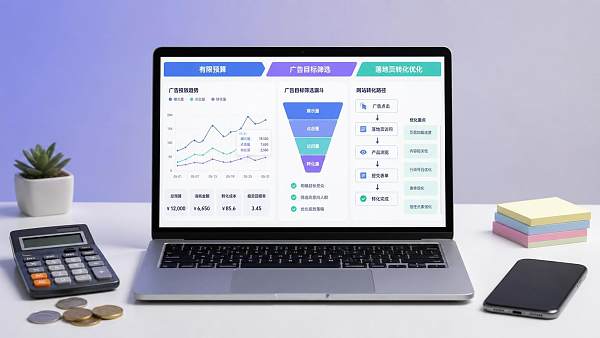
There is a common misconception here: many teams believe that with a small budget, they should first use the “Traffic” objective to obtain inexpensive clicks, and then switch to lead generation or conversions after gaining enough visits. This approach is not always valid. The Traffic objective can indeed generate volume more quickly, but the platform will prioritize people who are likely to click, not necessarily those who are willing to submit their information or place an order. For accounts that already have tight budgets, this type of “cheap but biased” data can distort subsequent decisions, especially when the audience sample is still too small.
Which Objectives Are Worth Testing First, and Which Should Come Later?
If you need to prioritize objectives for a limited budget, it is usually better to evaluate them using the following approach rather than copy a fixed sequence.
The objectives most likely to be overestimated are awareness, engagement, and pure traffic acquisition. This does not mean they cannot be used, but they are not suitable as the primary objectives when the budget is already limited. For businesses that need clear results such as inquiries, bookings, or orders, the early-stage budget should be spent on objectives that can more quickly prove whether this group of people will take action.
The Smaller the Budget, the More You Should Focus on the Landing Page Rather Than Just the Ad Dashboard
Many Facebook advertising campaigns perform poorly not because of the campaign settings, but because of the landing page. This is especially true on mobile devices. When users click through from their feed, they usually have only a few seconds of patience. Slow page loading, a lack of core information above the fold, overly long forms, and inconspicuous buttons can all further dilute an already limited budget.
This is why many overseas expansion projects separately optimize the mobile experience during the cold-start phase. Solutions such as YiYingBao AMP/MIP Mobile Intelligent Website Building deliver practical value not because they contain more “technical terminology,” but because they address the most realistic problems in handling advertising traffic: page loading speed, mobile display stability, and content synchronization efficiency. Publicly stated figures indicate an average loading-speed improvement of 85%, loading speeds of as fast as 0.5 seconds, and a 70% increase in mobile conversion rates. These metrics cannot be directly equated with the final return on ad spend for every project, but for advertising landing pages, reducing waiting time generally does help reduce bounce rates and retain valid clicks.
This is particularly important in cross-border e-commerce and local services, where differences in mobile-page performance can directly affect the choice of objective. If a cross-border store is going to use the Sales objective, the checkout path must be short, and images and pricing information must be clearly communicated above the fold. If a local service business is running booking or messaging campaigns, the phone number, form, and instant communication entry points should be placed prominently. The advertising dashboard optimizes for “who comes,” while the landing page determines “whether they continue after arriving.”
Some Accounts Are Suitable for Messaging First, While Others Are Not
The Messaging objective has regained attention among many small and medium-sized businesses in recent years for a very practical reason: compared with asking unfamiliar users to fill out a long form immediately, entering a conversation first creates a lower psychological barrier. For industries with complex quotations, long delivery cycles, or specifications that must be confirmed in advance, this objective often makes it easier to generate the first batch of qualified leads than “Website Conversions.”
However, it also has clear prerequisites. The team must be able to respond promptly, and the response scripts must not sound like automated customer service. Many accounts appear to have reasonable messaging costs, yet the sales team reports that lead quality is average. The problem is not necessarily that the platform found the wrong people, but that users did not receive a clear response within the first 30 seconds of the conversation, making it difficult to move the discussion forward. When the budget is small, this kind of operational waste is particularly damaging.
So when is the Messaging objective suitable? Typically, it is appropriate when the product requires explanation, users are likely to ask about price or minimum order quantities, the sales team can handle real-time conversations, and the website’s conversion process has not yet been properly established. If the website is already mature and the ordering process is standardized, the business should return to the Sales or on-site conversion objective as soon as possible rather than relying on human-assisted conversations in the long term.
Don’t Rush to Scale—First Determine Whether the Data Is “Truly Effective”
When the budget is limited, the most important thing is not to make the data look bigger, but to determine whether it is worth continuing. At this stage, advertising performance cannot be evaluated solely by click-through rate and cost per click, nor only by the number of forms submitted. For B2B projects, more meaningful indicators often include whether an inquiry contains clear requirements, whether the region is a match, and whether the contact information is complete. For B2C projects, you should examine where users drop off between adding to cart and payment: whether the advertising promise is inconsistent with the product page, or whether shipping costs, payment methods, or page speed are preventing completion.
The advantage of service teams such as YiYingBao, which provide website building, SEO, and advertising services at the same time, often lies here: they do not look at the problem solely from an advertising perspective. When Facebook advertising fails to perform, the problem may not be the audience, but disorganized information on a multilingual page. Sometimes it is not the creative, but an issue with the above-the-fold loading speed or the position of the conversion button on mobile. If account diagnosis focuses only on platform data, the conclusions will often be biased.
When the budget is already limited, it is even more important to avoid “mistaking technical issues for advertising issues and landing-page issues for audience issues.”
The Final Choice Depends on Where You Are Currently Stuck
If you already have a clear product, payment, and repurchase path, testing the Sales objective first is more direct. If you are running a lead-generation business and user decisions depend on communication, starting with Lead Generation or Messaging will generally make it easier to establish the first round of meaningful data. If the website is still new and the mobile experience is average, first improve the landing page until it is usable before discussing continued scaling. Otherwise, no matter how precisely the advertising objective is selected, you will only be sending the budget more quickly to the point where users drop off.
The truly稳妥 approach is not to use every possible Facebook advertising objective, but to first focus on the action closest to the desired result and make it work smoothly. Once lead quality, landing-page performance, and data transmission are stable, you can then add engagement, remarketing, and broader audience expansion. What a small-budget account needs most is never to “cover everything,” but to be able to clearly explain why every step should continue.
Related Articles


Related Products
 Yiyingbao SaaS Intelligent Website Building and Marketing SystemYiyingbao SaaS Intelligent Website Building and Marketing System, AI-powered no-code website building, rapid creation of multilingual B2B international websites in 10 minutes, global server acceleration, AI-powered SEO optimization, helping businesses connect efficiently with global markets. The perfect integration of technology and operation makes building an international trade website remarkably simple
 AI+SEM Intelligent Advertising Marketing SystemAI+SEM drives intelligent ad creation, empowering full-funnel precision advertising marketing. The system automatically generates weekly/monthly reports, AI recommends keywords and target countries, monitors core metrics in real-time with intelligent alerts, and enables one-click high-conversion ad solutions to help quickly acquire customers and improve ROI.
 AI+SEO Dual-Engine System Optimization ServicesYiyingbao’s AI+SEO dual-engine optimization system helps foreign trade enterprises acquire high-quality organic traffic through AI-powered keyword research, content generation, and comprehensive technical optimization, significantly improving search rankings and conversion rates.
 AI+SNS Social Media Marketing SystemYingbao AI+SNS Social Media Marketing System - Precision social capture for the social media era. Supports one-click content synchronization across major platforms like Facebook and LinkedIn. AI intelligently rewrites posts for enhanced relevance. 24/7 AI customer service and user profiling analysis empower businesses to efficiently expand into global markets.
 AI+SEO营销解决方案易营宝AI+SEO营销解决方案,通过AI批量写作、智能生成TDK、精准关键词扩词等功能,全面优化网站SEO效果,提升流量与转化率。助力企业构建高效智能网站新生态。
 AI+SEM Advertising Marketing SolutionsAI+SEM Advertising Marketing Solution leverages AI technology to deeply empower SEM ad campaigns. It automatically generates weekly/monthly reports using AI, presenting account data across multiple dimensions for comprehensive insights into campaign performance and trends. The system precisely recommends keywords and target countries, intelligently generates high-conversion ad copy, and enables one-click activation of efficient campaign plans to help businesses rapidly acquire customers. Simultaneously, it monitors core metrics in real time, intelligently identifies abnormal fluctuations, and issues timely alerts to ensure stable, high-return advertising results.
 Domain Name ServicesEasyWin provides professional domain name services, including intelligent queries, one-stop registration, brand protection, and full lifecycle management, helping businesses build a digital brand image.
 EasyOperate B2C Cross-Border E-Commerce Platform & Independent WebsiteEasyStore B2C Cross-border E-commerce Independent Store is an intelligent website building and cross-border e-commerce integrated solution independently developed by EasyStore Information Technology (Beijing) Co., Ltd. The system is specially designed for small and medium-sized as well as large export enterprises, integrating 'website building, operation, marketing, advertising, and conversion' into one, helping enterprises quickly establish cross-border e-commerce independent stores to achieve brand globalization and global sales growth.
The platform supports multiple languages, multiple currencies, and multi-channel marketing, with built-in AI intelligent translation and SEO optimization systems, suitable for mainstream markets such as Southeast Asia, Europe and America, Latin America, and the Middle East, assisting Chinese manufacturing enterprises in efficiently deploying international e-commerce strategies. SSL证书易营宝提供专业SSL安全证书服务,包括单域名和泛域名证书,确保网站数据传输加密、身份验证和完整性保护,助力企业建立安全可信的在线业务环境。









