









- Which customer acquisition channels will be affected by cross-border marketing trends in 2026?Sep 06, 2026View details
- Which homogenization risks should be considered in an analysis of the AI-powered website building industry?Aug 30, 2026View details
- How Will AI Marketing Trends 2026 Change Advertising Budget AllocationAug 28, 2026View details
- Is the EV SSL certificate market shrinking or upgrading? How should companies assess certificate procurement?Aug 11, 2026View details
- Why the old AMP SEO 2020 practices no longer work and what has changed in current optimization prioritiesAug 02, 2026View details
- How to Choose Topics for an Industry News Section to Attract More Organic Search TrafficJul 29, 2026View details
Facebook Advertising Tips: How to Test Audiences and Creatives During the Cold Start Phase?
To master Facebook advertising, the priority during the cold-start phase is not to immediately pursue low-cost conversions, but to use a controlled budget to identify “who will respond, what content can persuade them, and why they are willing to take further action after clicking.” Many accounts launch audiences, creatives, placements, and landing pages all at once from the start. Although the data may appear abundant, it becomes impossible to determine which variable is actually driving conversions. A more reliable approach is to treat cold start as an orderly validation process: conduct segmented testing, observe one variable at a time, eliminate underperformers promptly, and gradually scale the winning combinations.
Before cold start, answer one question: What exactly are you testing?
“Testing” in Facebook advertising is not simply about looking at click-through rates; it means establishing a decision-making sequence around business objectives. B2B foreign trade companies typically focus on form submissions, WhatsApp inquiries, or lead quality; cross-border e-commerce businesses place greater emphasis on add-to-cart, initiated checkout, and purchases; local services may require appointments, map directions, or direct-message inquiries. Different objectives require different audience signals and creative messaging, and these should not be mixed together.
It is recommended to define one primary conversion event before launching ads and verify that the pixel, Conversions API, and landing page events can report data properly. If there is still insufficient purchase data, you may temporarily use “initiated checkout,” “add to cart,” or high-quality leads as optimization signals, but do not remain focused on click optimization for the long term. A high number of clicks does not mean strong customer intent, especially for B2B businesses with high product prices and long decision-making cycles. What is truly worth accumulating are qualified leads that can enter the sales follow-up process.
Audience testing: from broad to narrow, rather than trying to “guess perfectly” from the start
The most common misconception during cold start is layering too many interest tags. For example, simultaneously restricting country, age, job title, industry interests, competitor pages, and behavioral characteristics ultimately creates a very small audience pool. Such settings may look precise, but they can actually cause significant fluctuations due to insufficient sample size and limit the platform’s learning capacity.
A practical testing framework is to divide audiences into three categories, with each ad set responsible for only one clear hypothesis:
- Broad audiences: Retain necessary conditions such as market, language, and age, without adding excessive interests, to verify whether the product has broad appeal.
- Interest- or industry-based audiences: Build each ad set around one user awareness dimension, such as “cross-border e-commerce tools,” “home renovation,” or “fitness training,” and avoid combining several completely different interests.
- Lookalike and retargeting audiences: Once website visits, video views, customer lists, or conversion events have accumulated to a certain extent, test audiences from different sources and with different lookalike percentages.
For accounts with limited budgets, there is no need to create more than ten ad sets at once. Start with 3 to 5 directions, assigning similar budgets and the same optimization objective to each group, and observe them continuously for a complete learning cycle. When evaluating results, do not look only at one day’s cost. Also consider impressions, click-through rate, landing page view rate, conversion rate, and lead quality. If an ad set’s spend has reached a certain multiple of the acceptable cost per conversion but still produces no effective signal, it should be paused or adjusted rather than left running indefinitely.
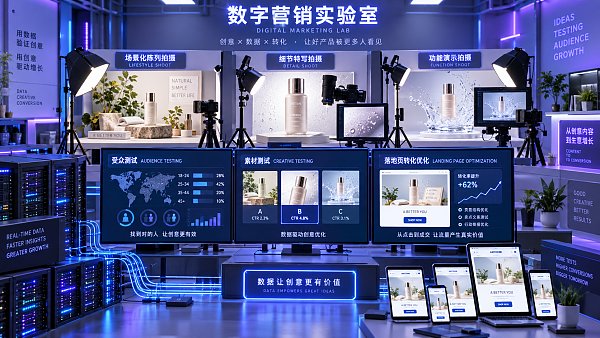
Creative testing should test “messaging angles,” not just replace an image
Creative fatigue and low click-through rates are often not caused by insufficiently polished design, but by the ad failing to quickly explain why users should stop and pay attention. During cold start, each creative should ideally correspond to one clear communication angle. For example, the same industrial product can be presented from the perspectives of “stable delivery time,” “certification standards,” “customization capabilities,” “use cases,” or “cost savings.” The same cross-border service can also be tested using case results, common challenges, process explanations, and founder-led presentations.
It is recommended to include 3 to 5 clearly differentiated creatives in each audience group, rather than merely changing headline colors or button copy. Creative formats can appropriately combine short videos, carousel ads, static scenario images, and UGC-style talking-head videos. The key, however, is to communicate essential information within the first three seconds or the first screen: who it is for, what problem it solves, and what the next step should be.
When evaluating creatives, analyze them by funnel stage: if users see the ad but do not click, first check the first-screen visuals and selling points; if the landing page view rate is low after clicks, there may be issues with loading speed, redirects, or page consistency; if page views are normal but conversions do not occur, revisit pricing, trust-building information, form length, and the action path. Do not attribute every issue to the ad creative.
The landing page is the often-overlooked “fourth variable” in cold start
When users enter a website from Facebook, their patience is far shorter than expected. Whether the ad promises “get a quote,” “view solutions,” or a “limited-time offer,” the first screen of the landing page should provide the corresponding answer instead of making users search for the entry point again. This is especially true on mobile devices: overly long forms, oversized images, and unclear payment or inquiry buttons can all distort front-end advertising data.
For businesses that need to capture overseas mobile traffic, it is important to focus on the integrated configuration of page speed, multilingual content, and conversion components. For example, Yiyingbao AMP/MIP mobile intelligent website builder supports generating pages in accordance with mobile standards and provides capabilities such as image compression, lazy loading, and CDN acceleration. During ad testing, the value of such foundational experience is not to replace advertising strategy, but to reduce interference from “users who clicked but left while waiting for the page to load,” enabling more reliable data from creative and audience testing.
How should budgets be allocated to avoid interrupting tests before they even begin?
Cold-start budgets should not be spread too thinly across too many areas. Rather than giving a small amount to each of ten ad sets, it is better to retain a limited number of comparable combinations so that each has the opportunity to receive enough impressions and clicks. If using ad set budget optimization, you can ensure relatively fair starting conditions across groups. Once some audiences have demonstrated stable performance, use campaign budget optimization to allow the system to allocate more budget toward the winning groups.
Adjustments should also be made with restraint. Frequently modifying budgets, audiences, creatives, or optimization events may cause ads to re-enter the learning phase. A more reasonable pace is to first define an observation window and record the timing and content of every change; address only the most obvious issue in each round; validate winning creatives with new audiences, then continue testing winning audiences with new creatives. In this way, what you accumulate is not an occasional set of good data, but a reusable framework for advertising decisions.
When moving from test results to scaling, focus on “replicability”
When a combination generates conversions, do not rush to double the budget. Confirm whether it can maintain basic stability across different dates, different creatives, or similar audiences. If it relies only on a single ad, one small audience, or a short-term promotion, costs can easily surge after scaling. A healthier approach is to retain the best-performing creative angles, expand into adjacent interests, lookalike audiences, and broader markets, while building retargeting paths for visitors, engaged users, and users who added to cart but did not purchase.
Truly practical Facebook advertising skills are not about finding a “high-volume setup” that works forever. They are about establishing clear experimental discipline during the cold-start phase: validate one key hypothesis at a time, make data explainable, and turn every budget expenditure into a basis for the next optimization. For operators, this is more important than focusing on short-term costs and provides stronger support for subsequent stable growth.
Related Articles



Related Products
 Yiyingbao SaaS Intelligent Website Building and Marketing SystemYiyingbao SaaS Intelligent Website Building and Marketing System, AI-powered no-code website building, rapid creation of multilingual B2B international websites in 10 minutes, global server acceleration, AI-powered SEO optimization, helping businesses connect efficiently with global markets. The perfect integration of technology and operation makes building an international trade website remarkably simple
 AI+SEM Intelligent Advertising Marketing SystemAI+SEM drives intelligent ad creation, empowering full-funnel precision advertising marketing. The system automatically generates weekly/monthly reports, AI recommends keywords and target countries, monitors core metrics in real-time with intelligent alerts, and enables one-click high-conversion ad solutions to help quickly acquire customers and improve ROI.
 AI+SEO Dual-Engine System Optimization ServicesYiyingbao’s AI+SEO dual-engine optimization system helps foreign trade enterprises acquire high-quality organic traffic through AI-powered keyword research, content generation, and comprehensive technical optimization, significantly improving search rankings and conversion rates.
 AI+SNS Social Media Marketing SystemYingbao AI+SNS Social Media Marketing System - Precision social capture for the social media era. Supports one-click content synchronization across major platforms like Facebook and LinkedIn. AI intelligently rewrites posts for enhanced relevance. 24/7 AI customer service and user profiling analysis empower businesses to efficiently expand into global markets.
 AI+SEO营销解决方案易营宝AI+SEO营销解决方案,通过AI批量写作、智能生成TDK、精准关键词扩词等功能,全面优化网站SEO效果,提升流量与转化率。助力企业构建高效智能网站新生态。
 AI+SEM Advertising Marketing SolutionsAI+SEM Advertising Marketing Solution leverages AI technology to deeply empower SEM ad campaigns. It automatically generates weekly/monthly reports using AI, presenting account data across multiple dimensions for comprehensive insights into campaign performance and trends. The system precisely recommends keywords and target countries, intelligently generates high-conversion ad copy, and enables one-click activation of efficient campaign plans to help businesses rapidly acquire customers. Simultaneously, it monitors core metrics in real time, intelligently identifies abnormal fluctuations, and issues timely alerts to ensure stable, high-return advertising results.
 Domain Name ServicesEasyWin provides professional domain name services, including intelligent queries, one-stop registration, brand protection, and full lifecycle management, helping businesses build a digital brand image.
 EasyOperate B2C Cross-Border E-Commerce Platform & Independent WebsiteEasyStore B2C Cross-border E-commerce Independent Store is an intelligent website building and cross-border e-commerce integrated solution independently developed by EasyStore Information Technology (Beijing) Co., Ltd. The system is specially designed for small and medium-sized as well as large export enterprises, integrating 'website building, operation, marketing, advertising, and conversion' into one, helping enterprises quickly establish cross-border e-commerce independent stores to achieve brand globalization and global sales growth.
The platform supports multiple languages, multiple currencies, and multi-channel marketing, with built-in AI intelligent translation and SEO optimization systems, suitable for mainstream markets such as Southeast Asia, Europe and America, Latin America, and the Middle East, assisting Chinese manufacturing enterprises in efficiently deploying international e-commerce strategies. SSL证书易营宝提供专业SSL安全证书服务,包括单域名和泛域名证书,确保网站数据传输加密、身份验证和完整性保护,助力企业建立安全可信的在线业务环境。









