









- Which customer acquisition channels will be affected by cross-border marketing trends in 2026?Sep 06, 2026View details
- Which homogenization risks should be considered in an analysis of the AI-powered website building industry?Aug 30, 2026View details
- How Will AI Marketing Trends 2026 Change Advertising Budget AllocationAug 28, 2026View details
- Is the EV SSL certificate market shrinking or upgrading? How should companies assess certificate procurement?Aug 11, 2026View details
- Why the old AMP SEO 2020 practices no longer work and what has changed in current optimization prioritiesAug 02, 2026View details
- How to Choose Topics for an Industry News Section to Attract More Organic Search TrafficJul 29, 2026View details
How Can B2B International Trade Google Advertising Strategies Identify High-Quality Traffic?
Meta Title: How to Identify High-Quality Traffic with a B2B Overseas Trade Google Ads Strategy
When running overseas trade advertising, many people focus first on clicks and spending speed. As a result, the budget is spent quickly, but inquiries remain unstable. To identify high-quality traffic through a B2B overseas trade Google Ads strategy, the key is not to “spend more,” but to “filter first, then scale.” You need to connect search terms, regions, audiences, page content, and conversion actions into one consistent process, blocking as many invalid clicks as possible and retaining people with genuine purchasing intent.
A B2B overseas trade Google Ads strategy should first solve the problem of “inaccurate traffic”
B2B overseas trade and ordinary retail advertising differ significantly: the conversion journey is longer, more decision-makers are involved, and the value of each inquiry is higher. Therefore, when evaluating advertising performance, you cannot look only at surface-level metrics such as CTR or the number of forms submitted. You also need to examine how many of these visitors are genuinely likely to become customers.
In practice, when many accounts fail to identify high-quality traffic, the problem is usually not Google Ads itself, but inaccurate preliminary judgments. The most common situations include:
- Keywords are too broad, bringing in large volumes of research-oriented and learning-oriented traffic;
- Country and language settings are not sufficiently specific, causing ads to reach non-target markets;
- Landing page content looks like a company introduction rather than a procurement solution page;
- Conversion settings only count “successful submissions” and do not distinguish valid inquiries;
- Advertising account data is disconnected from website data, making later optimization impossible.
In short: high-quality traffic is not generated simply by advertising; it is filtered out.
More keywords are not always better; overseas trade advertising should especially avoid broad-term traffic acquisition
Many operators initially cover a large number of core industry keywords, believing that more keywords mean broader coverage and more opportunities. In B2B overseas trade scenarios, this approach carries considerable risk. Many seemingly relevant keywords do not actually represent purchasing needs.
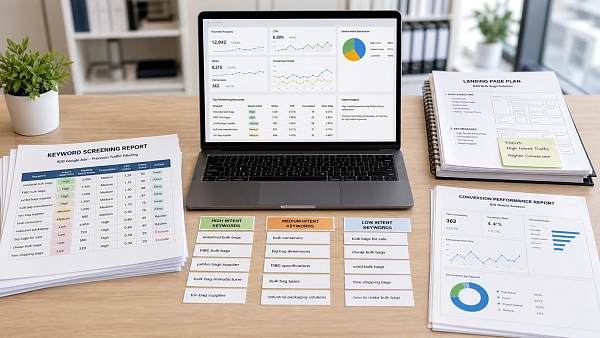
For example, some keywords are closer to “information searches,” some are closer to “supplier selection,” and others have already reached the “quotation comparison” stage. The latter two categories are closer to the high-quality traffic you want.
To determine whether a keyword is worth bidding on, you can first assess three aspects:
- Whether it shows purchasing intent, such as “supplier,” “manufacturer,” “factory,” “bulk,” “wholesale,” or “OEM”;
- Whether it clearly indicates a product, rather than being an overly broad industry term;
- Whether the searcher is more likely to be a peer, student, job seeker, or potential buyer.
Many accounts waste budget on broad industry terms that look attractive but lack precision. For example, bidding only on generic product names may attract people who are looking up information, searching for definitions, viewing images, or conducting market research. What you need is not activity for its own sake, but people who are willing to submit inquiries.
This is where the importance of negative keywords is often underestimated. Terms such as “job,” “salary,” “meaning,” “pdf,” “free,” “used,” and “sample template” may bring low-quality traffic in many overseas trade industries and should be continuously removed through search-term reports. Negative keyword management is not a one-time task; it is account maintenance that should be performed every week.
Regions, languages, and ad schedules determine how much invalid traffic you filter out
Many people assume that selecting a target country will automatically make advertising precise. In reality, it is not that simple. In B2B overseas trade advertising, insufficiently specific regional settings can easily direct budget to non-core markets, areas with low purchasing power, or visitors whose needs do not match your business.
A relatively reliable approach is to divide campaigns according to market maturity. For example, North America, Europe, the Middle East, and Southeast Asia should not be placed in one campaign. The reason is straightforward: search habits, click costs, and inquiry quality differ across markets. After mixing them together, the data you see is an average, but averages are not very helpful for optimization.
Language settings should not be handled casually either. Many export companies do have customers who search in English, but if you are targeting Spanish-speaking, Russian-speaking, or Arabic-speaking markets, searches in the local language are often closer to real purchasing scenarios. The prerequisite is that your landing page must keep up as well. You should not write the ad in the local language only to direct users to a stiff English page.
Now consider ad scheduling. B2B ads do not need to distribute budget evenly throughout the entire day. You should examine the time difference in each target market, identify when inquiries are concentrated, and then gradually exclude less effective periods. Especially when the budget is limited, allocating money to high-conversion periods is more useful than staying online all day.
The role of ad copy is not only to attract clicks, but also to pre-screen visitors
A common misunderstanding in overseas trade advertising copy is focusing only on increasing the click-through rate, which can attract many unsuitable visitors. For B2B businesses, ad copy should also perform a “pre-screening” function.
For example, your copy can clearly state your target customers, supply capabilities, product direction, certification capabilities, minimum order requirements, and even applicable industries. The benefit is that although the number of clicks may not be the highest, the visitors who arrive will be closer to genuine buyers.
If you provide customized processing, for example, do not write your copy as a generic product showcase. If you only accept bulk orders, you can appropriately highlight your bulk supply capabilities. Blocking mismatched visitors before they click is usually more cost-effective than allowing them to click and then lose them later.
If an ad group has been running for some time and receives acceptable clicks but poor-quality inquiries, do not rush to increase the budget. First check whether the copy describes the qualification threshold too vaguely.
If the landing page is unsuitable, even the most precise traffic will be lost
Many companies run ads reasonably well, but the page is what actually holds them back. After clicking an ad, B2B procurement customers most want to confirm not “how many years your company has been established,” but “whether you can solve my procurement problem.”
Therefore, an overseas trade landing page capable of handling high-quality traffic should answer at least the following questions:
- What do you sell, and what application scenarios is it suitable for?
- What practical differences set you apart from ordinary suppliers, such as lead time, certifications, customization, or production capacity?
- How can visitors contact you next, and is it convenient to submit an inquiry?
- Is there sufficient trust-building information to support a procurement decision?
The problem with many pages is not that they contain too little information, but that they emphasize the wrong information. Homepage-style pages often provide extensive brand stories, company visions, and news updates, while specifications, applications, delivery capabilities, and case-study details that buyers care about are hidden deep within the site. Advertising traffic is already expensive. Bringing visitors in without providing materials that enable them to make a quick judgment is a common source of loss.
If a company is still strengthening its website fundamentals, elements such as multilingual pages, an indexable site structure, and a landing-page system suitable for advertising should preferably be planned together with the advertising. Whether an advertising account can be optimized continuously and whether a website can reliably handle leads are, in fact, part of the same process. Integrated services such as 易营宝, which cover intelligent website building, SEO optimization, and Google Ads, are more suitable for companies with weak website foundations that also want their advertising to quickly reach an optimizable state. The focus is not the tool name, but avoiding a disconnect between front-end customer acquisition and back-end page performance.
What truly creates a gap is conversion tracking and lead classification
If an account only records that “someone submitted a form,” it is difficult to perform high-quality optimization. Google will treat all conversions as having the same value by default, but inquiry quality varies greatly in B2B overseas trade.
A more practical approach is to perform at least basic lead classification. For example:
- Invalid inquiries: spam or inquiries that clearly do not represent purchasing needs;
- General inquiries: interest in the product, but unclear requirements;
- High-intent inquiries: the country, quantity, purchasing scenario, and contact details are complete;
- Key opportunities: have entered the quotation, sample, or further business communication stage.
When you send back the quality of back-end leads to the advertising platform, the optimization direction becomes much clearer. Which keywords bring not merely “more forms,” but forms that are “more likely to be from customers”? Which regions have inexpensive clicks but poor leads? Which ad copy has an average click-through rate but generates higher-quality inquiries? These judgments should be based not on intuition, but on a data feedback loop.
Many companies later introduce AI-assisted advertising, which is essentially based on complete data. Without reliable conversion signals, even the best automation strategy can only continue amplifying the “wrong target.”
Do not rush to use Smart Bidding; first determine whether the account has an optimization foundation
The statement “Smart Bidding will make advertising more precise” is only half right. Smart Bidding can indeed improve efficiency, but the prerequisite is that the account has accumulated a certain amount of quality data and that conversions are clearly defined.
If your account has just started gaining volume, has few conversions, mixed search terms, and weak landing-page performance, relying entirely on automation at this stage will often produce unstable results. A more reliable pace is to first establish the keyword structure, negative keywords, regional segmentation, landing-page experience, and basic conversion tracking, and then gradually allow the system to learn.
Experienced campaign managers generally do not interpret “system intelligence” as a way to save effort, but as a way to “amplify the right data.” When the data is inaccurate, the faster it is amplified, the faster waste accumulates.
What types of companies should prioritize precise traffic filtering before scaling
If you fall into any of the following categories, your priority should be filtering traffic rather than competing for exposure:
- You have a limited budget and want every click to be closer to an inquiry;
- Your products have a high average order value and a long decision-making cycle;
- Your target regions are clearly defined and you do not need broad global traffic;
- Your sales team has limited follow-up capacity and cannot handle large volumes of low-quality leads;
- Your website is still being improved and is not suitable for large-scale trial and error.
In contrast, if you are testing a new product or conducting broad market validation, you can moderately expand the matching range. However, you should still reserve room for negative keywords, ad-group segmentation, and landing-page testing. Do not turn the account into one where “everything is advertised and nothing is clear” from the beginning.
Ultimately, to obtain high-quality traffic through a B2B overseas trade Google Ads strategy, the issue is not whether a particular button is configured more intelligently, but whether the entire process is more consistent: the people searching are more relevant, the content they see after clicking is more relevant, and the leads are evaluated more accurately after submission. Only inquiries generated through this consistent process are valuable for ongoing optimization.
If you are recently experiencing a situation in which “there are plenty of clicks, inquiries are unstable, and sales feedback indicates that leads are inaccurate,” first review your keywords, negative keywords, regional settings, landing pages, and conversion tracking. Once these elements are organized, using a B2B overseas trade Google Ads strategy to filter high-quality traffic will usually produce results faster than simply adding more budget.
Frequently Asked Questions
1. Do overseas trade Google Ads campaigns necessarily need to use many keywords?
No. In B2B scenarios, keyword quality and purchasing intent matter more. Too many broad terms can instead bring invalid clicks.
2. The click-through rate is high, but there are few valid inquiries. What is usually the problem?
Common causes include inaccurate search terms, copy that attracts the wrong people, or a landing page that cannot support procurement decisions.
3. Is Smart Bidding suitable for a new account?
It can be tested, but do not rely on it excessively. A new account first needs a solid basic structure and conversion tracking.
4. Do B2B overseas trade ads require a dedicated landing page?
In most cases, yes. Homepages often contain overly scattered information and make it difficult for procurement users to make a quick judgment.
5. How can you determine whether a lead qualifies as high-quality traffic?
Do not look only at whether contact information was submitted. Examine the country, description of needs, purchasing quantity, completeness of contact details, and whether the lead subsequently enters quotation discussions.
Image Placeholder List
: It is recommended to place this after the paragraphs related to “Keyword and Negative Keyword Filtering”; the image may show a “B2B Overseas Trade Google Ads High-Quality Traffic Filtering Process Diagram”; alt text: B2B Overseas Trade Google Ads Strategy High-Quality Traffic Filtering Process Diagram
Suggested Internal Link Anchor Text
- How to Create a Google Ads Landing Page: Link to a landing page planning or website-building solution page
- SEO Optimization Strategies for Overseas Trade Independent Websites: Link to an SEO service or content optimization topic page
- Multilingual Website Development Solutions: Link to a multilingual website development service page
- Methods for Improving B2B Overseas Trade Inquiry Conversions: Link to a marketing conversion solution page
- Overseas Promotion Data Tracking Setup: Link to an advertising or data analysis service page
Suggested External Authoritative Sources
- The official Google Ads Help Center or official brand technical documentation
- Official Google Analytics documentation and conversion tracking guidance
- Research materials from industry research institutions on B2B purchasing behavior and overseas digital marketing
Related Articles


Related Products
 Yiyingbao SaaS Intelligent Website Building and Marketing SystemYiyingbao SaaS Intelligent Website Building and Marketing System, AI-powered no-code website building, rapid creation of multilingual B2B international websites in 10 minutes, global server acceleration, AI-powered SEO optimization, helping businesses connect efficiently with global markets. The perfect integration of technology and operation makes building an international trade website remarkably simple
 AI+SEM Intelligent Advertising Marketing SystemAI+SEM drives intelligent ad creation, empowering full-funnel precision advertising marketing. The system automatically generates weekly/monthly reports, AI recommends keywords and target countries, monitors core metrics in real-time with intelligent alerts, and enables one-click high-conversion ad solutions to help quickly acquire customers and improve ROI.
 AI+SEO Dual-Engine System Optimization ServicesYiyingbao’s AI+SEO dual-engine optimization system helps foreign trade enterprises acquire high-quality organic traffic through AI-powered keyword research, content generation, and comprehensive technical optimization, significantly improving search rankings and conversion rates.
 AI+SNS Social Media Marketing SystemYingbao AI+SNS Social Media Marketing System - Precision social capture for the social media era. Supports one-click content synchronization across major platforms like Facebook and LinkedIn. AI intelligently rewrites posts for enhanced relevance. 24/7 AI customer service and user profiling analysis empower businesses to efficiently expand into global markets.
 AI+SEO营销解决方案易营宝AI+SEO营销解决方案,通过AI批量写作、智能生成TDK、精准关键词扩词等功能,全面优化网站SEO效果,提升流量与转化率。助力企业构建高效智能网站新生态。
 AI+SEM Advertising Marketing SolutionsAI+SEM Advertising Marketing Solution leverages AI technology to deeply empower SEM ad campaigns. It automatically generates weekly/monthly reports using AI, presenting account data across multiple dimensions for comprehensive insights into campaign performance and trends. The system precisely recommends keywords and target countries, intelligently generates high-conversion ad copy, and enables one-click activation of efficient campaign plans to help businesses rapidly acquire customers. Simultaneously, it monitors core metrics in real time, intelligently identifies abnormal fluctuations, and issues timely alerts to ensure stable, high-return advertising results.
 Domain Name ServicesEasyWin provides professional domain name services, including intelligent queries, one-stop registration, brand protection, and full lifecycle management, helping businesses build a digital brand image.
 EasyOperate B2C Cross-Border E-Commerce Platform & Independent WebsiteEasyStore B2C Cross-border E-commerce Independent Store is an intelligent website building and cross-border e-commerce integrated solution independently developed by EasyStore Information Technology (Beijing) Co., Ltd. The system is specially designed for small and medium-sized as well as large export enterprises, integrating 'website building, operation, marketing, advertising, and conversion' into one, helping enterprises quickly establish cross-border e-commerce independent stores to achieve brand globalization and global sales growth.
The platform supports multiple languages, multiple currencies, and multi-channel marketing, with built-in AI intelligent translation and SEO optimization systems, suitable for mainstream markets such as Southeast Asia, Europe and America, Latin America, and the Middle East, assisting Chinese manufacturing enterprises in efficiently deploying international e-commerce strategies. SSL证书易营宝提供专业SSL安全证书服务,包括单域名和泛域名证书,确保网站数据传输加密、身份验证和完整性保护,助力企业建立安全可信的在线业务环境。









