









Related recommendations
- Eight Departments, Including the Ministry of Commerce, Issue the 15th Five-Year Plan for the Development of Trade in ServicesNov 27, 2026View details
- General Administration of Customs Issues New Rules on Import and Export Cosmetic Labeling, Effective December 1Nov 26, 2026View details
- U.S. to Announce Section 301 Investigation Findings on 16 Economies, Potentially Proposing New TariffsNov 26, 2026View details
- Hapag-Lloyd’s $4.2 billion acquisition of ZIM faces a closing delay; ZIM reports third-quarter net profit of $830 millionNov 24, 2026View details
- SCFI falls for a third straight week to 3,503.78 points, with blank sailings on trans-Pacific routes rising to 10Nov 24, 2026View details
- Lazada 11.11 Mega Sale: LazMall Contributes Nearly Two-Thirds of GMVNov 23, 2026View details
What Is Search Engine Optimization? Beginners Should First Understand the Relationship Between Indexing, Rankings, and Traffic
Publish date:Nov 27, 2026
Author:Easy Yingbao (Eyingbao)
Page views:
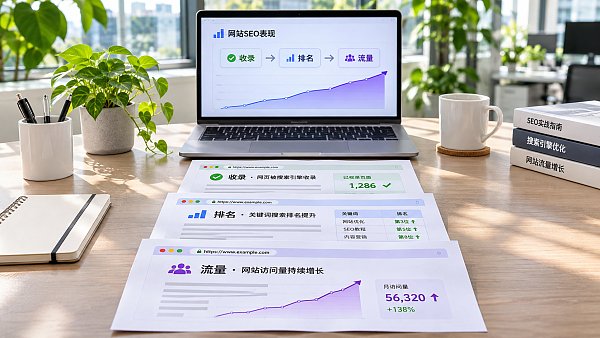
Search engine optimization is a systematic approach to getting a website indexed, earning rankings, and attracting traffic. This article helps beginners understand the three key steps—indexing, rankings, and traffic—and avoid the pitfalls of focusing only on quantity or rankings. Starting with a self-audit and key pages, you can quickly find out why your website is not gaining traction and help the right people find, trust, and stay with you when they need you. Click to learn more.
Inquire now : 4006552477
People who have just taken over a website often see a string of enticing numbers in the dashboard: ten articles published today, ten more pages added. But when they search, their website is still nowhere to be found, and the traffic curve is almost a straight line. That gap is real. It doesn’t mean you haven’t worked hard; you may simply be treating three different things as if they were one.
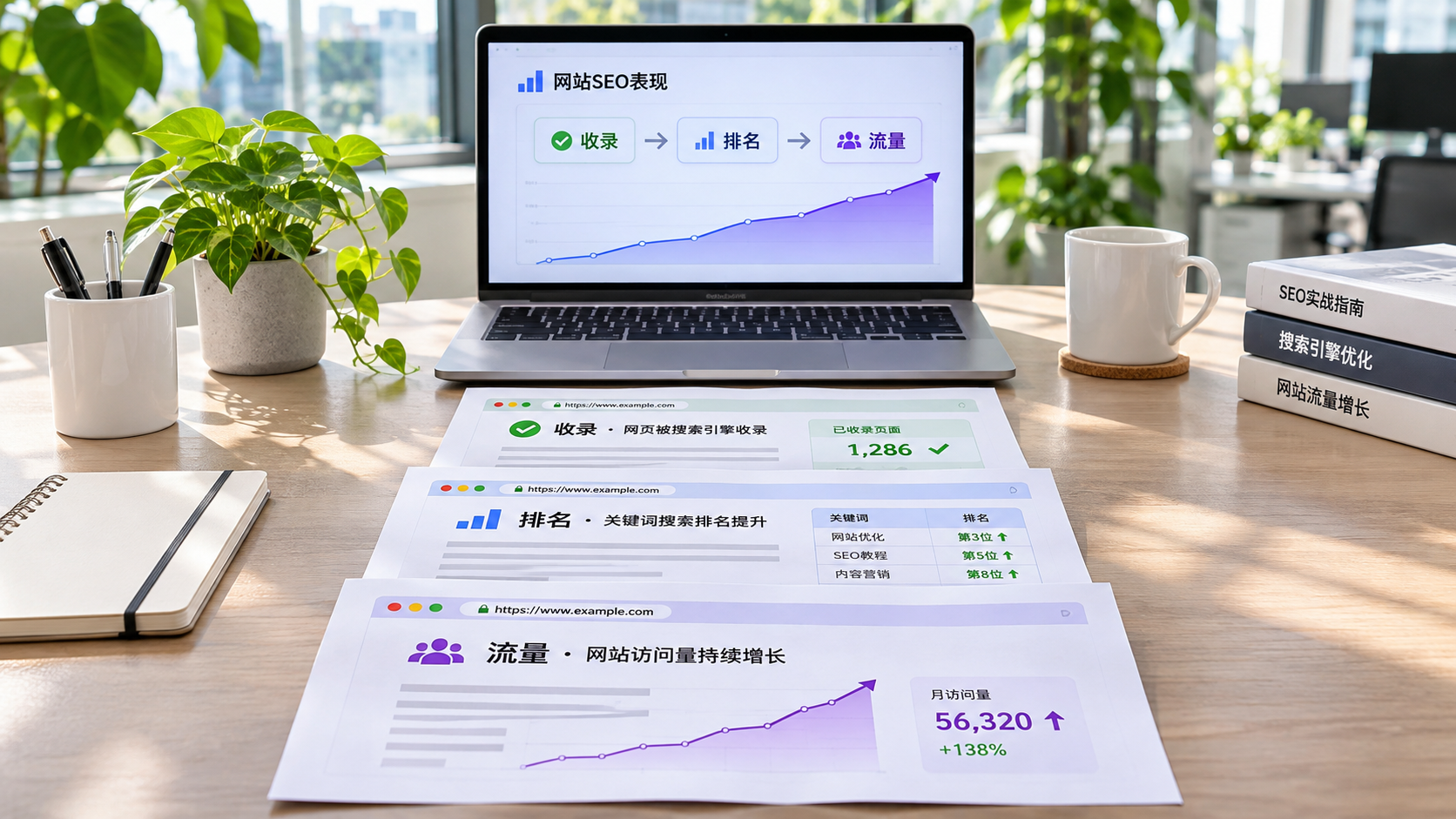
Search engine optimization is a systematic approach to getting a website indexed, earning rankings, and attracting traffic. It isn’t a switch you can flip or a contest to see who can publish the most articles. It’s a set of practices that helps search engines find you, understand you, and ultimately recommend you to users. The first thing beginners need is not a list of tactics, but an understanding of how indexing, rankings, and traffic relate to one another.
Indexing, rankings, and traffic: three separate hurdles
Indexing is the first hurdle. Search engine crawlers visit your website, retrieve its pages, and decide whether they’re worth adding to their databases. That process is indexing. Pages that aren’t indexed have virtually no chance of appearing in search results. Many people assume that publishing a page means it has been indexed, but crawling, evaluation, and inclusion in the index all happen in between. A messy site structure, deeply nested links, and too many duplicate pages can prevent crawlers from reaching your pages—or make them decide not to index them.
Rankings are the second hurdle. Being in the index doesn’t mean you’ll rank near the top. Search engines decide which pages to show first based on their relevance to the search query, content quality, and the overall credibility of the website, as well as user clicks and engagement. Different people may see different results even when they search for the same phrase, because intent, location, and device can all affect the results. Rankings are never fixed positions; they’re the result of repeated matching.
Traffic is the third hurdle, and the one most easily misunderstood. Ranking doesn’t guarantee clicks, and clicks don’t guarantee valuable visits. If a title isn’t compelling, users won’t click. If a page loads too slowly or doesn’t answer their question, they’ll leave as soon as they arrive. Traffic becomes truly valuable when people arrive from search with a clear question and your page answers it.
 Why can a website remain inactive despite publishing lots of articles?
This problem often stems from getting the sequence wrong. Many beginners write articles first, think about keywords afterward, and only then discover that their website hasn’t been properly indexed. More commonly, they publish lots of articles that all answer the same question or use phrases nobody searches for. Search engines can understand synonyms, but they place greater importance on whether a page directly addresses the user’s original question. No matter how carefully content is written, if it doesn’t match search intent, rankings and traffic are unlikely to improve.
In other cases, the pages themselves are fine, but the website is like a house with no signs. The homepage opens, but inner pages are buried deep; new articles have no internal links pointing to them, and older articles offer no paths to updated content. Crawlers arrive, look around, and leave. Users are no different: if they can’t find what to do next, they won’t stay long. Adding more articles won’t help here. First, organize the site structure and link important pages to one another; the results are often more noticeable.
Three common mistakes beginners make
Only looking at the number of indexed pages without checking which pages are indexed. Having a hundred low-quality pages indexed is less valuable than having ten pages indexed that genuinely solve users’ problems.
Focusing only on a page’s position for a particular keyword without checking whether anyone searches for it or whether those searchers are your target audience.
Treating SEO as a one-time renovation and expecting results once it’s done. In reality, SEO requires ongoing adjustments: revising titles, adding content, fixing technical issues, reviewing data, and making further changes.
For example, an in-depth article like “The Real-World Challenges and Countermeasures of Fintech in Promoting Business Innovation” [blocked] may be difficult for search engines to determine which search results it belongs in if it’s simply tucked away in a corner of the website without clear topic categorization or internal links. The value of the content itself matters just as much as how it’s found and understood.
Where should you start to get on the right track?
Beginners don’t need to pursue complicated tactics right away. Start with a simple check: Is your website indexed, and which pages are indexed? Can people find your key pages in search, and are you using the words your users actually use? How long do visitors stay, and do they continue reading? These three questions correspond to the checkpoints for indexing, rankings, and traffic.
Next, focus your efforts on a few truly important pages. Make their titles clear so readers can tell at a glance what each page is about. Give a direct answer at the beginning of the main text instead of taking three paragraphs to get to the point. Break up sections with subheadings to help users scan the content and search engines understand its structure. On the technical side, make sure pages load properly, display well on mobile devices, and don’t take too long to load. These fundamentals matter more than chasing new tactics.
There’s no need to publish as much content as possible. Rather than posting ten general articles in a week, write one core article in depth, then supplement it with related questions and case studies. Search engines have never favored quantity for its own sake; what matters is whether the pages work together to build a well-supported topic. As your website covers a topic more thoroughly, its rankings and traffic have a chance to improve and stabilize over time.
There’s another change beginners should keep an eye on: more and more users are asking questions directly in AI search and receiving a synthesized answer instead of a list of links. This raises the bar for content. Sentences need to be complete, facts need to be clear, and conclusions shouldn’t be buried in the middle of a paragraph. Content that can be quoted directly often performs more consistently in traditional search as well.
So, to return to the original question: what exactly is search engine optimization? It isn’t about getting a website to appear in search just once. It’s about helping the right people find you when they need you, trust you, and choose to stay. Indexing is the prerequisite for being seen, rankings are an opportunity to be chosen, and traffic is the result—not the goal in itself. Beginners have truly grasped the basics only when they understand how these three things relate to one another.
Related Articles
 Are the Multilingual TDKs Generated by Yiyingbao AI Website Builder Reliable?
 What Is Search Engine Optimization? Beginners Should First Understand the Relationship Between Indexing, Rankings, and Traffic
 How can you verify the accuracy of product copy generated by an AI website builder?

{item.title}
Related Products
 Yiyingbao SaaS Intelligent Website Building and Marketing SystemYiyingbao SaaS Intelligent Website Building and Marketing System, AI-powered no-code website building, rapid creation of multilingual B2B international websites in 10 minutes, global server acceleration, AI-powered SEO optimization, helping businesses connect efficiently with global markets. The perfect integration of technology and operation makes building an international trade website remarkably simple
 AI+SEM Intelligent Advertising Marketing SystemAI+SEM drives intelligent ad creation, empowering full-funnel precision advertising marketing. The system automatically generates weekly/monthly reports, AI recommends keywords and target countries, monitors core metrics in real-time with intelligent alerts, and enables one-click high-conversion ad solutions to help quickly acquire customers and improve ROI.
 AI+SEO Dual-Engine System Optimization ServicesYiyingbao’s AI+SEO dual-engine optimization system helps foreign trade enterprises acquire high-quality organic traffic through AI-powered keyword research, content generation, and comprehensive technical optimization, significantly improving search rankings and conversion rates.
 AI+SNS Social Media Marketing SystemYingbao AI+SNS Social Media Marketing System - Precision social capture for the social media era. Supports one-click content synchronization across major platforms like Facebook and LinkedIn. AI intelligently rewrites posts for enhanced relevance. 24/7 AI customer service and user profiling analysis empower businesses to efficiently expand into global markets.
 AI+SEO营销解决方案易营宝AI+SEO营销解决方案,通过AI批量写作、智能生成TDK、精准关键词扩词等功能,全面优化网站SEO效果,提升流量与转化率。助力企业构建高效智能网站新生态。
 AI+SEM Advertising Marketing SolutionsAI+SEM Advertising Marketing Solution leverages AI technology to deeply empower SEM ad campaigns. It automatically generates weekly/monthly reports using AI, presenting account data across multiple dimensions for comprehensive insights into campaign performance and trends. The system precisely recommends keywords and target countries, intelligently generates high-conversion ad copy, and enables one-click activation of efficient campaign plans to help businesses rapidly acquire customers. Simultaneously, it monitors core metrics in real time, intelligently identifies abnormal fluctuations, and issues timely alerts to ensure stable, high-return advertising results.
 Domain Name ServicesEasyWin provides professional domain name services, including intelligent queries, one-stop registration, brand protection, and full lifecycle management, helping businesses build a digital brand image.
 EasyOperate B2C Cross-Border E-Commerce Platform & Independent WebsiteEasyStore B2C Cross-border E-commerce Independent Store is an intelligent website building and cross-border e-commerce integrated solution independently developed by EasyStore Information Technology (Beijing) Co., Ltd. The system is specially designed for small and medium-sized as well as large export enterprises, integrating 'website building, operation, marketing, advertising, and conversion' into one, helping enterprises quickly establish cross-border e-commerce independent stores to achieve brand globalization and global sales growth.
The platform supports multiple languages, multiple currencies, and multi-channel marketing, with built-in AI intelligent translation and SEO optimization systems, suitable for mainstream markets such as Southeast Asia, Europe and America, Latin America, and the Middle East, assisting Chinese manufacturing enterprises in efficiently deploying international e-commerce strategies. SSL证书易营宝提供专业SSL安全证书服务,包括单域名和泛域名证书,确保网站数据传输加密、身份验证和完整性保护,助力企业建立安全可信的在线业务环境。









