









- Which customer acquisition channels will be affected by cross-border marketing trends in 2026?Sep 06, 2026View details
- Which homogenization risks should be considered in an analysis of the AI-powered website building industry?Aug 30, 2026View details
- How Will AI Marketing Trends 2026 Change Advertising Budget AllocationAug 28, 2026View details
- Is the EV SSL certificate market shrinking or upgrading? How should companies assess certificate procurement?Aug 11, 2026View details
- Why the old AMP SEO 2020 practices no longer work and what has changed in current optimization prioritiesAug 02, 2026View details
- How to Choose Topics for an Industry News Section to Attract More Organic Search TrafficJul 29, 2026View details
How to Establish High-Intent Customer Scoring? B2B Lead Grading Rules and Scoring Dimension Examples
How to establish a high-intent customer scoring system appears on the surface to be a sales management issue,but it is actually related to customer acquisition costs,project scheduling,and team collaboration。At a time when online leads are increasing and sources are becoming more fragmented,relying solely on experience-based judgment often wastes time on prospects that generate many inquiries but convert poorly。For B2B business,only by first building lead grading rules and scoring dimensions can teams identify customers who are truly close to a purchasing decision more quickly。
First clarify the scoring objective
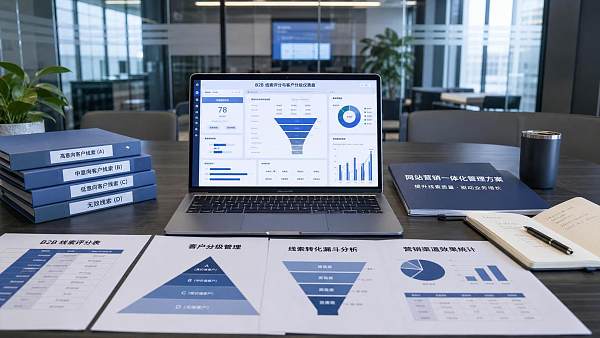
High-intent customer scoring is not simply about labeling leads,but about turning “who deserves priority follow-up” into an executable standard。Especially in businesses where website development,SEO optimization,advertising,and overseas social media are advanced together,leads may come simultaneously from organic search,landing page forms,advertising inquiries,social media direct messages,and content downloads。If the evaluation criteria are not unified,front-end customer acquisition and back-end conversion can easily become disconnected。
In general,a scoring model should answer at least three questions:whether the customer resembles the target customer,whether there is a clear current need,and whether the customer has the conditions to close in the near term。In other words,high-intent customer scoring considers both “fit” and “timing”。Neither can be missing。
Why this matter deserves more attention now
B2B customer acquisition has shifted from a single channel to the parallel use of websites,search,advertising,social media,and AI search。An increase in the number of leads does not necessarily mean an increase in valid opportunities。The real difficulty lies in the large differences in inquiry quality brought by different channels。
For example,some visitors enter a multilingual official website through industry keywords,stay for a long time,and proactively submit detailed requirements;others simply click into a page through a campaign ad and leave an incomplete email address。Both count as leads,but their priorities are clearly different。
In an integrated website + marketing service scenario,this difference becomes even more obvious。This is because website development,SEO,advertising,and social media operations are not isolated actions;together,they affect traffic quality。Whoever can turn front-end data into high-intent customer scoring will find it easier to convert marketing budgets into followable business opportunities。
For B2B lead grading,the core is not more,but more accurate
In actual business,grading should not be overly detailed。Too many levels will distort execution;too few levels will fail to guide actions。A relatively common practice is to divide leads into four tiers。
The value of this grading system is not in creating a table,but in unifying the pre-sales judgments of marketing,sales,and delivery。Once high-intent customer scoring can correspond to levels,the team knows who should be followed up immediately,who should continue to be nurtured,and who is not worth investing too much time in。
To establish high-intent customer scoring,look at at least these five dimensions
It is recommended to keep scoring dimensions between five and seven items,which can cover key facts while remaining easy to execute。The following five items are suitable for most B2B customer acquisition scenarios。
1. Customer profile fit
First check whether the industry,region,company size,and business model fall within the target scope。For example,foreign trade manufacturing,cross-border e-commerce,and brands going global are typical highly relevant customer groups;if the need deviates too far from core service capabilities,even a lively inquiry will be difficult to turn into a high-quality opportunity。
2. Clarity of demand
It is necessary to distinguish between “general inquiries” and “real needs”。Whether a multilingual official website,independent website development,SEO growth,or advertising plan is mentioned,and whether the target market,product line,and current website status are explained,will all affect high-intent customer scoring。
3. Behavioral activity signals
Customer behavior on the website is often more authentic than a simple statement of “interest”。Visit depth,time on site,repeated views of solution pages,material downloads,submission of multi-field forms,and demo bookings are all actions worth scoring。
4. Opportunity maturity
Maturity determines the follow-up rhythm。Whether there is a current project,whether a launch timeline already exists,whether the customer is in the supplier selection stage,and whether the project has already been approved internally will directly affect the closing window。
5. Decision-making and budget conditions
B2B deals are usually not decided by one individual alone。Whether the inquiry initiator is close to the decision-making chain,whether they control the budget,and whether they can promote internal evaluation will all affect the final conversion。If high-intent customer scoring ignores this item,it can easily misjudge “interested” as “about to close”。
A scoring example that can be referenced directly
To make the rules easier to implement,a 100-point system can be used first。The score does not need to pursue absolute scientific precision;the key is consistency before and after,and the ability to make continuous corrections。
For example,80 points or above can be regarded as high priority,60 to 79 points can enter focused nurturing,and below 60 points can be followed up at low frequency。This threshold is not fixed and should be reviewed and adjusted based on actual conversion results。
Website and marketing integration can make scoring more accurate
One reason high-intent customer scoring is often inaccurate is data fragmentation。Forms are in the website,visit records are in analytics tools,advertising data is in ad platforms,and sales notes are in another system,so in the end,judgment can only rely on feeling。
The value of integration lies in connecting website development,traffic acquisition,and lead identification。AI-driven intelligent website development and overseas marketing platforms like Yiyingbao,covering multilingual website development,SEO,advertising,social media traffic generation,and AI search optimization,are more suitable for accumulating complete lead trajectories。
When the website itself has a foundation that can be promoted,indexed,and converted,front-end traffic quality becomes more stable;when data from different channels can flow back in a unified way,high-intent customer scoring is no longer just subjective judgment,but a dynamic conclusion built on behavioral data and business rules。
Several common issues to avoid during implementation
- Only looking at form content and not visit behavior can easily overestimate surface-level enthusiasm。
- Judging leads from all channels by the same standard ignores differences in sources。
- Too many scoring dimensions make execution complex,and the team eventually returns to experience-based judgment。
- Rules are not adjusted for a long time after launch,making them unable to reflect market changes。
- Inconsistent criteria between marketing and sales cause high-intent customer scoring to lose credibility。
What deserves more attention is that scoring is not a substitute for communication,but helps the team focus communication on the right people。No matter how complete the rules are,they still need to be corrected in reverse using real closing results。
What to do next is more important than continuing the discussion
If you are preparing to establish high-intent customer scoring,do not rush to pursue a complex model。First sort out existing lead sources,then determine three to five of the most critical judgment items,and define clear scores and follow-up actions。After running for a period of time,review against real conversion rates;which dimensions are effective and which weights are too high will gradually become clear。
For businesses that rely on overseas independent websites,SEO,advertising,and social media working together to acquire customers,the earlier website data,marketing data,and lead management are connected,the more reference value high-intent customer scoring will have。Establish the rules first,then let data continuously calibrate them;this is often more effective than blindly pursuing more leads。
Related Articles


Related Products
 Yiyingbao SaaS Intelligent Website Building and Marketing SystemYiyingbao SaaS Intelligent Website Building and Marketing System, AI-powered no-code website building, rapid creation of multilingual B2B international websites in 10 minutes, global server acceleration, AI-powered SEO optimization, helping businesses connect efficiently with global markets. The perfect integration of technology and operation makes building an international trade website remarkably simple
 AI+SEM Intelligent Advertising Marketing SystemAI+SEM drives intelligent ad creation, empowering full-funnel precision advertising marketing. The system automatically generates weekly/monthly reports, AI recommends keywords and target countries, monitors core metrics in real-time with intelligent alerts, and enables one-click high-conversion ad solutions to help quickly acquire customers and improve ROI.
 AI+SEO Dual-Engine System Optimization ServicesYiyingbao’s AI+SEO dual-engine optimization system helps foreign trade enterprises acquire high-quality organic traffic through AI-powered keyword research, content generation, and comprehensive technical optimization, significantly improving search rankings and conversion rates.
 AI+SNS Social Media Marketing SystemYingbao AI+SNS Social Media Marketing System - Precision social capture for the social media era. Supports one-click content synchronization across major platforms like Facebook and LinkedIn. AI intelligently rewrites posts for enhanced relevance. 24/7 AI customer service and user profiling analysis empower businesses to efficiently expand into global markets.
 AI+SEO营销解决方案易营宝AI+SEO营销解决方案,通过AI批量写作、智能生成TDK、精准关键词扩词等功能,全面优化网站SEO效果,提升流量与转化率。助力企业构建高效智能网站新生态。
 AI+SEM Advertising Marketing SolutionsAI+SEM Advertising Marketing Solution leverages AI technology to deeply empower SEM ad campaigns. It automatically generates weekly/monthly reports using AI, presenting account data across multiple dimensions for comprehensive insights into campaign performance and trends. The system precisely recommends keywords and target countries, intelligently generates high-conversion ad copy, and enables one-click activation of efficient campaign plans to help businesses rapidly acquire customers. Simultaneously, it monitors core metrics in real time, intelligently identifies abnormal fluctuations, and issues timely alerts to ensure stable, high-return advertising results.
 Domain Name ServicesEasyWin provides professional domain name services, including intelligent queries, one-stop registration, brand protection, and full lifecycle management, helping businesses build a digital brand image.
 EasyOperate B2C Cross-Border E-Commerce Platform & Independent WebsiteEasyStore B2C Cross-border E-commerce Independent Store is an intelligent website building and cross-border e-commerce integrated solution independently developed by EasyStore Information Technology (Beijing) Co., Ltd. The system is specially designed for small and medium-sized as well as large export enterprises, integrating 'website building, operation, marketing, advertising, and conversion' into one, helping enterprises quickly establish cross-border e-commerce independent stores to achieve brand globalization and global sales growth.
The platform supports multiple languages, multiple currencies, and multi-channel marketing, with built-in AI intelligent translation and SEO optimization systems, suitable for mainstream markets such as Southeast Asia, Europe and America, Latin America, and the Middle East, assisting Chinese manufacturing enterprises in efficiently deploying international e-commerce strategies. SSL证书易营宝提供专业SSL安全证书服务,包括单域名和泛域名证书,确保网站数据传输加密、身份验证和完整性保护,助力企业建立安全可信的在线业务环境。









