- China’s Tariff Commission of the State Council Adjusts Additional Tariffs on U.S. Goods: 24% Tariff Suspended for Two MonthsNov 10, 2026View details
- APEC Shenzhen Spotlight: Cross-Border E-Commerce Orders Promote Asia-Pacific Trade and Economic CooperationNov 08, 2026View details
- China-Europe Railway Express and CIIE Hold Business Matchmaking Event, Focusing on Cross-Border E-commerce B2B ExportsNov 07, 2026View details
- China’s Ministry of Commerce Responds to Additional Charges on Low-Value Imports Imposed by the EUNov 06, 2026View details
- Two Internet Development Reports Released at the 2026 World Internet ConferenceNov 05, 2026View details
- Internet Business Revenue of Enterprises Above the Designated Size Reached RMB 1.716 Trillion in the First Three Quarters, with Profits Up 17.6%Nov 05, 2026View details
How Can Multi-Platform Social Media Distribution Unify Content and Improve Operational Efficiency?
The challenge of multi-platform social media distribution is not “posting the same content to more accounts,” but ensuring that content assets, channel rules, approval workflows, and performance data remain consistently traceable within a single system. If scheduling tools are used only for bulk publishing, they often merely reduce manual clicks; once LinkedIn, Facebook, Instagram, X, YouTube, TikTok, or regional social media platforms are involved, account permissions, asset specifications, link parameters, engagement handling, and data definitions may still remain fragmented.
Truly effective unified distribution should be regarded as a content operations hub issue: reusable content assets are managed upstream, rules are adapted for different channels in the middle, and data is collected downstream using unified identifiers and linked to websites, landing pages, or lead systems. What this establishes is not merely a “simultaneous publishing” capability, but a controllable, auditable, and optimizable distribution workflow.
Unified content does not mean copying and pasting across platforms
Each platform has a different content distribution mechanism. Text length, lead image ratio, video duration, subtitle display, hashtags, external link presentation, and engagement weighting all affect the final presentation. Publishing one long copy verbatim across every channel may ensure superficial brand consistency, but it can easily result in truncation, delayed key messages, invalid links, or non-compliant visual assets.
Content units suitable for cross-platform management should be divided into two layers: “core information” and “channel variants.” Core information typically includes the topic, target audience, proposition, supporting assets, call-to-action link, publishing time window, and compliance status; channel variants include the title, body length, cover crop, tags, @mentions, first-comment content, destination path, and engagement prompts. The former should maintain a single source of truth wherever possible, while the latter must be configurable independently according to platform rules.
This design avoids two common issues: first, operators repeatedly copy content to adapt it to channels, making versions impossible to confirm; second, a unified content library becomes overly rigid and forces all platforms to use the same expression. “Master content” and “published versions” in the system should establish a parent-child relationship, so that any modification on a channel can be traced back to the original asset without overwriting versions already published on other platforms.

The content asset layer determines whether subsequent automation is reliable
The foundation of multi-platform social media distribution is not account APIs, but a structured content library. Simply saving images, videos, and copy by folder makes it difficult to support bulk reuse and rule validation. A relatively complete asset model should at minimum retain asset identifiers, copyright or usage scope, language versions, applicable markets, dimensions and aspect ratios, expiration dates, related product pages, content topics, and review status.
For foreign trade websites and overseas marketing scenarios, assets and links should also carry market dimensions. English content is not inherently suitable for all English-speaking markets; nor is the same product page necessarily appropriate for visitors from North America, Europe, and the Middle East at the same time. If a distribution system stores only one generic link, it becomes difficult to distinguish traffic quality across different markets, languages, and channels later. A more reliable approach is to associate content records with localized URLs, UTM parameter templates, and landing page versions, then assemble them according to rules when publishing tasks are generated.
Media assets need pre-validation. Images should be checked for pixel dimensions, aspect ratio, file size, and format; videos should be checked for duration, bitrate, subtitle tracks, cover images, and whether they contain audio restricted by platforms. The value here is not in pursuing complex content recognition, but in moving publishing failures from “platform error responses” to the “task creation stage.” Pre-validation results should be saved as explicit statuses rather than displayed only as pop-up notifications; otherwise, failure causes cannot be counted and bulk tasks cannot be intercepted.
Channel adaptation requires a rules engine, not fixed templates
Platform rules change frequently, and the capabilities available to business pages, personal accounts, advertising accounts, or short-video accounts on the same platform are not identical. Therefore, the adaptation layer should not hard-code rules into the publishing page. A more reasonable approach is to maintain independent channel capability configurations, including publishable content types, field length limits, media restrictions, external link support, scheduled publishing capabilities, API frequency limits, draft statuses, and approval requirements.
When publishing tasks are generated, the system matches rules based on “channel-account-content type.” At a minimum, the rules engine must be able to determine whether an asset can be used directly, whether cropping or transcoding is required, whether alt text must be added, whether copy exceeds the limit, whether links are available, and whether the publishing time falls within the permitted account window. For fields that cannot be converted automatically, it should return actionable manual tasks rather than silently skipping them.
It is particularly important here to distinguish between “publishable via API” and “automatically publishable from a business perspective.” Some channel APIs support only certain account types or content formats; some functions can be invoked, but actions such as pinning comments, replying to direct messages, and collaborative publishing still need to be completed in the platform’s native interface. Technical evaluations should not only consider the number of supported platforms listed by a provider, but should also confirm, platform by platform, supported publishing types, readable data, failure retry mechanisms, and permission scopes.
Account and permission management is an easily underestimated boundary
Social media accounts are often jointly held by marketing teams, regional teams, agencies, or managers. If account passwords are stored across personal devices or shared documents, personnel changes can create significant control risks. A unified distribution system should use authorization tokens or platform-supported authorization mechanisms, and manage permissions by account, organization, role, and scope of operation.
The permission model should at least distinguish between content editing, approval, publishing, account authorization, data viewing, and system configuration. Publishing permissions should not inherently be equivalent to account management permissions; people who can view all data do not necessarily need access tokens. For high-impact accounts, it is advisable to record scheduled publishing, emergency withdrawals, and permission changes in operation logs, retaining the operator, time, content version, and returned result.
Approval should not simply mean “approve/reject.” For multilingual and multi-market distribution, the approval object should preferably be a specific publishing version containing the final copy, assets, links, channel, account, and publishing time. Otherwise, after master content is approved, it may still be modified on the channel side, and approval records cannot demonstrate whether the actually published content was confirmed.
The key to unified data is publishing identifiers, not report aggregation
Placing impressions, engagement, and follower counts from all platforms on one dashboard does not mean data has been unified. The calculation methods, reporting delays, and available granularity of platform metrics are not fully consistent, so direct horizontal comparison can easily mislead decisions. Unified analysis should first address the issue of attribution objects: every publication, each content version, every link, and every landing page visit needs a stable associated identifier.
In practice, a unique publishing ID can be generated for every publishing task and mapped to the post ID, asset ID, UTM parameters, and on-site events returned by the platform. Only then can more valuable questions be answered: what expression of a given topic was adopted on which channel; which sessions, forms, or inquiries a particular content version generated; and whether a repost creates duplicate attribution with the original post.
Platform-side data is suitable for measuring whether content has been seen and engaged with, while website analytics and CRM data are used to assess business actions after visits. The two types of data should not be forcibly merged into a single “conversion rate,” but should retain their source, collection time, and definition notes. When budget allocation or long-term investment is involved, unified cost and attribution definitions are more important than merely expanding report fields; related governance approaches can also refer to the discussion of budget preparation and process control in Strategies and Practices for Annual Investment Budget Preparation in State-Owned Enterprises.
When evaluating a system, focus on validating exception paths
The “one-click publishing” in demonstration environments usually covers normal processes, but actual stability depends more on exception handling. API rate limits, expired authorizations, interrupted asset uploads, missed scheduled tasks, platform review rejections, network timeouts, and duplicate submissions all require clear handling strategies. The system should distinguish between retryable and non-retryable errors: the former should use backoff retries with limited attempts, while the latter should be moved to a pending queue with specific reasons provided. Retries without idempotency controls may publish the same content repeatedly.
It is also necessary to verify whether task statuses genuinely reflect platform results. A successful send only means the request has been submitted by the system; it does not necessarily mean the content is publicly displayed on the platform. The status workflow should at least distinguish between draft, pending approval, pending publication, submitting, submitted, published, publishing failed, under platform review, and withdrawn. For platforms whose APIs cannot return final statuses, the system needs to clearly indicate data boundaries and must not substitute “successfully submitted” for “successfully published.”
Whether multi-platform social media distribution can improve operational efficiency depends on whether it reduces the costs of version confirmation, duplicate entry, asset rework, and result traceability. A content library, rules engine, permission auditing, and attribution identifiers are all indispensable. Without unified assets, automation creates more copies; without channel rules, bulk publishing amplifies errors; without status and data workflows, centralized management merely concentrates fragmented problems into one interface.
Related Articles
 How Can You Avoid Duplicate Content After Generating Articles in Bulk with AI?
 How Should You Allocate Your Budget for AI Advertising? The Boundaries Between Automation and Human Intervention
 How to Choose an AI Marketing Content Provider: Assess Content Quality and Copyright Risks



Related Products
 Yiyingbao SaaS Intelligent Website Building and Marketing SystemYiyingbao SaaS Intelligent Website Building and Marketing System, AI-powered no-code website building, rapid creation of multilingual B2B international websites in 10 minutes, global server acceleration, AI-powered SEO optimization, helping businesses connect efficiently with global markets. The perfect integration of technology and operation makes building an international trade website remarkably simple
 AI+SEM Intelligent Advertising Marketing SystemAI+SEM drives intelligent ad creation, empowering full-funnel precision advertising marketing. The system automatically generates weekly/monthly reports, AI recommends keywords and target countries, monitors core metrics in real-time with intelligent alerts, and enables one-click high-conversion ad solutions to help quickly acquire customers and improve ROI.
 AI+SEO Dual-Engine System Optimization ServicesYiyingbao’s AI+SEO dual-engine optimization system helps foreign trade enterprises acquire high-quality organic traffic through AI-powered keyword research, content generation, and comprehensive technical optimization, significantly improving search rankings and conversion rates.
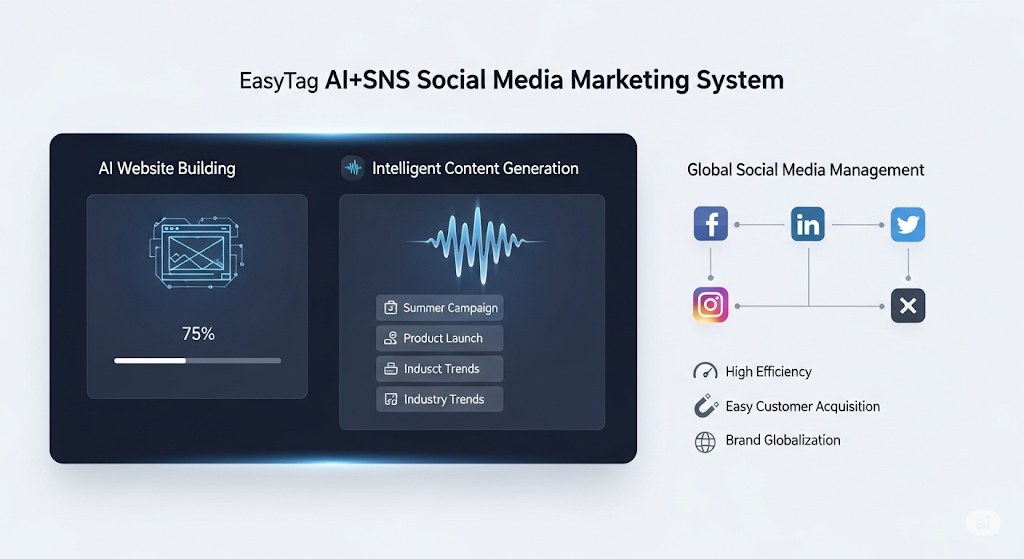
 AI+SNS Social Media Marketing SystemYingbao AI+SNS Social Media Marketing System - Precision social capture for the social media era. Supports one-click content synchronization across major platforms like Facebook and LinkedIn. AI intelligently rewrites posts for enhanced relevance. 24/7 AI customer service and user profiling analysis empower businesses to efficiently expand into global markets.
 AI+SEO营销解决方案易营宝AI+SEO营销解决方案,通过AI批量写作、智能生成TDK、精准关键词扩词等功能,全面优化网站SEO效果,提升流量与转化率。助力企业构建高效智能网站新生态。
 AI+SEM Advertising Marketing SolutionsAI+SEM Advertising Marketing Solution leverages AI technology to deeply empower SEM ad campaigns. It automatically generates weekly/monthly reports using AI, presenting account data across multiple dimensions for comprehensive insights into campaign performance and trends. The system precisely recommends keywords and target countries, intelligently generates high-conversion ad copy, and enables one-click activation of efficient campaign plans to help businesses rapidly acquire customers. Simultaneously, it monitors core metrics in real time, intelligently identifies abnormal fluctuations, and issues timely alerts to ensure stable, high-return advertising results.
 Domain Name ServicesEasyWin provides professional domain name services, including intelligent queries, one-stop registration, brand protection, and full lifecycle management, helping businesses build a digital brand image.
 EasyOperate B2C Cross-Border E-Commerce Platform & Independent WebsiteEasyStore B2C Cross-border E-commerce Independent Store is an intelligent website building and cross-border e-commerce integrated solution independently developed by EasyStore Information Technology (Beijing) Co., Ltd. The system is specially designed for small and medium-sized as well as large export enterprises, integrating 'website building, operation, marketing, advertising, and conversion' into one, helping enterprises quickly establish cross-border e-commerce independent stores to achieve brand globalization and global sales growth.
The platform supports multiple languages, multiple currencies, and multi-channel marketing, with built-in AI intelligent translation and SEO optimization systems, suitable for mainstream markets such as Southeast Asia, Europe and America, Latin America, and the Middle East, assisting Chinese manufacturing enterprises in efficiently deploying international e-commerce strategies. SSL证书易营宝提供专业SSL安全证书服务,包括单域名和泛域名证书,确保网站数据传输加密、身份验证和完整性保护,助力企业建立安全可信的在线业务环境。