









- Can the average annual growth rate reflect real opportunities in overseas markets?Oct 07, 2026View details
- Which customer acquisition channels will be affected by cross-border marketing trends in 2026?Sep 06, 2026View details
- Which homogenization risks should be considered in an analysis of the AI-powered website building industry?Aug 30, 2026View details
- How Will AI Marketing Trends 2026 Change Advertising Budget AllocationAug 28, 2026View details
- Is the EV SSL certificate market shrinking or upgrading? How should companies assess certificate procurement?Aug 11, 2026View details
- Why the old AMP SEO 2020 practices no longer work and what has changed in current optimization prioritiesAug 02, 2026View details
How AI Content Marketing Can Avoid Content Homogenization for Customer Acquisition
The homogenization of AI content marketing lead generation is often not because “not enough has been written,” but because the content uses the same templates for topic selection, evidence, expression, and the pages to which visitors are directed. Many articles appear to cover keywords, but merely repeat definitions, list features, or rewrite publicly available materials. Even when search traffic reaches the page, it is difficult to generate inquiries because readers cannot find criteria for making judgments relevant to their own business conditions.
To create differentiation, first break down the “content topic” into specific decision-making questions. For overseas website development and marketing, for example, “How do you do SEO?” is too broad. Questions such as “Should multilingual product pages be separated by country or by industry scenario?”, “Why do the form fields on an advertising landing page affect inquiry quality?”, and “How can products with numerous technical parameters avoid ambiguity after translation?” are content entry points that are closer to actual operations. AI is suitable for identifying these specific issues from search terms, on-site visitor paths, inquiry records, and page conversion performance, but it cannot skip human judgment and directly expand them in bulk.
First distinguish between “the same keyword” and “the same need”
The needs behind the same search term may not be the same. Among visitors searching for “industrial valve English website,” some are checking whether the product is compatible with the medium, pressure, and connection method; some are looking for sample or lead-time information; and others are simply comparing supplier pages. If all content is written as a company introduction plus a product overview, the pages will compete with one another and fail to address questions at different stages.
When developing topics, each topic can be tagged with at least four types of information: traffic source, target-market language, product or service scenario, and next action. Visitors from organic search often need more complete explanations of principles and parameters. Visitors from advertising need the page topic to match the advertising promise and need quick answers about price composition, delivery scope, compatibility conditions, and other issues. Visitors from social media content may first care about application visuals, usage results, or common faults. The same core keyword should not be handled with the same piece of content at every entry point.
Let AI handle summarization, while business facts determine the conclusions
AI can quickly organize competitor pages, extract frequently asked questions, identify complaints in reviews, and initially structure scattered product materials. However, the “industry consensus” it generates tends to converge: most pages mention quality, experience, customization, and rapid response. The text is fluent but lacks verifiable details.
Content differentiation should come from constraints that genuinely exist in the business. For example, product selection for a certain type of equipment should not only say “select according to specifications.” It should also explain whether the medium is corrosive, whether the installation space limits the direction of the interfaces, whether continuous operation creates heat-dissipation requirements, and whether voltage or plug configurations in different regions require separate confirmation. For service-oriented content, delivery boundaries should be clearly stated: who provides the page materials, whether translation involves direct translation or terminology review, which published links may be affected by a redesign, and how advertising materials and landing-page information will remain consistent.
This information does not need to be piled into a technical manual. Each piece of content should focus on one key decision-making chain: what the conditions are, what may happen if they are ignored, and what information should be added to the page or communication. After AI generates the initial draft, someone familiar with the product, delivery, or sales communication should verify the terminology, causal relationships, and boundaries of the commitments. In particular, parameters, lead times, compatibility, certifications, prices, and other content must not be published as facts based on wording completed by the model.
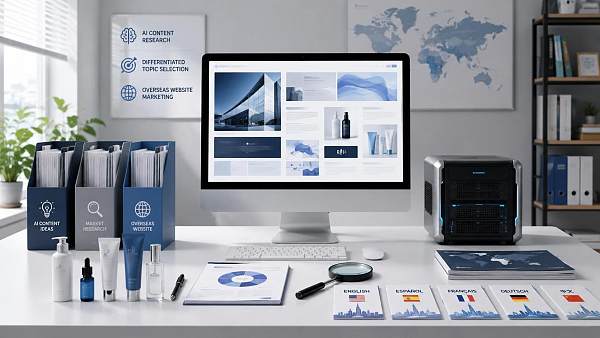
Write “points of difference” where readers can verify them
Abstract advantages are the easiest content to homogenize. Instead of writing “customization is supported” or “stable quality,” place the differences in specific page elements. A product page can explain adjustable dimensions, materials, surface treatments, and packaging methods, as well as which modifications will affect minimum order quantities, molds, testing, or transportation arrangements. Case-based content can present only the problem-solving process—for example, first identifying that the inquiry form lacked application-related fields and then directing visitors to corresponding pages according to their intended use—instead of vaguely describing the results.
Also avoid treating a specification table as differentiated content. Specifications themselves help with search indexing, but when the table does not explain the relationships between parameters, readers still have to repeatedly confirm them through communication. A more valuable approach is to add selection guidance near the specifications: which installation conditions a parameter suits, how two similar models differ, and when drawings, samples, or information about existing equipment should be submitted. This type of content can reduce ineffective inquiries and is more difficult to simply copy.
Multilingual content cannot be created through sentence-by-sentence substitution alone
Homogenization of multilingual pages often occurs during translation. When the source-language article is already relatively general, direct translation can easily lead to inconsistent terminology, units expressed in ways that do not match local conventions, and a disconnect between search behavior and the page title. More importantly, different markets may prioritize different aspects of the same product: some pages should explain applicable standards first, while others should prioritize transportation, after-sales service, or localized installation information.
You can first retain a consistent layer of facts, including models, materials, dimensional ranges, usage limitations, and delivery conditions; then adjust the order of questions, examples, and search terms for different language versions. Do not mechanically insert multiple country names into the same page simply to cover more keywords. If product conditions are genuinely different, separate pages should be created, with their respective materials, metadata, and internal links maintained separately, to prevent one page from promising mutually conflicting configurations.
Identify pages that “appear to have traffic but have no real differentiation” from content performance
Homogenization cannot be assessed solely by publication volume or rankings. When multiple pages receive impressions but have low click-through rates, a common reason is that their titles lack recognizable differences from other pages in the search results. Short dwell time and few further visits after clicking may indicate that the opening does not address the search question or that the content is merely a general introduction. If a page receives considerable traffic but generates low-quality forms, check whether it directs people with different needs toward the same action.
- Review content by topic clusters rather than by individual articles, and check whether similar pages are competing for the same group of search terms.
- Review recurring follow-up questions in inquiry records and add the answers to the corresponding pages instead of leaving them only in sales communications.
- Set factual sources for frequently updated product materials to prevent articles, product pages, and advertising landing pages from presenting different versions of parameters or delivery descriptions.
The value of AI content marketing lead generation lies in accelerating research, organization, and testing—not in producing similar articles more quickly. When content clearly answers a selection question in a specific scenario and is supported by verifiable business information, differentiation remains on the page rather than merely staying in the writing prompts.
Related Articles

Related Products
 Yiyingbao SaaS Intelligent Website Building and Marketing SystemYiyingbao SaaS Intelligent Website Building and Marketing System, AI-powered no-code website building, rapid creation of multilingual B2B international websites in 10 minutes, global server acceleration, AI-powered SEO optimization, helping businesses connect efficiently with global markets. The perfect integration of technology and operation makes building an international trade website remarkably simple
 AI+SEM Intelligent Advertising Marketing SystemAI+SEM drives intelligent ad creation, empowering full-funnel precision advertising marketing. The system automatically generates weekly/monthly reports, AI recommends keywords and target countries, monitors core metrics in real-time with intelligent alerts, and enables one-click high-conversion ad solutions to help quickly acquire customers and improve ROI.
 AI+SEO Dual-Engine System Optimization ServicesYiyingbao’s AI+SEO dual-engine optimization system helps foreign trade enterprises acquire high-quality organic traffic through AI-powered keyword research, content generation, and comprehensive technical optimization, significantly improving search rankings and conversion rates.
 AI+SNS Social Media Marketing SystemYingbao AI+SNS Social Media Marketing System - Precision social capture for the social media era. Supports one-click content synchronization across major platforms like Facebook and LinkedIn. AI intelligently rewrites posts for enhanced relevance. 24/7 AI customer service and user profiling analysis empower businesses to efficiently expand into global markets.
 AI+SEO营销解决方案易营宝AI+SEO营销解决方案,通过AI批量写作、智能生成TDK、精准关键词扩词等功能,全面优化网站SEO效果,提升流量与转化率。助力企业构建高效智能网站新生态。
 AI+SEM Advertising Marketing SolutionsAI+SEM Advertising Marketing Solution leverages AI technology to deeply empower SEM ad campaigns. It automatically generates weekly/monthly reports using AI, presenting account data across multiple dimensions for comprehensive insights into campaign performance and trends. The system precisely recommends keywords and target countries, intelligently generates high-conversion ad copy, and enables one-click activation of efficient campaign plans to help businesses rapidly acquire customers. Simultaneously, it monitors core metrics in real time, intelligently identifies abnormal fluctuations, and issues timely alerts to ensure stable, high-return advertising results.
 Domain Name ServicesEasyWin provides professional domain name services, including intelligent queries, one-stop registration, brand protection, and full lifecycle management, helping businesses build a digital brand image.
 EasyOperate B2C Cross-Border E-Commerce Platform & Independent WebsiteEasyStore B2C Cross-border E-commerce Independent Store is an intelligent website building and cross-border e-commerce integrated solution independently developed by EasyStore Information Technology (Beijing) Co., Ltd. The system is specially designed for small and medium-sized as well as large export enterprises, integrating 'website building, operation, marketing, advertising, and conversion' into one, helping enterprises quickly establish cross-border e-commerce independent stores to achieve brand globalization and global sales growth.
The platform supports multiple languages, multiple currencies, and multi-channel marketing, with built-in AI intelligent translation and SEO optimization systems, suitable for mainstream markets such as Southeast Asia, Europe and America, Latin America, and the Middle East, assisting Chinese manufacturing enterprises in efficiently deploying international e-commerce strategies. SSL证书易营宝提供专业SSL安全证书服务,包括单域名和泛域名证书,确保网站数据传输加密、身份验证和完整性保护,助力企业建立安全可信的在线业务环境。









