









- Which customer acquisition channels will be affected by cross-border marketing trends in 2026?Sep 06, 2026View details
- Which homogenization risks should be considered in an analysis of the AI-powered website building industry?Aug 30, 2026View details
- How Will AI Marketing Trends 2026 Change Advertising Budget AllocationAug 28, 2026View details
- Is the EV SSL certificate market shrinking or upgrading? How should companies assess certificate procurement?Aug 11, 2026View details
- Why the old AMP SEO 2020 practices no longer work and what has changed in current optimization prioritiesAug 02, 2026View details
- How to Choose Topics for an Industry News Section to Attract More Organic Search TrafficJul 29, 2026View details
How to Create AI-Assisted Content TDK? Title, Description, and Keyword Placement Best Practices
AI-assisted content generation TDK: what must be solved first is not writing, but search visibility
How to create AI-assisted content generation TDK? On the surface, it is about writing titles, descriptions, and keywords; in essence, it is about deciding how a page is understood by search engines and how it is clicked by real visitors. For website operations, TDK is not a checklist item filled in before a page goes live, but the first layer of expression that is seen in indexing, visibility, clicks, and conversions.
In a website + marketing services integrated scenario, content pages must serve both search and conversion. Especially when multilingual official websites, foreign trade independent sites, ad landing pages, and brand content pages operate in parallel, if TDK is written too broadly, even a well-built page may still lose its search entry advantage.
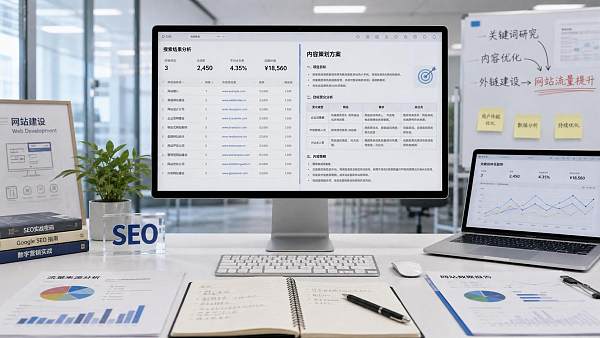
This is also why AI-assisted content generation TDK is drawing increasing attention. It is not just a productivity tool; it is more suitable for handling semantic classification, keyword decomposition, and version generation across a large number of pages, allowing operations to keep pace with website building, SEO, advertising, and content collaboration.
First, understand the role of TDK clearly
TDK usually refers to title, description, and keywords. Although the direct weight of keyword tags in mainstream search has already weakened, from the perspectives of content management, category archiving, on-site search, and AI generation rules, keyword layout still matters.
The title is responsible for telling search engines “what this page is mainly about,” and it also tells users “why it is worth clicking.” The description does not necessarily improve rankings directly, but it clearly affects click-through intent. Keywords are more like the outline of the page topic, determining whether the content expands around the core issue.
If AI is only allowed to directly generate a nice-sounding title, two problems often occur: one is over-generalization, and the other is keyword cannibalization between pages. Truly effective AI-assisted content generation TDK starts with defining the page type, target terms, and conversion action.
Why AI is needed for TDK even more today
In the past, a website might have only a few dozen core pages, which could still be maintained by manually writing each page. Now many companies simultaneously operate product pages, industry pages, solution pages, blog pages, campaign pages, and multilingual pages, so the number of TDK entries multiplies, and it is difficult for manual work to maintain consistency over the long term.
More importantly, the search environment is no longer focused only on traditional indexing. Pages must also account for Google SEO, ad landing page quality, social media landing consistency, and semantic readability in AI search scenarios. If the title is too short, the information is insufficient; if it is too full, the focus is easily lost.
For platforms like 易营宝 that cover intelligent website building, SEO optimization, ad placement, social media operations, and GEO optimization, the value lies in processing page generation, keyword strategy, and channel distribution under one logic. Only then will AI-assisted content generation TDK not drift away from real business goals.
Titles, descriptions, and keywords each have their own writing approach in practice
Capture the topic first, then add the scenario
For titles, it is recommended to prioritize the core topic word, then supplement with scenario words, result words, or limiting words. Taking “AI-assisted content generation TDK” as the core, you can expand around intentions such as “how to do it,” “practical execution,” “layout,” and “optimization,” rather than writing only broad concepts.
One practical benchmark is: after reading the title, can you understand within 5 seconds whether the page is about methods, cases, tools, or services? If the title itself does not clearly position the page, even a fluent AI-generated version will struggle to drive effective clicks.
The description should answer “why click”
The description is not about copying the first two sentences of the main text; it is about compressing the page value into a search summary. It is recommended to include the topic word, applicable scenario, and expected benefit, such as indexing, clicks, conversion, content consistency, or multi-page management efficiency.
If the page is for an independent site operation scenario, the description can naturally bring in connections to multilingual website building, SEO optimization, or ad landing pages, making it closer to the real needs of searchers instead of merely emphasizing vague terms like “high quality” or “all-around.”
Keyword layout should not only stare at the head term
Keyword layout is not simply repeating “AI-assisted content generation TDK.” A more effective approach is to separate and manage the main term, long-tail terms, question terms, scenario terms, and result terms, and then assign them to the title, description, opening paragraph, subheadings, and lists.
Use AI the right way: the core is prompt wording and page grouping
Many TDK results are unsatisfactory not because AI is incapable, but because the input conditions are too simple. If you only give one keyword and ask the system to output 10 titles, most of the results will be readable but unusable text. The truly practical method is to classify the page first, then add constraints.
- First distinguish the page type, such as product page, solution page, article page, or landing page.
- Then supplement the target market, language version, and core conversion action.
- Clarify the main keyword and two supporting keywords to avoid topic drift.
- Limit the title style so that it is informative rather than overly promotional.
- Require the description to include value points, but do not repeat the title wording.
In actual use, if a cloud website building system can synchronize category structure, page templates, keyword library, and SEO fields, the efficiency of AI-assisted content generation TDK will be significantly higher. Because the content is not generated in isolation, but continuously optimized within the semantic framework of the entire site.
Several common scenarios require different writing approaches
Even with AI-assisted content generation TDK, different page goals require different writing styles; one template cannot fit all. Especially in foreign trade and brand going-global scenarios, the responsibilities carried by pages vary greatly.
Product pages focus more on specific terms and conversion information, solution pages are better at highlighting industry scenarios, article pages need to balance knowledge discovery and continued indexing, and ad landing pages must emphasize landing-page consistency to avoid disconnects between the title and on-page content.
For multilingual official websites, you also need to pay attention to expression habits in different markets. Chinese often uses “how to do it” and “practical execution,” while English markets tend to favor logic such as “guide” and “best practices.” If the underlying website-building and marketing system supports multi-site, multi-language collaboration, TDK strategy can truly scale.
Avoid three common misunderstandings
First, some only pursue complete keywords in the title and do not consider the click experience. This easily leads to stiff semantics and too much repetition; search engines may understand it, but users are unwilling to click.
Second, some descriptions only summarize and do not show differences. Many page descriptions read smoothly, but they do not provide scenario, result, or method, so the result is visibility without click appeal.
Third, some treat keywords as isolated words and do not perform page layering. This causes multiple pages to compete around the same core term, disperses internal signals, and instead affects overall SEO performance.
If the website is also synchronizing Google Ads, social media operations, or AI search visibility optimization, these misunderstandings become even more obvious, because all channels are competing for the same batch of entry terms.
From now on, first establish a reusable TDK rule set
A more stable approach is not to let AI generate all fields in one batch at once, but to first establish rules and then expand step by step. You can first choose a category, define title length, description structure, keyword hierarchy, and long-tail keyword sources, then observe indexing, click-through rate, and dwell-time performance.
If you are already using a platform that integrates website building, SEO, advertising, and content collaboration, it is even more suitable to embed this rule set into page templates, keyword libraries, and generation workflows. In this way, when adding new product pages, article pages, or multilingual pages later, AI-assisted content generation TDK can produce stable output instead of starting from scratch every time.
The next worthwhile step is not to continue pursuing more title variants, but to first check whether existing pages have problems such as unclear topics, repetitive descriptions, keyword cannibalization, or misaligned page goals. Once these foundational issues are sorted out, and AI is used to amplify efficiency, TDK can truly become part of sustainable growth rather than a one-time filling task.
Related Articles


Related Products
 Yiyingbao SaaS Intelligent Website Building and Marketing SystemYiyingbao SaaS Intelligent Website Building and Marketing System, AI-powered no-code website building, rapid creation of multilingual B2B international websites in 10 minutes, global server acceleration, AI-powered SEO optimization, helping businesses connect efficiently with global markets. The perfect integration of technology and operation makes building an international trade website remarkably simple
 AI+SEM Intelligent Advertising Marketing SystemAI+SEM drives intelligent ad creation, empowering full-funnel precision advertising marketing. The system automatically generates weekly/monthly reports, AI recommends keywords and target countries, monitors core metrics in real-time with intelligent alerts, and enables one-click high-conversion ad solutions to help quickly acquire customers and improve ROI.
 AI+SEO Dual-Engine System Optimization ServicesYiyingbao’s AI+SEO dual-engine optimization system helps foreign trade enterprises acquire high-quality organic traffic through AI-powered keyword research, content generation, and comprehensive technical optimization, significantly improving search rankings and conversion rates.
 AI+SNS Social Media Marketing SystemYingbao AI+SNS Social Media Marketing System - Precision social capture for the social media era. Supports one-click content synchronization across major platforms like Facebook and LinkedIn. AI intelligently rewrites posts for enhanced relevance. 24/7 AI customer service and user profiling analysis empower businesses to efficiently expand into global markets.
 AI+SEO营销解决方案易营宝AI+SEO营销解决方案,通过AI批量写作、智能生成TDK、精准关键词扩词等功能,全面优化网站SEO效果,提升流量与转化率。助力企业构建高效智能网站新生态。
 AI+SEM Advertising Marketing SolutionsAI+SEM Advertising Marketing Solution leverages AI technology to deeply empower SEM ad campaigns. It automatically generates weekly/monthly reports using AI, presenting account data across multiple dimensions for comprehensive insights into campaign performance and trends. The system precisely recommends keywords and target countries, intelligently generates high-conversion ad copy, and enables one-click activation of efficient campaign plans to help businesses rapidly acquire customers. Simultaneously, it monitors core metrics in real time, intelligently identifies abnormal fluctuations, and issues timely alerts to ensure stable, high-return advertising results.
 Domain Name ServicesEasyWin provides professional domain name services, including intelligent queries, one-stop registration, brand protection, and full lifecycle management, helping businesses build a digital brand image.
 EasyOperate B2C Cross-Border E-Commerce Platform & Independent WebsiteEasyStore B2C Cross-border E-commerce Independent Store is an intelligent website building and cross-border e-commerce integrated solution independently developed by EasyStore Information Technology (Beijing) Co., Ltd. The system is specially designed for small and medium-sized as well as large export enterprises, integrating 'website building, operation, marketing, advertising, and conversion' into one, helping enterprises quickly establish cross-border e-commerce independent stores to achieve brand globalization and global sales growth.
The platform supports multiple languages, multiple currencies, and multi-channel marketing, with built-in AI intelligent translation and SEO optimization systems, suitable for mainstream markets such as Southeast Asia, Europe and America, Latin America, and the Middle East, assisting Chinese manufacturing enterprises in efficiently deploying international e-commerce strategies. SSL证书易营宝提供专业SSL安全证书服务,包括单域名和泛域名证书,确保网站数据传输加密、身份验证和完整性保护,助力企业建立安全可信的在线业务环境。









