









- Which customer acquisition channels will be affected by cross-border marketing trends in 2026?Sep 06, 2026View details
- Which homogenization risks should be considered in an analysis of the AI-powered website building industry?Aug 30, 2026View details
- How Will AI Marketing Trends 2026 Change Advertising Budget AllocationAug 28, 2026View details
- Is the EV SSL certificate market shrinking or upgrading? How should companies assess certificate procurement?Aug 11, 2026View details
- Why the old AMP SEO 2020 practices no longer work and what has changed in current optimization prioritiesAug 02, 2026View details
- How to Choose Topics for an Industry News Section to Attract More Organic Search TrafficJul 29, 2026View details
- Digital Marketing Shenzhen Market Insights: Why Are Companies Expanding Overseas Looking for Growth Teams in Shenzhen?Jul 31, 2026View details
- Can Zhejiang foreign trade independent websites still be developed today? Look at changes in traffic and lead generationJul 28, 2026View details
How much does responsive website development cost? How do functional requirements affect the overall quote?
How much does responsive website development cost, and why can quotes vary so much?
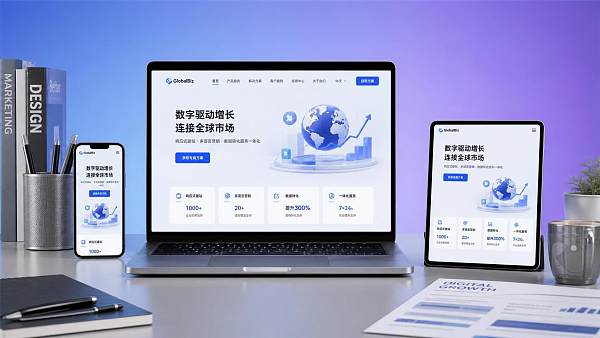
The quote for responsive website development may look like a page fee on the surface, but in reality it is more like a combined bill that includes a feature checklist and growth objectives. The number of pages certainly affects the cost, but what really creates the gap is usually the depth of interaction, system integration, content management, the SEO foundation structure, and whether subsequent promotion and operations need to be planned together.
Simply put, even though they are both corporate websites, some only need brand presentation, while others need to handle lead conversion, multilingual coverage, advertising support, and search indexing. The former is closer to standard website development, while the latter belongs to an integrated website and marketing services project, so the overall quote naturally will not stay at the same level.
In actual use, many companies understand “how much does responsive website development cost” as a one-time payment, but the more common way to judge it is to break it down: initial development cost, pre-launch content and technical work, and post-launch optimization and customer acquisition costs. This makes it easier to see the budget structure clearly and also facilitates later approval.
If a website must adapt to mobile phones, tablets, and desktops, while also taking into account overseas search, ad landing pages, and access speed across multiple regions, then the quote will definitely be affected jointly by the technical architecture and marketing capabilities, rather than being determined simply by “how many pages are made.”
Which parts does the budget actually go into? First look at this judgment table for a more intuitive view
Rather than arguing over a single total price, it is better to first see which modules make up the cost. The table below is suitable for judging whether a responsive website development quote is reasonable.
What needs attention is that low-price solutions often compress the following items. A website may appear to be able to go live, but if SEO structure, conversion tracking, or multilingual capabilities need to be added later, the extra cost will actually be higher.
Which functional requirements will significantly increase the responsive website development quote?
What truly affects how much responsive website development costs is not whether there is a website, but whether the website is responsible for business results. If it is only for company introduction and display, the development difficulty is limited; if the website also needs to generate leads, screen prospects, and support advertising, the cost will rise significantly.
- Multilingual and multi-region versions involve structural splitting, URL planning, and content management.
- Inquiry forms, online communication, and file uploads will increase front-end and back-end integration as well as security handling.
- SEO-friendly architecture, including title rules, page staticization, sitemaps, and structured data.
- Advertising landing pages and data tracking require event tracking points, conversion monitoring, and page A/B testing capabilities.
- Integration with CRM, ERP, or email systems will significantly increase implementation and testing workload.
Take a more intuitive scenario. If a company portal needs to showcase high-ticket products, the page is often not just about “graphic layout,” but must emphasize storytelling and conversion. For example, when displaying car-related products, it may include immersive visual storytelling, technical specification modules, option card layouts, real user reviews, and social interaction entry points. These functions will all affect the final quote for responsive website development.
Therefore, what is more worth asking during review is: do these functions directly serve the transaction path, or are they just visual bonus items? This judgment determines whether the budget is worth the investment.
What is the difference between just making a website and a “website + marketing” solution?
Many quote differences stem from different delivery boundaries. Just making a website usually delivers pages and a backend; while an integrated website and marketing solution delivers a digital asset that can be promoted, indexed, and converted.
From the perspective of Yibingbao’s informatization capabilities, this kind of service is not limited to page development, but puts intelligent website building, SEO optimization, ad placement, social media operations, and AI search visibility into the same growth chain. The value of doing this lies in planning indexing logic, conversion paths, and subsequent advertising interfaces together during the initial website build, rather than rebuilding them after launch.
A more common situation is that a company initially chose a low-threshold template site, and a few months later found that although the pages could open, they were not conducive to Google indexing, advertising landing pages lacked tracking, and in the end the site still had to be rebuilt. It seemed to save the budget, but in fact it increased trial-and-error costs and time loss.
If the business targets markets such as North America, Europe, Southeast Asia, or the Middle East, responsive website development also needs to consider access speed, language expansion, and differences in search behavior. At this point, the significance of an integrated solution is to reduce repetitive construction and allow the website to directly take on SEO and advertising work after launch.
How should you read a quote sheet to avoid low-price bids that keep adding items later?
The quote itself is not scary; vague quotes are what most easily hide risks. When reviewing a responsive website development quote, the focus is not the total amount, but whether the delivery description is clear.
It is recommended to prioritize checking these points
- Whether mobile adaptation is explicitly included, rather than only writing “responsive display.”
- Whether the number of pages, number of design drafts, and number of revision rounds are clearly stated.
- Whether basic SEO settings are included, rather than being charged separately later.
- Whether content input scope, image processing, and multilingual support methods are explained.
- Whether analytics code, conversion tracking, and form data flow are included.
- Whether the post-launch support period, security maintenance, and issue response are agreed upon.
If none of the above is written down, it is very easy for later items to become “functional add-ons,” “optimization add-ons,” and “integration add-ons.” This is also where many projects lose budget control.
When the budget is limited, which values should responsive website development protect first?
A limited budget does not mean you can only make a simple website; the key is to distinguish priorities. First keep the parts that affect lead generation and conversion, then consider the visual extensions that require higher investment.
Usually the most worthwhile items to keep are a clear information architecture, stable responsive adaptation, a basic SEO framework, a form conversion path, and a backend that can be expanded later. Because these capabilities determine whether the website can keep being used in the future, not whether it looks good on the day it goes live.
Visual expressions such as red or black main visuals, large minimalist banners, and asymmetrical dynamic layouts are suitable only when the brand direction is clear. If the project is for a company portal upgrade, you can also partially draw on the high-impact presentation styles commonly seen in the car industry, but the premise must still be service business goals, not purely pursuing a flashy effect.
If you still want to connect SEO, advertising, and social media operations later, then choosing a platform from the start that has cloud intelligent website building, data tracking, and content expansion capabilities will be more cost-effective than making repeated local repairs.
So in the end, how should you make a judgment so that it is not just a price comparison?
Returning to the core question, how much responsive website development costs has no standard answer detached from requirements. What is truly worth comparing is what result can be obtained under the same budget: just a website that can be visited, or a website that can support search, advertising, content, and conversion.
A more stable approach is to first clarify the business objectives: whether multilingual support is needed, whether overseas promotion is required, whether lead forms must be integrated, whether long-term SEO is needed, and whether advertising should be connected. The clearer the requirements, the more transparent the quote, and the fewer changes there will be later.
If you have already entered the comparison stage, it is recommended to unify the requirement list so that different service providers quote within the same scope, and then compare their technical capabilities, delivery boundaries, and follow-up service separately. This way, the quote for responsive website development will be closer to the real cost, and it will be easier to judge whether long-term input-output is reasonable.
When the website carries not only display, but also a growth entrance, budget decisions should not only look at the low price, but at whether it can support one to three years of content operations, search exposure, and customer conversion.
Related Articles



Related Products
 Yiyingbao SaaS Intelligent Website Building and Marketing SystemYiyingbao SaaS Intelligent Website Building and Marketing System, AI-powered no-code website building, rapid creation of multilingual B2B international websites in 10 minutes, global server acceleration, AI-powered SEO optimization, helping businesses connect efficiently with global markets. The perfect integration of technology and operation makes building an international trade website remarkably simple
 AI+SEM Intelligent Advertising Marketing SystemAI+SEM drives intelligent ad creation, empowering full-funnel precision advertising marketing. The system automatically generates weekly/monthly reports, AI recommends keywords and target countries, monitors core metrics in real-time with intelligent alerts, and enables one-click high-conversion ad solutions to help quickly acquire customers and improve ROI.
 AI+SEO Dual-Engine System Optimization ServicesYiyingbao’s AI+SEO dual-engine optimization system helps foreign trade enterprises acquire high-quality organic traffic through AI-powered keyword research, content generation, and comprehensive technical optimization, significantly improving search rankings and conversion rates.
 AI+SNS Social Media Marketing SystemYingbao AI+SNS Social Media Marketing System - Precision social capture for the social media era. Supports one-click content synchronization across major platforms like Facebook and LinkedIn. AI intelligently rewrites posts for enhanced relevance. 24/7 AI customer service and user profiling analysis empower businesses to efficiently expand into global markets.
 AI+SEO营销解决方案易营宝AI+SEO营销解决方案,通过AI批量写作、智能生成TDK、精准关键词扩词等功能,全面优化网站SEO效果,提升流量与转化率。助力企业构建高效智能网站新生态。
 AI+SEM Advertising Marketing SolutionsAI+SEM Advertising Marketing Solution leverages AI technology to deeply empower SEM ad campaigns. It automatically generates weekly/monthly reports using AI, presenting account data across multiple dimensions for comprehensive insights into campaign performance and trends. The system precisely recommends keywords and target countries, intelligently generates high-conversion ad copy, and enables one-click activation of efficient campaign plans to help businesses rapidly acquire customers. Simultaneously, it monitors core metrics in real time, intelligently identifies abnormal fluctuations, and issues timely alerts to ensure stable, high-return advertising results.
 Domain Name ServicesEasyWin provides professional domain name services, including intelligent queries, one-stop registration, brand protection, and full lifecycle management, helping businesses build a digital brand image.
 EasyOperate B2C Cross-Border E-Commerce Platform & Independent WebsiteEasyStore B2C Cross-border E-commerce Independent Store is an intelligent website building and cross-border e-commerce integrated solution independently developed by EasyStore Information Technology (Beijing) Co., Ltd. The system is specially designed for small and medium-sized as well as large export enterprises, integrating 'website building, operation, marketing, advertising, and conversion' into one, helping enterprises quickly establish cross-border e-commerce independent stores to achieve brand globalization and global sales growth.
The platform supports multiple languages, multiple currencies, and multi-channel marketing, with built-in AI intelligent translation and SEO optimization systems, suitable for mainstream markets such as Southeast Asia, Europe and America, Latin America, and the Middle East, assisting Chinese manufacturing enterprises in efficiently deploying international e-commerce strategies. SSL证书易营宝提供专业SSL安全证书服务,包括单域名和泛域名证书,确保网站数据传输加密、身份验证和完整性保护,助力企业建立安全可信的在线业务环境。









