









- Which customer acquisition channels will be affected by cross-border marketing trends in 2026?Sep 06, 2026View details
- Which homogenization risks should be considered in an analysis of the AI-powered website building industry?Aug 30, 2026View details
- How Will AI Marketing Trends 2026 Change Advertising Budget AllocationAug 28, 2026View details
- Is the EV SSL certificate market shrinking or upgrading? How should companies assess certificate procurement?Aug 11, 2026View details
- Why the old AMP SEO 2020 practices no longer work and what has changed in current optimization prioritiesAug 02, 2026View details
- How to Choose Topics for an Industry News Section to Attract More Organic Search TrafficJul 29, 2026View details
- Digital Marketing Shenzhen Market Insights: Why Are Companies Expanding Overseas Looking for Growth Teams in Shenzhen?Jul 31, 2026View details
- Can Zhejiang foreign trade independent websites still be developed today? Look at changes in traffic and lead generationJul 28, 2026View details
How can website operation services be optimized for conversions? First, identify the key pages where traffic is wasted
Why Should Conversion Optimization for Website Operations Start with Key Pages
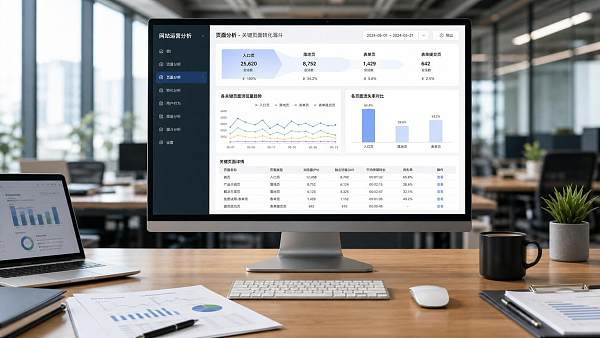
When it comes to conversion optimization in website operations, many people first think of buying more ads or rewriting more copy, but the result data does not improve significantly. The real common problem is not insufficient traffic, but that the traffic already entering the site is consumed by wrong pages, vague paths, and a sluggish experience.
Simply put, conversion optimization is not just about staring at buttons; it is about identifying which pages cannot retain traffic. Can the entry pages carry search intent? Can the content pages build trust? Can the landing pages drive inquiries? These are the core issues that website operations services need to address first.
In an integrated website + marketing services scenario, this step is especially critical. Because the access intent brought by search, ads, social media, and AI search is not the same, if the page structure still uses a one-size-fits-all approach, conversion bottlenecks often become concentrated. First identify the waste points, then optimize them; this is usually more effective than blind traffic expansion.
Which Pages Are Most Likely to Waste Traffic? Understanding This Makes Conversion Optimization Much Easier
More often than not, traffic waste is not evenly distributed, but concentrated on a small number of key pages. When doing conversion optimization for website operations services, prioritizing these pages usually shows improvement faster.
- Entry pages: the first page entered through organic search or an ad click, which determines whether the visitor continues browsing.
- High-bounce pages: pages with high visits but short dwell time and quick exits, indicating failed content handoff.
- Core service pages: pages that introduce solutions, capabilities, and case studies, directly affecting inquiry intent.
- Landing pages: pages that receive paid and campaign traffic, and are most prone to information overload or unclear action paths.
- Form pages and contact pages: the final barrier, often caused by too many fields or insufficient trust.
If it is a multilingual site, foreign trade site, or brand overseas expansion site, it is also necessary to additionally check the content matching degree of pages for different regions. Because the decision information corresponding to the same keyword is not exactly the same in North America, Europe, and Southeast Asia, if the page cannot match the right context, traffic will naturally be lost.
Look at the Data First to Know Which Pages Are Worth Optimizing First
Do not look only at the overall conversion rate. Website operations services need to look more at page-level signals, because the real problems are often hidden in process data. When making judgments, you can place “traffic volume” and “traffic loss level” together for analysis.
The meaning of this judgment table is to help website operations services quickly identify the “highest-priority pages,” rather than allocating effort evenly. Usually, as long as you capture the top 20% of key pages, you can explain most conversion fluctuations.
A Page Has Traffic but No Conversions: Where Is the Problem Usually
Many websites are not lacking visitors; they are lacking clarity about the next step after visitors arrive. When conversion optimization is done at the page level, it usually needs to handle four types of real problems, rather than simply changing a button color.
Search Intent and Page Content Are Not Aligned
Visitors enter the page through “website operations services conversion optimization” and expect to see diagnostic methods, page problems, and optimization paths. If the homepage first piles up company introductions or a long section of generic advantages, bounce rates will naturally rise.
Too Much Information, but a Weak Decision Path
Some page content is not sparse; cases, services, and functions are all written out, but it does not tell visitors “what should you judge now.” Such pages may look complete, but in reality they lack clear comparison points, risk reminders, and next-step actions.
Insufficient Trust Building, Especially in High-Inquiry Scenarios
Services such as website development, SEO optimization, and ad placement usually require stronger trust support before conversion. Without case types, delivery boundaries, regional experience, and technical capability explanations, inquiry intent will decline.
Platforms like 易营宝, which focus on long-term global market services, are more likely to form a conversion loop because the key is not only having more channels, but being able to connect website building, SEO, advertising, social media, and GEO optimization, reducing the information disconnect between pages.
Technical Experience Slows Down Decision-Making
Slow loading, broken mobile layouts, and unstable form submissions all make conversion optimization lose its foundation. Especially for overseas independent sites and multilingual sites, page performance directly affects search performance and inquiry completion rates, so the problem cannot be attributed only to copy.
For Website Operations Services, Should Conversion Optimization Start with Content or with Paths
In actual execution, this is not an either-or choice, but a matter of sequence. A more stable approach is to first improve paths, then revise content, and finally strengthen trust information. Because when the path is unclear, even the best content is hard to play its role.
The process can be promoted in the following order:
- First sort out the jump path from entry pages to target pages and remove invalid traffic diversion.
- Then unify page first-screen expression so users can quickly judge whether it matches their needs.
- Supplement cases, delivery processes, and FAQs to reduce pre-inquiry concerns.
- Finally optimize the last-step friction in forms, buttons, contact methods, and so on.
If the site simultaneously receives SEO, ads, and social media traffic, it is best to look at each channel separately. Access intent varies greatly by source, and a unified page often sacrifices conversion efficiency. Only when website operations services reach this stage do they truly enter refined optimization.
How to Judge Whether a Solution Provider Can Truly Deliver Conversion Optimization
This is a very practical question. Some teams are good at page beautification, and some are good at ad data, but they may not necessarily be able to turn website operations services and conversion optimization into an executable mechanism. When judging, focus on whether the following capabilities are in place.
- Can they break down problems by page and channel instead of only giving overall suggestions?
- Do they understand the different conversion paths brought by website building, SEO, advertising, and social media at the same time?
- Is there a continuous testing and review mechanism, rather than a one-time redesign?
- Can they support unified data observation across multiple languages, multiple regions, and multiple devices?
From this perspective, the value of an integrated solution becomes clearer. For long-term services in foreign trade, cross-border e-commerce, and brand overseas expansion, 易营宝’s cloud intelligent website building, AI ad marketing, and AI+SEO/GEO optimization systems are essentially shortening the coordination distance between traffic acquisition and conversion, so optimization no longer stays at single-point modifications.
What Are the Most Common Mistakes in Conversion Optimization, and How Should the Cycle Be Estimated
Many websites do not see improvements for a long time, not because the method does not exist, but because the execution judgment has deviated. The following mistakes are very common in website operations services.
- Only focusing on inquiry volume and not inquiry quality, resulting in high superficial conversion but low actual deals.
- Frequently making major page changes without preserving a testing cycle, making it impossible to identify the cause later.
- Treating bounce rate as a bad metric in isolation, without combining page tasks and traffic source analysis.
- Ignoring mobile devices and overseas access speed, causing high-quality traffic to be cut off by experience issues.
As for the cycle, it can usually be viewed in three stages. The first 1 to 2 weeks are suitable for page diagnosis and data sorting; the next 2 to 4 weeks are used to complete key page adjustments; after that, observe conversion changes for about 4 more weeks. If it involves a multilingual site, cross-regional placement, or the joint adjustment of SEO content structure, the cycle will be longer.
Therefore, when website operations services do conversion optimization, there is no need to rush to complete everything at once. A more effective approach is to first confirm the key pages, major bottlenecks, and measurable indicators, and then advance step by step. This not only clarifies input-output, but also makes it easier to form a long-term growth mechanism.
What Should Be Done Next to Make Conversion Optimization Truly Produce Results
If you have already realized that traffic is being wasted, the next step should not be to continue making changes based on intuition. First list the pages with the highest visits, the most obvious bounce, and the closest to inquiry, conduct a page-level diagnosis, and then decide the optimization order for content, paths, and forms.
For website + marketing service integration projects, it is best to inspect whether the website structure, search entry, landing pages, and social media traffic pages are coordinated with each other. Only by placing channels and pages within the same judgment framework can website operations services’ conversion optimization avoid remaining at local fixes.
A more practical approach is to first establish a key-page checklist, clearly defining each page’s goal, entry source, traffic-loss point, and expected action. After sorting out this basic information, compare solution capabilities, implementation cycles, and data tracking methods; only then will subsequent optimization be more stable and more likely to continuously amplify inquiry volume and deal efficiency.
Related Articles


Related Products
 Yiyingbao SaaS Intelligent Website Building and Marketing SystemYiyingbao SaaS Intelligent Website Building and Marketing System, AI-powered no-code website building, rapid creation of multilingual B2B international websites in 10 minutes, global server acceleration, AI-powered SEO optimization, helping businesses connect efficiently with global markets. The perfect integration of technology and operation makes building an international trade website remarkably simple
 AI+SEM Intelligent Advertising Marketing SystemAI+SEM drives intelligent ad creation, empowering full-funnel precision advertising marketing. The system automatically generates weekly/monthly reports, AI recommends keywords and target countries, monitors core metrics in real-time with intelligent alerts, and enables one-click high-conversion ad solutions to help quickly acquire customers and improve ROI.
 AI+SEO Dual-Engine System Optimization ServicesYiyingbao’s AI+SEO dual-engine optimization system helps foreign trade enterprises acquire high-quality organic traffic through AI-powered keyword research, content generation, and comprehensive technical optimization, significantly improving search rankings and conversion rates.
 AI+SNS Social Media Marketing SystemYingbao AI+SNS Social Media Marketing System - Precision social capture for the social media era. Supports one-click content synchronization across major platforms like Facebook and LinkedIn. AI intelligently rewrites posts for enhanced relevance. 24/7 AI customer service and user profiling analysis empower businesses to efficiently expand into global markets.
 AI+SEO营销解决方案易营宝AI+SEO营销解决方案,通过AI批量写作、智能生成TDK、精准关键词扩词等功能,全面优化网站SEO效果,提升流量与转化率。助力企业构建高效智能网站新生态。
 AI+SEM Advertising Marketing SolutionsAI+SEM Advertising Marketing Solution leverages AI technology to deeply empower SEM ad campaigns. It automatically generates weekly/monthly reports using AI, presenting account data across multiple dimensions for comprehensive insights into campaign performance and trends. The system precisely recommends keywords and target countries, intelligently generates high-conversion ad copy, and enables one-click activation of efficient campaign plans to help businesses rapidly acquire customers. Simultaneously, it monitors core metrics in real time, intelligently identifies abnormal fluctuations, and issues timely alerts to ensure stable, high-return advertising results.
 Domain Name ServicesEasyWin provides professional domain name services, including intelligent queries, one-stop registration, brand protection, and full lifecycle management, helping businesses build a digital brand image.
 EasyOperate B2C Cross-Border E-Commerce Platform & Independent WebsiteEasyStore B2C Cross-border E-commerce Independent Store is an intelligent website building and cross-border e-commerce integrated solution independently developed by EasyStore Information Technology (Beijing) Co., Ltd. The system is specially designed for small and medium-sized as well as large export enterprises, integrating 'website building, operation, marketing, advertising, and conversion' into one, helping enterprises quickly establish cross-border e-commerce independent stores to achieve brand globalization and global sales growth.
The platform supports multiple languages, multiple currencies, and multi-channel marketing, with built-in AI intelligent translation and SEO optimization systems, suitable for mainstream markets such as Southeast Asia, Europe and America, Latin America, and the Middle East, assisting Chinese manufacturing enterprises in efficiently deploying international e-commerce strategies. SSL证书易营宝提供专业SSL安全证书服务,包括单域名和泛域名证书,确保网站数据传输加密、身份验证和完整性保护,助力企业建立安全可信的在线业务环境。









