









- The U.S. has ended the $800 de minimis exemption for non-postal shipments; express courier packages must be formally declared.Nov 16, 2026View details
- ASEAN Signs Digital Economy Framework Agreement, Moving Toward Harmonized Cross-Border E-Commerce RulesNov 15, 2026View details
- Shenzhen Becomes the First City in Mainland China to Exceed RMB 5 Trillion in Foreign TradeNov 15, 2026View details
- Fujian Announces the First Batch of Provincial-Level Cross-Border E-Commerce Industrial Parks and Key Brands for CultivationNov 14, 2026View details
- Amazon Global Store Announces the Launch of the 2026 Black Friday Global Shopping SeasonNov 14, 2026View details
- CCTV.com Examines APEC’s Role in China’s Foreign TradeNov 12, 2026View details
How Should the Number of Design Revisions Be Specified in a Website Development Quote?
For website development quotes, it is advisable to agree on the number of design revisions together with the design stages, applicable pages, scope of feedback in each round, and how requests beyond the agreed scope will be handled. Simply stating “three free revisions” makes it difficult for the buyer to judge how much can be addressed in those three rounds or to control additional costs. For projects involving many pages, multiple languages, or marketing landing pages, confirming the homepage direction first and then the interior-page templates is easier to manage than counting all pages together.
When reviewing a website development quote (angebot website erstellung), you can use “two rounds of consolidated revisions after the first homepage draft” as a starting point for negotiation, but the number of rounds should be determined based on design complexity and internal approval processes. If brand managers, the sales department, and overseas teams all need to review the work, consolidate their feedback internally first; adding more revision rounds may not prevent repeated changes otherwise.
Define what counts as “one revision round” before agreeing on the number of rounds
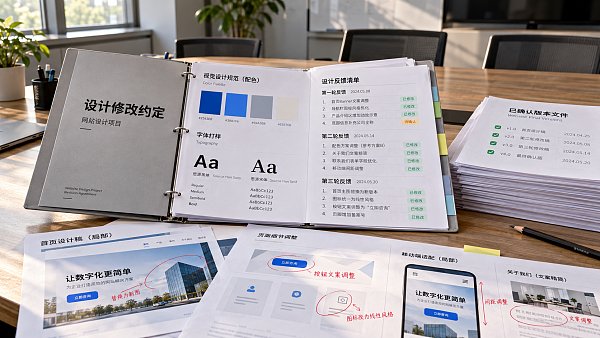
A revision round can be defined as follows: the supplier submits a complete version, the buyer consolidates its comments within the agreed timeframe, and the supplier makes the requested changes and resubmits the work. Multiple adjustments on the buyer’s single feedback list count as one round as long as they are within the agreed scope. This avoids counting every image or button change as a separate revision.
The feedback deadline should also be clearly defined. For example, the parties can agree that the designated representative will submit a consolidated written list within three business days of receiving the design draft. Comments provided before the supplier begins revisions can be included in that round. New requests submitted after revisions have started should first be assessed for their impact on completed work, and then either included in the next round or quoted separately. The deadline is a matter for negotiation, and should allow sufficient time for the actual internal review process.
It is also important to distinguish between “revisions” and “corrections.” If the design draft omits a section listed in the requirements, uses the wrong brand logo, or deviates from the approved design, the supplier should correct it without using up the buyer’s revision allowance. Otherwise, issues with the supplier’s own deliverables could consume the free revision allowance.
Do not use one vague allowance for the homepage, interior-page templates, and development and launch
The homepage establishes the overall visual direction, while product detail pages, case study pages, contact pages, and other pages serve different informational and conversion purposes. The quote should list the page templates that require individual design and the content pages that use shared templates. If 20 product pages use the same layout, specify how template changes will be applied across those pages to avoid counting revisions repeatedly by page.
Revision scope can be allocated across the following stages:
- Visual direction stage: Confirm the color scheme, fonts, above-the-fold layout, and overall page structure, and specify how many initial concepts are included. Whether additional options are chargeable should be addressed separately from the number of revision rounds.
- Homepage and interior-page template stage: Agree on the number of revision rounds for each and define the scope of changes such as image replacements, spacing, buttons, and module order.
- Development and acceptance stage: Address deviations based on the approved design and functional requirements. New page structures or interaction requirements should be assessed through the change-control process.
For websites designed to generate leads from overseas markets, also check inquiry forms, calls to action, product specifications, and mobile display before approving the design. For multilingual projects, specify whether line wrapping for long text, menu width, and layout adjustments for different languages are included in the deliverables. If the quote includes multilingual pages, the basic adaptation requirements should be clearly defined for acceptance.
Technical deliverables should also be listed separately. For example, if the quote includes an SSL certificate, specify the domain coverage, who is responsible for deployment and renewal, and whether HTTP-to-HTTPS redirection configuration is included. These are technical delivery items and should not be counted as design revisions; omissions in deployment should not be treated as a design adjustment.
Exceeding the revision allowance does not automatically mean extra charges—first determine whether the confirmed scope has changed
Once the revision allowance has been used, the reason for each change still needs to be considered. Changing an approved blue button to green is clearly different in workload and scope from adding a new dealer recruitment page. If the buyer reverses an already approved visual direction and requests a redesign, the supplier should also be allowed to reassess the cost and timeline.
The quote attachment should therefore define identifiable boundaries: replacing images or adjusting font sizes and local spacing within the approved structure counts as a detail revision; adding page templates, restructuring information hierarchy, or introducing new functionality falls under the change-control process. “Minor changes are free; major changes are chargeable” lacks clear criteria and can leave disputes unresolved until delivery.
Additional work can be priced by revision round, page template, or labor hours. The buyer should ask the supplier to specify the work covered by each billing unit. If billing by hours, the parties can agree on estimated hours, a cost cap, and renewed approval before that cap is exceeded. Whichever method is used, the supplier should first submit the change details, cost, and schedule impact, and proceed only after written approval from the buyer’s authorized representative.
The conditions for “unlimited revisions” should also be clarified. If they cover only detail adjustments within the direction of the initial draft, they may be no more generous than three clearly defined revision rounds. If there is no approval at each stage, the project may also be unable to move on to development. When procuring services, compare the scope of work and approval process included in the quote.
Write the terms as a process both parties can follow
A revision clause could be worded as follows, with the number of rounds and deadlines adjusted for the project:
“This quote includes two rounds of consolidated revisions for the homepage design and one round of consolidated revisions for each interior-page template. One round means that Party A’s designated representative submits one consolidated written list of comments, and Party B makes the corresponding adjustments and submits a new version. Multiple comments within the agreed scope will count as one round. Corrections required because Party B’s deliverables do not comply with the requirements list or approved design will not count toward the revision allowance. For new templates or functionality, or a complete redesign that reverses an approved direction, Party B will first submit the cost and schedule impact and proceed only after Party A’s written approval.”
In addition to the contract terms, retain version files, feedback lists, and stage approval records. The buyer is responsible for consolidating internal feedback, and the supplier is responsible for identifying the work completed, outstanding items, and reasons. Explain in advance how delayed feedback will affect the schedule. If silence after a deadline is to be treated as approval, specify the reminder method, grace period, and applicable stage to avoid a design being deemed accepted because one email was missed.
Before signing, ask the supplier to explain its billing method using a specific example: “After the second round of homepage revisions, the sales department asks to move the inquiry entry point to the first screen. Is that a local adjustment or a change request?” If both parties can reach the same answer based on the quote attachment, the revision terms are sufficiently clear to support execution.
Related Articles
 How do I set up website navigation when building a site with Yingbao?
 How Can You Tell Whether a Company Website Is Truly Optimized for Mobile?
 How Can UX Optimization Reduce Form Abandonment?



Related Products
 Yiyingbao SaaS Intelligent Website Building and Marketing SystemYiyingbao SaaS Intelligent Website Building and Marketing System, AI-powered no-code website building, rapid creation of multilingual B2B international websites in 10 minutes, global server acceleration, AI-powered SEO optimization, helping businesses connect efficiently with global markets. The perfect integration of technology and operation makes building an international trade website remarkably simple
 AI+SEM Intelligent Advertising Marketing SystemAI+SEM drives intelligent ad creation, empowering full-funnel precision advertising marketing. The system automatically generates weekly/monthly reports, AI recommends keywords and target countries, monitors core metrics in real-time with intelligent alerts, and enables one-click high-conversion ad solutions to help quickly acquire customers and improve ROI.
 AI+SEO Dual-Engine System Optimization ServicesYiyingbao’s AI+SEO dual-engine optimization system helps foreign trade enterprises acquire high-quality organic traffic through AI-powered keyword research, content generation, and comprehensive technical optimization, significantly improving search rankings and conversion rates.
 AI+SNS Social Media Marketing SystemYingbao AI+SNS Social Media Marketing System - Precision social capture for the social media era. Supports one-click content synchronization across major platforms like Facebook and LinkedIn. AI intelligently rewrites posts for enhanced relevance. 24/7 AI customer service and user profiling analysis empower businesses to efficiently expand into global markets.
 AI+SEO营销解决方案易营宝AI+SEO营销解决方案,通过AI批量写作、智能生成TDK、精准关键词扩词等功能,全面优化网站SEO效果,提升流量与转化率。助力企业构建高效智能网站新生态。
 AI+SEM Advertising Marketing SolutionsAI+SEM Advertising Marketing Solution leverages AI technology to deeply empower SEM ad campaigns. It automatically generates weekly/monthly reports using AI, presenting account data across multiple dimensions for comprehensive insights into campaign performance and trends. The system precisely recommends keywords and target countries, intelligently generates high-conversion ad copy, and enables one-click activation of efficient campaign plans to help businesses rapidly acquire customers. Simultaneously, it monitors core metrics in real time, intelligently identifies abnormal fluctuations, and issues timely alerts to ensure stable, high-return advertising results.
 Domain Name ServicesEasyWin provides professional domain name services, including intelligent queries, one-stop registration, brand protection, and full lifecycle management, helping businesses build a digital brand image.
 EasyOperate B2C Cross-Border E-Commerce Platform & Independent WebsiteEasyStore B2C Cross-border E-commerce Independent Store is an intelligent website building and cross-border e-commerce integrated solution independently developed by EasyStore Information Technology (Beijing) Co., Ltd. The system is specially designed for small and medium-sized as well as large export enterprises, integrating 'website building, operation, marketing, advertising, and conversion' into one, helping enterprises quickly establish cross-border e-commerce independent stores to achieve brand globalization and global sales growth.
The platform supports multiple languages, multiple currencies, and multi-channel marketing, with built-in AI intelligent translation and SEO optimization systems, suitable for mainstream markets such as Southeast Asia, Europe and America, Latin America, and the Middle East, assisting Chinese manufacturing enterprises in efficiently deploying international e-commerce strategies. SSL证书易营宝提供专业SSL安全证书服务,包括单域名和泛域名证书,确保网站数据传输加密、身份验证和完整性保护,助力企业建立安全可信的在线业务环境。









