When assessing website design costs (costo de diseño web), why does a custom website cost more than a template? From design and functionality to marketing requirements, this article breaks down the differences in pricing and long-term value. The key is to understand which business needs the additional investment addresses.
Custom websites usually cost more because the service provider must conduct a separate needs analysis, design the pages, develop the functionality, and test the site for each business. When assessing a proposal, focus on whether this work is necessary, whether the deliverables are clearly defined, and whether a template could meet the same needs.
1. Where Do the Price Differences Come From? Compare the Scope of Deliverables First

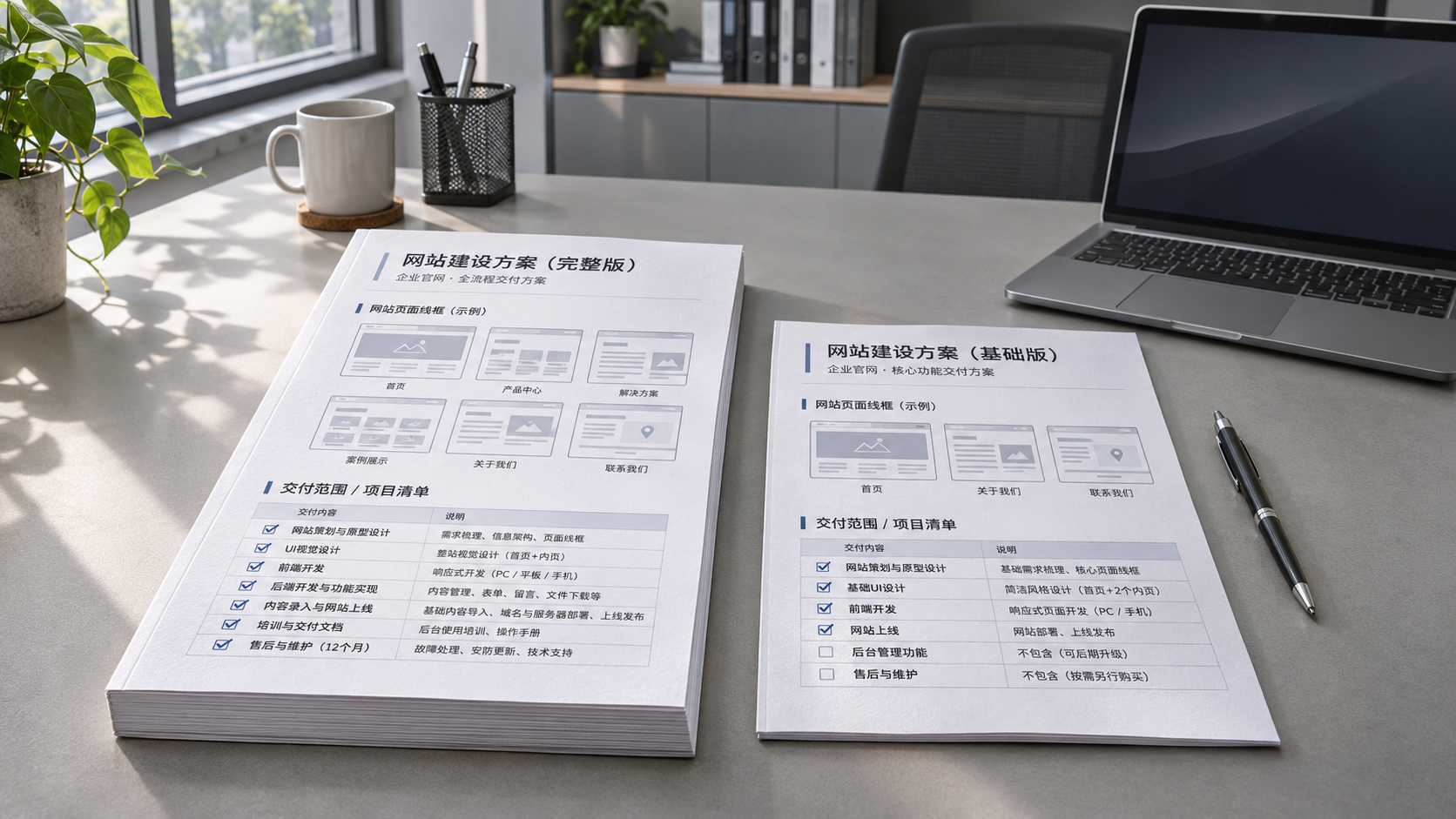
Template-based websites reuse page structures and ready-made features, spreading the upfront development cost across multiple projects. As a result, they are usually quicker to launch and cost less initially. Custom projects, by contrast, require content to be reviewed, interactions to be designed, and results to be validated from scratch, involving more staff time and communication.
When comparing quotes, first confirm whether they are based on the number of pages or the number of page types. Dozens of product detail pages may use the same template, while the homepage, product filtering page, solutions page, and inquiry page often need to be designed and developed separately.
Next, align the assumptions for content entry, number of languages, mobile optimization, and revision rounds. Some quotes cover only design and development, while others also include copywriting, translation, and data migration. When the scope differs, the total price alone cannot indicate value for money.
For proposals with widely differing prices, ask the service provider to itemize the costs, deliverables, and acceptance criteria by work module. This makes it possible to determine whether the premium reflects necessary work or vague service descriptions and open-ended commitments.
2. Which Customization Work Is Worth the Extra Cost?
The first category is design that helps customers understand the product. Manufacturers with complex specifications, application scenarios, and certification documents need a clear information hierarchy. The value of the design should be reflected in how easily customers can determine whether a product is suitable and find the next step for getting in touch.
The second category is functionality that affects business processes, such as filtering products by specifications, submitting drawings with quote requests, configuring tiered pricing, or connecting to a customer management system. These requirements involve data rules, permissions, and exception handling, so the workload cannot be assessed by page appearance alone.
The third category is multilingual and regional adaptation. Adding a language may involve URL structure, navigation length, fonts, forms, and content review. When products and contact details vary across markets, the rules for maintaining them also need to be planned in advance.
If the proposed customization mainly involves changing colors, adjusting banners, and replacing images, the business should ask the provider to explain the added value. Work worth paying for should address clearly defined user tasks, operational efficiency, or business needs, and have results that can be verified against acceptance criteria.
3. Planning to Market Overseas? Which Costs Should You Budget for in Advance?
A website intended to generate leads overseas should account for search indexing, advertising landing pages, and inquiry tracking during the build. Whether pages allow individual title settings, product content can be crawled easily, and forms can record traffic sources may all affect subsequent marketing activities.
These capabilities are not exclusive to custom websites; established templates and website-building platforms may offer them too. During evaluation, ask for demonstrations of specific features, confirm which are standard and which require additional development, and establish who will maintain them after launch.
For example, a foreign trade business planning to run ongoing advertising should check mobile loading speed, landing page editing, and conversion event configuration. If every adjustment to a selling point requires paid development, a lower initial build price may turn into ongoing operating expenses.
Yiyingbao provides intelligent website building, multilingual websites, and overseas marketing-related services. When assessing an integrated solution of this kind, ask the supplier to specify the deliverables and scope for website development, search optimization, and advertising services separately, and confirm data access permissions and account management arrangements.
4. Comparing Long-Term Costs Is More Useful Than Looking Only at the First-Year Price
Compare total cost of ownership over the same period—for example, calculate website development fees, platform subscriptions, servers, plugin licenses, maintenance, and feature expansion over the next three years. List the advertising budget separately to avoid including media spend in website development quotes.
You can draw on the idea of allocating costs by activity and account for design, content entry, testing, and maintenance separately. The cross-industry article Research on Optimizing the Application of Activity-Based Costing in Coal Mining Enterprises offers further reading on the methodology; actual project estimates should still be based on real working hours.
When assessing returns, give priority to the qualified inquiry rate, cost per qualified lead, and content update efficiency. Website design can affect these metrics, but results are also influenced by traffic quality, product competitiveness, and sales follow-up. Growth cannot be attributed entirely to website development.
For features with uncertain returns, invest in stages. For example, start with core product displays, the inquiry process, and data collection, then use actual traffic data to decide whether to develop a complex product selection tool. This reduces the risk of paying upfront for features that are rarely used.
5. With a Limited Budget, Should You Choose a Template, a Custom Site, or a Hybrid Approach?
If a business is at the market validation stage, has a small product range, and needs a conventional page structure, an established template is usually a better fit. The condition is that it meets requirements for editing permissions, mobile experience, and basic marketing capabilities, and that adding content later does not require frequent reliance on developers.
If a business has a complex product portfolio, a specialized customer purchasing process, or a need to connect with internal systems, customization is more likely to deliver value. In this case, prioritize resolving core business challenges and avoid spending too much of the budget on visual details whose impact cannot yet be verified.
A hybrid approach works well for many businesses: use an established system for content management and general-purpose features, then customize key pages and business modules. This helps control the cost of duplicate development while retaining the flexibility to adapt brand presentation and conversion workflows.
6. Before Signing, Use Deliverables and Acceptance Criteria to Confirm Whether the Price Is Reasonable
The contract should clearly specify page types, feature lists, content responsibilities, revision rounds, and the acceptance process. For requirements such as loading performance, browser compatibility, and form submissions, agree on testing conditions rather than relying on descriptions such as “premium design” or “marketing website.”
Also confirm ownership of the domain, content, design files, and data, as well as the terms for renewals, migration, and service termination. With a platform subscription model, find out what content can be exported and how much migration work may be required if the service is discontinued.
Custom websites usually cost more because they involve more dedicated work and delivery responsibilities, but a higher price does not automatically make them a better fit. Aligning business needs, service scope, long-term costs, and acceptance criteria item by item is the way to determine whether the additional budget is worth spending.