









- Which customer acquisition channels will be affected by cross-border marketing trends in 2026?Sep 06, 2026View details
- Which homogenization risks should be considered in an analysis of the AI-powered website building industry?Aug 30, 2026View details
- How Will AI Marketing Trends 2026 Change Advertising Budget AllocationAug 28, 2026View details
- Is the EV SSL certificate market shrinking or upgrading? How should companies assess certificate procurement?Aug 11, 2026View details
- Why the old AMP SEO 2020 practices no longer work and what has changed in current optimization prioritiesAug 02, 2026View details
- How to Choose Topics for an Industry News Section to Attract More Organic Search TrafficJul 29, 2026View details
Does a poor mobile experience on a B2B lead generation website affect conversions?
Does a Poor Mobile Experience on a B2B Lead Generation Website Affect Conversions?
Does a poor mobile experience on a B2B lead generation website affect conversions? The answer is yes. Slow loading, misaligned pages, unreadable product specifications, and difficult-to-complete forms can all cause potential customers to leave quickly, directly reducing the efficiency of acquiring overseas customers. For foreign trade manufacturing companies, mobile traffic loss is not merely the loss of a page visit; it may also mean losing a buyer who is looking for suppliers, comparing solutions, or even approaching a purchasing decision.
Many companies still misjudge this issue, believing that industrial product procurement is complex and involves high order values, so customers will always return to a desktop computer for thorough research. In actual business scenarios, overseas procurement professionals often conduct their initial screening on mobile phones at trade shows, during commutes, while inspecting warehouses, or through social media links and search results pages. Mobile devices may not handle the entire decision-making process, but they often determine whether a company can enter a customer's shortlist of potential suppliers.
Mobile Is Not a “Scaled-Down Official Website,” but an Entry Point to the Inquiry Journey
Mobile issues on B2B websites are often more than just visual design issues. A desktop homepage can accommodate complete navigation, company profiles, product categories, and multiple banner sections. When it is directly compressed onto a mobile screen, it can easily become a long page crowded with information. Users may scroll continuously for a long time and still fail to find product models, application scenarios, minimum order information, certification document access, or contact options. Their patience usually disappears before their interest does.
In particular, visitors who arrive through Google organic search, advertising landing pages, Facebook, or LinkedIn content generally come with relatively clear questions. They may be searching for a specific type of equipment, component material, or customization capability, rather than intending to read a company's entire history. If a landing page starts only with a large brand image while key product information and action points are placed far below, traffic may arrive but will still be difficult to convert into qualified inquiries.
The mobile experience also affects trust building. B2B buyers pay attention to whether a supplier is professional, whether information is consistent, and whether communication is convenient. Failed image loading, abnormal language switching, documents that cannot be downloaded or opened, and phone numbers or email addresses that cannot be used with one click can easily make users question the website's maintenance capabilities and extend that impression to the company's delivery and service capabilities. Such judgments may not be entirely fair, but they reflect real behavioral patterns in cross-border procurement.
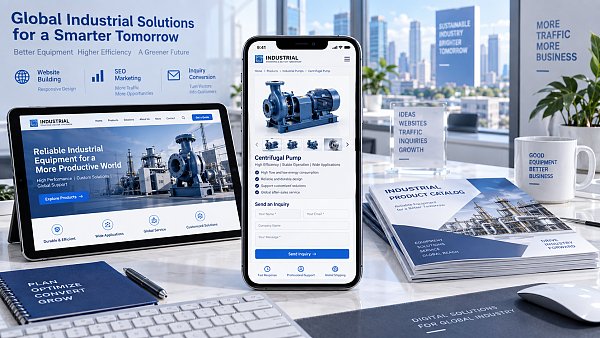
Which Mobile Issues Are Most Likely to Interrupt Inquiries?
Loading speed is usually the first issue to become apparent. Many traditional foreign trade websites still use uncompressed large images, autoplay videos, stacked plugins, or resource services located far from their target markets. After users click on a page, if the above-the-fold content takes too long to display its core information, even the most refined product pages that follow will have no opportunity to be seen. Speed optimization should not focus only on a single test score; it should also assess whether users in key markets can quickly open pages, click, and submit forms under real network conditions.
The second type of issue is a confusing information hierarchy. Industries such as machinery, building materials, and electronic components often have numerous SKUs and complex parameters. In an effort to “present everything comprehensively,” companies copy desktop catalogs directly onto mobile devices. The result is excessively deep menu structures, difficult filtering options, and specification tables that overflow horizontally on product detail pages. A more appropriate approach is to prioritize the information customers need most during their initial screening on mobile: product names, key specifications, application industries, customization scope, ways to obtain materials, and the next contact path.
The third type of issue occurs in forms. B2B inquiries should not treat customers as “information collection subjects” required to complete more than ten fields. A company name, contact person, email address, and requirement description are generally sufficient to form a basis for initial communication. Information that must be confirmed, such as purchase quantity, target market, and drawing files, can be completed during subsequent sales communications. When the mobile keyboard occupies most of the screen, excessively long forms, frequent CAPTCHA failures, and incompatible attachment uploads can all cause visitors who were genuinely interested to give up.
Assessing Issues Requires More Than Looking at Total Traffic
To determine whether a website is losing conversions on mobile, traffic sources, page paths, and lead quality need to be assessed together. If mobile traffic accounts for a significant share but time spent on product pages is noticeably shorter than on desktop; if ad clicks are normal but form submissions are scarce; or if many users stop at the above-the-fold section or a particular type of product page after visiting, page performance, content relevance, and interaction barriers should be investigated first rather than simply concluding that “overseas customer demand is insufficient.”
The tasks of different pages should also be distinguished. The homepage establishes basic awareness, product category pages support search and filtering, detail pages should answer questions about specifications, applications, and supply capabilities, while advertising landing pages should closely align with targeted keywords and advertising promises. Using the same long form or the same floating pop-up on every page may not be appropriate. For customized products requiring drawing confirmation, options such as “Send Requirements,” “Get Technical Documents,” and “Schedule a Consultation” may better align with the procurement process than a single “Request a Quote” button.
Multilingual websites also need to consider localization, rather than simply translating Chinese content into foreign languages. Text length varies across languages, and buttons on mobile screens can easily become compressed; buyers in different markets also have different preferences for units, contact details, and document wording. Before Russian, Spanish, Arabic, and other language pages go live, navigation, tables, forms, and download functions should be tested on actual mobile devices. It is not enough to confirm that they “look normal” in a back-end preview.
From Website Development to Customer Acquisition, Mobile Must Be Included in the Same Operating Logic
The disconnect between websites and marketing is another common cost for B2B companies. Website development teams complete pages based on visual design, SEO teams add content later, and advertising teams separately create landing pages. This ultimately leads to inconsistencies among keywords, advertising materials, page selling points, and sales messaging. After customers arrive through search or social media content, they cannot find the information previously promised and naturally find it difficult to continue leaving their contact details.
The value of integrated website and marketing services does not lie in stacking all functions into the same back end. Rather, it lies in planning website development backward from the inquiry journey: what the target market searches for, what needs advertisements generate, which product pages customers will browse, and what preliminary information the sales team requires. The website should provide the corresponding content and interactions accordingly. Mobile serves as both the traffic receiving end and the data feedback end of this journey.
Since its establishment in 2013, Yiyingbao Information Technology (Beijing) Co., Ltd. has built a service system around intelligent website development, SEO optimization, social media marketing, and advertising. Its AI-driven enterprise SaaS platform covers multilingual websites, B2B foreign trade marketing websites, cross-border online stores, and overseas promotion scenarios. For companies, the practical significance of these capabilities is that Google SEO, advertising landing pages, social media traffic acquisition, and subsequent content maintenance can all be considered during website planning, rather than repeatedly dismantling and modifying page structures after the website goes live.
Yiyingbao serves markets across North America, Europe, Southeast Asia, Japan and South Korea, the Middle East, Russian-speaking regions, Latin America, and Africa. When facing different languages and customer acquisition channels, mobile development should return to specific business questions: What are the core products? What are customers' primary concerns? What information is needed for an inquiry? How will the sales team follow up on leads? Technical tools can accelerate development and optimization, but they cannot replace a company's understanding of its customers' procurement journey.
Fix the Areas That Most Affect Customer Action First
If an existing website has been operating for some time, there is no need to rush into rebuilding it from scratch. Start by using mobile phones of different brands and screen sizes to simulate how overseas customers enter the website through search results, advertising links, and social media links. Check whether above-the-fold loading, product discovery, specification reading, language switching, document downloads, and form submission work smoothly. Then, combine traffic sources and page behavior data to identify where user loss is most concentrated.
Does a poor mobile experience on a B2B lead generation website affect conversions? Its impact often goes beyond form submission rates to include brand credibility, advertising budget efficiency, and the quality of leads for sales follow-up. Rather than adding more promotional content to the homepage, it is better to first enable customers to quickly confirm on their mobile phones “what you can provide, whether it suits my needs, and how to contact you next.” This is the conversion task that mobile should truly perform.
Related Articles


Related Products
 Yiyingbao SaaS Intelligent Website Building and Marketing SystemYiyingbao SaaS Intelligent Website Building and Marketing System, AI-powered no-code website building, rapid creation of multilingual B2B international websites in 10 minutes, global server acceleration, AI-powered SEO optimization, helping businesses connect efficiently with global markets. The perfect integration of technology and operation makes building an international trade website remarkably simple
 AI+SEM Intelligent Advertising Marketing SystemAI+SEM drives intelligent ad creation, empowering full-funnel precision advertising marketing. The system automatically generates weekly/monthly reports, AI recommends keywords and target countries, monitors core metrics in real-time with intelligent alerts, and enables one-click high-conversion ad solutions to help quickly acquire customers and improve ROI.
 AI+SEO Dual-Engine System Optimization ServicesYiyingbao’s AI+SEO dual-engine optimization system helps foreign trade enterprises acquire high-quality organic traffic through AI-powered keyword research, content generation, and comprehensive technical optimization, significantly improving search rankings and conversion rates.
 AI+SNS Social Media Marketing SystemYingbao AI+SNS Social Media Marketing System - Precision social capture for the social media era. Supports one-click content synchronization across major platforms like Facebook and LinkedIn. AI intelligently rewrites posts for enhanced relevance. 24/7 AI customer service and user profiling analysis empower businesses to efficiently expand into global markets.
 AI+SEO营销解决方案易营宝AI+SEO营销解决方案,通过AI批量写作、智能生成TDK、精准关键词扩词等功能,全面优化网站SEO效果,提升流量与转化率。助力企业构建高效智能网站新生态。
 AI+SEM Advertising Marketing SolutionsAI+SEM Advertising Marketing Solution leverages AI technology to deeply empower SEM ad campaigns. It automatically generates weekly/monthly reports using AI, presenting account data across multiple dimensions for comprehensive insights into campaign performance and trends. The system precisely recommends keywords and target countries, intelligently generates high-conversion ad copy, and enables one-click activation of efficient campaign plans to help businesses rapidly acquire customers. Simultaneously, it monitors core metrics in real time, intelligently identifies abnormal fluctuations, and issues timely alerts to ensure stable, high-return advertising results.
 Domain Name ServicesEasyWin provides professional domain name services, including intelligent queries, one-stop registration, brand protection, and full lifecycle management, helping businesses build a digital brand image.
 EasyOperate B2C Cross-Border E-Commerce Platform & Independent WebsiteEasyStore B2C Cross-border E-commerce Independent Store is an intelligent website building and cross-border e-commerce integrated solution independently developed by EasyStore Information Technology (Beijing) Co., Ltd. The system is specially designed for small and medium-sized as well as large export enterprises, integrating 'website building, operation, marketing, advertising, and conversion' into one, helping enterprises quickly establish cross-border e-commerce independent stores to achieve brand globalization and global sales growth.
The platform supports multiple languages, multiple currencies, and multi-channel marketing, with built-in AI intelligent translation and SEO optimization systems, suitable for mainstream markets such as Southeast Asia, Europe and America, Latin America, and the Middle East, assisting Chinese manufacturing enterprises in efficiently deploying international e-commerce strategies. SSL证书易营宝提供专业SSL安全证书服务,包括单域名和泛域名证书,确保网站数据传输加密、身份验证和完整性保护,助力企业建立安全可信的在线业务环境。









