









- Which customer acquisition channels will be affected by cross-border marketing trends in 2026?Sep 06, 2026View details
- Which homogenization risks should be considered in an analysis of the AI-powered website building industry?Aug 30, 2026View details
- How Will AI Marketing Trends 2026 Change Advertising Budget AllocationAug 28, 2026View details
- Is the EV SSL certificate market shrinking or upgrading? How should companies assess certificate procurement?Aug 11, 2026View details
- Why the old AMP SEO 2020 practices no longer work and what has changed in current optimization prioritiesAug 02, 2026View details
- How to Choose Topics for an Industry News Section to Attract More Organic Search TrafficJul 29, 2026View details
- Digital Marketing Shenzhen Market Insights: Why Are Companies Expanding Overseas Looking for Growth Teams in Shenzhen?Jul 31, 2026View details
- Can Zhejiang foreign trade independent websites still be developed today? Look at changes in traffic and lead generationJul 28, 2026View details
How to Create a Video News Page for Better Google Indexing
Video News Pages Must First Resolve the Conflict Between “Being Viewable” and “Being Indexed”
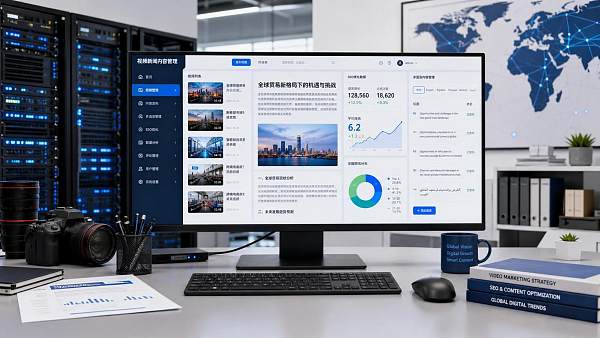
How can video news pages be designed to facilitate Google indexing? The key is not simply uploading a video, but enabling search engines to clearly understand the page topic, content update logic, and page value. For integrated website and marketing service projects, these pages often serve several purposes at the same time, including displaying brand updates, promoting events, documenting product launches, and generating long-term SEO leads. Therefore, their design cannot focus solely on the front-end effect.
In practice, video news pages tend to have several concentrated problems: the video can be played, but the body text is too thin; the page looks attractive, but the initial viewport is overloaded; the section is updated frequently, but lacks stable topical aggregation. As a result, crawling efficiency is low, indexing is slow, and it is difficult for keywords to build sustained accumulation. For websites targeting overseas markets, if multilingual support, mobile devices, and access speeds in different regions must also be taken into account, the page structure requires even more advance planning.
A more effective way to evaluate these pages is to view them within the actual business process. They are not standalone content pages, but part of the website’s content assets. Platforms such as 易营宝, which cover intelligent website building, SEO optimization, advertising, and multilingual marketing, generally place greater emphasis on page scalability because they must subsequently accommodate search traffic, advertising traffic, and traffic returning from social media. If the single-page structure is designed incorrectly, scaling it later will become increasingly difficult.
The Evaluation Priorities for Video News Pages Differ Across Usage Scenarios
Even when they are all video news pages, different section positioning leads to different Google indexing strategies. If a page mainly carries corporate news, search engines pay greater attention to information completeness and the credibility of the publication date. If the page focuses on product updates, it needs to provide details such as model numbers, functions, and application background. If the page serves brand expansion into overseas markets, it must also consider multilingual versions, regional content differences, and the return experience after external-link referrals.
Many websites mistakenly treat these scenarios as the same type of content page, using a uniform template, word count, and layout. This is convenient for management, but indexing results are often average. Google does not determine whether “this page uses a news template”; instead, it evaluates whether “this page answers a clear topic and has a content structure that can be crawled, understood, and associated.”
For Corporate News Pages, the Priority Is More Than Publishing Quickly
Corporate video news pages are commonly found in the news centers of official websites. On the surface, their task is to update company news. From the perspective of Google indexing, however, the real issue these pages must address is whether they are worth indexing. If a page contains only a brief description with an embedded video, it is difficult for search engines to determine its independent value.
The “primary video content + supplementary text” structure is more suitable for this scenario. The body text should at least explain the event background, time of occurrence, topics involved, and broader impact. If the news is related to overseas marketing, channel expansion, website upgrades, or marketing activities, relevant keywords should also be incorporated naturally into the title, subtitle, and opening paragraph, allowing the video news page to form a semantic connection with the website’s service topics.
There is also a detail that is often overlooked during implementation: many systems create very deep pagination for news lists, but provide no related recommendations, tag pages, or topic entrances within individual pages. Although the pages are published, they lack ongoing internal-link support. For websites seeking to build stable Google indexing over time, video news pages should ideally link back to section pages, topic pages, and related service pages, forming a content network instead of existing in isolation.
Video News Pages Containing Product Information Should Avoid Becoming “Promotional Pages”
Another common scenario is using video news pages to publish new products, feature updates, or case demonstrations. The biggest misjudgment here is writing the page as advertising copy. Excessive emphasis on being leading, innovative, or groundbreaking can instead reduce the density of searchable information. Google can understand clearly defined subjects more easily than abstract praise.
If a video news page presents a website-building feature upgrade, an SEO system update, or a demonstration of AI marketing capabilities, the changes should be described specifically. For example, which modules were updated, what problems were solved, which cross-border business scenarios are supported, and what implementation differences exist compared with the previous solution. In this way, the page can cover not only searches related to “video news pages,” but also longer-tail searches for specific functions.
- The title should preferably include the subject of the event rather than only a brand slogan.
- The opening paragraph should explain the update background and avoid immediately adopting promotional language.
- Add a text summary, core parameters, or applicable scope below the video.
- Configure a readable URL, an independent title tag, and description information for the page.
When Targeting Overseas Markets, Video News Pages Must Also Balance Speed and Language Adaptation
Once a video news page is used for overseas promotion, the issues become more practical. Oversized videos, excessive scripts in the initial viewport, and complex player dependencies can all slow page loading and affect crawling and user experience. Many projects discover after launch that the content itself is fine, but indexing remains unsatisfactory. The cause often lies in the technical layer rather than the copywriting.
In this scenario, the page should prioritize outputting the basic HTML content before loading video resources. The thumbnail, title, publication date, summary, and main text should be accessible first. If a multilingual website is used, corresponding relationships between different language versions must also be ensured. Simply copying the same video news page into different directories may result in duplicate-content evaluations.
For websites covering multiple regions, a common and reliable approach is to manage video news pages within a unified content system and then apply light differentiation based on regional markets. Platforms such as 易营宝, which serve multi-region websites over the long term, generally consider website structure, SEO fields, page speed, and content distribution within the same framework. This prevents video news pages from becoming isolated optimization points and makes ongoing expansion more convenient.
The Factors That Truly Affect Google Indexing Are Often These Overlooked Details
Many video news pages do not have poor content; their details are simply not handled properly. For example, the main image may lack alternative text, the video title may differ from the page title, the publication date may be missing, structured data may not be configured, paginated lists may not be crawled properly, or the body text on mobile devices may be hidden too deeply. None of these issues is fatal on its own, but together they can significantly reduce indexing efficiency.
Another common misjudgment is focusing only on the number of indexed pages without examining the quality of their traffic matches after indexing. If a video news page continuously brings in traffic from irrelevant keywords, this indicates that the topic boundaries have not been sufficiently narrowed. In contrast, consistently covering clear-intent keywords related to industry news, product updates, and brand activities indicates that the page structure and keyword placement are moving in the right direction.
Before implementation, several items should be checked carefully: whether the video news page has sufficient textual support, whether it has clear internal links, whether loading resources are controlled, whether multilingual and mobile versions have been independently verified, and whether the ability to aggregate future topics has been retained. These actions may seem basic, but they can improve the stability of Google indexing more effectively than simply increasing the volume of published content.
Before Launch, Define the Adaptation Standards Clearly
How can video news pages be designed to facilitate Google indexing? Ultimately, the answer comes back to execution standards. A page is not finished after a single article is completed; reusable publishing rules must be established. The title length, word count for the video description, body structure, internal-link requirements, speed thresholds, language-version strategy, and indexing monitoring cycle should all be defined before launch.
A more practical approach is to first review the existing video news pages and divide them into four categories: corporate news, product updates, event promotion, and overseas multilingual content. Then, review indexing performance, bounce rates, and keyword matching for each category. Only in this way can it be determined whether the problem lies in the content, structure, or technical layer, rather than repeatedly modifying the page’s superficial styling.
Once video news pages are incorporated into an integrated system of website building, SEO, and content operations, they become more than display windows; they become content nodes that can continuously accumulate search assets. The next priority should not be blindly expanding the quantity, but establishing differentiated rules within a unified template so that video news pages in different scenarios can be seen, understood, and indexed consistently.
Related Articles


Related Products
 Yiyingbao SaaS Intelligent Website Building and Marketing SystemYiyingbao SaaS Intelligent Website Building and Marketing System, AI-powered no-code website building, rapid creation of multilingual B2B international websites in 10 minutes, global server acceleration, AI-powered SEO optimization, helping businesses connect efficiently with global markets. The perfect integration of technology and operation makes building an international trade website remarkably simple
 AI+SEM Intelligent Advertising Marketing SystemAI+SEM drives intelligent ad creation, empowering full-funnel precision advertising marketing. The system automatically generates weekly/monthly reports, AI recommends keywords and target countries, monitors core metrics in real-time with intelligent alerts, and enables one-click high-conversion ad solutions to help quickly acquire customers and improve ROI.
 AI+SEO Dual-Engine System Optimization ServicesYiyingbao’s AI+SEO dual-engine optimization system helps foreign trade enterprises acquire high-quality organic traffic through AI-powered keyword research, content generation, and comprehensive technical optimization, significantly improving search rankings and conversion rates.
 AI+SNS Social Media Marketing SystemYingbao AI+SNS Social Media Marketing System - Precision social capture for the social media era. Supports one-click content synchronization across major platforms like Facebook and LinkedIn. AI intelligently rewrites posts for enhanced relevance. 24/7 AI customer service and user profiling analysis empower businesses to efficiently expand into global markets.
 AI+SEO营销解决方案易营宝AI+SEO营销解决方案,通过AI批量写作、智能生成TDK、精准关键词扩词等功能,全面优化网站SEO效果,提升流量与转化率。助力企业构建高效智能网站新生态。
 AI+SEM Advertising Marketing SolutionsAI+SEM Advertising Marketing Solution leverages AI technology to deeply empower SEM ad campaigns. It automatically generates weekly/monthly reports using AI, presenting account data across multiple dimensions for comprehensive insights into campaign performance and trends. The system precisely recommends keywords and target countries, intelligently generates high-conversion ad copy, and enables one-click activation of efficient campaign plans to help businesses rapidly acquire customers. Simultaneously, it monitors core metrics in real time, intelligently identifies abnormal fluctuations, and issues timely alerts to ensure stable, high-return advertising results.
 Domain Name ServicesEasyWin provides professional domain name services, including intelligent queries, one-stop registration, brand protection, and full lifecycle management, helping businesses build a digital brand image.
 EasyOperate B2C Cross-Border E-Commerce Platform & Independent WebsiteEasyStore B2C Cross-border E-commerce Independent Store is an intelligent website building and cross-border e-commerce integrated solution independently developed by EasyStore Information Technology (Beijing) Co., Ltd. The system is specially designed for small and medium-sized as well as large export enterprises, integrating 'website building, operation, marketing, advertising, and conversion' into one, helping enterprises quickly establish cross-border e-commerce independent stores to achieve brand globalization and global sales growth.
The platform supports multiple languages, multiple currencies, and multi-channel marketing, with built-in AI intelligent translation and SEO optimization systems, suitable for mainstream markets such as Southeast Asia, Europe and America, Latin America, and the Middle East, assisting Chinese manufacturing enterprises in efficiently deploying international e-commerce strategies. SSL证书易营宝提供专业SSL安全证书服务,包括单域名和泛域名证书,确保网站数据传输加密、身份验证和完整性保护,助力企业建立安全可信的在线业务环境。









