









- Which customer acquisition channels will be affected by cross-border marketing trends in 2026?Sep 06, 2026View details
- Which homogenization risks should be considered in an analysis of the AI-powered website building industry?Aug 30, 2026View details
- How Will AI Marketing Trends 2026 Change Advertising Budget AllocationAug 28, 2026View details
- Is the EV SSL certificate market shrinking or upgrading? How should companies assess certificate procurement?Aug 11, 2026View details
- Why the old AMP SEO 2020 practices no longer work and what has changed in current optimization prioritiesAug 02, 2026View details
- How to Choose Topics for an Industry News Section to Attract More Organic Search TrafficJul 29, 2026View details
What stages are included in building a cross-border service ecosystem?Analysis of website building、advertising、payment and CRM collaboration
The building of a cross-border service ecosystem,on the surface,looks like a combination of website,advertising,payment and customer management,but in practice,it is more like an operating system that runs through customer acquisition,conversion,fulfillment and repurchase。For overseas business,single-point investment often has limited results,only by coordinating website building capabilities,traffic acquisition,transaction closed loops and data accumulation can growth efficiency truly improve,and input-output can also be seen more clearly。
The building of a cross-border service ecosystem,the core is not “more”,but “connected”
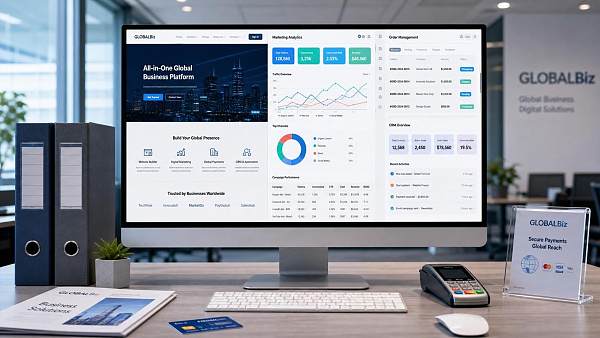
When many companies go overseas in the early stage,they will separately purchase website building,advertising,payment tools and customer management systems。Each module makes sense when viewed alone,but once linkage is lacking,problems will appear very quickly。
For example,advertising brings visits,but there is no suitable landing page;the website has traffic,but lacks localized payment;after payment is completed,lead and order data do not flow back to CRM,and subsequent follow-up again becomes manual sorting。
This is also why the building of a cross-border service ecosystem is receiving more and more attention。What it discusses is not just “which tools to use”,but whether these tools work together around the same growth goal。
Starting from an independent website,what is determined is the efficiency of all subsequent actions
In the website + marketing service integration model,a website is not simply an online business card,but the starting point of the entire cross-border service ecosystem building。It not only receives search and advertising traffic,but also undertakes the tasks of brand presentation,inquiry conversion,order closing and data collection。
A usable overseas website must at least solve four things:whether multilingual expression is accurate,whether the page structure is suitable for indexing,whether access speed is stable,and whether the conversion path is clear。
If it is a B2B scenario,the focus is usually on inquiry forms,product catalogs,trust endorsements and SEO structure;if it is B2C or a cross-border marketplace,the focus is more on product details,checkout process,payment success rate and remarketing connection。
From the perspective of industry practice,more and more companies are no longer satisfied with websites that “can go live”,but require sites to have promotion,indexing and conversion capabilities。This is also why AI intelligent website building,multilingual site clusters,and marketing-oriented landing pages continue to heat up。
Why website building must be viewed within the ecosystem
Website structure affects advertising quality scores,and also affects organic search rankings。Payment plugins and checkout logic determine whether users are willing to complete an order。Tracking points and form design are directly related to whether CRM can obtain a complete customer profile。
In other words,website building is not an independent project,but the underlying engineering of the entire cross-border service ecosystem building。
Advertising is not just buying traffic,but also verifying the match between market and page
The advertising stage is often understood as a tool for rapid customer acquisition,but in actual business,it also plays the role of testing markets,screening audiences,and verifying product messaging。Google ads,social media ads,and short video advertising are not exactly suitable for the same scenarios。
Search ads are more suitable for capturing explicit demand,social media ads are better at interest seeding and interest reach,while short videos are more suitable for improving awareness and explaining complex product selling points clearly。The issue is not how many channels there are,but whether they are connected with website pages,quotation methods and payment processes。
If the landing page information after an ad click is cluttered,or if the prices,languages and delivery instructions seen in different regions are inconsistent,advertising costs can easily be wasted。Advertising collaboration in cross-border service ecosystem building is essentially to let every click enter a conversion chain that is trackable,optimizable and reusable。
What the payment stage determines is not only collection,but also trust and loss
Payment is often handled at a later stage in cross-border business,but in fact it will affect conversion in advance。Whether users can see familiar payment methods on the site,whether the currency matches,and whether taxes,fees and shipping costs are transparent,will directly affect their willingness to place an order。
Different markets have very obvious differences in payment preferences。In regions such as North America,Europe,Southeast Asia and the Middle East,commonly used payment tools and checkout habits are not consistent。If payment design is not localized,even if front-end traffic is good,a large number of users may still be lost at the checkout stage。
What deserves more attention is that payment data is not isolated information at the financial level。Successful payments,abandoned payments,refund requests,and repeat orders should all flow back to CRM and marketing systems for subsequent segmented operations。
What points should payment collaboration focus on
- Whether it supports commonly used payment methods and currency settlement in the target market。
- Whether the checkout steps are simple,and whether the mobile experience is smooth。
- Whether order,refund and abandoned order data can automatically enter the customer management system。
- Whether it supports remarketing and automated reach based on payment behavior。
CRM is not for storing customer information,but for enabling leads to continuously generate revenue
In the building of a cross-border service ecosystem,CRM is often an underestimated link。Many teams do not realize how much loss the absence of unified customer management can bring until leads increase and customers are scattered across multiple channels。
A truly effective CRM not only records contact information,but also connects source channels,visit behavior,inquiry content,order status and repurchase cycles。Only in this way can it determine which ads are worth continuing to invest in,which pages should be optimized,and which customers are suitable for focused follow-up。
For B2B inquiry businesses,the value of CRM is reflected in lead grading,follow-up reminders and sales cycle management;for B2C independent websites and cross-border marketplaces,the value is reflected in member segmentation,abandoned order recovery,repeat purchases by existing customers and lifecycle operations。
When website building,advertising,payment and CRM are truly connected,the building of a cross-border service ecosystem has the foundation for continuous optimization。Because every budget,every click and every order can be analyzed from a unified data perspective。
The value of an integrated solution lies in shortening the trial-and-error chain
The current industry is paying more and more attention to website + marketing service integration,for a very practical reason。Overseas business chains are long,regional differences are large,and channels change quickly。Although assembling multiple suppliers separately is flexible,the collaboration cost is high,and responsibility boundaries can easily become blurred。
The value of platform-based service providers represented by Yiyingbao in recent years lies in integrating intelligent website building,cross-border marketplaces,AI advertising marketing,SEO and GEO optimization into the same logic。The significance of doing this is not just “more functions”,but to form a closed loop of promotion,indexing,conversion and data accumulation。
From the perspective of business fit,this type of capability is more suitable for scenarios such as multilingual official websites,B2B inquiry websites,brand independent websites,advertising landing pages and cross-border marketplaces。Especially in markets such as North America,Europe,Southeast Asia and the Middle East,localized content,advertising rhythm and site experience often need to be advanced simultaneously。
For teams that want to balance long-term organic traffic and short-term customer acquisition efficiency,an integrated solution is usually easier to establish unified metrics,and also more convenient for continuous optimization。
To judge whether cross-border service ecosystem building is effective,first look at these signals
Whether collaboration has been achieved should not only be judged by the number of systems,but more by whether operating results can be tracked and reviewed。In actual judgment,you can first start with several key questions。
- Whether the website is suitable for both search indexing and advertising traffic reception。
- Whether the languages,content and payment methods of different markets match local habits。
- Whether advertising data,form data and order data can be attributed in a unified way。
- Whether CRM can support lead segmentation,automated follow-up and repurchase operations。
- Whether SEO,social media,advertising and AI search exposure accumulate around the same site asset。
If these issues are handled separately for a long time,cross-border service ecosystem building will often remain at the level of tool procurement;if a unified process has already been formed,the difficulty of expanding markets,categories and channels later will decrease significantly。
What is more worth doing next is to first establish your own judgment framework
There is no completely unified standard answer for building a cross-border service ecosystem。Different industries,different regions and different transaction models will have different priorities。Compared with rolling out all modules at once,a more prudent approach is to first sort out the target market,customer acquisition path and current breakpoints。
If traffic is insufficient at this stage,the site structure and promotion strategy should be checked first;if there are visits but conversion is low,the focus should be on page messaging,payment experience and CRM follow-up;if orders are growing but repurchase and data accumulation are insufficient,customer segmentation and automated operation capabilities should be completed as soon as possible。
Only by viewing website building,advertising,payment and CRM on the same business map can cross-border service ecosystem building turn from a cost item into a growth foundation。The key next step is not how many more tools to buy,but to clarify which links must be connected first,which data must be unified first,and which market actions can be verified first。
Related Articles



Related Products
 Yiyingbao SaaS Intelligent Website Building and Marketing SystemYiyingbao SaaS Intelligent Website Building and Marketing System, AI-powered no-code website building, rapid creation of multilingual B2B international websites in 10 minutes, global server acceleration, AI-powered SEO optimization, helping businesses connect efficiently with global markets. The perfect integration of technology and operation makes building an international trade website remarkably simple
 AI+SEM Intelligent Advertising Marketing SystemAI+SEM drives intelligent ad creation, empowering full-funnel precision advertising marketing. The system automatically generates weekly/monthly reports, AI recommends keywords and target countries, monitors core metrics in real-time with intelligent alerts, and enables one-click high-conversion ad solutions to help quickly acquire customers and improve ROI.
 AI+SEO Dual-Engine System Optimization ServicesYiyingbao’s AI+SEO dual-engine optimization system helps foreign trade enterprises acquire high-quality organic traffic through AI-powered keyword research, content generation, and comprehensive technical optimization, significantly improving search rankings and conversion rates.
 AI+SNS Social Media Marketing SystemYingbao AI+SNS Social Media Marketing System - Precision social capture for the social media era. Supports one-click content synchronization across major platforms like Facebook and LinkedIn. AI intelligently rewrites posts for enhanced relevance. 24/7 AI customer service and user profiling analysis empower businesses to efficiently expand into global markets.
 AI+SEO营销解决方案易营宝AI+SEO营销解决方案,通过AI批量写作、智能生成TDK、精准关键词扩词等功能,全面优化网站SEO效果,提升流量与转化率。助力企业构建高效智能网站新生态。
 AI+SEM Advertising Marketing SolutionsAI+SEM Advertising Marketing Solution leverages AI technology to deeply empower SEM ad campaigns. It automatically generates weekly/monthly reports using AI, presenting account data across multiple dimensions for comprehensive insights into campaign performance and trends. The system precisely recommends keywords and target countries, intelligently generates high-conversion ad copy, and enables one-click activation of efficient campaign plans to help businesses rapidly acquire customers. Simultaneously, it monitors core metrics in real time, intelligently identifies abnormal fluctuations, and issues timely alerts to ensure stable, high-return advertising results.
 Domain Name ServicesEasyWin provides professional domain name services, including intelligent queries, one-stop registration, brand protection, and full lifecycle management, helping businesses build a digital brand image.
 EasyOperate B2C Cross-Border E-Commerce Platform & Independent WebsiteEasyStore B2C Cross-border E-commerce Independent Store is an intelligent website building and cross-border e-commerce integrated solution independently developed by EasyStore Information Technology (Beijing) Co., Ltd. The system is specially designed for small and medium-sized as well as large export enterprises, integrating 'website building, operation, marketing, advertising, and conversion' into one, helping enterprises quickly establish cross-border e-commerce independent stores to achieve brand globalization and global sales growth.
The platform supports multiple languages, multiple currencies, and multi-channel marketing, with built-in AI intelligent translation and SEO optimization systems, suitable for mainstream markets such as Southeast Asia, Europe and America, Latin America, and the Middle East, assisting Chinese manufacturing enterprises in efficiently deploying international e-commerce strategies. SSL证书易营宝提供专业SSL安全证书服务,包括单域名和泛域名证书,确保网站数据传输加密、身份验证和完整性保护,助力企业建立安全可信的在线业务环境。









