









- Why the old AMP SEO 2020 practices no longer work and what has changed in current optimization prioritiesAug 02, 2026View details
- How to Choose Topics for an Industry News Section to Attract More Organic Search TrafficJul 29, 2026View details
- Digital Marketing Shenzhen Market Insights: Why Are Companies Expanding Overseas Looking for Growth Teams in Shenzhen?Jul 31, 2026View details
- Can Zhejiang foreign trade independent websites still be developed today? Look at changes in traffic and lead generationJul 28, 2026View details
- What New Signals Are Emerging in Enterprise Services SaaS Marketing ReportsJul 27, 2026View details
- What Does a Global Traffic Ecosystem Service Provider Do? What Are the Differences from a Single Advertising AgencyJul 16, 2026View details
What Capabilities Are Needed for Customizing a Website Building System for the Middle East? Analysis of Language Direction, Payment Habits, and Deployment Requirements
Middle East Website Building System Customization: Why the Challenge Is Not Just Translation
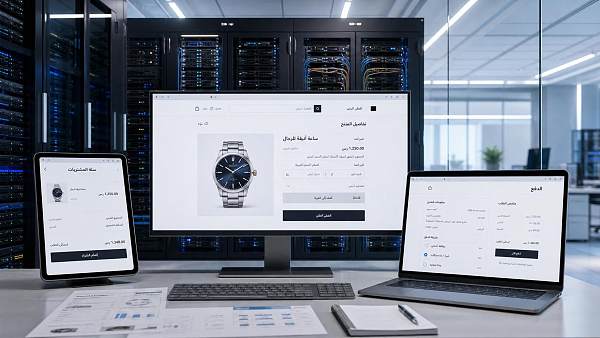
At first glance, Middle East website building system customization seems to be a multilingual issue, but in practice it is more like a complete localization restructuring.
This is especially true for Arabic-speaking markets, which have very clear requirements for interface direction, content presentation, payment logic, and deployment environments.
If a system simply adds an Arabic version to the original template, it is usually difficult for it to withstand real business validation.
Judging from recent project changes, when enterprises evaluate Middle East website building system customization, their focus has shifted from “whether it can go live” to “whether it can acquire customers steadily”.
This also means that the technical solution must support display, conversion, promotion, and ongoing operations and maintenance at the same time.
For integrated website + marketing service projects, a website building system is not only about front-end pages; it must also serve search visibility, ad landing efficiency, and data feedback.
Service systems like 易营宝, which cover intelligent website building, SEO optimization, ad placement, and multilingual sites at the same time, are better suited to handling highly localized scenarios such as the Middle East market.
Language Direction Adaptation Is the First Threshold for Middle East Website Building System Customization
The most common misjudgment in Middle East website building system customization is treating Arabic as an ordinary content translation task.
In fact, Arabic belongs to a right-to-left reading system, so the overall page direction needs to be reversed.
Navigation positions, button order, form alignment, image-text layouts, and carousel switching directions all need to be adjusted accordingly.
If only the text is processed while the layout is not, users will immediately feel that the experience is awkward, and the bounce rate is usually higher.
In real business scenarios, font compatibility and character rendering also require attention.
Arabic has obvious connected-script characteristics, so font weight, line height, letter spacing, and component width all need to be verified separately.
If this part is handled roughly, mobile display is the most likely to run into problems.
A qualified Middle East website building system customization solution should at least have the following language capabilities:
- Support right-to-left layout and style switching.
- Support bilingual or multilingual coexistence in Arabic, English, or other languages.
- Support independent link structures and metadata configuration for different languages.
- Support direction synchronization for forms, search, filters, and pop-ups.
- Support hierarchical content management and permission control for language versions.
Furthermore, if Middle East website building system customization also needs to take SEO into account, it cannot stop at interface mirroring. It must also handle multilingual indexing structures, canonical tags, and local keyword mapping.
Payment Habits Determine the Conversion Funnel, So the System Cannot Only Connect to International Channels
When many enterprises carry out Middle East website building system customization, they tend to connect common international payment methods first.
This step is certainly important, but stopping there is not enough.
Middle East users differ significantly from European and American markets in payment trust, payment tools, and order placement rhythms.
Some regions are more sensitive to cash on delivery, bank card payments, local wallets, and installment solutions.
Therefore, Middle East website building system customization needs to treat payment as business process design, rather than simply connecting an interface.
At the system level, four items usually need to be checked carefully.
- Whether the payment gateway covers the target country and whether the settlement currency is stable.
- Whether risk control rules support high-risk order identification and manual review.
- Whether order status flows are adapted to cash on delivery and cancellation-retry scenarios.
- Whether the marketing system can track successful payments, abandoned orders, and repeat purchases.
If the system cannot send payment data back to advertising and analytics platforms, subsequent ad optimization will be clearly limited.
This is also why integrated website + marketing service solutions have greater advantages.
Platforms like 易营宝, which have capabilities in website building, advertising, SEO, and data linkage, can more easily turn Middle East website building system customization into a closed loop, rather than a patchwork of multiple tools.
Deployment Requirements Are Not Only About Speed, but Also Stability, Security, and Compliance
There is another often underestimated part of Middle East website building system customization: deployment architecture.
Many teams assume by default that Asian nodes can also cover Middle East access, but the actual experience is often unstable.
An even clearer signal is that once an ad landing page loads slowly, conversion costs will rise directly.
Therefore, Middle East website building system customization needs to design deployment solutions based on target countries, access peaks, and business types.
It is usually recommended to first evaluate regional nodes, global acceleration, static resource distribution, and disaster recovery switching capabilities.
In addition to performance, security and compliance must also be advanced in parallel.
For example, HTTPS, data encryption, access control, log auditing, and hierarchical backend permissions are all basic requirements.
If registration, payment, form collection, and member centers are involved, the data storage location and privacy handling process also need to be checked.
A more robust Middle East website building system customization architecture should usually include these capabilities:
If the system itself lacks these basic capabilities, adding them later usually costs more than planning them upfront.
Marketing and Technology Must Be Designed Together to Unlock the Value of Middle East Website Building System Customization
Middle East website building system customization is not a pure development project; ultimately, it must be accountable for customer acquisition.
If the website can be opened and can process payments, but is not conducive to search indexing and ad conversion, its business value will be greatly weakened.
Therefore, marketing capabilities should be included in the same set of standards during technical evaluation.
For example, whether pages support independent titles, descriptions, structured data, and multilingual indexing control.
Another example is whether ad landing pages can be quickly duplicated, tested in multiple versions, tagged by channel, and tracked for conversions.
These capabilities determine whether Middle East website building system customization can support long-term SEO and advertising collaboration.
From the perspective of platform capabilities, integrated solutions are usually more suitable for multi-region overseas business expansion.
Relying on its AI intelligent website building, multilingual website construction, SEO optimization, ad placement, and social media operation system, 易营宝 can execute website building, promotion, and data optimization under the same framework.
For enterprises that need to quickly validate markets and continuously expand channels, this type of solution better matches the implementation pace of the Middle East market.
When Evaluating Middle East Website Building System Customization, Start with These Five Items
If you need to screen solutions, it is recommended to narrow the discussion down to key capabilities rather than the number of functions.
- Whether it natively supports Arabic direction adaptation, rather than relying on later fixes.
- Whether it covers local payments, order risk control, and status management.
- Whether it has regional deployment, security protection, and compliance handling capabilities.
- Whether it supports a closed loop for SEO, ad tracking, and data feedback.
- Whether it can provide long-term service capabilities that coordinate website building and marketing.
Ultimately, Middle East website building system customization is not a single-point technology purchase, but the construction of regional growth infrastructure.
Language direction determines the experience, payment habits determine conversion, deployment requirements determine stability, and marketing capabilities determine the room for subsequent growth.
When these items are evaluated together, the strengths and weaknesses of a solution usually become very clear.
When an enterprise is preparing to enter the Middle East market, what truly deserves priority investment is not a website that can display content, but a Middle East website building system customization solution that can continuously acquire customers, convert steadily, and support long-term operations.
Related Articles

Related Products
 Yiyingbao SaaS Intelligent Website Building and Marketing SystemYiyingbao SaaS Intelligent Website Building and Marketing System, AI-powered no-code website building, rapid creation of multilingual B2B international websites in 10 minutes, global server acceleration, AI-powered SEO optimization, helping businesses connect efficiently with global markets. The perfect integration of technology and operation makes building an international trade website remarkably simple
 AI+SEM Intelligent Advertising Marketing SystemAI+SEM drives intelligent ad creation, empowering full-funnel precision advertising marketing. The system automatically generates weekly/monthly reports, AI recommends keywords and target countries, monitors core metrics in real-time with intelligent alerts, and enables one-click high-conversion ad solutions to help quickly acquire customers and improve ROI.
 AI+SEO Dual-Engine System Optimization ServicesYiyingbao’s AI+SEO dual-engine optimization system helps foreign trade enterprises acquire high-quality organic traffic through AI-powered keyword research, content generation, and comprehensive technical optimization, significantly improving search rankings and conversion rates.
 AI+SNS Social Media Marketing SystemYingbao AI+SNS Social Media Marketing System - Precision social capture for the social media era. Supports one-click content synchronization across major platforms like Facebook and LinkedIn. AI intelligently rewrites posts for enhanced relevance. 24/7 AI customer service and user profiling analysis empower businesses to efficiently expand into global markets.
 AI+SEO营销解决方案易营宝AI+SEO营销解决方案,通过AI批量写作、智能生成TDK、精准关键词扩词等功能,全面优化网站SEO效果,提升流量与转化率。助力企业构建高效智能网站新生态。
 AI+SEM Advertising Marketing SolutionsAI+SEM Advertising Marketing Solution leverages AI technology to deeply empower SEM ad campaigns. It automatically generates weekly/monthly reports using AI, presenting account data across multiple dimensions for comprehensive insights into campaign performance and trends. The system precisely recommends keywords and target countries, intelligently generates high-conversion ad copy, and enables one-click activation of efficient campaign plans to help businesses rapidly acquire customers. Simultaneously, it monitors core metrics in real time, intelligently identifies abnormal fluctuations, and issues timely alerts to ensure stable, high-return advertising results.
 Domain Name ServicesEasyWin provides professional domain name services, including intelligent queries, one-stop registration, brand protection, and full lifecycle management, helping businesses build a digital brand image.
 EasyOperate B2C Cross-Border E-Commerce Platform & Independent WebsiteEasyStore B2C Cross-border E-commerce Independent Store is an intelligent website building and cross-border e-commerce integrated solution independently developed by EasyStore Information Technology (Beijing) Co., Ltd. The system is specially designed for small and medium-sized as well as large export enterprises, integrating 'website building, operation, marketing, advertising, and conversion' into one, helping enterprises quickly establish cross-border e-commerce independent stores to achieve brand globalization and global sales growth.
The platform supports multiple languages, multiple currencies, and multi-channel marketing, with built-in AI intelligent translation and SEO optimization systems, suitable for mainstream markets such as Southeast Asia, Europe and America, Latin America, and the Middle East, assisting Chinese manufacturing enterprises in efficiently deploying international e-commerce strategies. SSL证书易营宝提供专业SSL安全证书服务,包括单域名和泛域名证书,确保网站数据传输加密、身份验证和完整性保护,助力企业建立安全可信的在线业务环境。









